



Walk past any busy transit hub, mall food court, or theme park entrance. You’ve likely seen a small booth with a glass display case, warm golden fries sliding into a paper tray, and a customer tapping their phone to pay. No cook in sight. That’s the reality of automated French fry vending, and it’s exactly why the question “how much does a French fry machine cost?” dominates every conversation among operators evaluating their first unit.
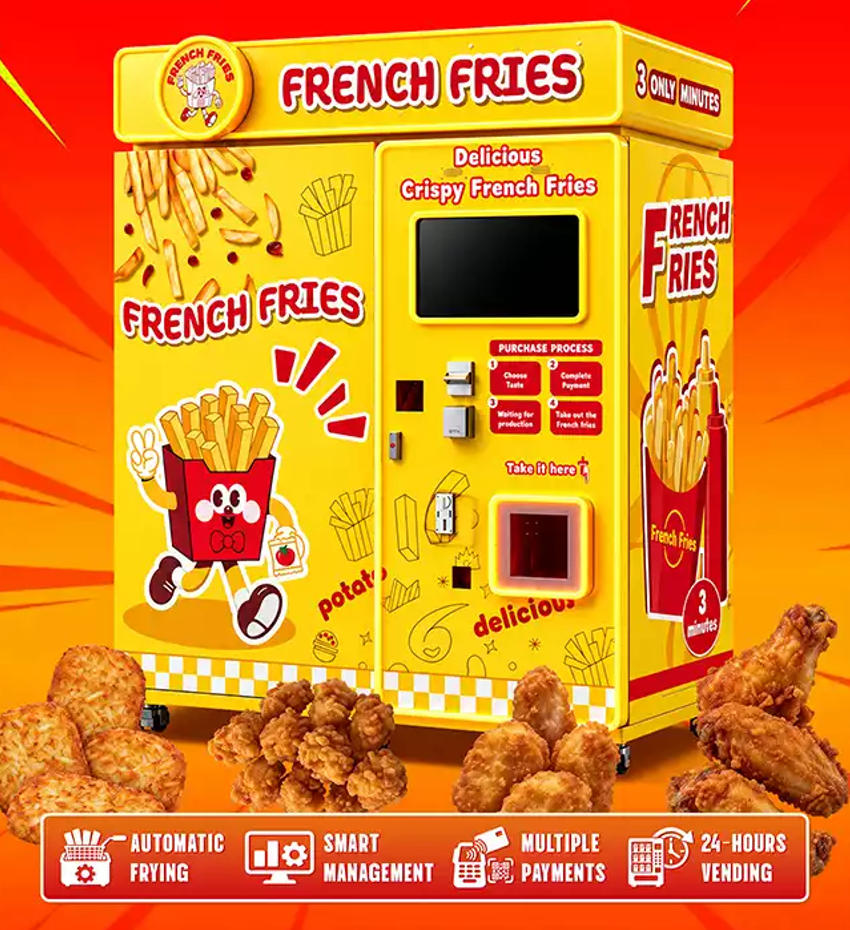
The short answer: a basic manual French fry cutter runs around US$50 to $300, a mid-range electric tabletop fryer goes for $300 to $1,500, while a fully automated French fry vending machine like the WM888 starts at around US$9,800. The right machine for your operation depends entirely on whether you need a kitchen tool or a turnkey retail terminal.
What Kind of French Fry Machine Are You Actually Looking For?
The word “French fry machine” covers a wide range of equipment, and prices swing wildly depending on what you actually need. At one end of the spectrum sit manual hand-crank cutters that turn potatoes into uniform strips in seconds. These are simple tools — no electricity required — and they’re priced between US$50 and $300. At the other end are full automated vending terminals that handle everything from frozen storage to frying, sauce dispensing, and payment collection without a single staff member touching the food.
Understanding this difference matters before you start comparing prices. If you run a small cafe and just need to cut potatoes faster than doing it by hand, an electric fry cutter is all you need. If you’re looking to deploy a self-service food outlet in a high-footfall location with zero labor, that’s a completely different investment category.
Manual and Manual-Style Cutters: $50–$300
These are the most affordable entry point. A typical manual French fry cutter uses a lever or crank mechanism to push a potato through a blade grid, producing uniform fries in one motion. They require no power, take up minimal counter space, and are popular among food trucks, small restaurants, and home kitchens. The trade-off is speed — you’re limited by how fast you can process potatoes by hand, and the consistency depends entirely on your operator’s technique.
Electric Tabletop Fryers and Cutters: $300–$1,500
Electric models add motors for continuous cutting and sometimes include built-in fry tanks. You’ll find units that auto-feed potatoes through rotating blades at one end and dispense cut strips at the other. Some combine cutting and shallow frying in a single compact unit. These machines reduce labor significantly compared to manual versions but still require someone to load product, monitor the oil, and package the finished fries. The price range reflects variations in cutting width options, motor power, and tank capacity.
For operators exploring a broader range of food service options beyond just fries, a French Fry Vending Machine USA: Costs, Rules, Reality guide can help you understand the regulatory and location landscape before making a purchase decision.
Fully Automated French Fry Vending Machines: $9,800+
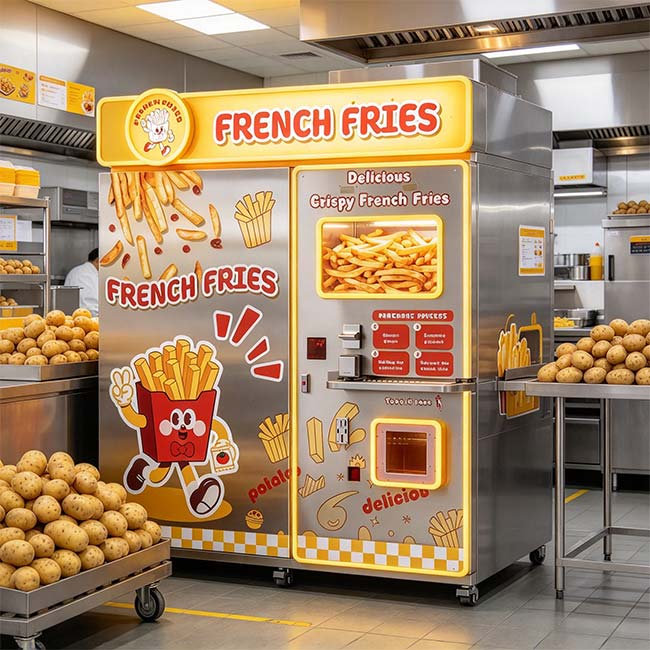
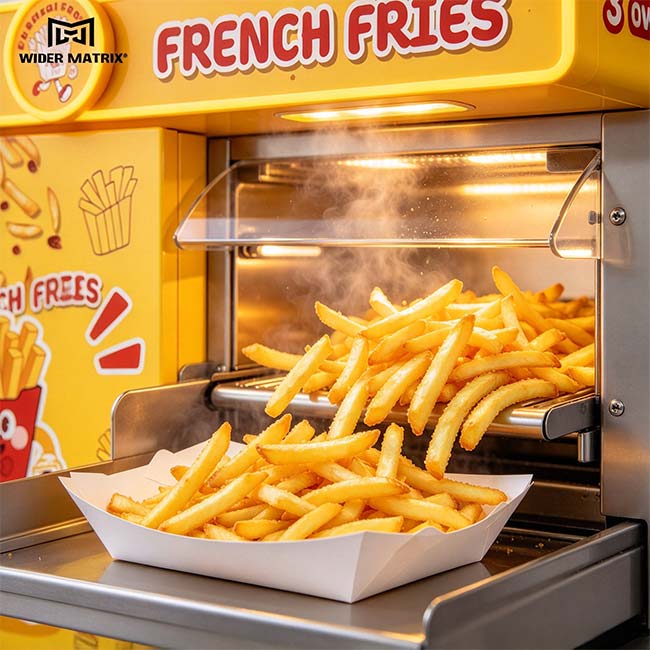
This is where the math changes dramatically. A fully automated machine like the WM888 Multi-function French Fries Vending Machine handles the entire process from frozen product storage to final packaging with sauce. You load frozen fries and pre-portioned ingredients once per day. The machine stores them at controlled temperature, fries them on demand, packages them, dispenses sauce, and accepts payment — all without anyone standing at the machine. The initial investment is higher, but so is the operational upside.
US$9,800 — US$9,800 per unit (Contact us for today’s best price on 2+ units). Contact us for today’s best price — promotional pricing updates regularly, and the price you receive today could be lower than the listed tag price.
How Much Does the WM888 French Fries Vending Machine Actually Cost?
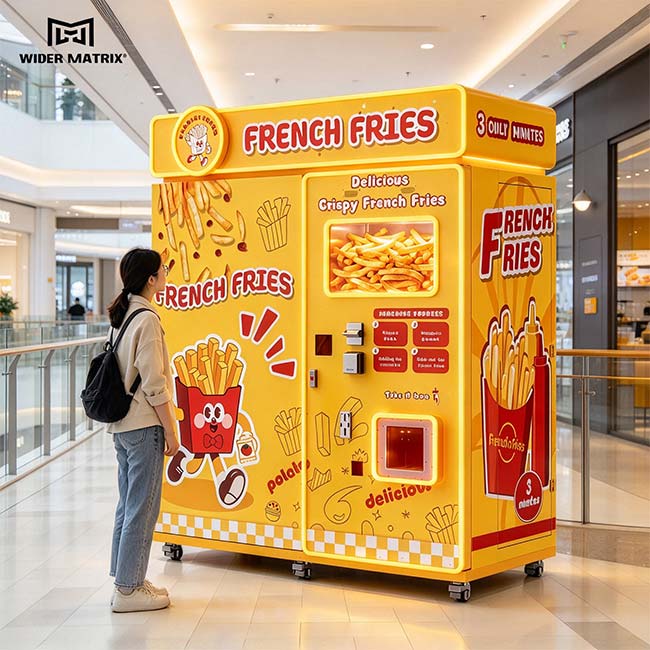
Wider Matrix designs the WM888 as a precision temperature-control commercial terminal for high-volume environments. The machine integrates dual 10L fry tanks that operate simultaneously, cutting production time by more than 50% during peak hours. It holds 173 servings or 160 paper boxes at once, with five sauce flavors at 200 packs each, so restocking happens once per shift instead of multiple times.
The system maintains a -3°C to 20°C storage range using R290 refrigerant, which lowers the frequency of restocking runs. Triple-sensor temperature control across the 0–180°C frying zone ensures consistent texture — the machine performs an initial fry followed by a second fry cycle for each product, producing that characteristic crispy exterior and tender interior. Oil draining happens automatically before packaging, giving you a healthier final product than deep-dip alternatives.
A 27-inch HD touchscreen lets customers browse the menu and watch the entire cooking process through a transparent window. Payment supports cash, coin with change, QR codes, Apple Pay, Google Pay, and credit cards — covering the major payment methods across 85+ languages. The machine’s footprint is approximately 2 square meters, and it works with both 220V and 380V power supplies, making it viable for indoor malls, outdoor kiosks, transit stations, and event venues worldwide.
What Should You Expect to Pay for Different Types of French Fry Equipment?
Before committing to a budget, it helps to see the full range of what’s available and what each tier delivers. The table below breaks down the main categories with their typical price ranges and what you get at each level.
| Machine Type | Price Range (USD) | Labor Required | Production Speed | Best For |
|---|---|---|---|---|
| Manual french fry cutter | US$50–$300 | High — operator cuts and fries by hand | Slow — limited by hand speed | Home kitchens, small cafes |
| Electric tabletop cutter | US$300–$800 | Medium — loads potatoes, monitors output | Moderate — continuous cutting, manual frying | Food trucks, busy counters |
| Electric cutter + fryer combo | US$800–$1,500 | Medium — loads, monitors, packages | Moderate to fast | Mid-size restaurants, food halls |
| Automated french fry vending machine (WM888) | US$9,800+ | Minimal — restock once daily, remote monitor | 90–120 seconds per serving, dual-tank高峰 | Transit hubs, malls, events, 24/7 locations |
If you’re comparing other food vending options to build a broader portfolio, understanding the cost structures across categories helps you allocate capital wisely. For context, a How Much Is a Popcorn Machine? 2026 Prices & What You Pay overview shows how popcorn machines sit at a lower price point but also deliver lower average order values compared to hot food fryers.
ROI Analysis: When Does a French Fry Vending Machine Pay for Itself?
The most common follow-up question after learning the price is whether the numbers make sense. Here’s a conservative breakdown based on real-world deployment assumptions.
Unit cost: US$9,800 US$9,800 per machine (Contact us for today’s best price — promotional pricing updates regularly)
Average selling price per serving: US$3.00 (varies by location and market pricing)
Cost per serving (ingredients, packaging, sauce): Approximately US$0.80–$1.20, averaging US$1.00
Gross margin per serving: US$2.00
At a conservative pace of 80 servings per day, the math looks like this:
- Daily revenue: 80 × US$3.00 = US$240
- Daily cost of goods: 80 × US$1.00 = US$80
- Daily gross profit: US$160
- Monthly gross profit (30 days): US$4,800
- Monthly operating costs (venue share, utilities, restocking labor): ~US$400–$600
- Monthly net profit estimate: US$4,200–$4,400
- Static payback period: approximately 2–3 months
These figures assume a mid-traffic location with steady foot flow. High-traffic transit stations and indoor malls often exceed the 80-serving baseline, which shortens payback to under 60 days. Lower-traffic spots may take 6–9 months. Location selection is the single biggest variable in your return timeline.
Real Customer Case: Indoor Mall Kiosk, Southeast Asia
A first-time operator installed one WM888 unit in a mid-size indoor mall in Malaysia, placing it near the main food court entrance. The mall sees approximately 12,000 visitors per weekday and 18,000 on weekends. The machine ran from 10:00 AM to 10:00 PM daily.
During the first month, the unit averaged 95 servings per day — higher than the conservative 80-serving assumption. Monthly revenue came to roughly US$8,550, with COGS around US$2,850 and a venue revenue-share agreement of US$1,200. Net monthly profit landed at approximately US$4,500, and the operator recovered the full machine cost within 90 days. By month four, daily sales stabilized at 110–130 servings as repeat customers discovered the location.
Where to Deploy a French Fry Vending Machine for Maximum Revenue
Location drives everything — not just daily volume, but the consistency of that volume. A machine in a poor location won’t improve no matter how good the food is. Here are the location types that consistently produce strong results, ranked by typical daily serving volume.
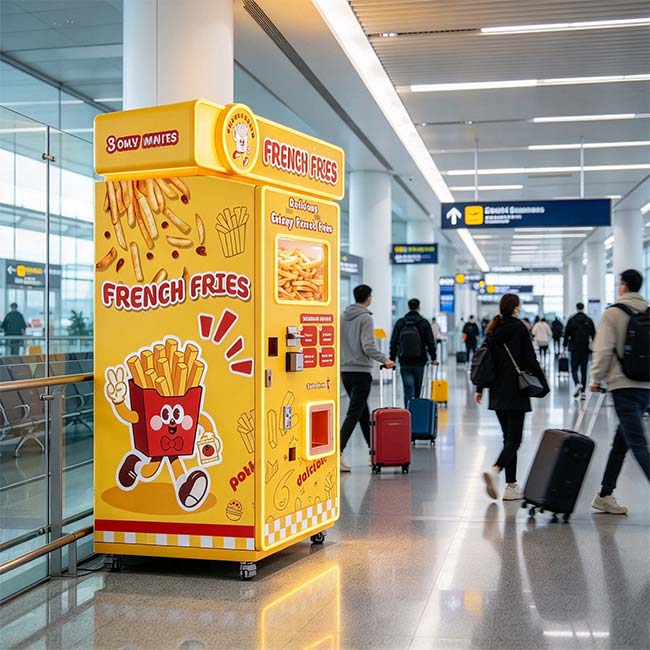
Transit hubs (airports, train stations, bus terminals): These are the highest-volume locations. Travelers grab quick hot food between connections, and the captive audience means every person passing by is a potential customer. Typical daily output: 120–200+ servings. The trade-off is that slot leases are expensive and competition for space is intense.
Indoor malls and shopping centers: Steady daytime and evening traffic, families and young shoppers as the core demographic. Children and teens are naturally drawn to fried foods, and the climate-controlled environment means the machine runs consistently year-round. Typical daily output: 80–150 servings.
Theme parks and entertainment venues: Long queues and extended stay times create natural snack demand. Operators here can charge premium prices because customers are already in a spending mindset. Typical daily output: 100–180 servings, with heavy concentration during afternoon and evening hours.
University campuses and student centers: Budget-conscious but high-volume demographics. Students grab fries between classes, and the price point of US$2–$3 per serving fits perfectly. Typical daily output: 60–120 servings, with peaks around lunch and dinner hours.
Outdoor festivals and events: Short-term deployments that can generate very high daily volumes over a concentrated period — 200+ servings per day during a three-day music festival, for example. These are ideal for testing a location before committing to a long-term lease.
For operators already running automated food outlets in the US market, understanding local regulations is essential. A French Fry Vending Machine USA: Costs, Rules, Reality resource covers permitting, health inspection requirements, and location restrictions you’ll need to navigate before deployment.
How the WM888 Compares to Traditional Fry Station Setup
It’s worth comparing the automated machine against the traditional alternative — hiring a staff member to man a fry station — because the cost structures are fundamentally different.
A traditional fry station requires at least one employee working during operating hours. In the US, that’s approximately US$15–$20 per hour depending on location. For a 12-hour shift, six days a week, annual labor cost runs roughly US$28,000–$37,000. Add social insurance, benefits, and turnover costs, and you’re looking at 30–40% of total operating expenses going straight to staffing.
The WM888 eliminates that line item. One person restocks the machine once per day — loading frozen fries, refilling sauce packets, and swapping out paper boxes. That restocking task takes about 15 minutes. The operator can manage multiple machines across different locations in a single workday, which is why multi-unit deployments scale efficiently.
Standardization is another advantage. Human fryers vary in technique — some过cook, some undercook, some salt inconsistently. The WM888’s triple-sensor temperature control produces the same result every time, regardless of who loaded the machine that morning. For a brand or franchise operator managing multiple locations, that consistency is non-negotiable.
What Comes With the WM888 and How Much Ongoing Cost Should You Expect?
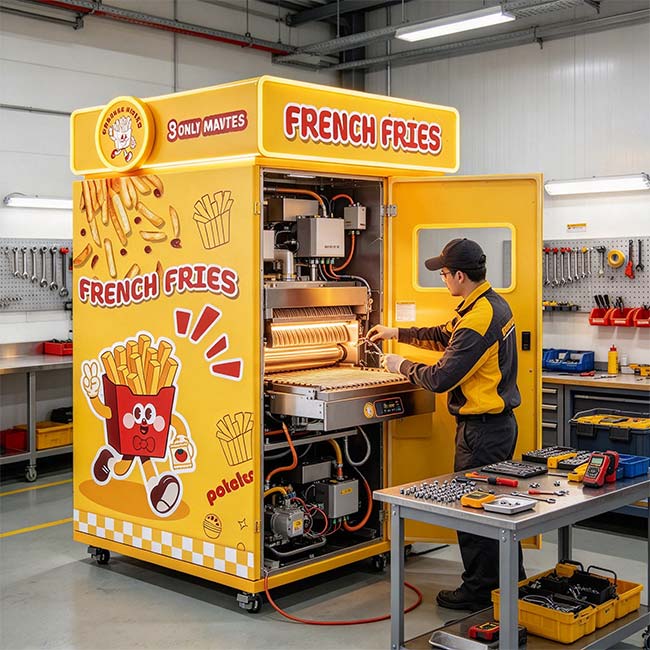
The purchase price covers the machine itself, a standard one-year warranty, and all necessary tools and spare parts in the packaging. Wider Matrix provides lifetime technical support with a three-shift engineer team available around the clock. Non-human-damage replacement parts ship by air at the manufacturer’s cost. Step-by-step installation videos are available on YouTube, and the team offers on-site training, deployment planning, operations training, and a formal ROI calculation report if you request one.
Ongoing costs break down into three categories:
- Ingredients: Frozen fries, paper boxes, sauce packets. Approximately US$0.80–$1.20 per serving depending on portion size and supplier pricing.
- Venue cost: Either a fixed monthly rent or a revenue-share percentage, typically 10–20% of gross sales depending on location type and foot traffic.
- Utilities: Electricity for the fry tanks, refrigeration, and touchscreen. A single WM888 unit draws approximately 2–3 kWh per day, translating to roughly US$15–$25 per month depending on local electricity rates.
With daily COGS around US$80–$120 at 80–120 servings, monthly ingredient costs land between US$2,400 and $3,600. Venue and utilities add another US$500–$1,000 monthly. Total monthly operating cost sits in the US$3,000–$4,500 range, leaving a comfortable margin at realistic sales volumes.
Alternatives Worth Considering Alongside the WM888
If the WM888’s focus on hot fries doesn’t match your target audience, Wider Matrix offers machines across several other food categories. A French Fry Vending Machine for Sale | WM888 by Wider Matrix page provides the full specification sheet and current promotional pricing for operators ready to move past the research phase.
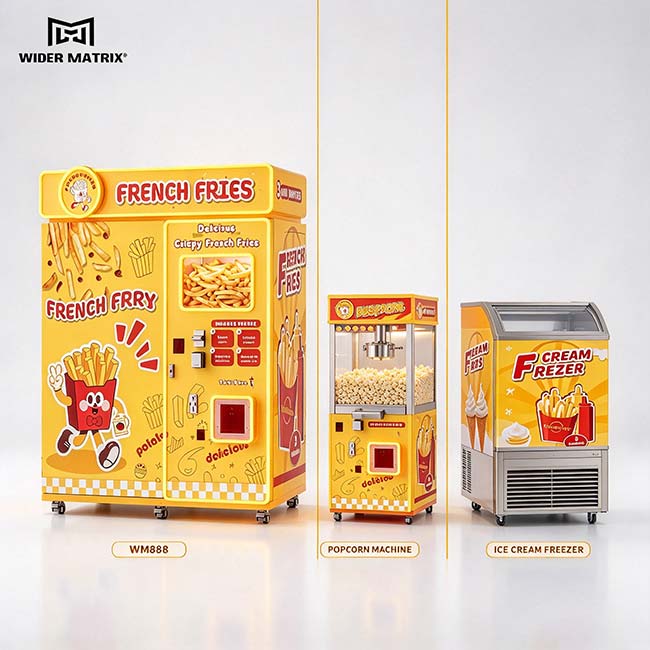
For operators who want a complementary product line, a popcorn machine runs at a significantly lower entry price and appeals to a slightly different impulse-buy moment. Meanwhile, an How Much Do Ice Cream Vending Machines Cost? (2026 Prices) overview can help you evaluate whether a cold-product machine makes sense for the same location or a different one entirely.
If your strategy involves deploying multiple machines across several locations, understanding the broader vending equipment market helps you compare total deployment costs. A How Much to Purchase a Vending Machine? 2026 Price Guide covers the full spectrum from beverage to snack to hot-food vending, so you can allocate your budget across the right mix for each location.
Key Factors That Determine Your Final Purchase Price
The listed price is a starting point. Several variables affect what you actually pay at checkout.
Unit quantity: Wider Matrix offers tiered pricing for bulk orders. A single WM888 carries the tag price, but orders of 2–5 units and 6–10 units qualify for reduced per-unit pricing. Contact us for today’s best price to get the current tier discount applied to your quote.
Shipping and import costs: The base price covers factory-gate delivery. International shipping, customs clearance, and import duties vary by destination country. Wider Matrix has shipped to 130+ countries as of September 2024, and the team can provide a landed-cost estimate for your specific location before you commit.
Customization: LED logo panels, custom graphic wraps, and branded packaging inserts are available. These add to the unit price but can strengthen brand presence at your location. The machine’s 27-inch touchscreen also supports custom advertising content, which can generate additional revenue through third-party ad placements.
Payment hardware: Depending on your region, you may need specific payment terminals (credit card readers, QR code scanners) that comply with local financial regulations. These are typically included in the standard package but may require region-specific certification for markets like the EU (SEPA compliance) or the US (PCI DSS).
FAQ: How Much Does a French Fry Machine Cost?
How much does a basic french fry cutter cost?
A manual hand-crank french fry cutter costs between US$50 and $300. An electric tabletop model with a built-in motor runs from US$300 to $800. These are kitchen tools, not standalone business units — they cut raw potatoes into fry shapes but don’t fry, package, or sell the product.
How much does a commercial french fry vending machine cost?
A fully automated machine like the WM888 is priced at US$9,800 US$9,800 per unit. Multi-unit orders receive tiered pricing — Contact us for today’s best price. Promotional discounts update regularly, so the quote you receive today may be lower than the listed amount.
Is a french fry vending machine profitable?
Yes, at the right location. A conservative deployment averaging 80 servings per day at US$3 per serving generates approximately US$4,200–$4,500 in monthly net profit after ingredient, venue, and utility costs. The payback period under these conditions is roughly 2–3 months. Higher-traffic locations can halve that timeline.
How many people do I need to operate a french fry vending machine?
Zero during operating hours. One person for daily restocking — loading frozen fries, refilling sauce packets, and swapping paper boxes — takes about 15 minutes per machine. A single operator can manage 5–10 machines across different locations in a standard workday.
Does Wider Matrix offer warranty and after-sales support?
Every WM888 includes a one-year standard warranty and lifetime technical support. Replacement parts for non-human damage ship free by air. The package includes installation tools and spare parts, step-by-step video guides on YouTube, and access to a three-shift engineering team available 24/7. On-site installation training, deployment planning, and ROI calculation reports are also available upon request.
What certifications do WM888 machines carry?
Wider Matrix machines carry CE, UKCA, RoHS, KC, BRC, Kosher, and HALAL certifications, meeting the major international safety and quality standards. This makes the WM888 viable for deployment across North America, Europe, the Middle East, Southeast Asia, and Australia without additional certification requirements in most markets.
Can I use the WM888 to sell products other than french fries?
The WM888 is designed as a multi-function unit. In addition to standard french fries, it can produce chicken wings, nuggets, popcorn chicken, onion rings, hash browns, and squid rings — all from the same machine by switching the product program and sauce pairing. This flexibility increases average order value without requiring additional floor space.
How long does it take to receive a WM888 after ordering?
Standard lead time is approximately 2–4 weeks from order confirmation, depending on configuration and destination. Express shipping is available for urgent deployments. Wider Matrix ships to 130+ countries and handles export documentation as part of the standard process.
Where can I see the WM888 in operation before buying?
Wider Matrix hosts demonstration units at select locations and welcomes site visits by appointment. Video walkthroughs and live remote demos are also available through the sales team. Visit widermatrix.com to schedule a consultation and request a demo slot.
More Reading
- Automatic Mobile Cover Printing Machine: The Complete Guide to Starting Your Custom Phone Case Business
- Print Your Own Phone Case Vending Machine: The Ultimate 2026 Business Guide
- Are Flower Vending Machines Profitable? 6 Real Records
- Flower Vending Machine Singapore: Best Locations in 2026
Get Your Personalized ROI Analysis & Expert Guidance
You now have a clear picture of what French fry equipment costs at every level — from a $50 manual cutter to a fully automated vending terminal. The next step is matching that knowledge to your specific situation: the location you have in mind, the traffic patterns you’ve observed, and the budget you’re comfortable committing.
Wider Matrix has been building and exporting automated vending solutions since 2016, shipping over 3,000 machines to 130+ countries across North America, Europe, the Middle East, Southeast Asia, and Australia. Beyond the hardware, our team provides deployment planning, on-site installation training, operations training, and a formal ROI calculation report tailored to your target location — so you can make your purchase decision with real numbers, not guesses.
Contact us today to receive:
- A free customized ROI projection based on your target location and expected daily volume
- References from operators running WM888 units in your region
- A detailed quotation with current promotional pricing and shipping estimate to your country
- Access to our installation video library and 24/7 technical support onboarding
There is no obligation to proceed after the consultation. Reach out through widermatrix.com or reply directly to this message, and a dedicated account manager will follow up within 24 hours with your personalized proposal.