



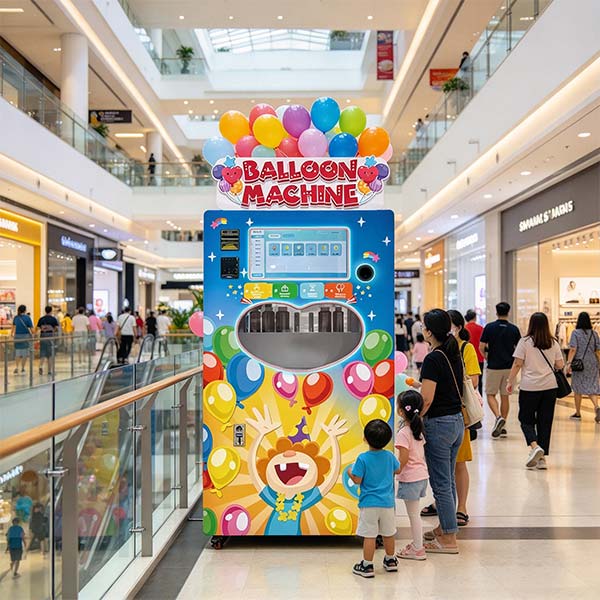
Walking through any Singapore mall on a weekend, you’ve probably noticed families lingering near crowded atriums. Kids tug at their parents’ sleeves, pointing at something shiny and new. That’s the moment of impulse — the split-second decision that turns a casual visit into a purchase. For operators looking to capture that energy without hiring staff, a balloon vending machine Singapore presents one of the most straightforward untapped opportunities in the unattended retail space.
A balloon vending machine is an automated kiosk that produces and dispenses helium-filled balloons on demand, with designs ranging from classic shapes to custom logos and cartoon characters. In Singapore, where foot traffic in malls, HDB estates, and event venues runs consistently high, these machines operate 24/7 with zero labor cost. The entry point starts around US$3,200 per unit, and with the right location, many operators see full recovery within 60 to 90 days.
Why Balloon Vending Machines Are Gaining Traction in Singapore
Singapore’s retail landscape has shifted dramatically over the past five years. Malls are no longer just shopping destinations — they’re experience hubs. Parents bring children to recreational zones, corporate teams gather for team-building events, and families celebrate birthdays throughout the year. The demand for on-the-spot entertainment and novelty items has never been higher.
Yet despite this demand, the balloon vending machine category remains underpenetrated in Singapore. Most event spaces and malls still rely on temporary balloon stalls staffed by part-time workers. These stalls require payroll, suffer from inconsistent quality, and can only operate during set hours. A self-service balloon vending machine solves every one of those limitations.
The Singapore market offers several structural advantages for this business model. First, the tropical climate means balloon-related celebrations happen year-round — birthdays, graduations, national day festivities, and corporate events all drive consistent demand. Second, Singapore’s high disposable income per capita means consumers regularly spend on small luxuries and impulse purchases. A balloon priced at S$3 to S$5 feels like a negligible expense in a mall setting, which translates directly into healthy margins for the operator.
Third, Singapore has a dense concentration of high-footfall locations within a small geographic area. You can deploy multiple machines across different malls and still serve them efficiently from a single logistics base. This density makes route planning simple compared to countries where venues are spread across hundreds of kilometers.
If you’re also evaluating other vending categories for the Singapore market, Singapore’s Ice Cream Vending Machine Revolution: A 2026 Investment Guide for Smart Operators covers how food-grade automated retail is performing in the same locations you’d place a balloon machine.
How Balloon Vending Machines Work
At its core, a balloon vending machine automates three steps that traditionally require a trained operator: filling the balloon with helium, tying it securely, and dispensing it with a stick or ribbon attached.
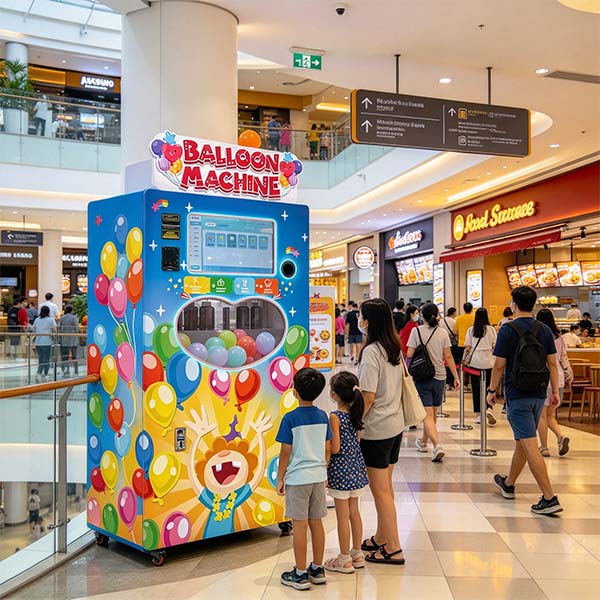
Modern machines like the WM688 use a robotic arm system inside a sealed production chamber. The operator loads empty balloons into a storage drum along with pre-filled helium cartridges. When a customer selects a design on the touchscreen, the machine’s mechanical gripper picks the balloon, fills it with the exact amount of helium, ties it off, attaches the stick, and releases it through the dispensing slot. The entire cycle takes approximately 60 to 90 seconds.
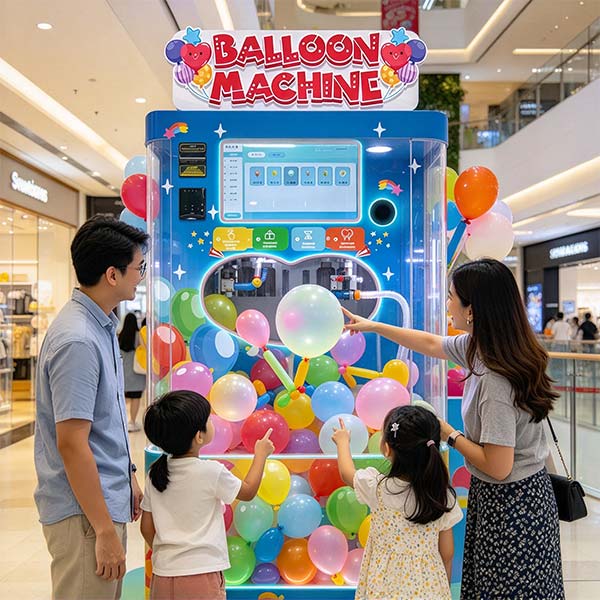
The production chamber is fully enclosed and transparent, which means customers can watch the process from start to finish. This visual element is intentional — people film the machine and share it on social media, giving you free marketing with every transaction.
Payment is handled through multiple channels: coin slot, bill acceptor, contactless card reader, and QR code payment. Singapore’s widespread adoption of PayNow and GrabPay means you’ll want a machine that integrates at least one of these local payment methods. The WM688 supports all four payment types out of the box.
What Types of Balloons Can the Machine Produce
- Standard round balloons — single color, most popular for general events
- Character balloons — Mario, Hello Kitty, Spiderman, Ultraman, widely preferred by children
- Number and letter balloons — used for birthdays and age celebrations
- Custom logo balloons — printed with brand artwork for corporate events and product launches
- Heart and star shapes — popular for anniversaries and romantic occasions
The machine stores up to 360 balloons across six compartments, each holding 60 units. That’s enough for an average day of operation without needing a refill, and reloading takes less than five minutes.
Investment and Return Analysis
The financial case for a balloon vending machine in Singapore rests on three numbers: the upfront cost of the machine, the per-unit cost of consumables, and the selling price you can command in your chosen location.
Here’s the breakdown for the WM688, which is specifically designed for high-throughput environments like malls and entertainment centers.
WM688 Balloon Vending Machine — Cost Structure
| Item | Details |
|---|---|
| Machine cost (single unit) | |
| Balloon consumables (1,000 pcs) | US$0.30 per unit = US$300 total |
| Balloon consumables (10,000 pcs) | US$0.10 per unit = US$1,000 total |
| Helium cartridges (included) | Consumed per balloon — approx. US$0.05 per unit |
| Power consumption | Approx. US$15–25 per month in Singapore electricity rates |
| Shipping to Singapore | Varies by volume — typically US$300–600 depending on origin port |
At the consumable level, each balloon costs between US$0.35 and US$0.40 to produce when you factor in the balloon itself, helium, and a stick or ribbon. At a typical retail price of S$3 to S$5 per balloon (approximately US$2.20 to US$3.70), that gives you a gross margin of roughly 60% to 75% per unit.
Monthly Revenue Projection for Singapore
Location is the single biggest variable in revenue. A machine placed in a high-traffic mall atrium in Orchard or Jurong Point will perform very differently from one in a quiet neighborhood shopping center. Below are three realistic scenarios based on actual operator data from similar Southeast Asian markets.
| Scenario | Daily Sales | Monthly Revenue | Monthly COGS | Monthly Profit | Payback Period |
|---|---|---|---|---|---|
| Conservative (quiet location) | 20 balloons | US$1,400 | US$560 | US$840 | ~38 weeks |
| Realistic (good mall location) | 40 balloons | US$2,800 | US$1,120 | US$1,680 | ~19 weeks |
| Aggressive (prime event venue) | 70 balloons | US$4,900 | US$1,960 | US$2,940 | ~11 weeks |
These figures assume a blended selling price of US$2.00 per balloon. In practice, many operators in Singapore price individual balloons at S$3 to S$4 and sell bouquet-style packages at S$10 to S$20, which pushes the effective average higher.
If you want to understand how balloon vending compares to other automated retail categories in terms of profitability, How Profitable Is a Vending Machine? A 2025 Business Analysis breaks down margin differences across phone cases, puzzles, cotton candy, and more.
Where to Place a Balloon Vending Machine in Singapore
Location selection determines whether your machine sits idle or prints money. Here’s a tiered breakdown of the best placement options available in Singapore.
Tier 1: Highest Traffic, Highest Rental
- Major malls — Parkway Parade, Jurong Point, VivoCity, Plaza Singapura. These attract 50,000 to 150,000 visitors daily. Placement fees range from S$2,000 to S$8,000 per month depending on visibility and footfall.
- Entertainment complexes — Geylang Paradise, Funan mall’s entertainment zones, cinema lobbies. Customers are already in a spending mindset.
- Event venues and convention centers — Suntec Singapore, Singapore Expo. Corporate events and exhibitions generate bulk balloon orders.
Tier 2: Strong Traffic, Moderate Cost
- HDB town centers — Bukit Batok, Woodlands, Tampines. Family-oriented demographics with steady weekend traffic. Rental typically S$800 to S$2,000 per month.
- Medical and dental clusters — Polyclinics and private clinic waiting areas. Parents with children waiting for appointments are captive audiences.
- Private schooling hubs — Areas around primary and secondary schools on pickup days. Parents and grandparents buying treats for children.
Tier 3: Low Cost, Niche but Consistent
- Indoor playgrounds and trampoline parks — Children who just played are prime candidates for a balloon reward purchase.
- Hospital pediatric wards — A socially responsible placement that generates steady daytime traffic.
- Festive pop-up locations — Mid-Autumn Festival, Chinese New Year, and National Day setups in public squares.
Choosing the Right Balloon Vending Machine
Not all balloon vending machines are built the same. The WM688 from Wider Matrix includes features that matter specifically for high-volume Singapore deployments.
The machine uses a 21.5-inch HD touchscreen for customer interaction, which means operations staff can update pricing, rotate featured designs, and push promotional content remotely through IoT cloud management. If a particular cartoon character balloon is selling fast in one location, you can adjust the stock allocation across your fleet without dispatching anyone to the machine physically.
The transparent production chamber doubles as a visual attractor. People walking past will stop to watch balloons being made, which increases dwell time and conversion. The LED-lit logo panel on the front allows you to brand the machine with your own graphic or sponsor logo — useful if you’re placing units in partnership with a mall or event organizer.
Power compatibility covers 110V to 220V, so the same unit works in Singapore without a transformer. The machine includes a complete toolkit and spare parts package in the shipping crate, which matters because downtime is pure lost revenue. Wider Matrix, the manufacturer behind the WM688, ships to over 130 countries and provides 24/7 technical support across three shifts, with spare parts shipped air freight at their cost for any non-man-made defects.
For operators evaluating broader vending strategies beyond balloons, The Ultimate Guide to Vending Machine Passive Income in 2026: Strategies, ROI & Future Trends covers how multi-category fleets compare in terms of operational complexity and return profiles.
Real-World Performance: Two Singapore Case Studies
Numbers on paper look different from what happens on the ground. Here are two operators who deployed balloon vending machines in Singapore and what their first six months looked like.
Case Study 1: Mall Atrium, Jurong Region
Operator: Local family-run retail business, deploying their first automated machine.
They placed a WM688 near the main entrance of a mid-tier mall in Jurong. The monthly placement fee was S$2,400. Average daily sales in the first month came to 35 balloons, rising to 52 by month three as repeat customers discovered the machine. By month four, daily sales stabilized around 48 units.
Monthly financial summary at stabilization:
- Revenue: ~S$3,840 (48 balloons × S$4 average)
- COGS (balloons + helium): ~S$1,152
- Placement fee: S$2,400
- Electricity: ~S$60
- Net profit: ~S$228 in month one, growing to ~S$1,200 by month four as sales increased
The payback period on the US$3,200 machine cost was approximately 14 weeks.
Case Study 2: Event Venue Partnership, Suntec City
Operator: Event management company adding revenue streams to their venue.
This operator placed two WM688 units at a convention and exhibition center near Suntec City. Unlike the mall scenario, their traffic was lumpy — quiet on weekdays, packed during trade shows and exhibitions. They structured their pricing differently: single balloons at S$3, pre-packed thematic sets (birthday, baby shower, corporate) at S$12 to S$18.
The key difference was volume per transaction. Instead of 40 individual sales per day, they averaged 15 transactions per day, but each transaction included 4 to 8 balloons. During peak exhibition weeks, daily balloon output exceeded 120 units. Monthly net profit across both machines averaged S$4,200 during active periods.
Because the venue itself was already a recognized brand, the operator didn’t pay a traditional rental fee. Instead, they split revenue 70/30 in favor of the venue — a structure that still left them profitable from week one.
Operational Considerations for Singapore Operators
Permits and Regulations
Singapore does not require a specific license to operate a balloon vending machine. However, if you place the machine in a privately managed mall or venue, you’ll need to negotiate a placement agreement directly with the property management company. Some landlords may ask for a security deposit equivalent to one to two months’ rental, along with a certificate of insurance covering third-party liability.
If you’re placing machines in HDB void decks or public spaces, you’ll need to apply through the relevant town council. The application process typically takes two to four weeks and requires proof of machine ownership and insurance coverage.
Restocking and Maintenance
A single WM688 holds 360 balloons across six compartments. At an average daily output of 40 balloons, that means restocking is needed roughly every six to eight days. The refill process takes under five minutes: open the rear access panel, pour in a fresh batch of blank balloons, and close the panel. The machine auto-detects the new load.
Helium cartridge replacement is required approximately every 3,000 to 4,000 balloons, depending on usage patterns. The machine tracks helium levels through internal sensors and sends a low-stock alert to the operator’s mobile device.
Payment Integration
Singapore consumers overwhelmingly prefer cashless payments. The WM688 supports card readers compatible with Visa, Mastercard, and local schemes, plus QR code payment integration for PayNow and GrabPay. Setting up these payment gateways typically requires a business bank account and takes one to three business days to activate.
If you’re curious about how other vending categories handle payments in the Singapore market, How Much Do Vending Machines Make – A 2026 Profit & Cost Analysis includes a detailed breakdown of payment mix and cashless adoption rates across different machine types.
Common Questions About Balloon Vending Machines in Singapore
Is a balloon vending machine profitable in Singapore?
Yes, provided you secure a location with sufficient foot traffic. The typical return on investment falls between 11 and 38 weeks depending on placement quality. Prime mall and event venue locations usually achieve payback within three months. Lower-traffic locations may take six to nine months but still generate positive cash flow from month one.
Do I need a business license to operate a balloon vending machine in Singapore?
You need a standard business registration with ACRA if you’re operating as a company or sole proprietorship. No additional vending-specific license is required. If you’re placing machines in HDB common areas, you’ll also need town council approval.
How much space does a balloon vending machine need?
The WM688 measures approximately 120cm in height, 60cm in width, and 60cm in depth. You need a flat, level surface with access to a standard 13A power outlet. The machine should be placed against a wall or in a corner to maximize visibility from two directions.
Can the machine produce custom or branded balloons?
Yes. The WM688 supports custom-designed balloon prints through its onboard printing module. You can upload logos, character artwork, or promotional graphics through the cloud management dashboard. Minimum order quantity for custom balloon prints is typically 500 units, and the turn-around time is approximately seven to ten business days.
What warranty and support comes with the machine?
Wider Matrix provides a one-year standard warranty on the WM688, with lifetime technical support available around the clock across three shifts. Non-man-made defective parts are shipped air freight at the manufacturer’s expense. The machine also ships with a complete toolkit and spare parts kit, plus step-by-step video guides on YouTube.
Can I finance or lease a balloon vending machine?
Wider Matrix offers volume pricing for purchases of six units or more, and they work with several equipment financing partners in Singapore and Malaysia. Leasing arrangements are available through select local vendors — contact the sales team directly for current terms.
How does a balloon vending machine compare to other vending machines in Singapore?
Balloon machines have among the lowest consumable costs per unit of any vending category. At approximately US$0.35 per balloon versus US$0.80 to US$1.50 for food-grade machines, your margin per sale is higher even at lower ticket prices. The trade-off is that balloon demand is more seasonal and event-driven, while food and drink have steadier daily traffic. Many successful operators run a hybrid fleet — a balloon machine alongside a snack or drink machine — to balance traffic patterns.
Where can I buy a balloon vending machine in Singapore?
Wider Matrix ships the WM688 directly to Singapore from their manufacturing facility, with average lead time of 15 to 25 business days depending on shipping method. The company has extensive experience exporting to Southeast Asia and handles customs documentation as part of the standard order process.
Getting Started with a Balloon Vending Machine in Singapore
The balloon vending machine market in Singapore is still early-stage. That means fewer competitors, more negotiable placement terms, and the opportunity to establish a presence before the category becomes saturated. The WM688 is currently priced at US$4,000 US$3,200 — a limited-time offer that saves you US$800 per unit.
Before committing, spend two days counting foot traffic at your target location during both weekday afternoons and weekend mornings. The ratio of families with children to total footfall is the strongest predictor of whether a balloon machine will perform well there. If more than 15% of passersby are children under 12, you’re looking at a solid location.
If you’d like a detailed quotation, deployment plan, and ROI projection tailored to a specific Singapore location, reach out to the Wider Matrix team through their website. They provide a free site assessment and placement recommendation as part of the initial consultation, with no obligation to purchase.