



A practical guide to placing a refrigerated flower vending machine in Singapore. It covers the eight location types that work best, the cold chain problem the tropical climate creates, the festival calendar that drives a third of annual demand, the payment mix local buyers expect, the checks to run before signing for a spot, what the machine has to be able to do, how factory pricing and payback work, and how to source and ship a cabinet into Singapore.
Singapore is awake when the flower shops are not
Think about who is still moving around the city at eleven at night. A nurse coming off a shift at a hospital in Novena. A passenger who has just cleared immigration at Changi and is walking to the taxi queue. A student leaving a library on a university campus. A resident crossing a town centre after a late dinner. All of them can walk past a florist that has been shuttered for hours.
That gap is the whole argument for a flower vending machine in Singapore. It is not that people here buy fewer flowers than anywhere else. It is that the shops selling them keep shop hours in a city that does not. Mall florists close with the mall. Standalone florists pull down the shutter in the evening. The people who remember a birthday at nine at night, who land on a red-eye flight, or who finish work after a twelve hour shift are left with nothing open.
There is a second reason the city suits this kind of machine, and it has nothing to do with opening hours. Singapore grows very little of the cut flowers it sells. Almost everything on a local flower stall arrived by air, mostly from Malaysia, the Netherlands, Ecuador, Kenya, Colombia and China. A stem has already travelled thousands of kilometres before it reaches a wholesaler here, and the moment it lands it is sitting in air that is hot, close, and often above 80 percent humidity for most of the year. Cold storage is not an add-on in this market. It decides whether a bouquet lasts four days or eight, and it decides how much of the stock you throw into a bin at the end of the week.
The third reason is labour. Staffing even a small retail counter for twelve hours a day is expensive here, and the cost does not stop when the shop is quiet. An unattended cabinet has no roster, no leave, no shift handover, and no idle hours. One person with a trolley can service several machines in a morning.
Getting the flower vending machine Singapore location decision right matters more than which cabinet you happen to buy. Two operators can install the same model on the same island and see completely different results, because one is standing in a corridor where people pass on their way home and the other is standing in a corridor where people pass on their way to a meeting.
Where a flower vending machine actually works in Singapore
There is no single answer to the flower vending machine Singapore location question, and anyone who offers one is selling something. Crowds matter less than the pattern of the crowd: when people pass, how fast they are moving, whether they are carrying anything, and whether they are in a mood to spend fifteen dollars on the way past. The eight site types below all work, but they work for different reasons and they need different stock.
MRT interchanges and bus interchanges
A rail interchange concentrates more people into a smaller area than almost anywhere else in the city. Raffles Place, City Hall, Orchard, Dhoby Ghaut, Bugis, Serangoon, Paya Lebar, Jurong East, Woodlands and Tuas Link all push commuters through a single paid concourse twice a day.
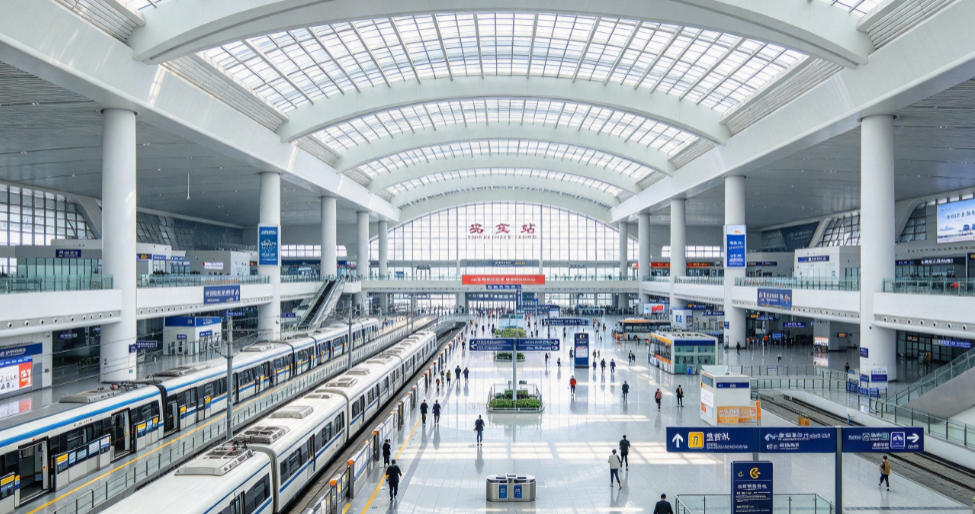
The catch is speed. A commuter on the way home is not browsing. The sale has to be simple enough to finish in about half a minute: one cabinet, clear prices, tap the card or scan the code, collect the bunch. The evening peak is worth far more than the morning peak, because very few people want to carry a bouquet into an office at eight in the morning. If you can choose, aim for the walkway between the fare gates and the bus interchange rather than the platform level, where people are already focused on catching a train. A flower vending machine placed on a route that commuters walk twice a day has a far better chance than one tucked against a wall that everyone ignores.
Approval is the slow part. Space inside a station sits with the rail operator and its retail and advertising partners, so expect a concession arrangement and a long chain of sign-offs rather than a plain monthly rent. Start the conversation months before you want the machine to switch on.
Shopping malls and the linkways between them
Malls are where the impulse buyer with a gift in mind already is. Orchard Road, Suntec City, VivoCity, Bugis Junction, Jewel Changi, Tampines Mall, Nex, Jem and Waterway Point all see steady spending traffic through the day.
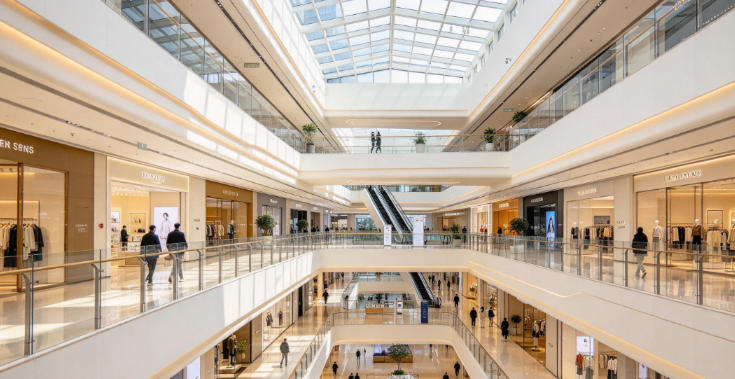
Mall management rarely judges a machine on its own; it judges what the machine adds to the corridor. Flowers sit naturally near the parts of a mall where people already buy gifts: the cinema floor, the jewellery floor, the supermarket, the stretch of restaurants where couples queue for a table on a Friday. A basement corridor next to a supermarket is often the busiest and least expensive patch of floor in the whole building, and a flower vending machine in that corridor picks up supermarket traffic without competing with the supermarket.
Expect a minimum term of twelve to twenty four months and a fit-out deposit, and check whether electricity is metered separately or folded into the rent. A mall will also want to know how the cabinet looks, because a scratched white box in a premium corridor is a problem for them, not just for you. This is the point where OEM branding earns its keep, and it is worth reading a guide on choosing the right vending machine manufacturer before you commit to a look.
Hospitals, polyclinics and medical centres
Hospitals are one of the most underrated sites for this business. Singapore General Hospital, National University Hospital, Tan Tock Seng, Khoo Teck Puat, Ng Teng Fong, Raffles Hospital and Parkway East all handle visitors who arrive with a purpose and often with flowers in mind. The flower counters inside them, though, keep the same office hours as the rest of the building.
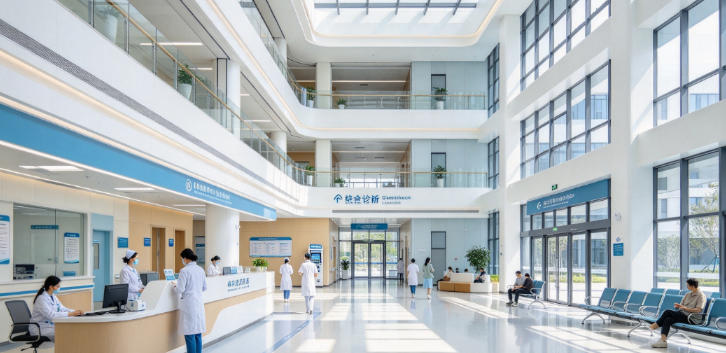
A flower vending machine near the main entrance, the pharmacy, or the lift lobby of a ward block runs on an entirely different clock. Evening and weekend demand here is as strong as weekday demand, which is the opposite of a downtown office tower. Visitors also buy at a higher price point, because a get well bouquet carries sentiment that a cheap bunch cannot.
Check the facilities policy first. Infection control rules govern where water and plant material may be placed, and some wards restrict flowers altogether. The safe position is the public lobby, not the ward corridor.
Hotels, serviced apartments and condominium lobbies
Singapore has several hundred hotels and several thousand residential blocks, and most of their lobbies are quiet, staffed, air-conditioned spaces with power already available. A bouquet bought at ten at night works for a guest who has just landed, for a couple returning from dinner, and for a resident who has forgotten an anniversary.
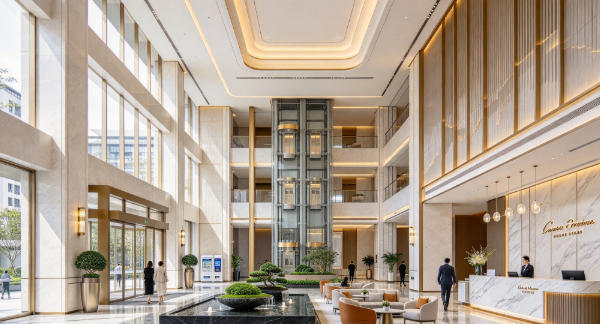
Condominium lobbies are run by the management corporation, which will want assurances that the machine is quiet, clean, and needs no staff presence. Some blocks ask for a monthly fee; others ask for a share of revenue. Both are normal. The real constraint is floor area, because lobbies are often tight and the cabinet needs clearance at the back and sides for ventilation. Measure before you agree, and check whether the lift can take the machine’s weight on a pallet.
Offices, business parks and one-north
Raffles Place, Marina Bay, Tanjong Pagar, one-north, Changi Business Park and Mapletree Business City empty out at six, which is exactly when somebody remembers that it is a colleague’s last day or a partner’s birthday. The lobby just before the evening train is the spot that matters, not the pantry on level fourteen.
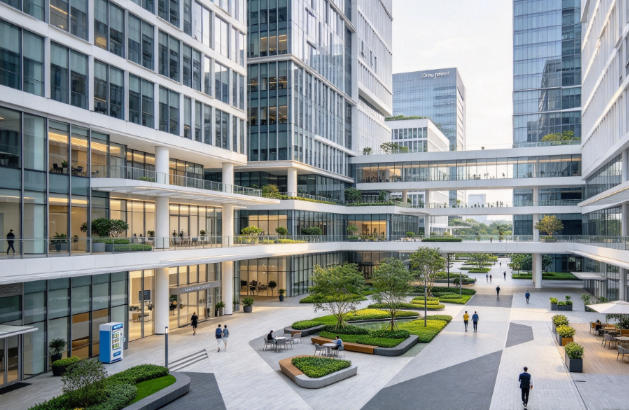
Two things to check. First, some towers already hold a corporate florist account, and the landlord may protect it. Second, office towers empty on public holidays and quieten down through the December break, so model the month rather than the week. A flower vending machine in a business park can have a strong Monday to Friday and a very weak weekend, which is fine as long as the rent reflects it.
Campuses
NUS, NTU, SMU, SUTD, SIT, SUSS, the polytechnics and the international schools hold tens of thousands of people who buy small gifts often. Students are price sensitive. A single stem or a small wrapped bunch under twenty dollars sells better here than a large arrangement, and the peaks are predictable: Valentine’s Day, exam season, graduation and orientation week.
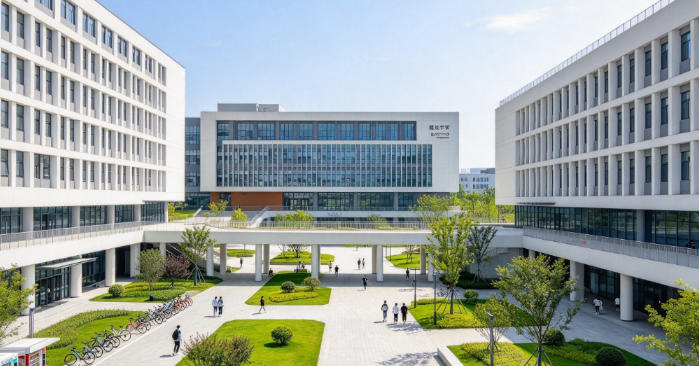
The estate office approves placement, and the timetable makes demand lumpy. Keep stock small and turnover high rather than tying up cash in stock that sits in a corridor over the semester break.
HDB town centres, community clubs and hawker centres
Bedok, Tampines, Ang Mo Kio, Toa Payoh, Yishun, Woodlands and Jurong hold dense residential catchments. Wet market crowds come through in the morning, families in the evening. Flower stalls here are long established and cheap, so a machine competes on hours rather than on price, and it wins on the nights when the stall is dark.
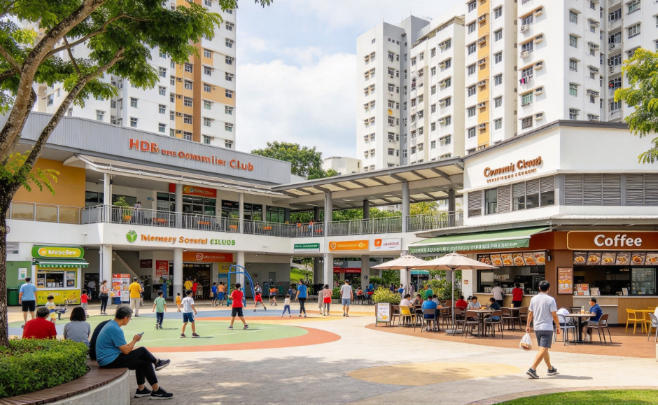
If the space is common property, permission comes from the town council or HDB, and the process is slower than a private landlord’s. Read up on where you can legally place a vending machine before you start knocking on doors, because the answer differs between a mall corridor, a station concourse and a void deck.
Attractions, event venues and the Sports Hub
Gardens by the Bay, Sentosa, the Mandai wildlife parks, Singapore Sports Hub, the Marina Bay area and the F1 street circuit weekend all produce short, intense spikes. On a concert night or a school holiday, a single day can outsell a quiet week elsewhere.
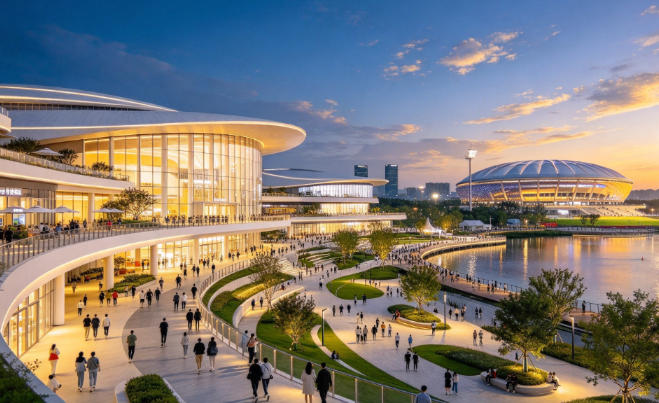
Event placement is permit based and temporary, so the machine has to be movable and the operator has to be ready to redeploy. Done well, a two week placement pays for its share of the machine. Read about high traffic locations that support this kind of model before you build a route plan.
Matching the location to the stock
The difference between a site that pays and a site that disappoints is usually stock, not footfall. A hospital lobby and a university corridor see similar numbers of people and need completely different cabinets. Use the table as a starting point, then check the site at the hours you expect to earn in, rather than at lunchtime on a Tuesday.
| Location type | When traffic peaks | What sells | What to check first |
|---|---|---|---|
| MRT and bus interchange | Evening peak | Small wrapped bunches, single stems | Concession terms and operator approval |
| Mall corridor or linkway | Weekend, evening, holidays | Gift bunches with a card insert | Lease term, fit-out deposit, power metering |
| Hospital or clinic lobby | Evening and weekend | Mid size bouquets, get well arrangements | Facilities policy on flowers and water |
| Hotel or condominium lobby | Late evening | Small bouquets, single roses | Clearance behind the cabinet and noise |
| Office tower or business park | Weekday, five to eight in the evening | Desk sized bunches | Existing florist arrangements in the building |
| Campus | Term time, mid afternoon | Cheap single stems and small bunches | Estate office approval and semester calendar |
| HDB town centre | Morning and evening | Budget bunches, festival stock | Town council or HDB permission |
| Attraction or event venue | Event days only | Impulse and souvenir bunches | Permit window and machine mobility |
The festival calendar decides a third of your year
Flower demand in Singapore is not spread evenly across the twelve months. A handful of dates carry an outsized share of annual turnover, and a flower vending machine that is stocked for an ordinary Wednesday on Valentine’s Day will sell out before lunch and then miss the whole evening trade.
Two things follow from this. First, stock planning has to run weeks ahead of the calendar, because wholesale prices for roses climb steeply in the days before Valentine’s Day and supply tightens. Second, the machine has to be positioned where the festival crowd actually is. Chinese New Year traffic goes to the housing estates and the heartland malls. Valentine’s Day traffic goes to malls, campuses, cinemas and hotels. Deepavali traffic concentrates around Little India and the residential blocks nearby. Deepavali, Hari Raya, Christmas and the year end corporate season all behave differently, and a cabinet in the wrong place on the wrong week is just an expensive fridge.
| Period | What drives demand | Stock note |
|---|---|---|
| January to February, Chinese New Year | Reunion dinners and gifting, wish for prosperity | Red and gold tones, pussy willow, blossom branches |
| 14 February, Valentine’s Day | Largest single day of the year for red roses | Buy roses early, expect sharp wholesale price rises |
| March to April, Hari Raya Puasa | Open house visits and family gifting | Green and white arrangements, small baskets |
| May, Mother’s Day | Second strongest weekend of the year | Carnations and mixed bunches, sellout by midday |
| June, school holidays | Family outings and graduations | Move stock towards attractions and campuses |
| August, National Day | Red and white themed gifting, corporate orders | Themed wraps and small flag accents |
| September, Teachers’ Day | Small bunches bought near schools and campuses | Low price stems in high volume |
| October to November, Deepavali | Festive colours, marigold and jasmine | Concentrate near Little India and nearby estates |
| November to December, Christmas and year end | Corporate gifts, parties, home gatherings | Bulk corporate orders land in early December |
Outside those peaks, ordinary demand is steady rather than dramatic. Birthdays, anniversaries, apology flowers and hospital visits fill the rest of the year, and they arrive without a schedule. That is why the site matters more than the season, and why a flower vending machine in an evening commuter corridor keeps earning through the quiet months when a festival-only stall would be standing idle.
What to check before you sign for a spot
Most costly mistakes on this kind of site are physical rather than commercial, and a wrong flower vending machine Singapore location is expensive to undo once the lease is signed. A machine that cannot be restocked from a trolley, or that sits in direct sun, will underperform no matter how many people walk past it. Work through this list on site, in person, before money changes hands.
- Power. A dedicated thirteen amp socket on its own circuit is the minimum. Shared circuits trip when the compressor kicks in, and a tripped cabinet means spoiled stock.
- Clearance. Refrigerated cabinets need space to breathe. Around thirty centimetres at the back and sides is typical, and blocking it pushes the compressor harder and shortens its life.
- Sun and shelter. Indoor, shaded placement, out of direct sun. A glass front facing an afternoon sun trap stays warm no matter what the setpoint says.
- Floor. Level and solid. Most flower cabinets are tall and narrow, and a sloped floor makes levelling and door alignment a permanent problem.
- Signal. Basement corridors and station concourses are the worst places for mobile data. Test the actual spot, because a machine that loses connection cannot report sales or send a stock alert.
- Restock route. Measure the door, the lift and the corridor. If a two metre cabinet cannot get in, the entire plan is dead.
- Access to water. Conditioning flowers before they go into lanes needs a sink or a tap nearby. This is the detail that most first time operators forget.
- Written approval. A verbal yes from a manager is worth nothing when the landlord changes. Get it in writing, naming the machine and the space.
- Exclusivity. Read the clause carefully. If the location promises exclusivity, that is valuable. If it grants exclusivity to somebody else, you have just paid for a prime spot that will never be yours.
- Who pays for what. Power, cleaning, waste removal and repairs all need to be assigned in the agreement, not settled by argument later.
On the money side, the range is wider than most people expect. Some landlords treat a vending machine as a free amenity and charge nothing, while a prime mall corridor can run into hundreds of dollars a month before you sell a single stem. Negotiating the terms of placement is a skill in itself, and the answers to how often locations are actually free, how much a landlord can reasonably ask for, and how to price a monthly fee against expected sales are worth reading before the first meeting.
The three problems this market creates
Every city has its own obstacles for this trade. In Singapore, three of them come up again and again, and all three are solvable with the right machine and the right routine.
Heat, humidity, and the cold chain
Cut flowers are a perishable product with a short clock. In a temperate market, a stem that sits a few hours out of refrigeration is a minor issue. Here, a bouquet in an open display at thirty degrees will visibly droop inside a day.
The answer is an unbroken cold chain, and it starts long before the machine. Flowers are conditioned at a wholesaler, moved in a chilled van, and loaded into a refrigerated cabinet in the same trip. The cabinet then has to hold a stable setpoint rather than cycle up and down, and it has to hold humidity as well as temperature, because dry chilled air pulls moisture out of petals just as quickly as heat does. This is the single most important reason not to treat a flower vending machine as a snack machine with different stock inside it.
Payments
Singapore is close to a cashless market, but not in the way outsiders assume. Cash still exists and machines should still take coins and notes, because a foreign visitor with a wallet full of notes is a real customer. What matters more is the mix of local electronic methods.
Contactless bank cards are the default. NETS is deeply embedded and many residents reach for it by habit. PayNow QR is now everywhere, and shoppers expect to scan a code as easily as they tap a card. Apple Pay and Google Pay ride on top of the card rails, so if contactless works they usually work too. Wider Matrix builds its machines with coin, banknote, credit card, NFC and QR payment modules, which covers all of the above without a separate terminal. If you want the technical background, how a smart vending machine processes a payment and reports it is a useful starting point.
Spoilage and the cost of restocking
Fresh flowers that do not sell are a total loss. There is no discount bin for a bouquet that has gone over. That changes the arithmetic of every route: the goal is not to fill the cabinet, it is to have the right amount in the right lanes at the right time.
Two habits control this. First, rotate stock so the oldest bunch is at the front of the lane and sells first. Second, read the dashboard rather than the cabinet. Stock alerts and sales history tell you what sold yesterday, which is a better guide to today’s load than the empty space left over. Wide coverage of the wider technology is available in this overview of smart vending machines.
How the customer actually uses it
From the outside, the machine is simple, and it has to be. A customer standing in a station concourse will give it about half a minute of attention.
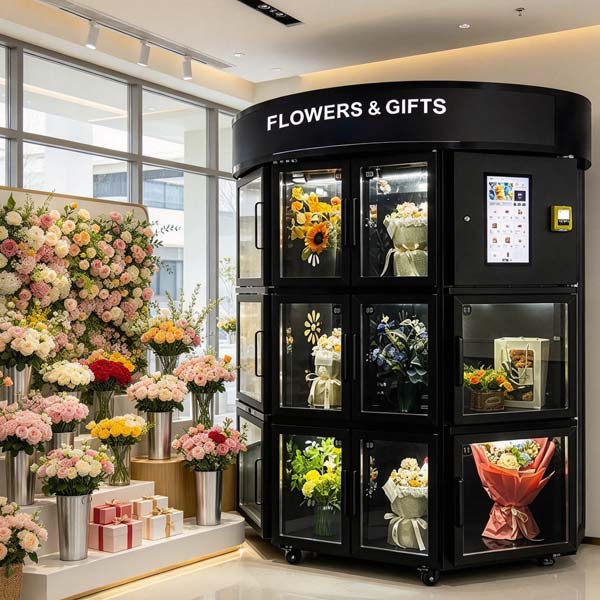
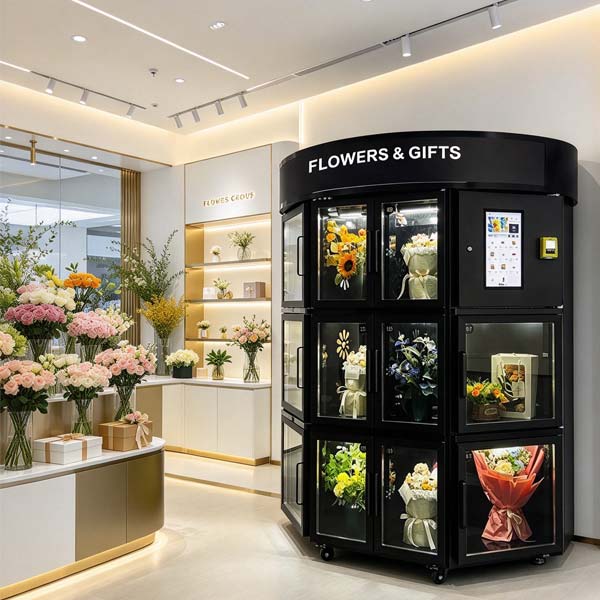
They see a lit glass front with individual bunches behind it. They touch the screen, pick a bunch by picture, and see the price. They pay by card, NETS, PayNow QR, or cash. A lane releases the bunch, the door opens at the collection slot, and they take it and walk on. The whole thing is over before the next train announcement.
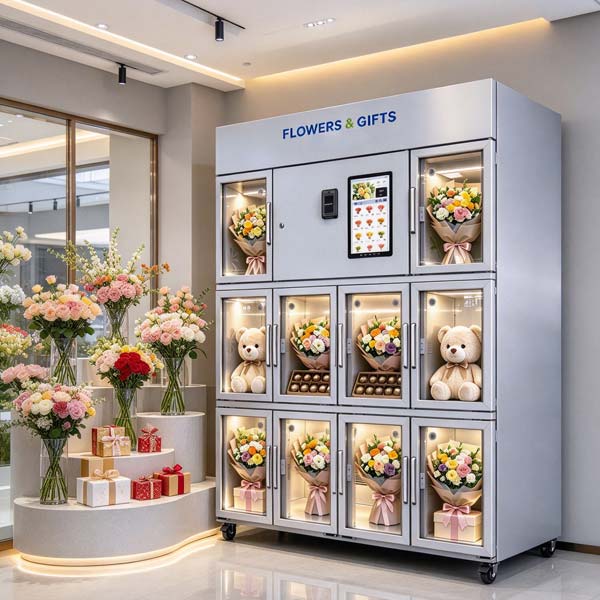
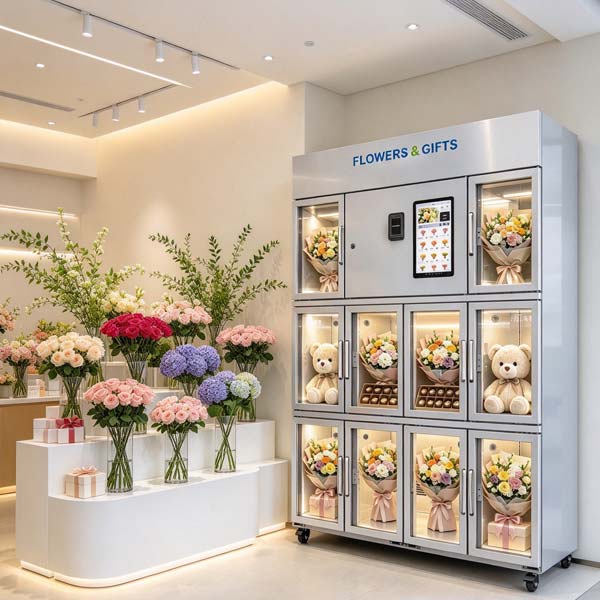
The part that is invisible to the customer is what makes the sale possible. A refrigerated cabinet holds the flowers at a set temperature and humidity. Individual lanes hold the bouquets so nothing is crushed and no stem is handled twice. Because each lane has its own capacity setting, the operator knows exactly how many units are in the machine without opening the door.
For anyone planning a route rather than a single site, the sequence that works is straightforward. Pick the location type, then the exact spot within it, then the cabinet size, then the stock mix. Doing that in the other order, starting with a machine and hunting for somewhere to put it, is how operators end up with a comfortable flower vending machine in a corridor nobody uses. It is worth a look at how operators work through location decisions and turnover before committing to a site.
What the numbers look like on the way in
Nobody should buy a machine on the strength of a payback figure printed in an article. What is useful is knowing which costs you are signing up for and roughly how heavy each one is.
The machine itself is the largest single line. A refrigerated flower cabinet is a more expensive build than a standard snack vendor, because of the compressor, the insulation and the sealed display. Expect a quotation built around cabinet size, the number of lanes, refrigeration specification and payment configuration rather than a fixed list price.
Consumables are the running cost that matters most, and unlike sugar or popcorn cups, flowers do not have a stable unit price. Prices move with the season, the festival calendar and the exchange rate at the auction. Valentine’s Day roses and a midweek bunch of chrysanthemums are not the same business, and a flower vending machine that ignores that gap will be buying at the wrong moment.
Placement follows. A free corner in a condominium lobby and a paid corridor in Orchard are two different investments, and the comparison has to be made on expected sales per square metre, not on rent alone. Machine price, placement cost and consumable spend together form the entry cost, and the full breakdown of vending machine cost is a sensible thing to read before you build a spreadsheet. Then add power, payment processing fees, transport, GST on import, and the occasional repair.
For scale, Wider Matrix’s factory prices on its other machines run from US$1,800 for the WM680 popcorn unit to US$5,999 for the WM880 i1600 phone case machine, with the WM980 cotton candy vending machine at US$4,800, the WM186 protein shake machine at US$4,150 and the WM520 puzzle machine at US$5,500 for the current generation. A refrigerated flower cabinet sits in the same broad band, and a configuration quote is the only honest way to price it.
Two habits keep the model honest. Set a conservative sales estimate, then see whether the machine still clears its costs at half that number. And watch spoilage as closely as revenue, because in this trade a wasted bouquet costs more than a lost sale.
What a refrigerated flower vending machine has to be able to do
The cabinet is doing two jobs at once: it is a shop window and it is a cold room. If it does the first well and the second badly, the flowers will not survive long enough to be sold. These are the capabilities worth insisting on.
| Item | What it means in practice |
|---|---|
| Cooling | Compressor refrigeration with adjustable temperature and humidity setpoints, so the cabinet can be tuned for cut flowers rather than drinks |
| Loading | Spring, push plate and hook lane types across two or more shelves, so a single stem and a wrapped bunch can share one cabinet |
| Capacity planning | Each lane is set to a fixed number of units, and the dashboard shows lanes used against total lanes |
| Connectivity | Wi-Fi and 4G, which matters in basements and concourses where Wi-Fi is weak or absent |
| Cloud management | One dashboard for products, inventory, orders, revenue and cabinet temperature |
| Restocking | One click replenish and one key fill, so a route visit is a few minutes per machine |
| Interface | Multi-language touchscreen, which helps in tourist heavy areas and mixed residential blocks |
| Payments | Coin, banknote, contactless card, NFC and QR code on the same cabinet |
| Placement | Indoor use on level ground, with around thirty centimetres of clearance at the back and sides |
| Maintenance | Monthly cleaning of the evaporator and condenser, and a monthly test of the leakage protection switch |
| Warranty | One year, with online support for installation, operation and upkeep |
Two of those rows are worth more attention than the rest. Humidity control is what separates a flower vending machine from a drink cooler, and connectivity is what separates a managed route from a set of machines you have to visit in order to learn anything. A cabinet that reports its own temperature and stock level turns a guess into a decision.
Restocking, cleaning and the weekly rhythm
Once the site is settled, the business runs on a routine. Operators who keep to a fixed rhythm spend less time per machine, waste less stock, and spot a fault before it turns into an empty cabinet at the start of a festival weekend.
A working day usually starts at the wholesaler or the cold room, not at the machine. Bunches are conditioned, trimmed and wrapped, then loaded into an insulated box or a small chiller for the route. The dashboard is read the night before, so the load for each site is decided before the van leaves. Route order matters as much as stock: a machine in the CBD is not worth visiting at half past eight in the morning, and a station concourse is best serviced between the two peaks rather than during one.
At the cabinet, the routine is short and unglamorous. Open the door, pull the oldest stock to the front of the lane, load the new stock behind it, check the water in any conditioning tray, wipe the glass, close the door and confirm on the dashboard that the lane counts have updated. On a well laid out cabinet this takes ten to fifteen minutes. Add a monthly task list: clean the condenser and evaporator, test the leakage protection switch, check the door seals, and inspect the lighting strip.
A few spares are worth keeping on the shelf, because a stalled flower vending machine loses money by the hour rather than by the day. A spare spring lane, a spare locker solenoid, a spare lighting strip and a spare door gasket cover most of what actually fails. Anything involving the compressor or the refrigerant should go to the manufacturer or a qualified refrigeration technician rather than to a general handyman.
The last part of the rhythm is records. What sold, at what price, at what hour, and what was thrown away. In a trade where the stock spoils, the discard log is as valuable as the sales log, because it is the only honest way to find out whether a site is being overstocked.
Sourcing the machine, and what else the same factory builds
Wider Matrix builds vending machines in Guangzhou and ships them internationally. The company has been in the trade since 2016, has shipped more than 3,000 units to over 130 countries, and runs an engineering team of more than fifty people. Machines are assembled and tested before shipment, the warranty is one year, and support runs online around the clock. Quality paperwork covers CE, ISO 9001 and RoHS, and OEM and ODM work is standard rather than a special project, which matters when a mall wants your cabinet to match its corridor.
That last point is a real commercial advantage in Singapore. A flower vending machine in a mall in Orchard or a hotel lobby in Marina Bay is part of the building’s appearance. Being able to specify the cabinet skin, the screen interface, the language set and the branding without a separate design agency is the difference between opening on schedule and opening a quarter late.
The same factory also builds several other categories, which is useful if you are planning more than one machine and want a single supplier, a single spare parts list and one support channel.
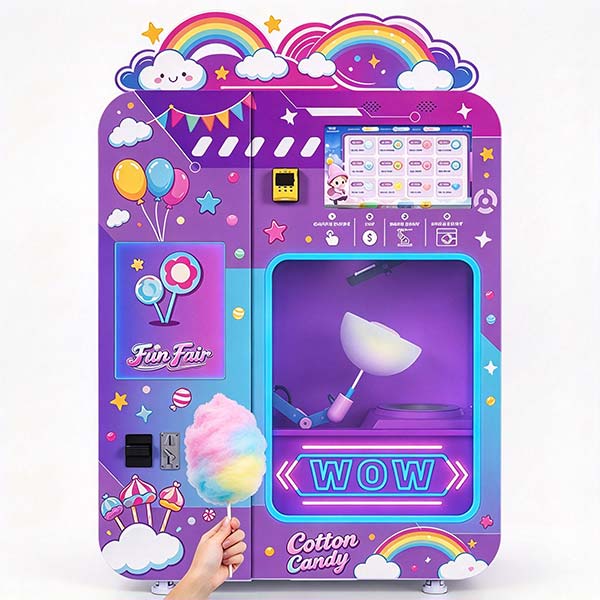
- Cotton candy. WM980 with a four degree of freedom robotic arm, 36 candy patterns and 28 to 30 grams of sugar per candy, priced from US$4,800. The flower shape is one of the available designs, which makes the flower shaped cotton candy vending machine a natural companion at family venues.
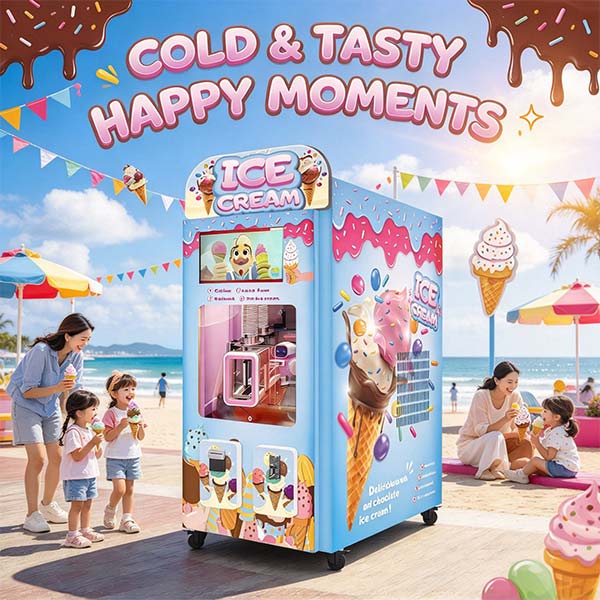
- Ice cream. WM550 with a 21.5 inch touch screen, 15 second cup dispensing and up to 300 cups per batch, or the compact model at 81 by 126 by 180 centimetres for tight spaces.
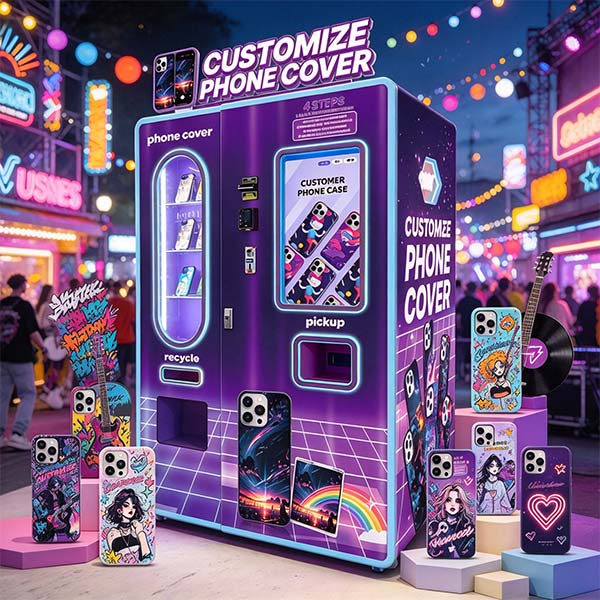
- Phone case printing. WM880 stores over 1,000 cases and prints a custom design in a few minutes, from US$4,999 for the F1080 version. Singapore already has a phone case market, as this guide to the phone case vending machine in Singapore sets out.
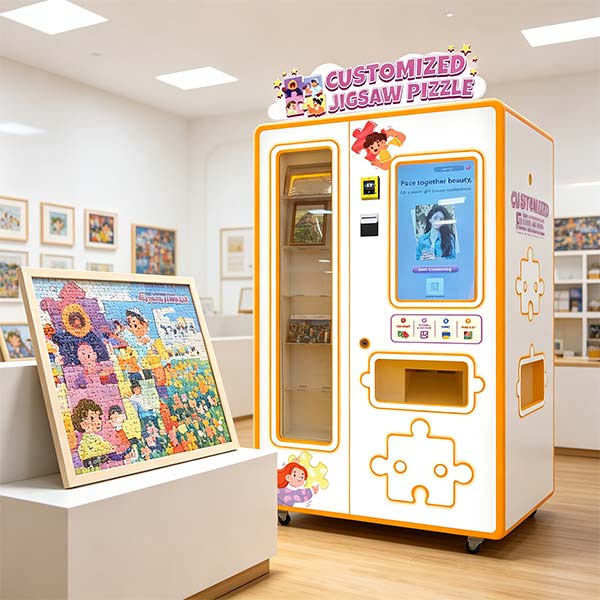
- Puzzle printing. WM520 and WM520+ turn an uploaded photo into a jigsaw puzzle in three minutes, with a 27 inch screen on the current generation.
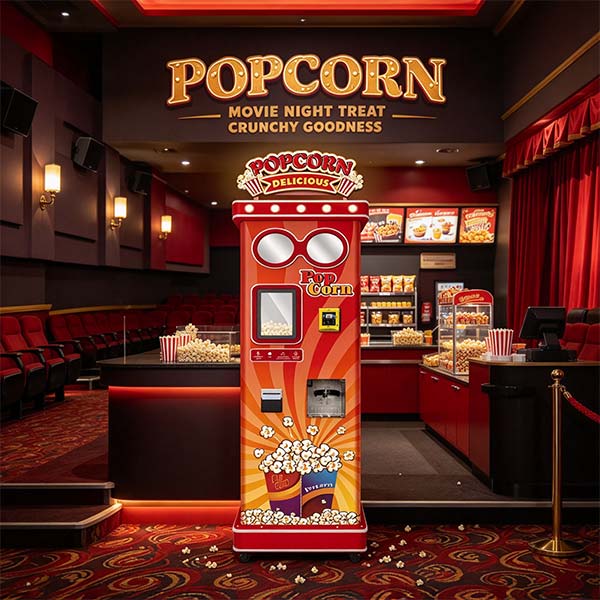
- Popcorn. WM680 pops fresh corn in about 120 seconds from a 5.6 kilogram hopper, priced from US$1,800. If you want the buyer’s view, see the popcorn vending machine buying guide.
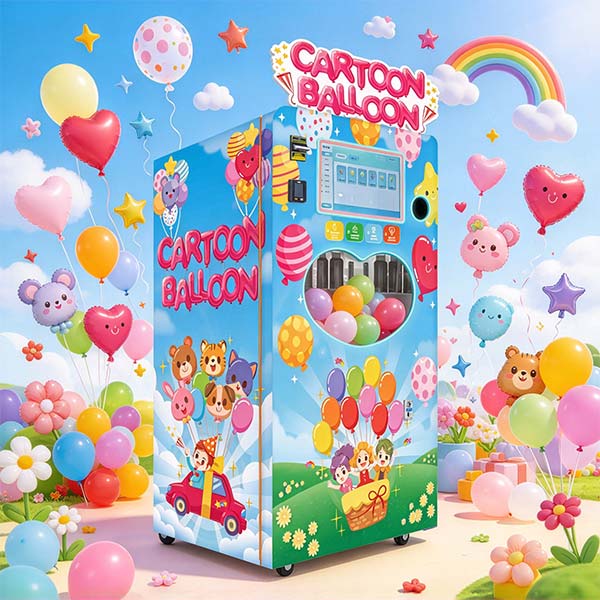
- Balloons. WM688 holds 360 balloons across six slots, with automatic clamping and a 21.5 inch screen.
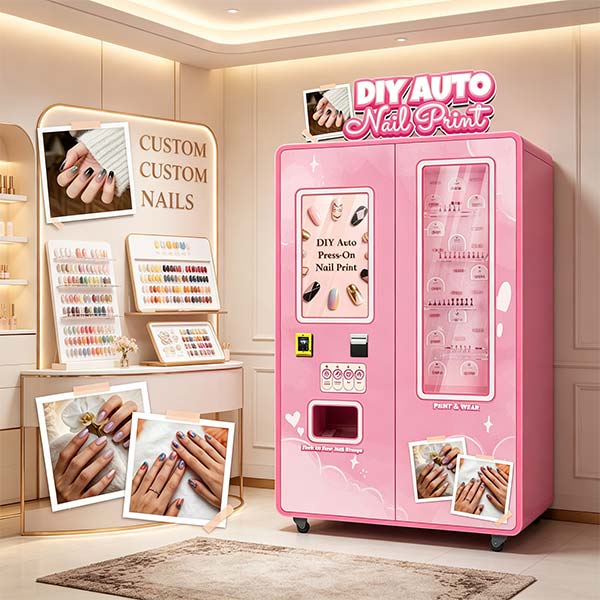
- Nail printing. WM860 prints a full nail set in about five minutes and holds 720 pairs of press on nails.
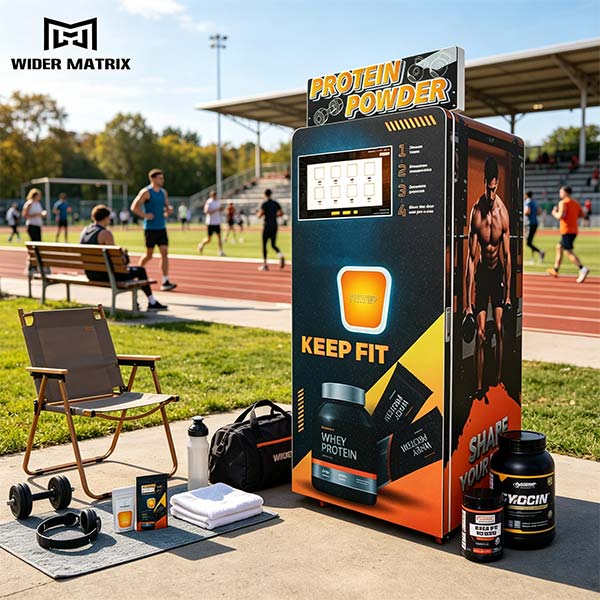
- Protein shakes. WM186 mixes in the cup across seven powder hoppers and three temperature zones, at US$4,150 factory direct.
If you are comparing manufacturers rather than products, the useful reading is around what separates the leading vending machine manufacturers in China and how pricing, spare parts and after sales service differ between them. Wider Matrix appears in most of those comparisons for a simple reason: the machines are built in its own factory and sold factory direct, which removes one layer of margin between the build cost and your invoice.
How a machine compares with the other ways of selling flowers here
It is worth being honest about what a vending cabinet does not do, because that shapes how you use it.
A physical flower shop allows custom work, standing orders and event contracts, and it lets a customer smell and touch the product before buying. It also carries Singapore’s commercial rent and the cost of a full day of staffing, and it closes at night.
Selling through an online delivery platform needs no floor space and reaches customers across the island, but the platform takes a share of every order and the buyer does not stumble across your flowers on the way home. Delivery also multiplies the cold chain problem, because a bouquet spends time in a van, in a lobby, or on a doorstep.
Consignment in a supermarket or a cafe costs nothing to set up, but the margin is thin and you have no control over how the stock is handled or how the bouquets are displayed.
A flower vending machine trades range for coverage. It cannot customise a bouquet or take a standing order, but it sells through the night, needs no counter staff, and catches the buyer who is already walking past. In practice the strongest setup for a small operator is a machine or two on good sites, plus a simple online order channel that the machine itself advertises on its screen. The cabinet pays for the location, and the online channel handles the customers who want something specific.
Whether any of this works depends on the site before it depends on the machine, and the wider question of whether a vending machine is profitable in Singapore is worth answering with real numbers rather than optimism. Demand for automated selling here is broad, not narrow. Food categories have moved the same way, as the rise of the pizza vending machine in Singapore shows, and flowers follow the same logic: sell where people already are, at the hours they are already out.
Mistakes that cost operators money
Most of the expensive errors in this business are made in the first three months, before there is any data to argue with.
Choosing a location on rent is the most common. A cheap spot in a quiet arcade is not cheap. A site that charges a fee but sits on the evening commuter route is usually the better buy, and the calculation has to start from expected transactions rather than from the monthly figure. The same logic applies to signage: a cabinet nobody notices is a cabinet nobody uses, and these operating tips cover the small adjustments that lift a site’s turnover.
Underestimating the cold chain comes second. Operators who buy flowers the morning of a restock and drive them across the island in an unrefrigerated van lose more stock in a week than a well run site loses in a month. Conditioning and transport are part of the same system as the cabinet.
Overloading the machine is third. Filling every lane because empty space looks wasteful is the fastest route to spoilage, especially in a market where the festival calendar swings demand by a large multiple. Load for the day you expect, not for the day you hope for.
Ignoring the payment mix is fourth. A cabinet that takes cards but not QR codes will turn away a share of local buyers, and a cabinet that takes only QR codes will lose foreign visitors. The mix matters more than the terminal.
Signing an exclusivity clause without reading it is fifth. Exclusivity granted to you is an asset. Exclusivity granted to somebody else, in a location you are paying for, is a five year mistake.
Treating restocking as an afterthought is sixth. One person with a trolley and a chilled box can service several machines in a morning, but only if the route is planned, the stock is conditioned in advance, and the dashboard is checked before the van is loaded.
Frequently asked questions
How much does a flower vending machine cost in Singapore?
A refrigerated flower cabinet is quoted per configuration, because cabinet size, lane count and refrigeration specification all move the price. For scale, factory list prices on the machines this manufacturer builds run from US$1,800 for the WM680 popcorn machine to US$5,999 for the WM880 i1600 phone case machine. Freight, GST and installation add to the landed cost in Singapore. Running cost is separate, and the flower stock itself is the largest part of it.
Can a flower vending machine run unattended for 24 hours?
Yes. There is no staff step in the sale, so the machine can trade through the night. The work that remains is restocking, cleaning and watching the dashboard. On a busy site, one restock a day is usually enough.
Where are flower vending machine Singapore locations most profitable?
Evening commuter corridors, hospital lobbies and mall basement linkways produce the most reliable turnover, because all three catch people who are already in the building and already carrying a purpose. Attraction and event sites can beat them on a single day but not across a month.
Do I need a licence or permission to place a flower vending machine in Singapore?
Register the business with ACRA first. On private premises you need written approval from the owner or the management corporation, and for public spaces such as a station concourse, an HDB common area or a park a permit from the operator or agency in charge is required. Cut flowers are not food, so the food vending licensing regime does not normally apply to a flower only machine, but it does apply if the same cabinet dispenses food or drink. Accepting card payments requires a merchant account with an acquirer.
How do you keep flowers fresh in a machine in Singapore’s climate?
The cabinet has to be refrigerated, with temperature and humidity both adjustable and stable. Flowers stay in the cold chain from the wholesaler to the lane, and stock is rotated so the oldest bunch sells first. Placing a cabinet in direct sun defeats the refrigeration.
What support and warranty come with the machine?
Warranty runs for one year and covers parts and service under normal use, with support available online around the clock. Installation, operation and maintenance are covered by video guides, and the machine is assembled and tested before shipment. Consumables are bought separately in bulk.
What payment methods should the machine accept in Singapore?
Contactless bank cards, NETS and PayNow QR cover the large majority of local buyers. Coins and banknotes still matter for visitors. Wider Matrix machines ship with coin, banknote, contactless card, NFC and QR modules on the same cabinet.
Is it cheaper to rent a flower vending machine or buy one?
Buying keeps the revenue and leaves you with an asset, and payback depends on the site. Renting lowers the entry cost but usually carries a revenue share or a high monthly fee. For a location you expect to keep for two years or more, buying is normally cheaper.
Getting a flower vending machine into Singapore
If you already have a site in mind, the fastest route to a usable number is a specific enquiry. Tell the manufacturer where the machine will stand, roughly how many transactions you expect in a day, how many lanes you want, whether the location needs branded artwork, and what power is available at the wall. Those five answers are enough to size a cabinet and price it.
Wider Matrix handles enquiries from overseas operators directly and replies within 24 hours, usually with a configuration and a shipping option rather than a single take it or leave it price. Ask for the refrigeration specification in writing, confirm the warranty terms and the spare parts list, and check what the cloud dashboard shows before the machine is packed.
One last piece of advice. Before you buy, spend an evening at the site you are considering, at the hours you expect to earn in, and count the people who walk past with a bag in each hand. That hour of watching tells you more about whether the spot works than any projection.