




A profitability answer built on real records from our own customers rather than estimates. It sets out six flower vending machine deployments we supplied across Portugal, Scotland, Maryland, Texas, France and Russia, showing the orders, sales, cost of goods and profit each customer logged, together with the landed machine cost, the rent per square metre and the electricity draw. It explains why the records come out the way they do, works the payback arithmetic against a real landed cost, isolates the three habits behind the strongest records, and covers what the cabinet has to do, where the machine comes from, and how to get a quote.
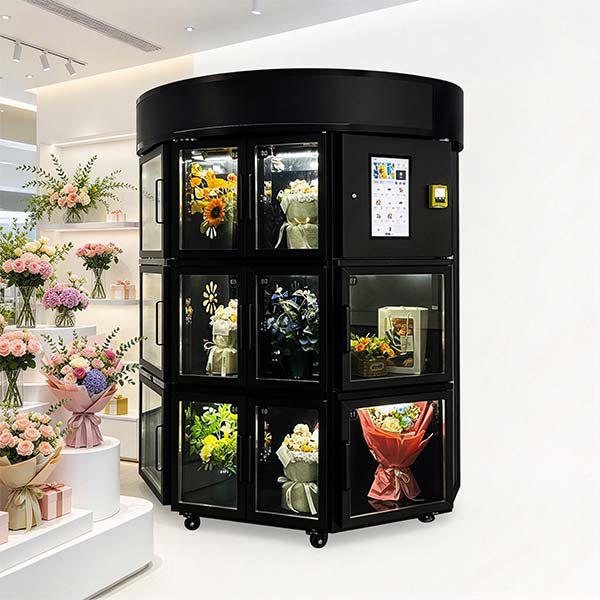
The short answer is yes, and the records show it
The question most operators begin with is a blunt one: are flower vending machines profitable? On the recorded evidence, yes. A flower vending machine is a small retail unit with no counter wage, a long trading day and a ticket size well above a snack sale, and the six deployments documented below show what that adds up to in practice.
Across those six records, monthly revenue ranged from US$1,290 in a Dallas mall corridor to US$5,557 in Maryland, with European records of €2,178 in Lisbon, €4,440 in Bordeaux, £6,930 in Scotland and ₽41,520 in St. Petersburg. Two of the six logged a monthly profit in the low four figures in their own currency. Our customers report payback measured in months rather than years, and in two cases a flower vending machine paid for itself in a little over two months.
That is the affirmative case, and it deserves to be stated plainly. It also deserves the second half of the sentence. One of the six records shows a profit of €170 on €4,440 of sales, because the customer was paying nearly the full sale price back out in flowers. The gap between the best record and the worst one is not the machine. It is how the stock was bought, priced and rotated. A flower vending machine is a profitable format for a customer who runs it as a small shop with a short shelf life attached, and a thin one for a customer who treats it as a box that fills itself.
What six of our customers actually recorded
The figures below are taken from the operating dashboards of flower machines we supplied to customers, reported by those customers as they ran them. Sales, cost of goods and profit are the monthly or period totals logged by the customer, and orders are the count of completed sales in that same record. The machine and freight figure is what the customer paid to have the unit delivered and installed.
| Deployment | Where | What was installed | Orders | Sales | Cost of goods | Profit |
|---|---|---|---|---|---|---|
| Lisbon flower shop extension | Lisbon, Portugal | One 10 slot unit at a mall near the existing shop | 140 | €2,178 | €140 | €2,038 |
| 24/7 Bloom fleet | Scotland, UK | Dozens of 8 slot units, custom signage, indoor and outdoor sites | 231 | £6,930 | £3,465 | £3,465 |
| Floral designer flower wall | Maryland, USA | One 10 slot unit used as a pick and pay flower wall | 111 | $5,557 | $1,981 | $3,576 |
| Dallas mall corridor | Dallas, Texas, USA | One unit running around the clock in a mall | 25 | $1,290 | $25 | $1,265 |
| Wedding florist side line | Bordeaux, France | One unit running alongside an existing wedding business | 201 | €4,440 | €4,270 | €170 |
| St. Petersburg branded unit | St. Petersburg, Russia | One 10 slot unit in the customer’s own brand livery | 56 | ₽41,520 | Not meaningful in the record | ₽41,514.4 |
The cost of goods column is where the whole answer lives, and it is the column most first time buyers never look at until it is too late. In Lisbon our customer logged €140 of goods against €2,178 of sales. In Dallas it was $25 against $1,290. In Maryland it was $1,981 against $5,557, roughly a third. In Scotland it was £3,465 against £6,930, exactly half. In Bordeaux it was €4,270 against €4,440, which is nearly everything, and the profit column shows what that costs. The same cabinet, sold the same way, in the same week, produces a completely different answer depending on what the customer paid for the flowers.
Lisbon, Portugal
Helena Bento already ran a flower shop in Lisbon and wanted a second point of sale that did not need a second assistant. She ordered a 10 slot machine and placed it at a mall near her existing shop, the first machine of its kind in the district. Her recorded month shows 140 orders, €2,178 in sales and €2,038 in profit, with €140 of goods against it. She reports recovering the cost in a little over two months, and she now treats the cabinet as the second counter her shop never had room for.
Scotland, UK
24/7 Bloom is a fresh flower brand in Scotland that ordered dozens of 8 slot machines and had the signage and cabinet bodies built differently for each site. They placed them across several locations in Scotland, indoors and outdoors. The record shown is for a single machine: 231 orders in a month, £6,930 of sales and £3,465 of profit, with cost of goods at £3,465. The customer reports that payback came faster than expected and describes the fleet as the backbone of their expansion rather than an experiment at the edge of it.
Maryland, USA
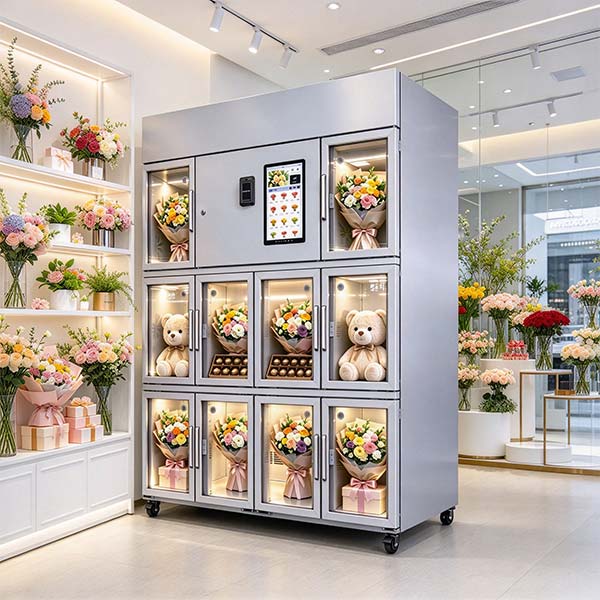
A local floral designer used a 10 slot machine to build a flower wall where customers pick and pay on the spot, which is the format that works best for people who do not want to wait. Her record shows 111 orders, $5,557 in sales, $1,981 of goods and $3,576 of profit, across indoor and outdoor sites. The customer reports fast payback and treats the cabinet as a second revenue line rather than a replacement for her design work.
Dallas, Texas, USA
Celeste’s machine sits in a mall in Dallas and runs around the clock. She replenishes every day or two and keeps the stock fresh, well priced and varied so that regulars have something new to look at. Her recorded month shows 25 orders, $1,290 of sales, $25 of goods and $1,265 of profit, with monthly revenue settled above $1,200. It is a small, steady business rather than a spectacular one, and it produces that result without anybody standing behind a counter.
Bordeaux, France
Marina Pereira is a wedding florist who added a machine so that her wedding work and her everyday work could run side by side without one eating the other’s calendar. Her record shows 201 orders, €4,440 of sales and €170 of profit, because the goods line came to €4,270. She reports that the unit has already paid for itself and that orders have settled at three or more a day. Her case is worth reading twice, because it shows both things at once: the machine did earn its cost back, and the margin was thin because the flowers were expensive relative to what she charged.
St. Petersburg, Russia
Mikhail opened a flower shop in St. Petersburg in 2023. When the mall next to him went into decline and his counter traffic fell away, he noticed a street nearby with steady footfall and a cluster of 24 hour shops. He ordered a machine in his own brand livery and placed it there. His record shows 56 orders and ₽41,520 of sales for the period. He reports the machine paying for itself in about two months at an average of two orders a day, and he describes it as the highest traffic point in his business now.
What the six records have in common, and where they differ
Six of our customers, six countries, and a surprising amount of agreement once the currencies are stripped out. Ask are flower vending machines profitable and you get six different numbers back, which is precisely why the question is better answered with records than with a single figure.
The common ground comes first. Every one of them runs a refrigerated cabinet. Every one of them restocks by hand, on a short cycle, from a wholesale supply. Every one of them trades through hours that a staffed counter would not. Every one of them sells a fixed, already made product at a visible price. And every one of them produces a monthly figure in the four digits in the local currency, with the Dallas record at $1,290 sitting lowest on a very high average ticket.
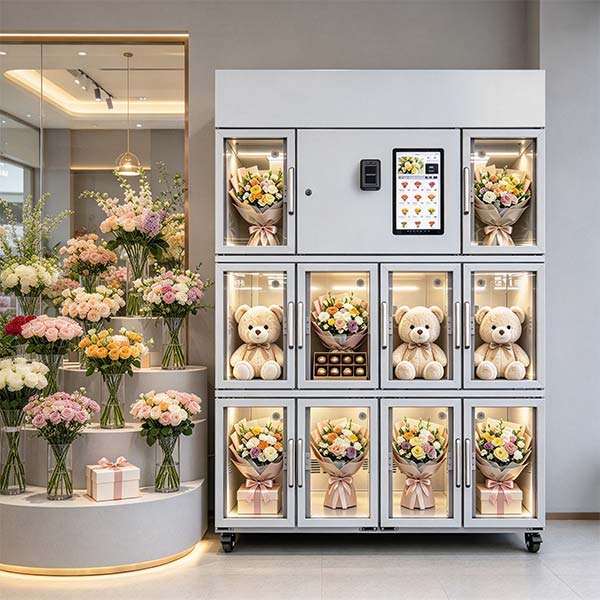
The differences are just as instructive. Order counts ran from 25 a month in Dallas to 231 in Scotland, a factor of more than nine. Average order value ran from €15.56 in Lisbon to $51.60 in Dallas, a factor of more than three. Those two numbers move in opposite directions, which is the most useful observation in the whole set. The Scottish fleet sells often and cheaply. The Dallas and Maryland machines sell less often and much dearer. Both produce a good month, and they get there for entirely different reasons.
That matters when you choose a site, because the two models want different locations. A high volume, low ticket flower vending machine wants passing traffic at predictable hours: a commuter concourse, a mall corridor, a hospital lobby. A low volume, high ticket machine wants people with time and a reason to spend: a gift buying floor, a hotel, an evening restaurant stretch. Putting a high ticket cabinet on a commuter route is one of the more common ways to end up with a record like Bordeaux’s, where the orders arrived but the margin did not.
How the customer uses it, and why the format sells
None of these records would exist if the machine were hard to use. The format works because a customer can finish the whole thing in about half a minute, standing up, with a bag already in one hand.
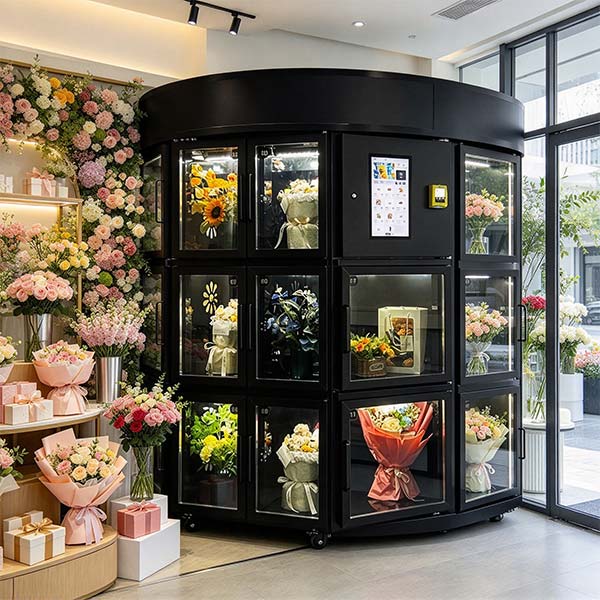
They see a lit glass front with individual bunches behind it, each one visible and each one priced where it can be read from a metre away. They touch the screen, pick a bunch by picture and confirm. They pay by card, by QR code, or in cash depending on the machine and the market. A lane releases the bunch, the door opens at the collection point, and they walk on. No queue, no assistant, no conversation.
That speed is the whole commercial argument, and it is worth being clear about what it is not. A flower vending machine does not sell arrangements. It sells a bunch that is already made, already wrapped and already priced. Our Maryland customer built her cabinet into a flower wall precisely so that customers could pick and pay on the spot, and that is the format that works best for people who do not want to wait for anything.
The lanes matter here more than they look. Spring, push plate and hook lane types let single stems and wrapped bunches share the same cabinet, which means one machine can run a wide price range instead of forcing a choice between cheap stems and expensive bouquets. Each lane carries a fixed number of units, so the owner knows exactly what is inside without opening the door, and the dashboard reports it remotely. How that reporting works in practice is described in how a smart vending machine processes a sale and reports it.
What the customer never sees is the part that makes the sale possible. A refrigerated cabinet holds the flowers at a set temperature and humidity. The lanes hold them so that nothing is crushed and no stem is handled twice. And because the cabinet reports its own stock, the next load is decided from a phone rather than from a guess at the door, which is the mechanism behind every low goods share in this set of records.
Why the records come out the way they do
Read across those six deployments and four things explain the numbers. None of them is surprising, but together they are the entire business case.
The first is trading hours. A shop counter sells for the hours somebody is standing behind it. A flower vending machine sells for every hour the building is open, which in a mall or an office block is most of the day and in a 24 hour location is all of it. Two of the six records come from locations that never close, and both of those customers describe the machine as their busiest point rather than their most convenient one.
The second is the wage. A flower shop needs an assistant, and in most of these markets an assistant is the largest fixed cost a small flower business carries. That is the difference between a flower vending machine and a flower shop, and it is the difference that shows up in every one of these records. A flower vending machine needs minutes a day, not a shift. That is not the same as needing nothing, and every customer in these records replenishes regularly, but it is the difference between carrying a wage and not carrying one.
The third is the ticket. A snack machine sells a bag or a cup. These records show average orders of €15.56 in Lisbon, £30.00 in Scotland, $50.06 in Maryland, $51.60 in Dallas, €22.09 in Bordeaux and ₽741 in St. Petersburg. Even the lowest of those is a real sale rather than a coin drop, and it is the reason a cabinet with a modest order count can produce a meaningful monthly figure.
The fourth is the footprint against the rent. In these records placement is priced per square metre, at €5 in Lisbon, £16 in Scotland, $20 in Maryland and Dallas, €30 in Bordeaux and ₽1,000 in St. Petersburg. The cabinet occupies under one square metre of floor, so at the most expensive European rate in the set the placement cost stays under €30 a month. That is a small number against a four figure sales month, and it is one of the reasons this format works in locations where a shop would not.
Electricity is the other line that appears in every record, and it is consistent across all six: 6 kWh a day. At the Lisbon rate of €0.152 per kWh that is about €28 a month. At the Scottish rate of £0.277 it is about £50 a month. It is a running cost that does not fall when sales fall, which is worth knowing on a slow month, but it is small enough that it rarely decides anything.
What it costs to get a flower vending machine running
The landed cost of the machine is the largest single cheque, and it is the number most people ask about first. These records give a real answer rather than an estimate. Machine plus freight came to €4,350 in Lisbon, £3,480 in Scotland, $4,800 in Dallas, $5,100 in Maryland, €4,250 in Bordeaux and ₽431,153 in St. Petersburg.
That places the landed cost of a flower cabinet squarely inside the band the rest of the range occupies. The WM680 popcorn machine is US$1,800 at the factory, the WM186 protein shake machine is US$4,150, the WM980 cotton candy machine is US$4,800 and the WM880 i1600 phone case machine is US$5,999. A refrigerated flower cabinet is a more expensive build than a snack vendor because of the compressor, the insulation and the sealed display, and it lands in the same territory as the other cold and cabinet machines. The full breakdown of how these costs stack, including freight, duty and installation, is set out in the investment breakdown of vending machine cost.
What that means in practice is that a flower vending machine is a capital decision of roughly four to five thousand followed by a small monthly one. The capital question is largely settled. Roughly €4,000 to €5,000, or the local equivalent, buys the machine delivered. Everything after that is a monthly operating question, and the monthly operating costs in these records are placement, electricity and flowers. Placement is priced per square metre and runs from €5 to €30 a month in the European records. Electricity is 6 kWh a day, so €28 a month at the Lisbon rate. Flowers are the variable, and they are the only one that can genuinely sink the numbers.
Working out your own payback against a real landed cost
A payback figure only means something against a capital number, so the arithmetic below runs each record against its own landed cost rather than against a single assumed figure. Every row is division and nothing else, which is the point: the numbers are not estimates, they are the customer figures already shown above, divided.
| Record | Landed cost of the machine | Monthly profit recorded | Months to recover |
|---|---|---|---|
| Lisbon, Portugal | €4,350 | €2,038 | 2.1 |
| Scotland, UK | £3,480 | £3,465 | 1.0 |
| Maryland, USA | $5,100 | $3,576 | 1.4 |
| Dallas, USA | $4,800 | $1,265 | 3.8 |
| Bordeaux, France | €4,250 | €170 | 25.0 |
| St. Petersburg, Russia | ₽431,153 | ₽41,514.4 | 10.4 |
Notice how closely the arithmetic lines up with what the customers themselves reported. Divide €4,350 by the Lisbon profit of €2,038 and the answer is 2.1 months, which is what Helena Bento describes. Divide £3,480 by the Scottish profit of £3,465 and the answer is one month, which is what 24/7 Bloom means by faster than expected. That alignment is the useful part of these records, because it means the dashboard figures and the customer experience are telling the same story.
The Bordeaux record is the other side of the same coin, and it is worth doing the sum on it too. Divide €4,250 by €170 and the answer is 25 months. The customer reports having recovered the cost and running three or more orders a day, and both things can be true over a longer period than the dashboard row suggests. The lesson is not that the machine failed. It is that the goods line has to stay a fraction of the sale rather than most of it.
So the practical method is the one a shopkeeper would use. Count the buying decisions your site produces in a day, at the hours you expect to trade in. Get a real wholesale quote for the mix you intend to stock and express it as a share of the price you intend to charge. Multiply the two and subtract placement, electricity and payment processing. Then divide the landed cost by what is left. Half an hour with a calculator gives a better answer than any published payback figure, including the ones above.
On the margin question specifically, the recorded share of goods against sales ran at about 6 percent in Lisbon, 50 percent in Scotland, 36 percent in Maryland, 2 percent in Dallas and 96 percent in Bordeaux. Those are enormous differences, and they are not explained by the machine or the city. They are explained by buying, pricing and rotation, which is the subject of the next section.
The three habits behind the strong records
Six of our customers, six different markets, and the same three habits separating the strong records from the weak one.
The first is buying at wholesale and buying ahead. Our Lisbon customer logged €140 of goods against €2,178 of sales. Our Bordeaux customer logged €4,270 against €4,440. That is a difference of more than thirty times on the goods line, and it comes from where the flowers were bought and when. Anybody buying at retail on the morning of a restock will produce a Bordeaux record no matter how good the site is.
The second is stocking to the day rather than to the cabinet. Every customer in these records replenishes regularly, and the strongest ones read the sales record before they load rather than filling every lane because the space is there. Empty space in a cabinet is not a problem. It is working capital that has not been spent and stock that has not been risked yet.
The third is keeping the cold chain whole. These are refrigerated cabinets holding living stock, and the shelf life depends on the whole journey rather than on the compressor alone. Flowers conditioned properly, moved in a chilled box and loaded into a cabinet already at temperature will hold for days. Flowers that spend an hour in a warm van will not, and the difference shows up in the goods line as waste rather than as a visible cost.
Those three habits are unglamorous and they are cheap. They are also the entire difference between the best and worst record in this set, which is a more useful thing to know than any headline revenue figure.
The mistakes that turn a good record into a thin one
The habits in the previous section are what the strong records share. What follows is the same ground seen from the other end, because the thin record in this set was produced by a handful of avoidable decisions rather than by anything about the cabinet, the city or the machine.
Buying at retail is the first and by far the largest. A flower vending machine needs wholesale access to work at all. Our Lisbon customer logged €140 of goods against €2,178 of sales because she was buying at trade prices and planning ahead. Our Bordeaux customer logged €4,270 against €4,440 because she was not. No amount of footfall, pricing cleverness or machine quality fixes a goods share of 96 percent, and a customer who cannot buy at wholesale is not ready to run one of these yet.
Filling every lane is the second. Empty space in a cabinet is not a problem to be solved. It is working capital you have not spent and stock you have not yet risked. The strongest customers in this set deliberately underfill, and they would rather miss a sale than create a bin bag at the end of the week.
Counting the site at the wrong hour is the third. A location that looks busy at one in the afternoon can be dead at eight in the evening, and the evening is when a flower machine earns. Count at the hours you expect to trade in, on more than one day, and count the people who are in a position to stop rather than everybody who walks past. A first cabinet on a strong evening site is also the realistic starting point for anyone testing vending as a side hustle rather than as a full time operation.
Ignoring the rotation is the fourth. The oldest bunch goes to the front of the lane every single time. It takes two seconds, and it is the difference between selling stock at full price and throwing it away. Our Dallas customer’s habit of replenishing every day or two is the same discipline seen from the other end.
Breaking the cold chain is the fifth. Flowers conditioned properly, moved in a chilled box and loaded into a cabinet already at temperature hold for days. Flowers that spend an hour in a warm van, or that sit in a cabinet facing an afternoon sun, do not, and the loss shows up as waste rather than as a line item anybody notices.
Pricing like a florist is the sixth, and it is the one that surprises people. A customer at a cabinet is not paying for design, advice or delivery. They are paying for convenience at an hour when nothing else is open. Prices set at or above the local florist’s read as expensive, because the customer can see the flowers are not arranged. Prices set clearly below read as a bargain. Two or three clear price points, with one entry level option and one that carries a card and a wrap, is the range that works, and it is worth a look at how much a vending machine costs against what it can charge before fixing them.
Treating the machine as passive income is the seventh. It is a small shop with a short shelf life attached. The work is minutes per machine per visit rather than hours of staffing, but it happens every day rather than once a week, and skipping it is exactly what produces a thin record. The general question of how profitable a vending machine really is has the same answer in every category: it depends on whether the customer turns up.
The first year, month by month
A projection on paper is flat. A real first year is not, and knowing the shape of it prevents most early exits. Very few of these machines fail because the machine was wrong. They disappoint because the customer expected month one to look like month ten, and the point of the first year is not to prove that a flower vending machine works in general. It is to prove that it works at your site.
Month one is installation and measurement rather than revenue. The cabinet is positioned, powered, levelled and brought down to temperature, and the first loads are deliberately small. The point of that month is to learn which lanes sell and at what hour, because two cabinets in two locations produce completely different answers. Loading light costs a little in missed sales and saves a great deal in spoiled stock.
Months two and three build a baseline. Sales settle, the dashboard starts to show which days and which price points carry the site, and the goods share can finally be measured rather than estimated. This is the period when rotation discipline either becomes a habit or falls apart, and it is the best single predictor of what the rest of the year looks like.
Month four is usually the first real festival test, and the lesson is nearly always the same. The machine sells out in the middle of the peak and then sits with stock nobody wants on the following Monday. Buying earlier and stocking narrower fixes it, and it is worth planning for rather than discovering.
Months five to nine are refinement. Slow lanes come out of the mix, bundle offers are tested, promotion dates are set from the screen, and prices move where the data supports it. Revenue in this stretch usually moves less than margin does, because most of the gain comes from buying better and wasting less rather than from selling more.
Months ten to twelve are the decision point. If the cabinet is covering its fixed costs and paying down its own purchase price, the question becomes whether to add a second machine on the same route, and how many machines it takes to reach six figures becomes a real piece of arithmetic rather than a fantasy. If the cabinet is not covering its costs, the useful question is whether the site is wrong or the routine is wrong. Changing the routine is nearly free. Changing the site is not, which is why a marginal site deserves a full twelve months before it is written off.
What changes the answer from market to market
The same cabinet produces different results in different cities, and four local conditions move the number more than the machine does. Reading them before choosing a site is worth more than any comparison of cabinet brands.
Climate comes first, and it cuts both ways. In a hot, humid market the compressor works harder, shelf life is shorter and the cold chain has to be airtight from the wholesaler to the lane. In a temperate market the same bouquet keeps longer, waste is lower and the margin is easier to protect, which is why a flower vending machine in a cooler climate is a slightly easier business to run than one in the tropics. A cooler climate effectively buys you time, and in a business built on a perishable product time is the same thing as money.
Labour cost comes second. Where a counter assistant is expensive, unattended operation saves more, and the gap between running a flower vending machine and staffing a small shop widens. In a market where shop labour is very cheap, a neighbourhood flower stall can undercut a cabinet on price and the machine has to win on hours instead. The machine wins the trade between nine at night and seven in the morning, and it loses the trade that wants an arrangement built to order.
Payment habits come third. Where nearly everyone taps a card or scans a code, each sale is fast and cash handling costs disappear. In a cash-heavy market the cabinet needs note and coin modules and a routine for collecting, counting and banking cash safely. Both are workable. The mistake is specifying a machine for a market you are not actually operating in.
Gift culture and the festival calendar come fourth. The density of gifting occasions is what fills the peaks, and a market with a heavy festival calendar supports higher prices more often through the year. A market with fewer occasions is not unprofitable, but it leans harder on ordinary daily demand and therefore on location quality, because there are fewer dates to make up for a weak site.
Our six customers span Portugal, Scotland, the United States, France and Russia, and between them they cover both cool temperate and continental climates, both high and moderate wage markets, and both cashless and cash-heavy buying habits. That the format produced a positive record in all six, including the thin one, is itself part of the answer to whether owning a vending machine is profitable across very different conditions.
What the cabinet has to do for the numbers to hold
Every figure in this article assumes a machine that behaves. A cabinet that loses temperature overnight, forgets its own stock levels or cannot report what it sold will quietly eat the margin regardless of how well the site performs. These are the capabilities worth insisting on before you sign an order, and they are what Wider Matrix builds into its cabinets rather than treating as paid extras.
| Capability | Why it matters to profit |
|---|---|
| Compressor refrigeration with adjustable temperature and humidity setpoints | Humidity control is what separates a flower cabinet from a drink cooler, and it decides shelf life |
| Stable, non-cycling temperature | Constant cycling shortens vase life and drives up waste and power cost together |
| Per lane capacity settings | You cannot plan a daily load without knowing exactly how many units each lane holds |
| Spring, push plate and hook lane types | Lets single stems and wrapped bunches share one cabinet, which widens the price range |
| Wi-Fi and 4G connectivity | Without a connection the machine cannot report sales or alert you to low stock |
| Cloud dashboard with sales, inventory and temperature | This is the data that keeps the goods line low, and it separates a managed route from guesswork |
| One click replenish and one key fill | Cuts the minutes per machine per visit, which is the main labour cost of the business |
| Remote price and promotion updates | Festival pricing can be applied without sending anyone to the site |
| Multi-language touchscreen | Widens the customer base in mixed and tourist heavy areas |
| Coin, banknote, contactless card, NFC and QR payment | Removes payment as a reason for a willing buyer to walk away |
| Custom signage, cabinet livery and branding | The Scottish fleet was built this way, and it is what turns a machine into a brand point |
| One year warranty and online support | Protects the margin against early faults and keeps a stalled machine from becoming a waste event |
| Around 30 cm clearance at the back and sides | Blocked airflow pushes the compressor harder and shortens the life of the most expensive component |
The wider technology behind those rows, and what it does to the labour side of the business, is covered in this overview of smart vending machines, and the operating habits that keep machines earning are gathered in these practical vending machine business tips.
What to ask before you order
The records tell you what the machine can do. They do not tell you which cabinet to buy, and that is a separate question with a short list of answers worth having in writing.
Ask for the refrigeration specification rather than the word refrigerated. You want the temperature range, whether humidity is controlled separately from temperature, and how the cabinet behaves after a door opening or a power interruption. In a business where shelf life is the margin, this is the most important line in the quotation.
Ask how the cabinet reports. Which dashboard, what it shows, whether sales, inventory and cabinet temperature are all visible from a phone, and whether prices and promotions can be pushed remotely. A machine you have to visit in order to learn anything about is a machine that will cost you stock, and a flower vending machine with no reporting is a gamble rather than an investment.
Ask about lane types and capacity. Spring, push plate and hook lanes serve different products, and the mix decides whether you can run single stems and wrapped bouquets side by side. Ask how capacity is set per lane and how it is reported, because that number is what your daily load gets planned against.
Ask about payments for your market specifically. Contactless cards, QR codes, notes and coins are all standard, but the right mix depends on where the cabinet will stand. Ask which modules are fitted as standard, which are optional, and what the optional ones cost, before you sign rather than after.
Ask about branding. The Scottish fleet was built with different signage and cabinet bodies for different sites, and our St. Petersburg customer got his own livery. If you are placing machines in malls, hotels or for a chain, that is a standard requirement rather than an exotic one and it should be quoted as one, which Wider Matrix handles in house rather than through a third party design agency.
Ask about warranty, spares and response time. One year with online support is the standard on this range. Ask which spare parts are held, what a replacement costs, and how long a response takes in your time zone. A cabinet that is down for a week is a cabinet full of spoiled stock, and that costs far more than the part.
Ask for the landed price rather than the factory price. Freight, insurance, duty, local taxes and installation all belong in the number you divide by when you work out your payback, and a quotation that leaves them out is not a quotation.
Where this machine comes from
Wider Matrix builds and ships this machine, and every record in this article is from a customer running one we supplied. The flower vending machine comes off the same Guangzhou production line as the rest of the range, is sold factory direct with the same one year warranty and online support, and carries the same CE, ISO 9001 and RoHS file. OEM and ODM work is routine rather than a special project, which is how the Scottish fleet ended up with different signage and cabinet bodies for different sites, and how the St. Petersburg customer got a unit in his own brand livery.
The full specification sheet is being finalised, so ask for the current configuration sheet and landed price when you enquire. In the meantime the capability table above is the accurate summary of what the machine does, and the case records are the accurate summary of what our customers have done with their machines.
Sold factory direct is the part that changes the arithmetic, because it removes a trading margin between the build cost and the invoice. On a capital item that has to be recovered out of a perishable product, that gap goes straight into the payback period. A note on how to weigh that against other suppliers appears in what separates the leading vending machine manufacturers in China.
The same factory builds several other categories, which is worth knowing if you plan to run a route rather than a single machine, since one supplier means one spares list and one support channel.

- Cotton candy. WM980 with a four degree of freedom robotic arm and 36 candy patterns, using 28 to 30 grams of sugar per candy, priced from US$4,800. The flower shape is one of the available designs, which makes a flower shaped cotton candy vending machine a natural companion at family venues.
- Ice cream. WM550 dispenses a cup in 15 seconds and holds up to 300 cups per batch, with the compact model at 81 by 126 by 180 centimetres for tight spaces.
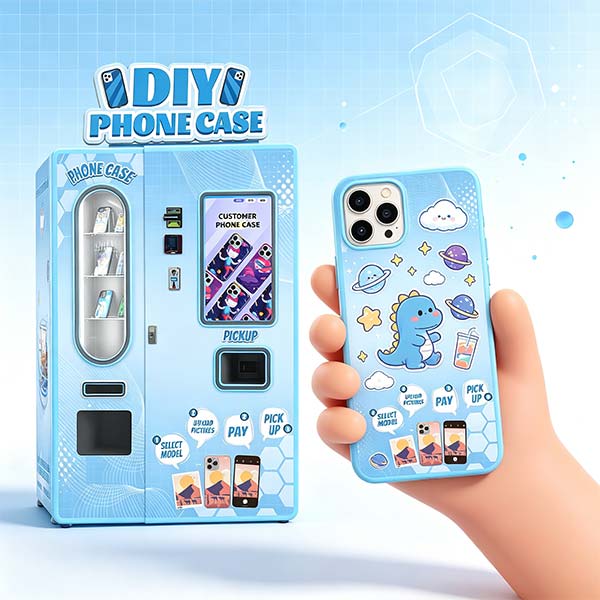
- Phone case printing. WM880 stores over 1,000 cases and prints a design in minutes, from US$4,999, and there is an established market for it as this guide to the phone case vending machine in Singapore sets out.
- Puzzle printing. WM520 and WM520+ print a photo puzzle in three minutes, with a 27 inch screen on the current generation and a published return of 59.18 percent over its modelled year.
- Popcorn. WM680 pops fresh corn in about 120 seconds from a 5.6 kilogram hopper, from US$1,800, with cup costs of ten to twelve cents, and the economics at that price point are covered in what makes popcorn machines profitable.
- Balloons. WM688 holds 360 balloons across six slots, with balloons costing ten to thirty cents each depending on volume.
- Nail printing. WM860 prints a full nail set in about five minutes on roughly US$1.50 of material, which is why its margin is the widest in the range.
- Protein shakes. WM186 mixes in the cup across seven powder hoppers and three temperature zones, at US$4,150 factory direct, with cups at US$0.80 to US$1.50 against a US$3.00 to US$8.00 retail price.
Read across that list and the pattern holds. The categories with cheap, manufactured consumables produce the widest margins, and flowers sit harder than all of them because the consumable is alive. That is exactly why the flower records that work are the ones where the goods line was held down by buying well, and why the answer to the profitability question is a matter of operating discipline rather than of machine choice.
Frequently asked questions
Are flower vending machines profitable?
Yes, on the evidence from our own customers, provided the goods line stays a small fraction of the sale. Six of our customer deployments logged monthly revenue from US$1,290 to US$5,557, with European records of €2,178, €4,440 and £6,930 and a Russian record of ₽41,520. Customers report payback in months, and in two cases in around two months. The one thin record in the set, at €170 profit on €4,440 of sales, came from paying nearly the whole sale price back out in flowers.
How much does a flower vending machine cost?
In the recorded deployments, machine plus freight came to €4,350 in Lisbon, £3,480 in Scotland, $4,800 in Dallas, $5,100 in Maryland, €4,250 in Bordeaux and ₽431,153 in St. Petersburg. Placement is charged separately per square metre, and electricity is charged at the local rate on a draw of 6 kWh a day.
How much does a flower vending machine make a month?
The recorded monthly figures are €2,178 in Lisbon, £6,930 in Scotland, $5,557 in Maryland, $1,290 in Dallas, €4,440 in Bordeaux and ₽41,520 in St. Petersburg. Orders per month ran from 25 to 231, and the average order value ran from €15.56 in Lisbon to $51.60 in Dallas. A flower vending machine sitting in the middle of that range, at roughly 100 orders a month and a €20 ticket, is a four figure monthly business. Your own figure will depend on the site and the ticket you can charge.
How long does it take to pay back?
Divide the landed cost by the monthly profit after fixed costs. Against the Lisbon record of €4,350 landed and €2,038 profit, that is about 2.1 months, which matches what the customer reported. Against the Bordeaux record of €4,250 and €170 profit it is about 25 months, which is what happens when the goods line eats the sale.
What does it cost to run one each month?
Placement, electricity and flowers. Placement is priced per square metre and ran from €5 to €30 a month in the European records, with the cabinet occupying under one square metre. Electricity is 6 kWh a day, which is about €28 a month at the Lisbon rate of €0.152 per kWh and about £50 at the Scottish rate of £0.277. Flowers are the variable and the largest one.
Can a flower vending machine run unattended for 24 hours?
Yes. There is no staff step in the sale, and two of the six records are from locations that never close. A flower vending machine still needs a replenishment visit, and the strongest customers go every day or two. The saving comes from needing minutes per machine rather than a shift, not from needing nobody at all.
What is the profit margin on a flower vending machine?
It is set entirely by what the flowers cost as a share of the selling price. The recorded goods share ran at about 6 percent in Lisbon, 36 percent in Maryland, 50 percent in Scotland and 96 percent in Bordeaux. The machine is the same in every case, so the margin is an operating result rather than a product result.
Is it more profitable to buy or rent a flower vending machine?
Buying keeps all the revenue and leaves an asset, but the landed cost has to be recovered out of a perishable product, which the Lisbon and Scotland records show happening in one to two months when the goods line is low. Renting lowers the entry cost and usually carries a revenue share or a high monthly fee that caps the upside. For a site you expect to keep for two years or more, buying normally produces the better long run figure.
Get a quote for a flower vending machine
If the records above match the kind of site you have in mind, the next step is a specific enquiry rather than a general question. Send five things: where the cabinet will stand, the hours you expect to trade in, your estimate of buying decisions per day, the price points you intend to offer, and the power available at the wall.
Wider Matrix supplies this machine factory direct, answers enquiries from operators within 24 hours, and will send the current configuration sheet along with the landed price for your destination. Ask for the refrigeration specification in writing, confirm the warranty and the spare parts list, and find out what the cloud dashboard reports before the cabinet is packed.
Then do the one thing every customer in these records did before committing: spend two evenings at the site, at the hours you expect to earn in, and count the people who pass and are in a position to buy. Two evenings of counting will tell you more about what your flower vending machine will earn than any table on this page, including the ones with real numbers in them.