



A practical buyer’s look at running a hot fry vending machine in the USA, built on the Wider Matrix WM888 specification: 11,500W power draw, 650 kg cabinet, 173 servings between restocks, dual 10 litre fry tanks, oil changes every 150 to 200 uses, plus what permits, placement and daily servicing actually involve.
What happens at 2 a.m. with nobody on shift
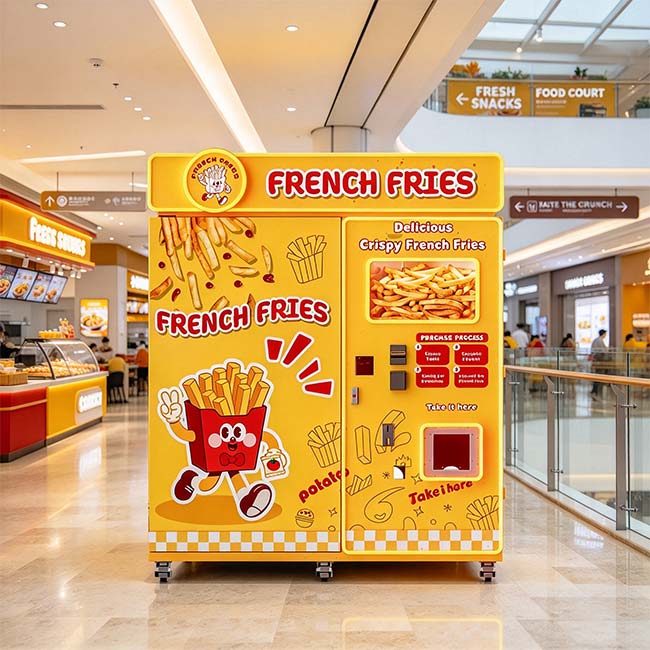
A customer taps an order on the 27 inch screen, pays, and watches the basket drop behind a transparent window. The machine pulls frozen fries out of a compartment held at -3°C, drops them into one of two 10 litre tanks, fries them, drains the oil, fills a paper box and pumps the sauce the customer picked. About 90 to 120 seconds later the box slides out.
That is the promise of a french fry vending machine, and on a well built unit it holds up. What decides whether your site works is the unglamorous half: whether the building can feed it power, whether the floor carries 650 kg, and who turns up on Tuesday to change the oil. Wider Matrix ships the WM888 for exactly this job, and the figures below come from its specification sheet.
The WM888 numbers that decide a site
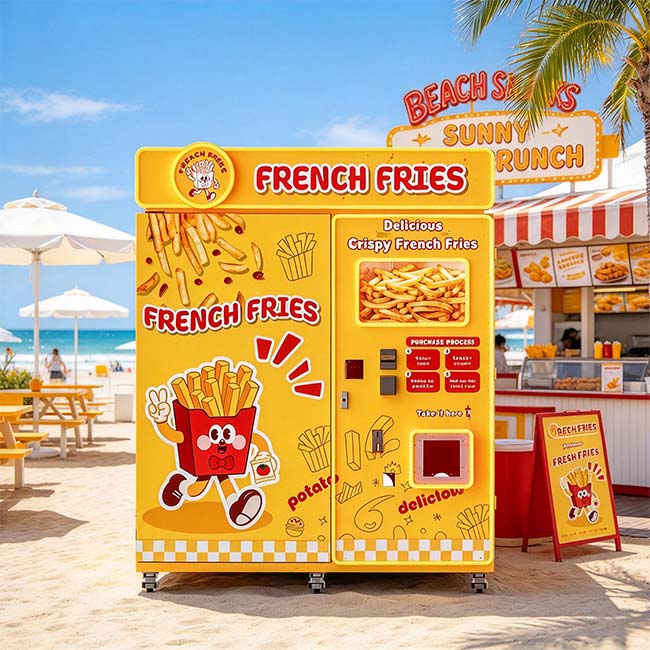
A french fry vending machine is kitchen equipment that happens to take cards. Two specs knock out more US locations than anything else, so read the table with your site in mind.
| Item | WM888 |
|---|---|
| Model | WM888 multi function French fries machine, Wider Matrix |
| Dimensions | 193 x 110 x 240 cm, about 2 sq m of floor |
| Weight | 650 kg |
| Power supply | 220V or 380V, 50Hz to 60Hz |
| Maximum draw | 11,500W |
| Fry tanks | 2 x 10L, running at the same time |
| Frying temperature | 0 to 180°C, triple sensor control |
| Frozen storage | -3°C, adjustable from -3°C to 20°C, refrigerant R290 |
| Capacity | 173 servings, 160 paper boxes |
| Sauce | 5 flavors x 200 packs |
| Serve time | about 90 to 120 seconds |
| Screen | 27 inch HD touch screen with image, video and advertising playback |
| Payment | QR code, cash with coin change, credit card, Apple Pay, Google Pay |
| Languages | 85+ languages, free customization |
| Oil change interval | about every 150 to 200 uses |
The 173 serving capacity and 160 paper boxes set your restocking rhythm, and five sauce flavors at 200 packs each last longer than most first time operators expect. Dual tanks matter more than capacity in practice, because two baskets working at once is what keeps a queue moving at halftime or between shifts.
Power, floor and doorway
At 11,500W maximum draw, the WM888 needs more than a standard US wall circuit can carry. Most installations run a dedicated line, and the machine accepts 220V or 380V at 50Hz or 60Hz, so your electrician has options. Confirm the panel before you sign anything for the site, since upgrading service in an older building can cost more than delivery does.
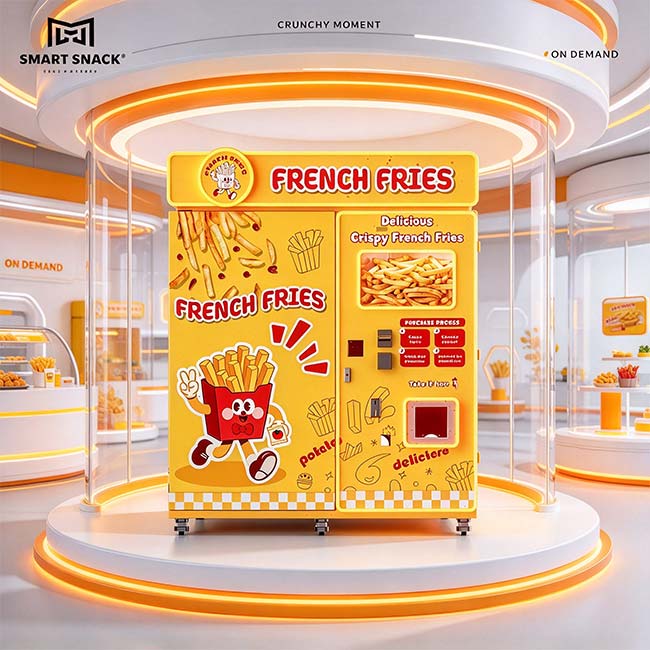
Weight catches people out just as often. The cabinet is 650 kg and measures 193 cm long, 110 cm wide and 240 cm tall. Measure the freight elevator, the loading dock and every doorway along the route. A machine that fits the room but not the corridor is a genuine problem, and it happens more than suppliers admit.
Budget roughly 2 sq m of floor plus working space in front of the service door. Frying produces grease vapour and a smell, so raise ventilation with the location owner before you commit to a spot beside an open seating area.
Purchase price and running cost
List price for a single WM888 is US$9,800. Wider Matrix quotes 2 to 5 units, 6 to 10 units and larger orders on request, and the final figure moves with destination, shipping terms, customization, local taxes and current promotions. Ask for a landed number rather than a machine number, because freight and duty on a 650 kg cabinet are not small.
On the cost side you are buying frozen fries, frying oil, paper boxes and sauce packs, plus electricity and whatever the site charges in rent or revenue share. Oil gets changed roughly every 150 to 200 uses, which is the line item new operators forget to budget. The machine also needs a person: restocking, wiping down the window and cabinet, and checking that the tanks are clean.
Our own planning example assumes 80 servings a day and works out to a static payback of 3 to 6 months. Read it as arithmetic on assumed numbers. Your rent, your price per box and your real foot traffic move the result far more than the hardware does, and no manufacturer can promise you foot traffic.
Fries are the opening act
The WM888 handles anything that can be deep fried. Thin cut, thick cut and crinkle cut fries, chicken wings, nuggets, popcorn chicken, onion rings, flavored hash browns and squid rings all run through the same two tanks. That spread matters in the USA, where a site that only wants fries at lunch often wants something heartier after 10 p.m.
Temperature runs from 0 to 180°C under three sensors, so each product gets its own setting. The cycle fries, re-fries for a crisp outside, then drains oil before the box is filled. Ketchup, mayonnaise and BBQ sauce are among the five flavors, each dispensed from its own pack.
Oil choice is yours: shortening, soybean, corn or peanut. Keep shortening at or below 200°C and soybean oil at or below 230°C. Those limits come from the factory operating notes and exist to stop the oil breaking down early.
What the operator actually does each week
Unattended does not mean unsupervised. The WM888 runs the whole chain by itself, from frozen storage through conveying, frying, draining, packing and sauce dispensing, and the backend tracks sales, stock and machine status around the clock, raising an alarm when something leaves its range. Software updates arrive over the air, so firmware fixes do not cost you a site visit.
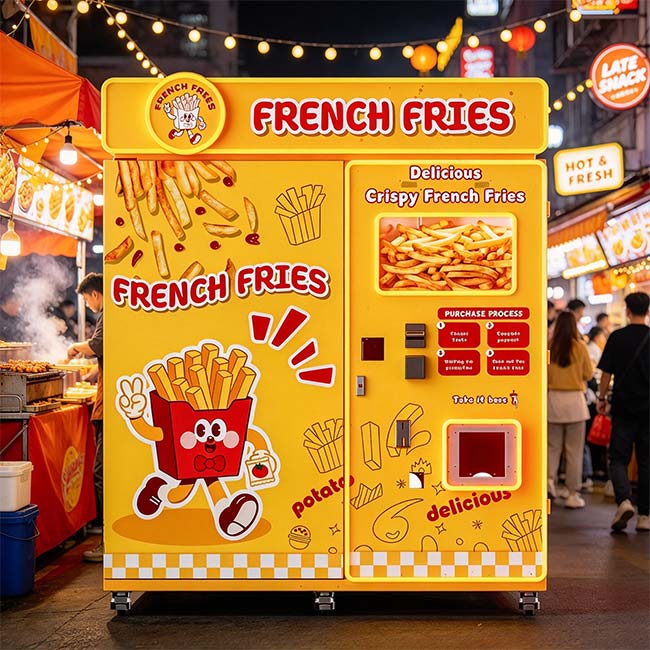
What still needs a person is loading frozen product, topping up boxes and sauce packs, changing oil, and cleaning. If you already run a route, this slots into it. If you do not, budget the driving time, because a machine that sat empty for two days sells nothing, and the low stock alert only helps if somebody reads it. The same logic applies across formats, and our notes on what unattended operation looks like in the USA go into it in more detail.
Permits and placement rules in the USA
Vending rules here sit with state and county health departments, and a french fry vending machine that cooks on site is treated differently from a machine that drops a packaged bar. Expect questions about where frozen product is held, how the fry tanks get cleaned, how often the oil is changed and who answers a customer complaint. Get the answers in writing before installation, not after.
The detail varies by state. Two worked examples: whether Texas requires a permit for vending machines and what a New Jersey permit involves. Neither transfers directly to your county, but both show which paperwork comes first and who to ask.
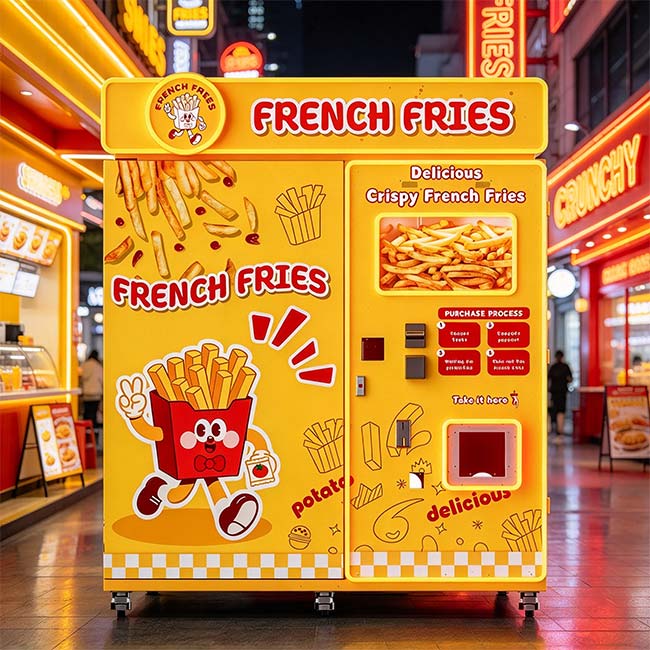
Location owners ask different questions: how much power, how much smell, who cleans up. Our guide to finding and securing vending machine locations covers that conversation step by step.
Where hot fries sell, and where they sit
Late hours and captive crowds sell fries. Cinemas, bowling alleys, arenas, university buildings with all night study space, factories at shift change, truck stops and bars whose kitchen closes early all fit. A french fry vending machine also rides along with whatever a counter already sells, which is why operators often place one beside a drink or dessert unit instead of on its own.
The weak spots are predictable. Lobbies that empty at 6 p.m., sites with only a couple of hundred people passing per day, and buildings where the nearest adequate power is on the other side of the floor. Capacity of 173 servings between restocks only helps if the site can move that volume while the frozen product is still at its best.
If you have not settled on fries, we ran the same comparison across eight vending machine categories, and the honest finding was that the site decides more than the category does.
Factory direct or through a reseller
Wider Matrix builds the WM888 and ships it with global voltage support, 85+ interface languages with free customization, and over the air software updates. Buying direct is what gets the voltage, menu and cabinet branding set for your market before the machine leaves the floor, and it means spare parts come from the same stock the machine was built from.
A local distributor earns the markup when you want someone to commission the unit, deal with the health department alongside you, and turn up with a van when a component fails. Ask both channels for the parts lead time in writing. If you are still shortlisting, our notes on how to check a vending machine manufacturer in China list the questions that separate a factory from a trading company.
Hot food vending is wider than fries, and much of the same engineering shows up in pizza and other heated formats. For the broader picture, start with the rise of automated hot meals.
Questions to ask before you commit
- What amperage is actually available at the spot, and who pays if the panel needs upgrading?
- How many servings a day do you honestly expect, and does that cover rent or revenue share with margin left over?
- Who changes the oil every 150 to 200 uses, and where does the used oil go?
- Is there a plan for power loss, and does the machine alarm you if storage temperature drifts?
- How long does a spare part take to arrive, and is it stocked in the USA or shipped from the factory?
- Will the site put cleaning responsibilities and access hours in the agreement?
Frequently asked questions
How much does a french fry vending machine cost in the USA?
The WM888 lists at US$9,800 for one unit, and the price quoted on inquiry can be better depending on quantity and current promotions. Landed cost also carries freight for a 650 kg cabinet, import duty, local taxes and any customization. Compare suppliers on the landed figure, not the machine figure.
Can a french fry vending machine run with no staff on site?
Frying, packing and sauce dispensing are fully automatic, and the backend watches stock, sales and machine status with alarms for faults. A person is still needed for restocking frozen product and boxes, oil changes about every 150 to 200 uses, and cleaning. Treat it as a route stop rather than a staffed counter.
How many servings does it hold before someone has to refill it?
The WM888 carries 173 servings with 160 paper boxes and five sauce flavors at 200 packs each. Frozen product sits at -3°C, adjustable to 20°C. Busy sites will restock more often than raw capacity suggests, since orders arrive in bursts around events and shift changes.
What power supply does it need?
220V or 380V at 50Hz or 60Hz, with maximum draw of 11,500W. That exceeds what a standard US wall circuit carries, so plan a dedicated line and have an electrician confirm the panel. The cabinet also weighs 650 kg and measures 193 by 110 by 240 cm, so check floor loading and doorway widths before ordering.
Do I need a permit to run a hot food vending machine in the USA?
In most places yes, and hot food draws more scrutiny than packaged snacks because the machine cooks on site. State and county health departments set the rules, covering frozen storage, cleaning, oil handling and who answers complaints. Start with your county health department, then confirm with the location owner.
How often does the frying oil need changing?
Roughly every 150 to 200 uses in normal operation, and sooner if the machine runs hot all day. The WM888 takes shortening, soybean, corn or peanut oil. Keep shortening at or below 200°C and soybean oil at or below 230°C so the oil lasts closer to that interval.
What can it cook besides fries?
Anything deep fryable inside its temperature range: chicken wings, nuggets, popcorn chicken, onion rings, flavored hash browns and squid rings, alongside thin cut, thick cut and crinkle cut fries. Each item gets its own temperature setting, and the cycle fries, re-fries and drains before the box is filled.
Is a fry machine a better bet than a snack or dessert machine?
It depends on the site rather than the category. A fry machine needs more power, some ventilation and more frequent servicing, and it sells at hours when a staffed kiosk is closed. Compare the requirements side by side, then match them to what your location can actually provide.
Talk to Wider Matrix about your site
Send us three things and we can give you a straight answer: photos of the spot with a tape measure in frame, the voltage available at the panel, and a rough count of how many people walk past per day. We will tell you whether the WM888 fits that site, what the landed cost looks like for your state, and what changes if you want your own branding on the cabinet.
If you are planning more than one unit, say so in the first message. Pricing is tiered at 2 to 5, 6 to 10 and above 10 units, and the quote shifts with shipping terms and destination.
A french fry vending machine is not the right answer for every floor plan, and we will say so when the power or the foot traffic does not support one. Where it does fit, the machine covers the hours you would otherwise pay a night crew for.