



A plain walkthrough of what a fully automatic ice cream machine does in daily use, the three Wider Matrix models and their real dimensions, flavor and topping options, cup and spoon costs, placement ideas, cleaning, stocking, and the after-sales support you get from a factory. Includes a FAQ on price, unattended operation, size, flavors, power, payment, and restocking.
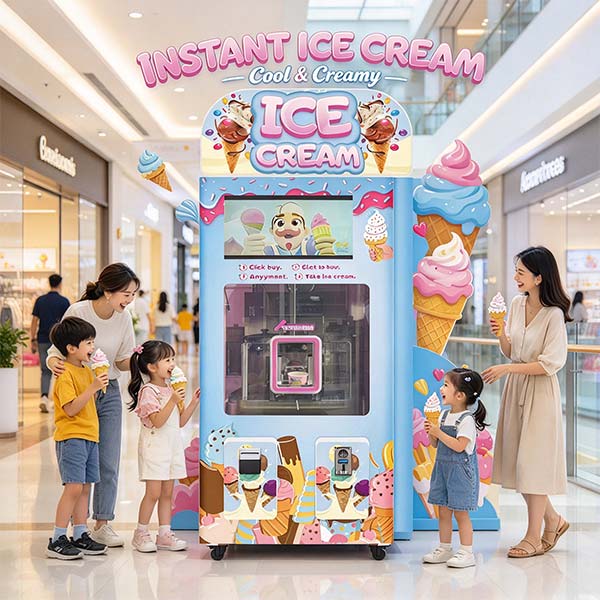
What a fully automatic ice cream machine looks like on a normal day
You walk past a machine in a mall and a kid is tapping the screen, picking a flavor, and fifteen seconds later a cup of soft ice cream drops into the tray. Nobody stood behind a counter. Nobody rang up a sale. That is the whole point of a fully automatic ice cream machine, and it is also where most of the useful questions start.
The phrase gets used loosely, so it helps to say what it means here. A fully automatic ice cream machine mixes, freezes, portions, and dispenses the product on its own. The customer pays through the screen, the machine drops a cup, fills it, and adds the selected toppings without a person loading each order. You stock it, you clean it, and you refill it, but you do not stand there serving.
This changes the math for a lot of small businesses. A dessert counter that needed two shifts of staff becomes a cabinet against the wall that earns during hours a person would never want to work. The trade is that the machine has to be reliable, easy to clean, and simple enough that a non-technical operator can keep it running. Those are the things worth checking before you buy, not the brochure adjectives.
Most people first meet one of these machines as a customer and only later think about owning one. The experience from the outside is simple, which is the point. The experience from the inside, as the operator, is mostly about routines: when you refill, how you clean, and what you do when a cup jams at the worst time. The view from the operator’s chair is the useful one, because the outside view already sells itself.
What to check before you buy a fully automatic ice cream machine
The cabinet looks simple in a video and the pitch is simple too. The work is in the questions you ask before the money leaves your account, because the right machine for a mall is the wrong machine for a lobby, and the spec sheet does not tell you that on its own. Spend an hour on these checks and you avoid the mistake that costs the most, which is buying the wrong size and living with it.
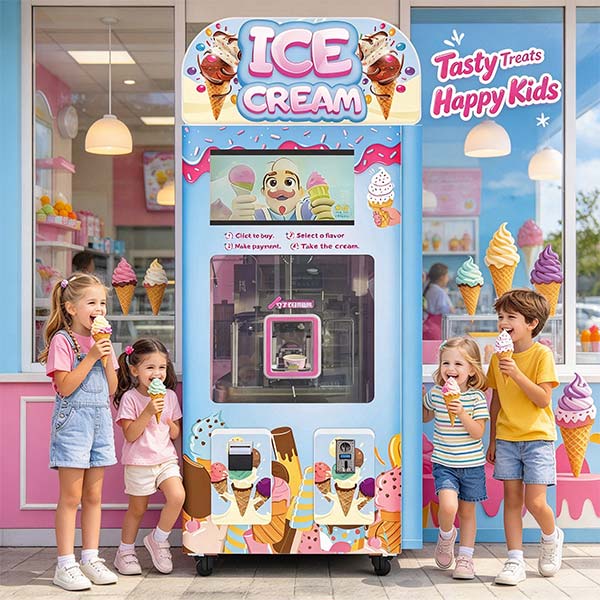
First, count your real traffic, not your hopeful traffic. A location that sees two hundred people on a good Saturday is not the same as one that sees two hundred every afternoon. The WM550 with its 300 cup batch suits the steady busy spot. The small model with its 90 cup fill suits the place that sells in drips. Match the batch to the day and you stop throwing out dairy at close.
Second, walk the delivery path with a tape measure. The WM550 is 227 cm long and 640 kg, and it will not bend around a corner it does not fit. Measure the door, the turn, and the floor rating. A cabinet stuck in a loading bay because nobody checked the doorway is a problem you could have solved with a measuring tape and ten minutes.
Third, ask the supplier which parts wear out and whether they stock them. A fully automatic ice cream machine has moving pieces that touch food, and those seals and dispensers are the items that fail first. If the answer is a shrug or a long lead time, that tells you more than any photo. Wider Matrix builds the WM550 line on shared parts, so the wear items are the same across units and the factory can name them by model.
Fourth, confirm the payment set matches your market. Coin and banknote matter where cash still rules. Card and NFC matter where they do not. The machine here takes all four, so that box is ticked, but check it anyway because a machine that cannot take the local money is a sculpture.
Fifth, price the cups before you price the machine. The cabinet is a one time cost. The cups are forever. At US$0.08 to US$0.12 each, the cup cost looks tiny until you multiply by the cups you expect to sell in a year. That yearly number is the one that decides whether the spot works, and it is the one most buyers skip.
Finally, ask who answers at 9pm on a Saturday. A machine that earns while you sleep will, at some point, stop at 9pm on a Saturday. The company that built it can open the unit and name the failed part. The company that resells it relays your email and hopes. Write down which one you are talking to before you pay.
How a sale happens at the machine
The customer experience is short and that is the design goal. Someone walks up, the 21.5 inch portrait touch screen shows the flavor and topping choices, they tap what they want, and they pay. The machine releases a cup, dispenses the soft ice cream, and adds the selected fruit sauce and small toppings. The whole cycle takes about 15 seconds from tap to finished cup.
Payment goes through coin, banknote, credit card, or NFC, so the machine works in a subway station and in a tourist mall without you swapping hardware. The same screen carries an advertising display, which means the front of the cabinet does double duty as a small billboard for your other offers or the machine itself.
From the operator side, a sale is just a restock event you handle later. You are not timing staff to peak hours. You check the hopper, the cup stack, and the topping bins on a schedule you set, not one the crowd sets for you. A busy Saturday afternoon turns into a fuller bin on Sunday morning, not a tired teenager at closing time.
People sometimes worry the screen will confuse older customers or kids. In practice the flow is tap flavor, tap topping, tap pay, which most five year olds manages faster than the adult behind them. The interface is built for speed at a kiosk, not for reading, so short labels beat long descriptions.
The three machines Wider Matrix builds
Wider Matrix makes the WM550, the WM550+, and a smaller counter style unit. They share the same idea, a self-serve cabinet that runs without staff, but they differ in footprint, flavor count, and price. The numbers below come straight from the build specs, not rounded marketing figures.
| Model | Dimensions (L x W x H) | Weight | Flavors and combos | Price (single unit) |
|---|---|---|---|---|
| WM550 | 227 x 93 x 95 cm | 640 kg | 1 flavor, 9 combinations | US$5,799 |
| WM550+ | 227 x 93 x 95 cm | 640 kg | 2 flavors plus 1 mix, 27 combinations | US$6,799 |
| Small model | 81 x 126 x 180 cm | about 240 kg | 1 milk base, 6 combinations | US$4,400 (1 to 4 units) |
The WM550 is the single flavor workhorse. One ice cream base, three fruit sauces, and three small toppings give you nine finished combinations. The WM550+ keeps the same body but adds a second base and a mix flavor, which lifts the combination count to 27. If your location draws repeat customers, that extra variety is what keeps them from getting bored after the third visit.
The small model is the one to look at when floor space is tight. At 81 x 126 x 180 cm it is narrower and taller than the WM550, which matters in a corner slot where you have wall height but not much width. It holds up to 90 cups per fill and serves a 100g cup, so it suits a lower traffic spot better than a busy food court.
The price step between the three is not just about size. The WM550+ costs US$1,000 more than the WM550 because of the second base and the mix system, not because the cabinet grew. If you run a place where people come back weekly, that thousand buys variety that pays back in repeat visits. If your spot sees mostly one time tourists, the single flavor WM550 or the small model may be the smarter spend.
You can see the full product page for the Automatic Ice Cream Vending Machine and the dedicated Ice Cream Vending Machine WM550 listing if you want photos and the current options.
Flavors and toppings without a kitchen
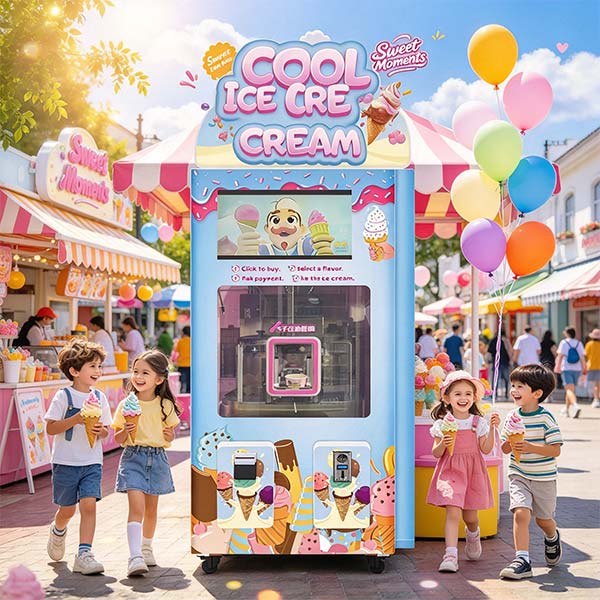
People expect choice from an ice cream stop, and the machines deliver it through a fixed set of bases, sauces, and toppings rather than a made-to-order kitchen. The WM550+ gives two ice cream bases and a mix base, three fruit sauces, and three small toppings. The customer builds the cup they want from those, which is enough variety to feel personal without you managing a freezer full of loose ingredients.
The small model runs one milk base with three fruit sauces and two small toppings, six combinations total. That is a smaller menu, but in a low footfall location six options is plenty and it keeps your refill list short. You are not throwing out half used sauce bottles at the end of the week.
The combination counts are worth knowing because they shape repeat visits. Nine combinations covers a family entertainment center. Twenty seven covers a mall where the same faces come back weekly. Six covers a lobby or a small cafe where the machine is a bonus, not the main draw. Pick the count that matches how often the same person sees your machine, not the biggest number on the sheet.
The mix flavor on the WM550+ deserves a word because it is the feature people underestimate. A swirl of two bases in one cup reads as a premium item even though it costs you nothing extra to offer. Customers treat it like a custom order, which is the feeling you want without the labor of a real custom order.
Where these machines earn their spot
Placement decides most of the outcome, more than the color of the cabinet. The machines fit anywhere with a flat floor, a 220V outlet, and steady foot traffic. The usual winners are malls and shopping centers, arcades and family entertainment centers, cinema lobbies, university campuses, and gas stations with a convenience store attached.
A fully automatic ice cream machine also works in places a staffed kiosk would never pay for. A bowling alley open until midnight. A gym lobby on a hot Saturday. A tourist stop with seasonal crowds where hiring summer staff is a headache. Because the machine runs unattended, the location just needs to be secure and visible, not staffed.
One note from operators: keep it near where people already wait or gather. Next to a seating area, by the exit, or along the main walk path beats a dead corner even if the corner is cheaper to place. The screen pulls attention, but only if someone is there to see it. A machine tucked behind a pillar sells to the pillar.
Think about the weather pattern of your spot too. Ice cream is a warm day impulse, so an outdoor festival location lives and dies by the forecast, while an indoor mall gives you a steadier base. If you can move the cabinet between seasons, the small model at about 240 kg is the one you can reposition between seasons without a forklift crew.
Security is the part nobody mentions in the happy stories. A machine full of cash takes coins and notes, so the spot needs to be watched or camera covered overnight. Most operators put it inside a staffed building for exactly this reason, which also solves the weather problem for free.
Running one day to day
Daily work is restock and clean, not serve. You check the cup stack, the sauce levels, and the topping bins, then wipe the dispensing area and the tray. The 28L output on the WM550 covers up to 300 cups per batch, so on a normal day you are refilling hoppers, not babysitting the freeze cycle.
Cleaning is the task people underestimate. Soft ice cream leaves residue that hardens if you ignore it, so a short end of day wipe and a deeper weekly pull apart of the dispensing parts keeps the cup tasting right. The bins are simple to reach, which matters more than it sounds when you are doing this at close.
The machine draws 3000W on 220V power, at both 50Hz and 60Hz, so it works on the grid in most countries without a transformer. At 640 kg the WM550 is not something you slide around alone, so plan the spot before delivery rather than after.
A simple routine beats a perfect one. Most operators who keep a machine for years do the same short checklist every night: wipe the tray, check the three sauce levels, confirm the cup stack, and glance at the screen for any error. Fifteen minutes. The machines that fail are usually the ones nobody looked at for a week.
The error messages on the screen are your friend here. They tell you a cup is low or a bin is empty before a customer finds out. Train whoever opens the location to read them, and you avoid the bad review that starts with “it was broken.”
Keeping it clean and safe to eat
Food safety is the worry every first time buyer raises, and it is the right worry. The machine handles a dairy product, so the parts that touch it need a real clean, not a wipe. The daily pass handles the tray and the visible dispensing mouth. The weekly pass pulls the parts that touch product so you can wash them properly.
The 28L output means a lot of product moves through the system on a busy day, and warm weather makes residue set faster. In summer, some operators add a midweek deep clean on top of the weekend one. The parts are designed to come apart without tools, which is the difference between a clean machine and one that just looks clean.
Keep the cup and topping area closed to pests. The cabinet is sealed during operation, but the moment you open a bin to refill, you are the one keeping it tidy. A lid left off a sauce bin for an hour is an invitation, and the fix is boring: close it, every time.
None of this is harder than running a coffee machine or a slushie unit. The difference is that a vending cabinet sits where you are not standing, so the discipline has to be a checklist, not a habit you form by being there. Write it down for the person who covers for you.
What the cups and spoons cost
The machine price is the headline, but the cups and spoons are the repeat cost, and they are cheap enough to matter. Standard cups run US$0.12 each at 10,000 pieces and drop to US$0.10 each at 40,000 pieces. The small model uses a cup with a built in spoon at US$0.10 each for 1,000 to 4,999 pieces and US$0.08 each at 5,000 pieces and up.
| Item | Quantity | Cost per piece |
|---|---|---|
| Standard cup | 10,000 pcs | US$0.12 |
| Standard cup | 40,000 pcs | US$0.10 |
| Small cup with spoon | 1,000 to 4,999 pcs | US$0.10 |
| Small cup with spoon | 5,000+ pcs | US$0.08 |
| Spoon | 10,000 pcs | US$0.03 |
The standard cup ships 1,026 to a box in seven layer packaging, and spoons ship 3,000 to a box. The small cup measures 8.5 cm across the top, 7 cm at the bottom, and 5.2 cm tall, which is the size that fits the small machine’s dispenser. Buying at the higher tier cuts your per cup cost, so if you run more than one machine the volume order pays for itself quickly.
None of this includes the sauce and topping materials, which you source locally. That is usually the smart move anyway, because local fruit sauce is fresher and you are not shipping weight across a border. The cup and spoon are the only consumables you typically import, and they are light and stack flat.
Stock the cups based on your worst week, not your average one. Running out of cups on a hot Saturday costs more than the shelf space a spare box takes. At 1,026 cups per box, one box covers a busy location for a while, and two boxes cover a busy month.
Pricing the cup without guessing the market
The machine cost is fixed and the cup cost is known, from US$0.08 to US$0.12 each plus your local sauce. The one number you set is the retail price, and that belongs to your location, not the factory. A fully automatic ice cream machine in a city mall can carry a different tag than the same cabinet in a small town arcade, because the customer and the rent are different.
Look at what a scoop costs nearby. A staffed parlor, a fast food soft serve, a convenience frozen treat, those are your real competition, not another cabinet across the country. Price within that band and the machine sells on convenience, the fifteen second cup and the lack of a queue, rather than on being the cheapest thing on the floor.
Keep the material cost in view so the margin is real. At US$0.10 a cup and a local sauce that costs you a few cents, you know your floor before you set the tag. A fully automatic ice cream machine that sells a few hundred cups a week at a sensible margin covers its own restock many times over, which is the part that makes the location work.
Do not chase the lowest price to win a race nobody entered. The cabinet already saves the labor a parlor pays, so you do not need to undercut to earn. Set a fair price for the spot, watch the screen for the sell rate, and nudge by a coin if the queue slows. The number is on the display, not in a guess.
Avoid the trap of a high price justified by a premium machine. The customer sees a cup, not the invoice. A fully automatic ice cream machine earns on steady volume at a fair tag, not on a few proud sales at a proud price. Match the tag to the footfall and the treat, and the batch size takes care of the rest.
Stocking the machine without tying up cash
It is tempting to order the biggest cup tier on day one to get the lowest price. The catch is cash sitting in a storeroom. A new location has no track record, so order enough to cover a few busy weeks and let the sales tell you the real rate before you commit to 40,000 cups.
The small cup with the built in spoon is the easier first buy because the 1,000 to 4,999 tier already lands at US$0.10 each, close to the bottom price. You are not punished for starting small, which lowers the risk of the first order. Move to the 5,000 plus tier once you know the machine clears a few hundred cups a week.
Sauce and toppings are the items to watch for waste, not the cups. A sauce bottle opened and half used at the end of a slow week is money in the bin. Match the number of loaded sauces to your real sales, not the maximum the machine allows. Three sauces that sell beat five sauces that mostly sit.
Using the screen as a small billboard
The 21.5 inch screen does two jobs. It takes the order, and it shows ads. The advertising display sits on the same face your customer is already looking at, so a short promo for your other machines or a nearby offer gets seen without a separate sign.
Operators with more than one product type use the screen to cross sell. A cotton candy machine two aisles over, or a popcorn unit by the exit, gets a slot on the ice cream screen. The customer waiting for their cup reads it for a few seconds, which is free attention you would otherwise pay for with a poster.
Keep the ad content short and local. A price, a direction, and a picture beats a paragraph. The screen is a glance, not a brochure, and the people in front of it are about to eat ice cream, not read.
Seasonal swings and how to plan for them
Ice cream is a warm weather impulse, and that fact shapes the whole year even for an indoor machine. A fully automatic ice cream machine in a climate controlled mall sells steadier than one at an open air event, but both feel the heat. The operators who do well plan the slow months instead of being surprised by them.
In the hot months, footfall and cup count both rise, so your job is supply. More cups on site, more sauce loaded, and a tighter restock loop so the machine never hits empty on the day it sells most. The 300 cup batch on the WM550 earns its keep in July, when a smaller unit would have you refilling twice a shift.
In the cool months, the impulse fades and the machine becomes a steady background earner rather than a star. This is the time to deep clean without rush, check the wear parts, and test any new flavor or topping you plan to push when the weather turns. A slow February is a free maintenance window if you treat it like one.
For seasonal locations, the small model at about 240 kg is the one you can relocate. A beach town or a festival circuit that runs hard in summer and shuts in winter can store the cabinet off season and bring it back without a crew. The 640 kg WM550 is a more permanent fixture, better for a year round indoor spot than a location that packs up each winter.
The mistake is staffing or stocking for the peak all year. Buying 40,000 cups because summer needed them, then watching half sit through a quiet autumn, ties up cash you could use elsewhere. Order to the season, watch the rate, and let the sales tell you when to step up.
How it compares with a staffed kiosk
A staffed soft serve counter gives you a person who upsells and cleans as they go. It also gives you wages, scheduling, and the problem of no coverage when someone calls in sick. A fully automatic ice cream machine trades that human touch for coverage you do not have to staff.
The honest gap is the custom order. A person can free pour a weird combination a kid dreams up. The machine offers the set menu it was loaded with. For most vending spots that is fine, because the customer is buying speed and a treat, not a conversation. If your location lives on custom builds, a kiosk may still win.
The other comparison people ask about is a plain soft serve machine versus a vending cabinet. A soft serve machine still needs someone to pull the lever and take payment. The cabinet does both. That is the whole reason the word automatic belongs in the name.
There is also the rent angle. A staffed kiosk needs a person sized footprint plus a break area and storage the staff uses. A cabinet needs a corner. In a tight mall lease, that square meter difference is real money every month, and the machine earns from the same corner a plant would have occupied.
The small model up close
The small machine is easy to overlook because the WM550 gets the headline, but for the right spot it is the better buy. At 81 x 126 x 180 cm and about 240 kg, it fits a corner a wider cabinet would never reach, and its six combination menu is enough for a place where the machine is a bonus rather than the main event.
The 100g cup is the detail that defines it. A smaller serving suits a lobby, a cafe counter, or a waiting area where someone wants a treat, not a full dessert. The 90 cup maximum per fill means you are not hauling huge hoppers for a location that sells in drips, and the built in spoon cup means one less item to stock and load.
The price is the part that pulls first time buyers in. At US$4,400 each for one to four units, it is the lowest entry to a real automated ice cream cabinet, and the 1,000 to 4,999 cup tier already lands at US$0.10 each, close to the bottom cup price. You are not punished for starting small, which lowers the risk of the first order while you learn your location.
The trade is capacity and variety. Ninety cups and six combinations will not carry a busy food court on a hot day. If your spot grows into that traffic, the WM550 or WM550+ is the step up, and the small model moves to a second, quieter location. Think of it as the starter cabinet that proves the spot before you spend on the big one.
Picking the right size for your space
Start with the floor, not the feature list. The WM550 and WM550+ are 227 cm long, 93 cm wide, and 95 cm tall, a low wide cabinet that sits against a wall or in an open aisle. The small model is 81 cm wide but 180 cm tall, so it needs ceiling clearance and a stable base but barely any floor width.
If you have a wide wall in a food court, the WM550 gives you 300 cups per batch and the bigger flavor range. If you have a narrow slot by a door or inside a store, the small model at about 240 kg is easier to position and still serves a real menu of six combinations. Match the cup capacity to your traffic: 90 cups fills a quiet spot for a day, 300 cups covers a busy one.
Weight is the part first time buyers miss. At 640 kg the WM550 needs a solid floor, not a raised stage or a weak tile. Check the spot before you commit, because moving it twice costs more than measuring once. The small model at about 240 kg is friendlier, but still not a one person lift.
Door width is the quiet killer of delivery day. Measure the path from the truck to the spot, including any steps and the doorframe, before you order. A 227 cm cabinet turns sideways but does not shrink, and a tight turn at the wrong corner turns delivery into a problem you could have seen on a floor plan.
Why the fifteen second cup protects your queue
The speed of the dispense is not a spec line, it is the thing that keeps a line from becoming a reason to leave. A fully automatic ice cream machine that fills a cup in fifteen seconds can clear a small crowd without backing into the walkway, and a crowd that moves is a crowd that buys. The same cabinet at twice the time turns a rush into a jam.
Most vending spots live or die on the bad minute, the one Saturday when everyone wants a treat at once. At fifteen seconds a cup, thirty people clear in about eight minutes with no panic. At a slower pace that same thirty becomes a wall people walk around. The seconds are the difference between a busy hour and a lost one.
The cup drop and the fill are automatic, so the speed is the machine’s, not the operator’s mood. A staffed counter speeds up or slows down with the person holding the lever. The cabinet does not have an off day, which is why the time holds when it matters most. That steadiness is the quiet reason operators pick a fully automatic ice cream machine over a soft serve unit they would have to staff.
Pair the speed with the right batch size and the rush stops being scary. The WM550 holds up to 300 cups per batch, so a hot afternoon does not stall on an empty hopper while a line forms. The small model’s 90 cup fill suits the quieter spot where a rush is a few people, not a few dozen. Match the batch to the crowd and the fifteen seconds do the rest.
Payment, power, and the details people forget
The payment stack covers coin, banknote, credit card, and NFC, which means the machine takes cash in markets that still run on it and cards where they do not. You do not pick one at purchase and lose the others. The 21.5 inch portrait screen handles the order and the ad display, so the face of the cabinet is working even when no one is buying.
Power is 220V at 50Hz or 60Hz, drawing 3000W while running. That is a standard commercial outlet in most places, not a special install. Plan a dedicated line so the freeze cycle does not fight a coffee machine on the same circuit, and you are set.
Cup time stays at 15 seconds across the models, which is the number that matters at peak. A line moves when each cup is fast, and fifteen seconds keeps a small crowd from backing up into the walkway. A slower machine turns a queue into a reason to walk away.
Cash handling is the detail that bites operators who forget it. Coins and notes collect in the machine, so someone has to empty the vault and reconcile it. Build that into the routine the same as restocking, or the money sits there uninsured and uncounted.
Receiving delivery and getting it level
The cabinet arrives as a single unit, not a flat pack, so the delivery is about placement, not assembly. The crew needs a path, a floor that holds the weight, and a person who knows exactly where it goes. Having that decided ahead of time turns a two hour drop into a ten minute one.
Level matters more than people expect. A cabinet that tips even slightly can misalign the cup drop or the dispenser, and then cups land wrong or the fill looks off. Set it on a flat, solid base and check it before you load the first hopper. The fix after a week of wrong cups is annoying and avoidable.
Give the machine a short run before you open it to customers. Load cups, load one sauce, run a few test cups, and watch the screen for errors. A dry run catches a blocked dispenser or a wrong setting while the only customer is you, not a kid with a parent and a phone camera.
Training the person who opens the location
The machine runs itself, but the human who unlocks the door each morning is the one who keeps it honest. Whoever opens needs three skills and none of them take long to learn. Read the screen, refill the bins, and empty the cash. That is the whole daily list.
Reading the screen is the skill people skip. The display shows errors before a customer sees them, a low cup stack or an empty sauce bin, and the opener who checks it at start of day prevents the bad review that starts with “it was broken.” Five minutes with the screen each morning beats an angry message at noon.
Refilling is muscle memory once shown. Cups load from the stack, sauces pour into their bins, toppings top up, and the tray gets a wipe. Show the opener the order once and they will do it the same way after, which is the point. A cabinet cleaned by habit stays clean. A cabinet cleaned by memory of a training video from last year does not.
The cash step is the one operators forget because it feels like the machine’s job. Coins and notes collect in the vault, and someone has to take them out and record them. Put it on the open or close list, whichever fits your routine, and the money stops being a mystery at the end of the month.
Write the routine down. A fully automatic ice cream machine sits where you are not, so the discipline has to live on paper or a phone note, not in your head. The locations that keep a machine for years all have the same unglamorous thing: a checklist the staff follows.
Mistakes first time operators make
The first mistake is buying the biggest model for a small spot. A 300 cup batch machine in a lobby that sells thirty cups a day means most of the product sits, and dairy that sits is product you throw out. Match capacity to real traffic and grow into a bigger unit later.
The second is skipping the nightly wipe. It takes minutes and prevents the one problem customers notice first, a dirty tray. The machines that earn for years are the ones someone looks at, not the ones left to run on hope.
The third is treating the sauce load like the maximum load. Five sauces look impressive on paper and sit in bins by week two. Load what sells, watch what does not, and trim. A short menu that moves beats a long one that ages.
The fourth is forgetting the cash. A machine that takes notes is a safe you fill every day and ignore. Empty it on a schedule and record it, or the leftover becomes a mystery nobody wants to own.
What a normal week with a fully automatic ice cream machine looks like
The brochures show the machine shining in a mall. The real week is quieter and more routine, and that routine is the product. Monday you open, glance at the screen, and confirm the cups and sauces made it through the weekend. Tuesday a school group hits the location and you top up midday, something you would never do for a staffed counter because the staff is the staff. Wednesday is calm, so you run the deeper clean and check the wear parts.
Thursday the screen flags a low sauce bin before anyone complains, and you refill it on the way past. Friday the footfall picks up and you load an extra box of cups because Saturday is the day that sells. Saturday proves you right, the machine clears a busy afternoon at fifteen seconds a cup, and you empty the cash vault that night. Sunday you restock and wipe, and the week starts again.
None of this needs a specialist. The opener who learns the screen, the bins, and the vault runs the whole week. A fully automatic ice cream machine turns a food business into a restock loop, and the loop is short. The operators who keep one for years are not ice cream experts. They are people who follow a boring list without fail.
The week also shows where your location sits on the traffic curve. After a month you know which day dips and which day spikes, and you load to the spike instead of the average. That single habit, loading to the real peak, is most of the difference between a cabinet that pays and one that just sits. The data is on the screen every morning if you read it.
The quiet truth is that the machine asks less of you than a staffed counter and more of you than a poster. A poster you forget. A cabinet you check. The check takes minutes, and the minutes are what keep the cups coming and the reviews clean.
Support after you take delivery
Buying the cabinet is the start, not the finish. Wider Matrix ships from the factory and handles setup questions, spare parts, and the usual wear items like dispensing seals and cup mechanisms. Because the build is standardized across the WM550 line, a part that fails on one unit is the same part on the next, which keeps replacements simple.
The point of buying from a maker rather than a reseller is the path to the answer when something breaks. A trader relays your email and waits. A factory can open the unit on the bench and tell you which seal, which bin, and which setting. For a machine that earns while you sleep, that gap shows up the first time it stops at 9pm on a Saturday.
Spare parts are the unglamorous half of ownership. Keep a small kit of the wear items on site, the seals and the cup parts, and a jam at closing becomes a five minute fix instead of a week of waiting. The factory can tell you exactly which kit matches your model, so ask for it with the order.
Matching the model to the location you have
The three models are not a ladder where bigger is better. They are answers to three different spots, and the right pick follows the spot, not the price. A family entertainment center with repeat weekly faces wants the 27 combination WM550+ so regulars do not tire of the menu. A tourist mall with one time visitors is fine on the nine combination WM550, because the crowd rarely returns to notice the shorter list.
A lobby, a small cafe, or a quiet waiting area is the home of the small model. Six combinations and a 90 cup fill cover a place where the machine is a pleasant extra, not the reason people came. Spending WM550 money there buys capacity nobody uses, and capacity that sits is cash on a floor you could have kept.
The footprint decides as much as the menu. A wide wall takes the 227 cm WM550 without a thought. A narrow slot by a door takes the 81 cm small model because width is all you have. Measure before you fall in love with a feature, because the feature cannot change the wall.
Think about growth too. A location that proves itself on the small model can step up to the WM550 and pass the small one to a second, quieter spot. Starting small is not a compromise when the spot is small. It is the match. The operators who struggle are the ones who bought the big cabinet for the tiny corner and fought it for a year.
Why a factory matters more than the logo on the side
There is a stack of companies that will put your name on an ice cream cabinet and ship it from someone else’s warehouse. The price looks close and the photos look the same. The difference shows up in lead time, in whether the spec sheet matches the unit, and in who answers when the dispenser jams on a holiday.
Wider Matrix builds its own vending line, and the ice cream machine shares the same factory floor as its cotton candy machines, popcorn machines, and protein shake machines. That matters because the hard parts of vending, the payment stack, the touch screen, the unattended reliability, are solved once and carried across the range. You are not the first machine they ever shipped.
If you run a mixed floor, that shared lineage is handy. The same screen logic and the same payment hardware mean one person learns the system and runs several product types. You are not training staff on five unrelated boxes. A location that wants cotton candy, popcorn, and ice cream from one supplier gets one support line, not three.
The logo question is real for buyers comparing two seemingly identical cabinets. The cabinet that comes from the factory that built it carries the cost structure of the builder, which is why the price and the support live in the same place. A trader splits those, and the support is the part that goes thin.
Ready to see the WM550 in person
If the numbers above fit your location, the next step is a spec sheet and a quote for the model you want. Tell us the spot, the foot traffic you expect, and whether you need single flavor or the 27 combination WM550+, and we will size the order and the shipping. Reach the team through the Contact Us page and we will send the current pricing tiers for the volume you have in mind.
For a fuller cost picture before you write in, the New Ice Cream Vending Machine Price Guide 2025 walks through machine pricing and cup costs, and the Ice Cream Vending Machine for Sale buyer’s guide covers what to check before you commit to a unit.
Frequently asked questions
How much does a fully automatic ice cream machine cost
The WM550 single flavor unit is US$5,799 for one machine. The WM550+ with 27 combinations is US$6,799 for one unit. The smaller model is US$4,400 each when you order one to four units, with lower tier pricing as the quantity rises. Those are factory prices before shipping and any local taxes.
Can the machine run without any staff
Yes. It dispenses a cup, fills it, and adds toppings on its own after the customer pays on the touch screen, and a full cup takes about 15 seconds. You handle restocking and cleaning on a schedule, but no one needs to stand at the machine during open hours, and it can run around the clock.
How big is the WM550 and will it fit my space
The WM550 measures 227 x 93 x 95 cm and weighs 640 kg, so it needs a solid floor and wall or aisle room about as long as a couch. The small model is 81 x 126 x 180 cm and about 240 kg, which fits a narrow slot with ceiling height. Measure the spot and the door path before delivery.
What flavors and toppings does it offer
The WM550 gives one ice cream base with three fruit sauces and three small toppings for nine combinations. The WM550+ adds a second base and a mix flavor for 27 combinations. The small model uses one milk base with three sauces and two toppings for six combinations. All options come from the loaded set, not a live kitchen.
How many cups can it make and how fast
The WM550 holds 28L of output, up to 300 cups per batch, and each cup takes about 15 seconds to dispense. The small model serves a 100g cup with a maximum of 90 cups per fill. Your refill schedule depends on foot traffic, not the machine speed.
What power and payment does it need
It runs on 220V power at 50Hz or 60Hz and draws 3000W while operating. Payment accepts coin, banknote, credit card, and NFC, so the same unit works in cash heavy and card heavy locations without hardware changes.
How much do cups and spoons cost to restock
Standard cups are US$0.12 each at 10,000 pieces and US$0.10 each at 40,000 pieces. The small cup with a built in spoon is US$0.10 each for 1,000 to 4,999 pieces and US$0.08 each at 5,000 pieces and up. Spoons alone are US$0.03 each at 10,000 pieces. Sauce and topping ingredients are sourced locally.
Does Wider Matrix handle warranty and support
Wider Matrix builds the machines at its own factory and supplies spare parts and setup help after delivery. Because the WM550 line uses shared, standardized parts, replacements are straightforward and the factory can identify the failed component directly rather than relaying through a reseller.