



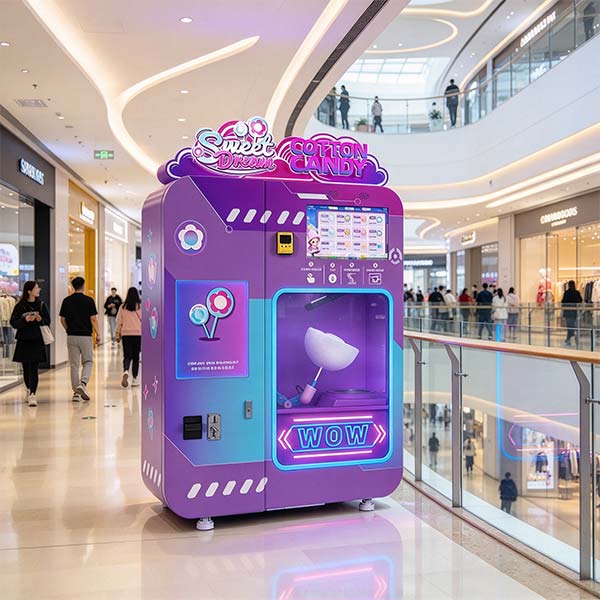
You’ve walked through a mall, a carnival, or an amusement park and seen that glowing machine spinning out bright pink clouds of cotton candy. A line forms every time. You wonder how much it costs, where you can actually buy one, and whether this business makes sense for you.
If you’re asking where can I find a cotton candy vending machine?, the answer is straightforward: you source directly from a manufacturer that builds commercial-grade units designed for high-traffic venues. The best machines combine automated sugar-floss production, contactless payment, remote monitoring, and durability ratings that handle hundreds of servings per day without a staff member on-site.
The Short Answer: Where to Buy a Commercial Cotton Candy Vending Machine
Your most reliable path is to purchase from an established manufacturer that ships internationally and backs each unit with a warranty and ongoing technical support. Companies like Wider Matrix, which has exported over 3,000 machines to 130+ countries since 2016, offer models built specifically for unattended retail environments.
When evaluating suppliers, check for these essentials: CE/UKCA/ETL certification, IoT remote monitoring capability, spare parts included in the package, and a documented installation and training process. A manufacturer that ships complete tool kits and provides multilingual video tutorials cuts your downtime significantly in the first weeks of operation.
What to Look for in a Commercial Cotton Candy Vending Machine
Not every cotton candy machine belongs in a vending application. A countertop unit for a fair booth operates under completely different demands than a 24/7 kiosk in a shopping mall. Here is what separates a machine built for commercial vending from one that is not:
- Fully automated production cycle — The machine mixes sugar, heats, spins, and dispenses without human intervention. A quality unit completes a batch in 60–90 seconds.
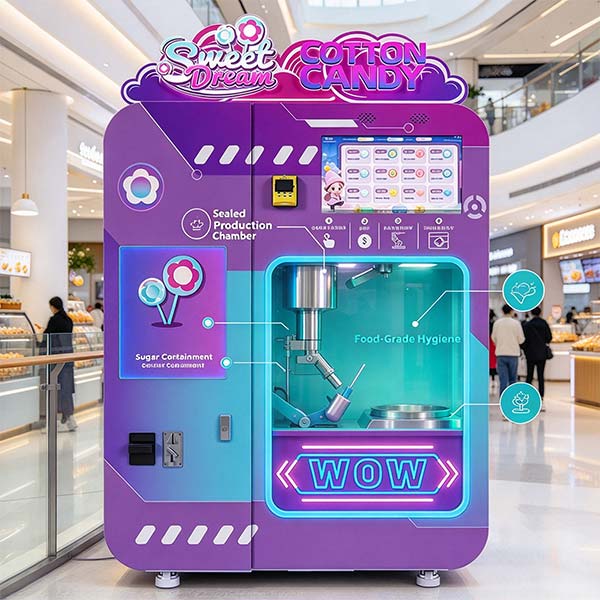
- Sealed production chamber — Sugar is contained inside a closed compartment, meeting food-safety standards and keeping the exterior clean.
- Multi-flavor capacity — At least two flavor chambers let you offer different tastes without manual reloads between each customer.
- Contactless payment integration — NFC, QR code, and card reading are standard on current-generation models.
- Remote monitoring and inventory alerts — The owner receives real-time sales data, low-supply notifications, and fault codes through a cloud dashboard.
- Standard safety certifications — CE, UKCA, RoHS, and where applicable ETL or UL certification signals that the electrical and mechanical systems meet recognized safety requirements.
Top Cotton Candy Vending Machine Models and Pricing (2026)
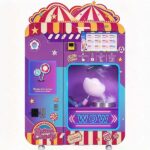
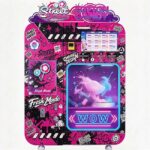
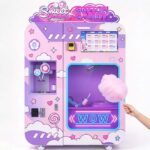
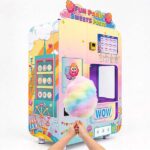
Two models from Wider Matrix dominate the commercial segment right now. The Fully automatic cotton candy vending machine WM980 is the flagship unit, and the Automatic Cotton Candy Vending (Candy House) serves operators who need a compact footprint without sacrificing output.
Below is a side-by-side comparison of the current pricing for both models:
| Feature | WM980 Plus | Candy House (MC Vending) |
|---|---|---|
| Original Price (MSRP) | ||
| Current Price | US$4,999 | US$3,999 |
| Savings | Save $1,701! | Save $1,801! |
| Production time per serving | 60–90 seconds | 60–90 seconds |
| Flavor options | Up to 6 flavors | Up to 4 flavors |
| Payment methods | Card, NFC, QR code, coin | Card, NFC, QR code |
| Remote monitoring | Yes — cloud dashboard | Yes — cloud dashboard |
| Warranty | 1 year + lifetime tech support | 1 year + lifetime tech support |
| Included consumables | 6 × 2 kg sugar packs | 4 × 2 kg sugar packs |
A third option worth considering is the Multi-Flavor Cotton Candy Vending Machine MG301, designed for operators who want rapid flavor switching and a slightly smaller machine envelope for tighter spaces.
ROI Analysis: How Fast Can You Earn Your Money Back
Understanding the return on investment is the step most buyers skip before placing an order. Here is a breakdown based on real operating data from active machines in North American and European markets.
Unit economics per serving
- Granulated sugar cost per serving: approximately $0.30
- Paper cone or wrapper: $0.05
- Flavor syrup or colorant: $0.05
- Total variable cost per serving: ~$0.40
The retail price varies by location. In U.S. malls and amusement venues, a single serving sells for $4.00–$8.00. In European locations, prices typically range from €3.50 to €7.00. Using a conservative average selling price of $5.00 per serving, the gross profit per unit is $4.60, which translates to a 92% gross margin.
Daily sales and monthly revenue
Based on deployment data from existing machines in mid-to-high traffic locations (shopping malls, indoor play centers, movie theaters):
| Metric | Conservative | Typical | High Traffic |
|---|---|---|---|
| Servings per day | 25 | 50 | 100+ |
| Daily revenue (at $5.00/serving) | $125 | $250 | $500+ |
| Monthly revenue (30 days) | $3,750 | $7,500 | $15,000+ |
| Monthly variable costs | $300 | $600 | $1,200 |
| Monthly gross profit | $3,450 | $6,900 | $13,800+ |
Paid-back period by model
| Model | Investment | Conservative ROI | Typical ROI | High-Traffic ROI |
|---|---|---|---|---|
| WM980 Plus | ~2.2 months | ~0.7 months | ~0.4 months | |
| Candy House | ~1.2 months | ~0.6 months | ~0.3 months | |
| MG301 Multi-Flavor | ~1.3 months | ~0.6 months | ~0.3 months |
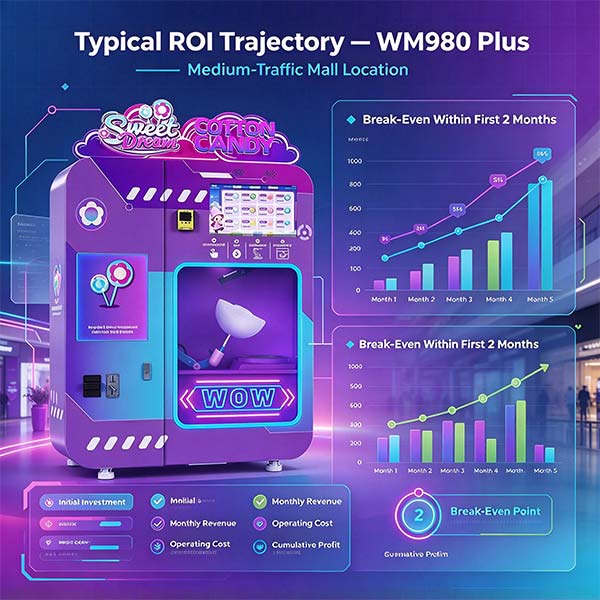
Even under conservative sales estimates, the payback period falls well within the first quarter. Most operators report that the machine has covered its purchase price within the first 4–8 weeks of operation in a properly selected location.
How to Choose the Right Location for Your Machine
The single biggest factor behind profitability is not the machine itself — it is where you put it. A machine in a low-traffic area will underperform regardless of how well-built it is. A machine in the right spot can exceed the revenue estimates above.
High-performing location categories include:
- Shopping malls and retail complexes — Foot traffic is consistent throughout the day, and impulse purchases are common near food courts and entertainment zones.
- Indoor amusement centers and trampoline parks — Families with children are already in a spending mindset, and cotton candy is a natural add-on to the experience.
- Movies theaters and entertainment complexes — Pre-show waiting time creates a low-friction purchasing window.
- Water parks and indoor play areas — Seasonal peaks can be extremely profitable, especially during summer months and school holidays.
- Fairs, festivals, and pop-up events — Mobile-friendly placement lets you test multiple markets before committing to a permanent lease.
If you want a systematic approach to finding and securing locations, this guide to profitable vending machine placement covers the full process — from site scouting to negotiation and lease structuring.
Real Customer Case Studies
Case 1: Mall kiosk in Southern California
A first-time vending operator installed a WM980 Plus near the entrance of a mid-size shopping mall in Orange County. The machine was placed adjacent to a children’s clothing store, creating natural crossover traffic. Within the first 30 days, the unit recorded 1,650 servings at an average ticket of $5.50, generating $9,075 in revenue against $660 in variable costs. The operator paid back the machine cost in under five weeks and continued at roughly $5,000–$7,000 per month in gross profit afterward.
Case 2: Indoor trampoline park in Germany
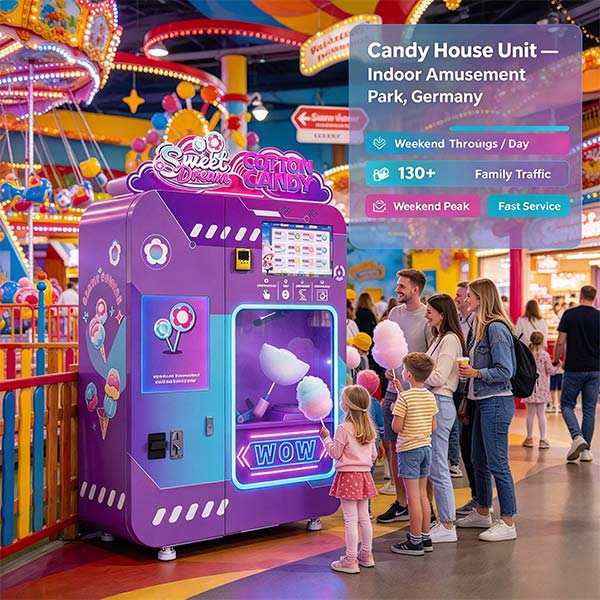
A family-owned indoor play facility added a Candy House unit near the reception desk in late 2024. Weekend traffic averages 400–600 visitors per day during the summer season. The machine averaged 70 servings on weekdays and 130 servings on weekends, producing monthly revenues between €4,200 and €7,800 depending on the month. The operator cited the sealed production chamber and remote monitoring as key factors — they could check inventory levels from their office without walking to the machine.
Wider Matrix: Manufacturer Background and Support
Wider Matrix was founded in 2016 by entrepreneurs with backgrounds in automation and vending hardware. The company designs and manufactures commercial vending solutions and has shipped over 3,000 units to customers across 130 countries, including the United States, Canada, Germany, the UAE, Australia, and Thailand.
All machines carry standard international certifications — CE, UKCA, RoHS, KC, and BRC where applicable. Every order includes a complete tool kit, spare parts pack, and access to step-by-step installation videos on YouTube. Technical support runs on a three-shift schedule around the clock, and non-wear parts damaged under normal operation are shipped air-freight at the manufacturer’s expense during the warranty period.
Operational Considerations Before You Buy
Before placing an order, address these practical questions:
- Power requirements — Confirm the outlet type and voltage at your target location. Most Wider Matrix machines operate on 100–240V AC, 50/60 Hz, but a site visit is still necessary.
- Floor space — The WM980 Plus requires approximately 0.8 m² of floor space. The Candy House is more compact. Verify clearance for door swing and service access.
- Sugar and flavor supply chain — Order consumables in bulk to avoid stockouts. A typical machine uses one 2 kg sugar bag per 400–500 servings.
- Payment processor setup — Most machines support major card terminals and QR-code wallets. Confirm compatibility with payment providers available in your country before deployment.
- Local regulations — Some municipalities require a food-handler permit or a temporary vendor license even for automated machines. Check with your local health department before installation.
Frequently Asked Questions
Where can I find a cotton candy vending machine to buy?
The most reliable source is a direct manufacturer rather than a marketplace reseller. Buying direct gives you warranty coverage, spare parts access, and technical support. Wider Matrix ships internationally from its production facility and includes comprehensive after-sale support with every order.
How much does a commercial cotton candy vending machine cost?
Commercial-grade units range from approximately US$3,999 to US$5,299 depending on the model and configuration. The WM980 Plus is priced at US$6,700 US$4,999 (save $1,701), while the compact Candy House model is US$5,800 US$3,999 (save $1,801).
How profitable is a cotton candy vending machine business?
Gross margins typically range from 88% to 94%, depending on your location and pricing. At an average of 50 servings per day and $5.00 per serving, a single machine can generate roughly $7,500 in monthly revenue with about $600 in variable costs. Most operators recover their initial investment within 1 to 3 months.
Do I need a staff member to operate the machine?
No. These machines are designed for unattended operation. They accept payment, produce the product, and dispense it automatically. The only tasks requiring human presence are refilling sugar and flavor cartridges — which most operators handle once or twice per week depending on traffic volume.
What happens if the machine breaks down?
Wider Matrix provides a 1-year warranty covering manufacturing defects and non-wear part failures. Replacement parts are shipped air-freight at no cost to the buyer during the warranty period. The company also maintains a three-shift engineering support team available 24/7, and all machines come with troubleshooting videos and remote diagnostic capability through the cloud dashboard.
Can I customize the machine with my own brand colors and logo?
Yes. Wider Matrix offers OEM and ODM customization, including custom vinyl wraps, LED panel graphics, and branded touch-screen interfaces. Minimum order quantities may apply for fully custom designs.
Is cotton candy more profitable than popcorn in a vending application?
Cotton candy and popcorn have different cost structures and appeal to different audiences. Cotton candy has a higher per-serving margin (around 92%) but typically lower daily volume than popcorn in some venues. A head-to-head comparison is available in our article on cotton candy vending machine vs popcorn vending machine, which breaks down unit economics for both products.
Summary
If your question is “where can I find a cotton candy vending machine?”, the most efficient route is to work directly with a manufacturer that offers certified, IoT-enabled machines with strong after-sale support. Wider Matrix’s WM980 Plus and Candy House models are priced well below their original MSRP through current promotional offers, and the economics work quickly: at typical traffic levels, the machine pays for itself within the first one to three months of operation. The next decision is not which machine to buy, but where to place it — and that decision alone determines whether your revenue hits the conservative estimate or exceeds it.