



A mall does not buy a machine, it buys a reason for people to stop walking. Cotton candy and popcorn look like close cousins on paper, and they behave very differently once one is standing in a corridor. The cotton candy vending machine is the higher-margin, higher-attention machine, and it fits malls with leisure traffic, children and event weekends. The popcorn vending machine is the volume machine, and it fits cinemas and food courts where people are already moving. The WM980 weighs 300 kg and shapes 36 designs from 28 to 30 grams of sugar per serving; the WM680 pops a 32 oz cup in 120 seconds from a 5.6 kg corn hopper. Send your mall city, the footfall you can estimate, and how many machines you are weighing, and Wider Matrix will come back with the right model, a landed price and a placement plan for your site.
For most shopping malls, the cotton candy vending machine is the better investment. It sells at a higher price per serving than popcorn, it makes a product people stop and photograph, and the gap between what one serving costs to produce and what a customer pays is wider. The popcorn vending machine wins in a narrower set of conditions: a mall with a cinema, a heavy food court trade, and family footfall that keeps moving, where fast service and a low entry price matter more than the profit on any single sale. A machine that starts near US$1,800 is an easier first commitment than one at US$4,800, and in the right corridor it can pay for itself in a few months.
That is the short version. The longer version is that these two machines sit in the same aisle and do completely different jobs. One is an impulse attraction that has to catch a shopper’s eye from twenty metres away. The other is a volume product that lives next to where people are already eating. Choosing between them is less about which machine is technically better and more about which corridor in your mall you can actually get, and what the foot traffic in that corridor is already doing.
This is a question buyers put to Wider Matrix regularly, usually after a landlord has offered two or three spots and left the operator to work out what belongs in each one. The answer below is written from that position: a mall, a real corridor, and a choice between two machines that both run unattended, both take card and phone payments, and both cost money to buy.
What a mall is really buying when it installs either machine
A shopping mall does not need another source of sugar. It already has coffee shops and a food court. What it lacks is a reason for a person to pause in the middle of a corridor, spend two minutes, and leave with something in their hand. That pause is the product. It is also the thing that makes any vending machine worth its floor space, because a paused shopper is a shopper who is still inside the building.
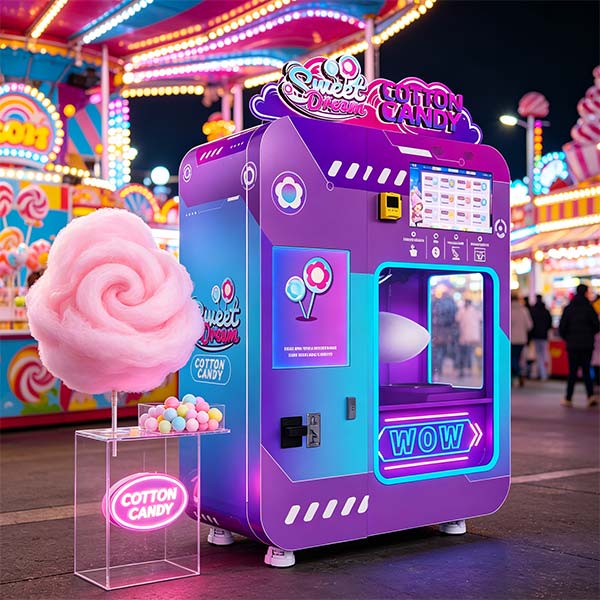
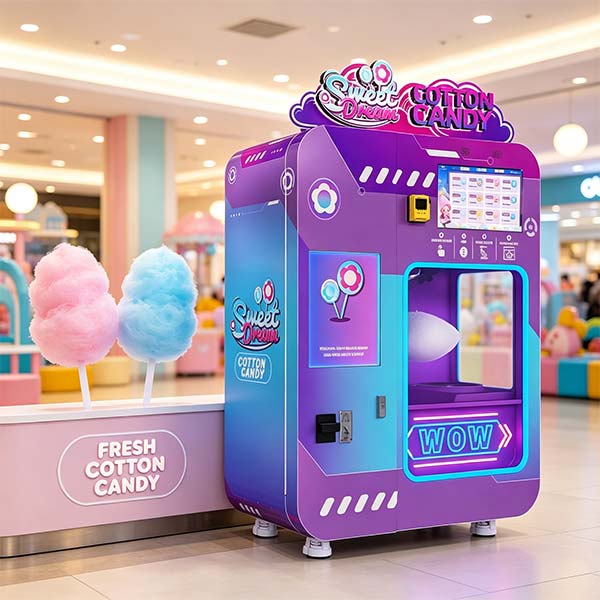
Cotton candy and popcorn create that pause in different ways. Cotton candy is theatre. The customer picks a shape on a touch screen, pays, and watches a robotic arm spin sugar into a flower or a cloud through a glass window. The machine is loud in the way that a sweet shop is loud: it draws a small crowd of children, and children bring adults, and adults are the ones with the card. Popcorn works on the nose instead. A mall running a popcorn machine on the second floor is advertising itself to the ground floor, and the smell does the selling without a screen.
Both machines can run without anyone standing next to them. The cotton candy units Wider Matrix builds for mall work use a cloud management system and a 24 hour unattended mode, so staff are only needed to refill sugar and clear the occasional jam. The popcorn machine runs the same way, with a smart backend that reports sales, machine status and alarms to a phone or a laptop. Neither machine forces a mall to hire anyone, which is the first number a landlord usually asks about. For a fuller look at how cotton candy fits a mall environment, the write-up on an automatic cotton candy vending machine for shopping malls covers the venue in more depth.
Cotton candy and popcorn, side by side
Putting the headline numbers next to each other is the fastest way to see why the same mall can justify either machine depending on the corridor. The figures below come from two current Wider Matrix models, the WM980 for cotton candy and the WM680 for popcorn.
| Item | Cotton candy (WM980) | Popcorn (WM680) |
| Footprint (W x D x H) | 132 x 195 x 67 cm | 570 x 540 x 1930 mm |
| Weight | 300 kg | 70 kg |
| Power | 500W standby, 3000W processing | 3000W, 220V |
| Capacity on board | 4 x 2 kg sugar tanks | 5.6 kg corn, 140 cups |
| Production time | Fully automatic, ends with collection | About 120 seconds per cup |
| Cup or serving | 28 to 30 g of sugar per candy | 40 g per 32 oz cup |
| Design range | 36 shapes, updated by remote software | Flavour range, multi-language screen |
| Payment | Coin, cash, card, NFC | Coin, cash, card, NFC, QR |
| Entry price | US$4,800 for one unit | US$1,800 for one to five units |
Two lines in that table decide most placement decisions. The first is weight. A 300 kg cotton candy machine is not something a mall lets you drop on a mezzanine without a structural check, and moving it later takes a pallet truck and a plan. The 70 kg popcorn machine can be wheeled and repositioned far more easily, which matters in a building where management sometimes moves tenants twice a year. The second is production time. Popcorn turns a cup around in about two minutes, so a queue keeps moving even on a busy Saturday. Cotton candy is slower per unit, and that is not a fault. It is the reason people stand and watch, and watching is what pulls the next customer in.
The full range of cotton candy configurations runs from the standard WM980 cotton candy vending machine up to models with larger tanks and outdoor housing, and the equivalent popcorn detail is covered in the guide to automatic popcorn vending machines. Both matter here because the mall question is really a version of a bigger one: which machine earns more per square metre of a leased corridor.
Scenario 1: the main concourse or atrium of a family mall
A family mall with a central atrium, a soft play area upstairs and a steady weekend crowd is cotton candy territory. These buildings run on dwell time. People arrive, walk a loop, feed the children, walk another loop, and leave. A machine in the middle of that loop has to stop the loop, and nothing stops a child faster than watching sugar turn into a flower behind glass.
The WM980 is built for exactly this. It weighs 300 kg and stands 132 x 195 x 67 cm, so it needs a solid floor and a clear metre of approach space, which most atriums can give. It carries four 2 kg sugar tanks as standard, and those tanks can be upgraded to 3 kg each for an additional US$200, which cuts the number of refill trips a week. Each candy uses 28 to 30 grams of sugar, so a single 2 kg tank holds roughly 65 to 70 servings before it runs dry. Across four tanks, that is a few hundred candies between refills, and the cloud dashboard tells the operator when a tank is low rather than making them guess.
The reason cotton candy outperforms popcorn in this spot is the price a customer will pay. A shaped candy on a stick in an atrium is a treat with a photograph attached, and shoppers treat it as a small entertainment purchase rather than a snack. That tolerance for a higher price is what widens the margin. The production number that supports it is the 36 designs the machine can shape, from flowers and mushrooms to hearts and clouds, all of which update remotely as the catalogue grows. A machine that can produce a different shape each month keeps the atrium crowd interested, and the crowd is what the mall is renting to you.
Scenario 2: the food court and the cinema entrance
The food court and the cinema wing are different buildings inside the same building. People here are already committed to eating. They are moving with a tray or a ticket, they are not browsing, and they want something in their hand fast. Popcorn fits that behaviour better than cotton candy, and the cinema association is only part of the reason.
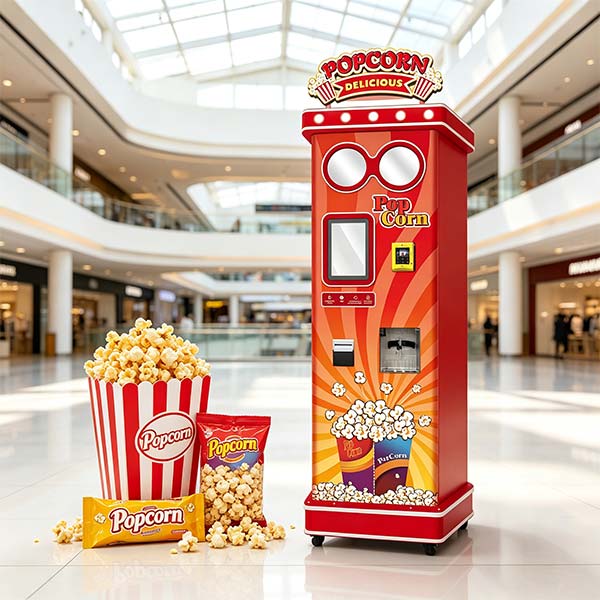
The WM680 popcorn machine is a 70 kg cabinet that stands 570 x 540 x 1930 mm and runs on 3000W at 220V. It holds 5.6 kg of dry corn and 140 pre-loaded cups, and each 32 oz cup carries about 40 g of popcorn. From payment to collection, a cup takes roughly 120 seconds. That speed is the whole argument in a food court. A family walking past at lunchtime will not wait five minutes for a novelty candy, but they will wait two minutes for popcorn, especially when the machine is popping it in a clean hot-air cycle with no oil and the smell is already in the corridor.
The economics of this corridor favour volume over margin. Cups cost between US$0.10 and US$0.12 depending on order size, the corn is cheap by the sack, and a 32 oz cup in a mall food court typically sells for a few dollars. The margin per cup is narrower than a cotton candy, but throughput is higher and the machine costs a fraction of the cotton candy unit. If a buyer is launching on a modest budget or testing a first location, this is the lower-risk entry. The popcorn vending machine price breakdown and the wider piece on whether popcorn machines are profitable both go into that math in detail. For cinemas specifically, the placement logic is set out in this look at cinema popcorn vending machines.
One practical note for a mall food court: this is the corridor where a popcorn machine competes with an existing tenant. If the food court already has a popcorn stand paying rent, the mall will rarely allow a second source. If it does not, the machine fills a gap the mall has been trying to fill, and that is a much easier lease conversation.
Scenario 3: event weekends, kids’ zones and outdoor plazas
The third placement is the one buyers underestimate. Many malls treat their plaza, event space or rooftop as dead square footage most of the year and busy square footage during holidays, school breaks and seasonal markets. That is a completely different operating pattern, and it changes which machine belongs there.
For indoor event halls and kids’ zones, cotton candy usually takes the spot, because event crowds are there to be entertained rather than fed, and a shaped candy is an event souvenir. For outdoor plazas, the outdoor-rated cotton candy model is the one that holds up. The WM668 adds a high-brightness display that stays readable in daylight, a rainproof roof, and six 2 kg sugar tanks rather than four, which matters when a weekend market runs for two days without a proper refill window. It lists at US$5,299 for one unit. The extra tank capacity is not a luxury in this setting. A Saturday market can drain a smaller tank stack by mid-afternoon, and a machine that stops selling because it ran out of sugar is worse than no machine at all.
Popcorn still earns a place during the same events, but usually indoors, in a temporary stall near the event entrance where the smell carries and the two-minute cycle keeps a queue moving. The practical answer many operators land on for a mall with an active events calendar is to run one machine of each type: cotton candy in the permanent leisure corridor, popcorn in the food and cinema zone, and the cotton candy unit moved to the event space for holiday weekends. Because the WM668 uses the same cloud platform and the same payment stack as the indoor models, moving it between spots does not mean re-learning the system.
The money: cost per serving, price and payback
Any comparison between these two machines is really a comparison between two cost structures. Cotton candy has a higher entry price and a higher price per sale. Popcorn has a lower entry price and a lower price per sale, and it makes up the difference in volume.
On the cotton candy side, the raw material is small. Each candy uses 28 to 30 grams of sugar, and the specialty sugar Wider Matrix supplies runs from US$3.25 per bag at 96 bags down to US$2.75 per bag at 2,004 bags. At roughly a kilogram a bag, the sugar for a single candy lands near 10 cents. A paper stick adds 3.8 to 5 cents, depending on order size, and electricity adds a few cents more at 3000W during processing. That puts the all-in cost of one candy somewhere around 16 to 18 cents. Sold at US$3 to US$5 in a mall, the margin per unit is the widest of any machine in this category, and that is the core reason cotton candy usually wins the atrium argument. The detailed profit picture is set out in this breakdown of how much a cotton candy vending machine makes.
On the popcorn side, the cup is the largest consumable line. Cups cost US$0.12 each at 1,000 units and US$0.10 at 10,000 units, and the corn is inexpensive in bulk. The machine itself starts at US$1,800 for one to five units, so the capital at risk is roughly a third of a cotton candy install. A cup selling for a few dollars against a consumable cost under a quarter leaves a healthy margin, and because the machine serves a cup every two minutes, the revenue per hour is high. The trade-off is that popcorn is more sensitive to location than cotton candy. It needs a corridor with sustained foot traffic all day, not a burst around a school pick-up time. Buyers weighing the two against the wider market can start with this guide to vending machine cost to see where each model sits in the range.
Payback, for both, is a location question disguised as a price question. A cotton candy machine in a busy atrium can recover its cost within weeks, while the same unit in a quiet corridor may take a year. A popcorn machine in a food court pays back on volume, and a popcorn machine in a corridor with no food trade pays back slowly. Neither machine fixes a bad spot, and no honest supplier will tell a buyer otherwise.
Space, power and installation inside a mall
Mall management cares about three things before it approves any machine: where it goes, what it weighs, and what it draws. Get those wrong and a signed agreement can stall at the facilities stage.
The cotton candy machine is the heavier of the two at 300 kg. That weight is spread across a footprint of 132 x 195 x 67 cm, so it needs a level floor and, on an upper level, confirmation that the slab can take a concentrated load. Most ground-floor concourses handle it without a second look, but a mezzanine or a glass-floored atrium will need a structural opinion. Lifting equipment and a pallet truck are part of the delivery plan. The popcorn machine, at 70 kg, is a different proposition. Two people can shift it, it can be repositioned without machinery, and it fits into tighter alcoves where a cotton candy unit would be refused.
Power is closer between them. The popcorn machine draws 3000W at 220V. The cotton candy machine draws 500W on standby and about 3000W while shaping a candy, so its average draw across a day is lower even though the peak looks the same. For a mall, peak draw is what the electrical plan has to cover, and both machines need a dedicated circuit that can carry that peak without tripping. A buyer who can offer the landlord a clear electrical sheet, rather than a shrug, tends to get approval faster. The popcorn machine is specified at 220V, so a buyer importing into a 110V market should confirm the voltage configuration at the point of order.
Consumables and what a mall manager will notice
A mall manager will not read your spec sheet. They will notice three things about the machine standing in their building: noise, smell and mess. Both cotton candy and popcorn can be run without becoming a nuisance, but they fail in different ways when they are neglected.
Cotton candy is the cleaner of the two in daily operation. It works from sealed sugar tanks and sealed paper sticks, so there is no open food handling and no oil. The sugar is granulated to 1.2 to 1.7 mm and comes in six colours with no powder residue, which is the reason it does not leave a fine dusting over the machine and the floor. Waste is limited to a spent stick and, occasionally, a candy that fails to shape. Refilling is straightforward: swap a tank, restock the stick magazine, and the machine is running again.
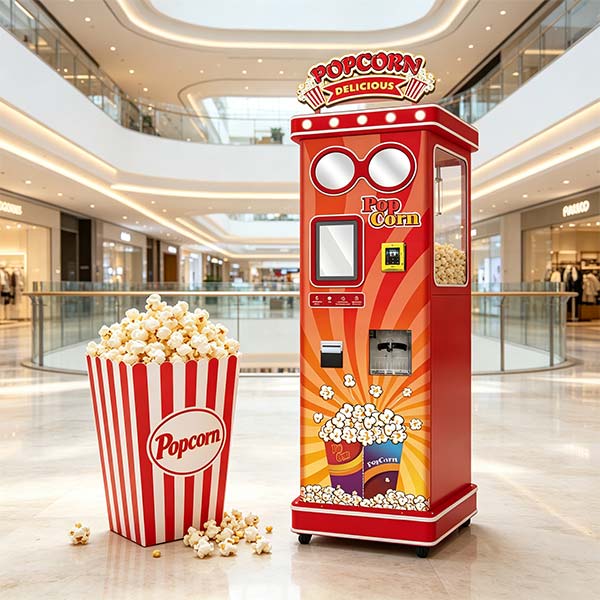
Popcorn is messier but more forgiving. The machine handles dry corn kernels and uses a hot-air cycle rather than oil, so there is no grease and no burnt-oil smell, which is what usually gets a food machine banned from a corridor. The trade-off is corn debris and the occasional kernel on the floor, plus the volume of cups to manage. With 140 cups on board, a busy machine runs out of cups before it runs out of corn, so restocking is a daily habit rather than a weekly one in a high-traffic site. For a mall, the strongest argument for popcorn is the smell itself. The retail industry has borrowed it for decades for one reason: it makes people hungry, and hungry people buy.
Choosing the cotton candy or popcorn machine supplier
The choice between the two machines is only half the decision. The other half is who builds the thing and who answers when it breaks. Buyers in this market commonly end up talking to a trading company that presents itself as a factory, and the gap shows up two years later when a part is needed and nobody knows where the board comes from.
Wider Matrix is a manufacturer based in Guangzhou, building vending equipment since 2016. The company has shipped more than 3,000 units and has machines running in over 130 countries, with a team of 50-plus engineers behind the product line. That matters for a mall order because most mall installations are not standard. A machine has to fit an exact alcove, match a mall’s visual guidelines, and speak the local language on screen. A factory with an engineering team handles that as a normal order. A reseller with a catalogue does not.
The questions worth asking any supplier are the same for both machine types. Can they show the line that builds the unit? Who wrote the software, and can they push a fix remotely? What are the consumable costs, in writing, for the quantities a mall site actually burns through? What happens on a Saturday night when a payment reader fails? For a structured version of that list, this guide to choosing the right vending machine manufacturer is a useful checklist, and the companion piece on choosing a vending machine supplier covers the commercial side of the same relationship.
Certifications, shipping and getting the machine into your market
Import paperwork is where a cheap quote becomes an expensive delay. A machine without the right certification can sit in a customs warehouse while the buyer argues with a broker, and a stalled machine earns nothing. Both the cotton candy and popcorn ranges from Wider Matrix carry CCC, CE, RoHS, RCM, CB and ISO 9001 certification, along with five or more independent R&D patents and more than thirty industry awards. Those documents are what a customs broker asks for, and they are the reason these machines clear into the EU, the UK, Japan, Australia and North America without the buyer paying for extra testing.
Shipping is straightforward for both machines, but the weights dictate the method. A single popcorn machine at 70 kg can move by air freight when speed matters. A cotton candy machine at 300 kg almost always moves by sea, and the container plan is built around how many units fit. Wider Matrix quotes on FOB or CIF terms so a buyer can see the factory price and the landed cost as separate lines, and the company ships worldwide on a routine basis, with installations across Asia, Europe, North America and the Middle East. The sourcing overview on China vending machine manufacturers and suppliers is a helpful reference for what a factory should hand over before a container is booked.
Warranty, spare parts and after-sales support
Support is decided on the bad day, not the good one. A machine in a mall is running in front of strangers for fourteen hours a day. When something fails, the operator wants an answer before the next trading day, not a ticket in a queue.
Wider Matrix provides one year of warranty with lifetime technical support behind it, a response time within 24 hours, and a round-the-clock after-sales line. Both machine types report their own status remotely, so a fault often reaches the operator and the supplier before a customer says anything. The cotton candy platform supports over-the-air software updates, which means a new candy design or a payment tweak does not require a technician on site. The popcorn machine carries the same remote management idea through its PC and mobile app, with sales figures, order history and machine alarms visible from one screen. Installation and operator training are part of the handover, and spare parts are stocked so a replacement does not mean waiting on the next container. For a mall with several machines, remote access across the whole group is the part that saves the most time, because one dashboard covers every unit in the building.
Branding and customization for the mall
A machine sitting in a mall is also a piece of furniture in someone else’s building, and malls have opinions about their interiors. Both machine types can be ordered with custom graphics, colours and a logo, and both can run advertising content on their own screens.
For cotton candy, the customization runs deep. Exterior wraps, luminous characters, the user interface and the vending software can all be adjusted for a buyer or a mall brand, and OEM and ODM work is standard rather than special. The machine supports multiple interface languages and flexible payment configuration, which matters if the same order is heading to several markets. The advertising display can run a mall’s own promotions or a partner brand’s content, which turns the machine into a small revenue line rather than a cost. The popcorn machine offers the same idea through customizable machine layout, skins, luminous characters and colour schemes. For a first mall order, the sensible approach is to keep the build standard, prove the location works, and invest in branding on the second batch once the numbers are known.
Other vending machines that fit a mall
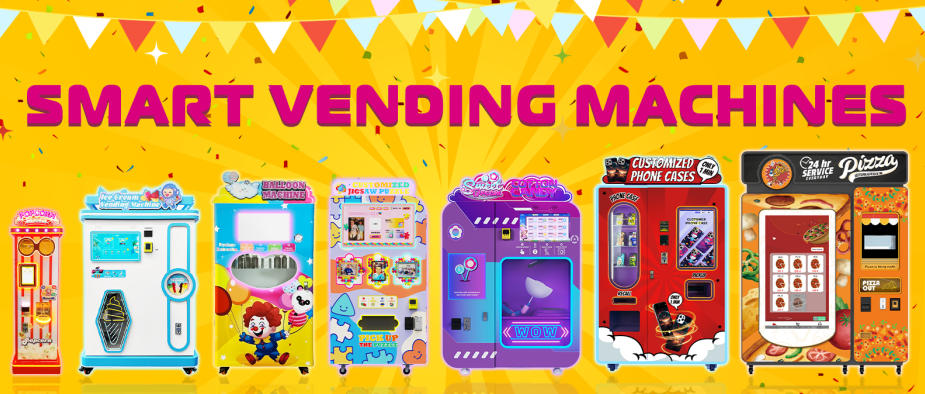
Cotton candy and popcorn are the two machines in this comparison, but a mall corridor rarely wants to stop at one. A buyer planning a route through a large mall or a group of malls usually looks at a small family of machines and places them where each one fits.
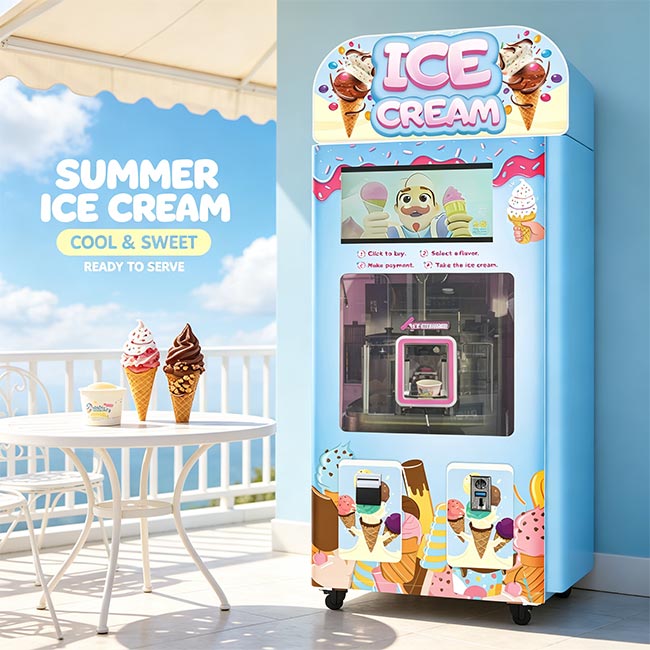
An ice cream machine suits the same leisure crowd as cotton candy, and the WM550 dispenses a cup in about 15 seconds with an output of up to 300 cups per batch, which handles a weekend rush. A phone case printing kiosk works in malls for a different reason: it converts a bored teenager into a customer who waits for a custom product, and it belongs near the fashion and electronics tenants. Balloon vending machines are a natural fit for family-entertainment floors, since a 360 balloon capacity across six slots keeps a children’s zone supplied without constant attention. For malls with a gym or fitness tenant, a protein shake machine serves a different daypart and keeps the corridor earning in the early morning when most retail is shut.
Puzzle and nail printing machines round out the mix for malls with a craft, gift or beauty audience. Buyers can see the ice cream side in the WM550 ice cream vending machine write-up and the balloon side in this guide to the price of a balloon vending machine.
Common questions about mall vending machines
Q: Which is better for a mall, a cotton candy vending machine or a popcorn vending machine?
A: For most malls, the cotton candy machine is the better single choice because it sells at a higher price and earns a wider margin per serving. The popcorn machine is better when the spot sits in a food court or cinema wing with heavy all-day footfall, where speed and a low entry price outweigh the profit on each sale. If the mall has both a leisure corridor and a food zone, the strongest result usually comes from running one of each.
Q: How much does a cotton candy vending machine cost?
A: The WM980 lists at US$4,800 for a single unit, with tier pricing from three units upward. The upgraded WM980 Plus is US$4,999 and the outdoor-rated WM668 is US$5,299. Upgrading the WM980 from 2 kg to 3 kg sugar tanks adds US$200. Volume buyers and distributors can request a batch quotation.
Q: How much does a popcorn vending machine cost?
A: The WM680 popcorn machine is US$1,800 per unit for one to five units, with additional tier pricing above that. Cups add US$0.10 to US$0.12 each depending on order size. Because the entry price is low, this is often the machine a first-time operator tests a mall location with before committing to a larger install.
Q: How much floor space does each machine need?
A: The cotton candy WM980 measures 132 x 195 x 67 cm and needs clear approach space in front for the crowd it draws. The popcorn WM680 is narrower at the base and taller, at 570 x 540 x 1930 mm, and it needs about a square metre of clear space plus room for customers to queue for two minutes.
Q: What power supply do the machines need?
A: Both machines run on 220V and peak at about 3000W during production. The cotton candy machine drops to 500W on standby, so its average draw across a day is lower. Wider Matrix also builds other models in the range with 110V or dual-voltage support for North American and other markets, and the configuration is confirmed at order. A mall installation needs a dedicated circuit sized for the peak, not the average.
Q: How much does it cost to run one of these machines in a mall?
A: Cotton candy is the cheaper machine to run per serving. One candy uses 28 to 30 grams of sugar, roughly 10 cents at bulk pricing, plus a paper stick at 3.8 to 5 cents and a few cents of electricity, for an all-in cost near 16 to 18 cents. Popcorn is dominated by the cup at US$0.10 to US$0.12, with corn adding only a little on top. In both cases, rent or a location fee will usually be the largest running cost, not the consumables.
Q: How much can a vending machine make in a mall each month?
A: Revenue depends almost entirely on foot traffic and the price point a mall supports. A cotton candy machine in a busy leisure corridor can sell a few hundred candies a month at US$3 to US$5 each, while a popcorn machine in a food court moves more units at a lower price. Rather than quote a generic monthly figure, the useful exercise is to estimate daily footfall in the specific corridor and work back from a realistic conversion rate.
Q: Do I need a licence to place a vending machine in a mall?
A: The requirement varies by country, state and city. In most markets a sales tax or seller’s permit is needed, some health authorities treat food machines as food service, and the mall itself will usually ask for public liability insurance and its own placement agreement. Check the local rules before signing, and factor the licensing time into the launch schedule.
Q: Can the machines be branded for my company or for the mall?
A: Yes. Both machine types support OEM and ODM work covering exterior graphics, colour schemes, logos, luminous characters and the on-screen interface. The cotton candy machine also lets a mall run its own advertising content on the built-in display, which can offset part of the placement cost.
Q: How often do the machines need restocking?
A: It depends on traffic. The cotton candy WM980 holds four 2 kg sugar tanks, and each tank covers roughly 65 to 70 candies, so a busy machine may need a refill every day or two. The popcorn machine holds 5.6 kg of corn and 140 cups, and in a high-traffic food court the cups usually run out before the corn does, making daily restocking the norm.
Q: Which payment methods do the machines accept?
A: The cotton candy machines accept coin, cash, credit card and NFC. The popcorn machine accepts coin, cash, card, NFC and QR payment. Both support flexible payment configuration, so a buyer can adjust the set to match what shoppers in a given market actually carry.
Q: Which machine is easier to maintain?
A: Cotton candy has fewer moving consumables and no open food handling, so day-to-day upkeep is mostly tank swaps and stick reloads, supported by a self-cleaning burner process. Popcorn has more debris to manage and more cups to restock, but its air-heating design avoids oil and grease, which keeps cleaning simple. Both machines report faults remotely, so routine maintenance can be planned around the data rather than a schedule.
Q: Can both machines run without staff?
A: Yes. Both are designed for unattended operation, with cloud management, remote monitoring and multi-language screens. Staff are needed only for restocking and occasional cleaning, which is the main reason these machines fit a mall that does not want to add headcount.
Q: How do I get a quotation for a mall installation?
A: Send the target city, the corridor or zone under consideration, an estimate of daily foot traffic, and how many machines are planned. Wider Matrix will come back with the recommended model, the landed price on FOB or CIF terms, the available customization options, and shipping to your port.
How to move from comparing to ordering
A mall will not decide this for you. The building can offer a corridor, but it cannot know whether the people in that corridor will pay for a shaped candy or a cup of popcorn. That judgement belongs to the operator, and it is worth making with real numbers rather than a generic projection. Walk the site at three different times of day, count the people who pass the spot, and watch how many of them stop at whatever is already there. A corridor where people already slow down is cotton candy territory. A corridor where people are already eating is popcorn territory.
Once the spot is clear, the machine choice becomes straightforward. Wider Matrix builds both, ships both worldwide, and supports both with the same servicing, training and spare-parts structure, so the buyer is not choosing between two suppliers. To turn the shortlist into a real decision, share the mall location, the footfall estimate and the number of units under consideration through the contact page. A quotation with the right model, the landed price and a placement plan for the corridor comes back faster when those three details are on the table.