


This guide walks through the due diligence that separates a real China vending machine factory from a middleman. It covers factory verification, market-specific certifications, written specifications, MOQ and tier pricing, safe payment terms, pre-shipment inspection, warranty and spare parts, consumables supply, shipping and landed cost, verifiable track records, and the remote management system, ending with a FAQ aimed at first-time importers. Wider Matrix, a Guangzhou-based manufacturer shipping to more than 130 countries, shares the same checklist it gives overseas buyers before they place a deposit.
Sooner or later, most buyers in this business think about going straight to the source. Buying a vending machine directly from a China manufacturer usually means a lower price, more control over the build, and a shorter path to the people who make the machine. That is a genuine advantage, and for plenty of products it is the right way to buy.
It is also the step where first-time importers lose money. “Factory direct” is a phrase that trading companies, resellers and outright scammers all use with the same confidence. The quote looks fine until a machine arrives with the wrong plug, no spare parts, and a sales contact who has stopped replying to email.
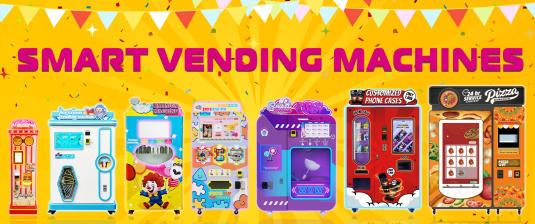
I handle overseas orders at Wider Matrix, a vending machine manufacturer based in Guangzhou. We build ice cream, popcorn, cotton candy, pizza, phone case, jigsaw puzzle, balloon, protein shake and nail printing machines, and we ship them to more than 130 countries. What follows is the checklist I walk buyers through before they send a deposit. I would give you the same list even if you planned to buy from somebody else.
The short answer, if you only read one paragraph: confirm the seller owns a factory, confirm their certificates cover your country, get the specifications in writing with voltage and power, send money to a company bank account only, and put warranty, spare parts and shipping terms into the contract. Anything vague on those five points is a reason to slow down.
Who is actually on the other end of the message
The first thing to settle is whether you are talking to a manufacturer or a trader. That distinction matters more than most buyers expect. A trader cannot change the hardware for you, often cannot supply spare parts a year after the sale, and adds a margin that you are paying for nothing.
Ask for the company’s business license and check that the registered name matches the bank account, the website and the name on the proforma invoice. Look up the factory address. If it turns out to be a residential building or a shared office, you have learned something useful before spending a cent.
The fastest test is a live video call. Ask for a walk through the production line, not a slideshow of stock photos. A real factory can show you assembly, testing and the loading area at short notice. A trader will stall, reschedule, or quietly send you footage belonging to somebody else.
There is one more signal worth watching, and it is the one that matters most to buyers who want their own brand: can they customize? A factory that runs its own tooling and software can change the cabinet, the interface language and the payment module. A pure reseller can only change the sticker on the outside. At Wider Matrix our engineers work directly with buyers on OEM and ODM builds, which is only possible because the design team and the assembly line sit in the same building in Panyu, Guangzhou.
If you want a slower, more thorough version of this step, we published a full guide on how to choose a vending machine manufacturer, plus a companion piece on China vending machine manufacturers and suppliers that explains how the supply chain is layered.
Do the certificates match the country you are selling in
A machine that is legal in China is not automatically legal in your market, and this is one of the most expensive mistakes to fix later because you tend to discover it at customs.
Match the certificate to the destination:
- Europe: CE for the machine, RoHS for the materials
- Japan: PSE
- Australia and New Zealand: RCM
- South Korea: KC
- China: CCC
- Generally useful anywhere: CB test certificate and ISO 9001 for the quality system
Some destinations will also expect a local approval on top of these, so always check the import rules for your own country rather than assuming a CE mark is the end of the story.
A page that says “CE certificate” is not enough on its own. Ask which test report it comes from and who issued it. Wider Matrix holds CCC, CE, ISO 9001, RoHS, PSE, RCM and CB documentation, along with five or more independent R&D patents and KC, CE and PSE patents, so a buyer can request the actual files instead of a logo in a brochure. A supplier who cannot send the test report within a day or two usually does not have one.
Get the specifications in writing, with numbers
Vague specs are how buyers end up with a machine that does not fit the space they already rented. Before you pay, the seller should give you a document listing the model number, dimensions, weight, voltage, power draw, capacity and payment methods. A spec sheet, not a marketing page.
Here is what those numbers look like on machines we actually ship, so you have something concrete to compare against whatever quote is in front of you:
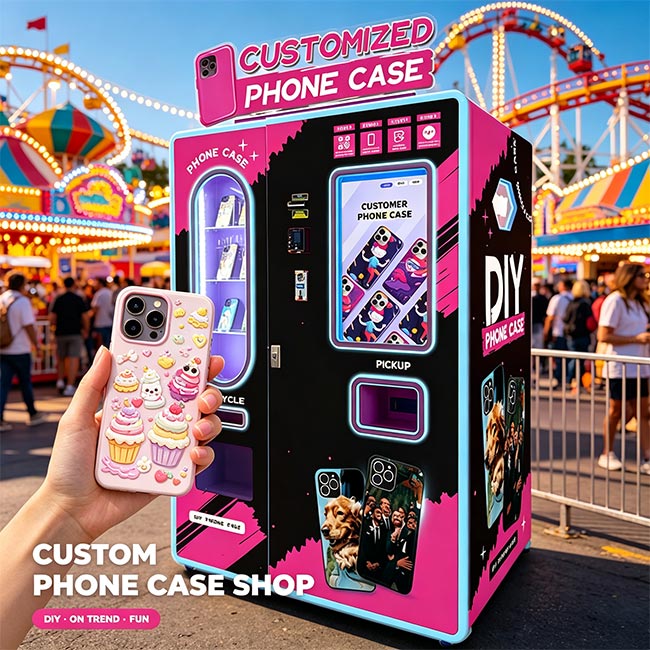
The WM880 phone case vending machine runs on 110V to 220V, draws 410W, measures 1340 x 990 x 2170 mm, weighs 380 kg, and holds roughly 1,020 phone cases.
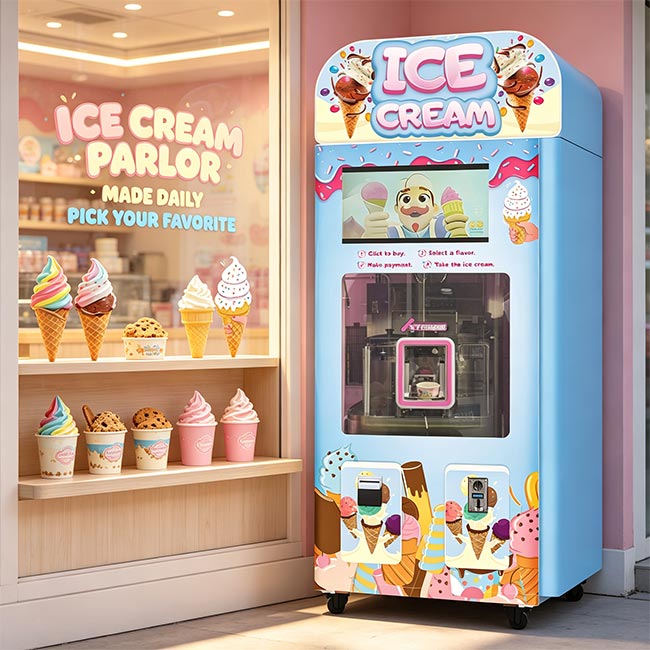
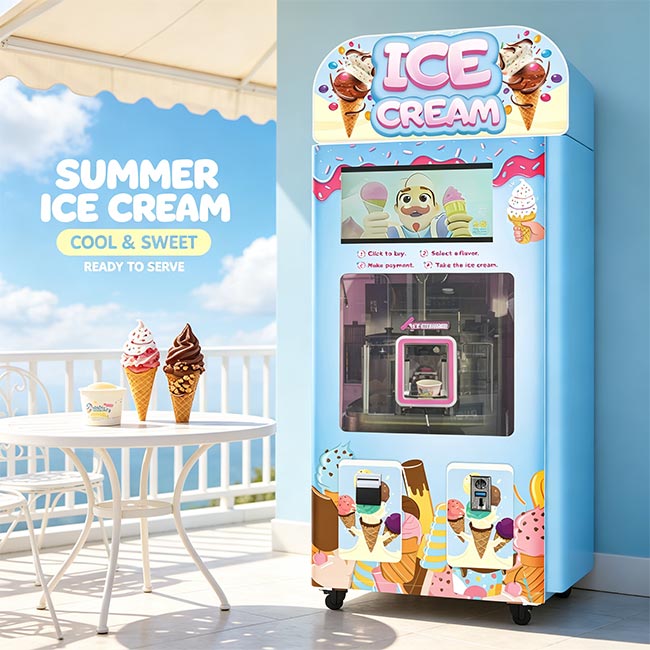
The WM550 ice cream vending machine measures 227 x 93 x 95 cm, weighs 640 kg, uses 3000W at 220V, and dispenses a cup in about 15 seconds with capacity for up to 300 cups per batch.
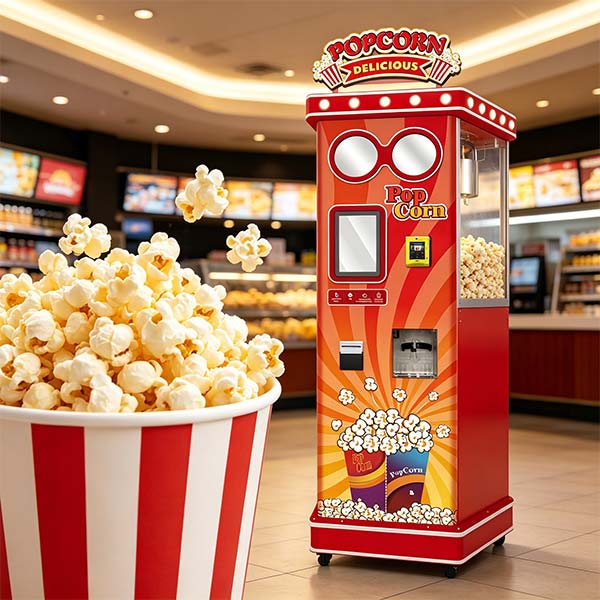
The WM680 popcorn machine is the light one at 70 kg, pops a serving in roughly 120 seconds, and stores 5.6 kg of corn plus 140 cups.
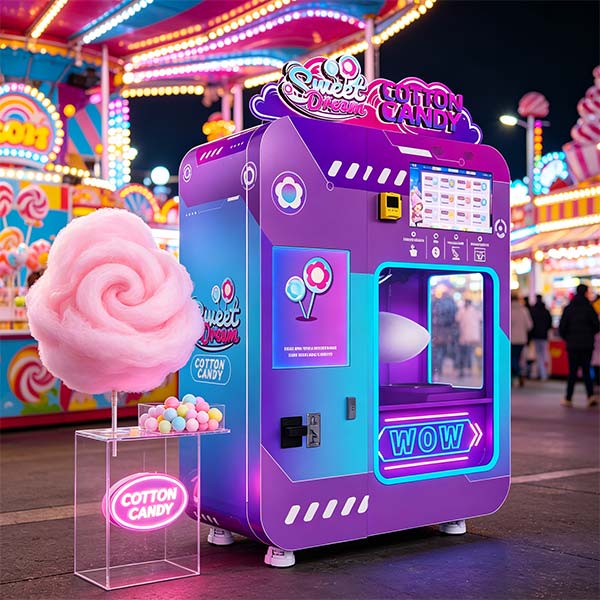
The WM980 cotton candy vending machine weighs 300 kg, uses 500W on standby and 3000W while making candy, and produces 36 candy designs.
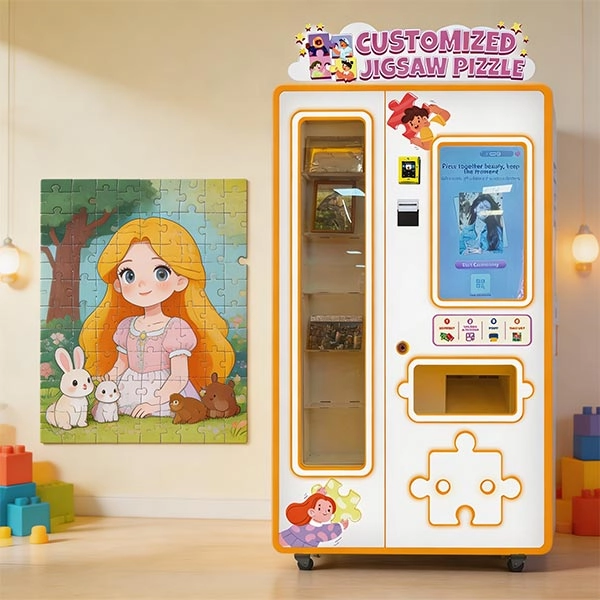
The WM520 jigsaw puzzle vending machine weighs 370 kg and prints a puzzle in about three minutes.
Two details get skipped all the time. Voltage comes first: a 220V machine will not run on a 110V outlet without a step-up transformer, and buyers in North America keep discovering this after delivery. Power comes second: a 3000W machine needs a dedicated circuit, and the landlord or venue has to approve it. Confirm both before the deposit, not after.
Understand the real MOQ and how tier pricing works
Plenty of Chinese suppliers advertise “MOQ 1 unit” and then gently push you toward ten. Others want a minimum order before they quote at all. Neither approach is wrong, but you should know the rule before you start negotiating.
Factories that genuinely build their own machines will usually sell one for testing, price it higher, and then step the price down as volume rises. Our own tiers work that way. One popcorn machine is US$1,800, the phone case machine starts at US$4,999 for the base print head version, and the cotton candy machine is US$4,800 for a single unit with discounts kicking in from three units. First-time importers normally start with one or two machines, prove the location, and then reorder.
If you are still working out budgets, our breakdown of what vending machines cost across the market covers the price bands by machine type, and there is a separate look at sourcing ice cream vending machines in China if that is the category you are working in.
Where the money goes matters
Payment terms are where careful buyers separate themselves from people who get burned. The standard structure for a China factory order is a 30% deposit to start production and 70% before shipment, usually by bank transfer, with letters of credit or escrow platforms used on larger orders.
Three rules I would give any buyer:
- Pay the company account that matches the business license, never a personal account, even when the salesperson says it will be faster.
- Keep the deposit small enough that you could absorb the loss if things went wrong. Thirty percent is normal. A request for 100% upfront is not.
- Use a payment channel that leaves a paper trail, such as a letter of credit or a trade assurance style escrow, on your first order with any new supplier.
If a supplier refuses to accept any protected payment method on a first order, that tells you something about the supplier, not about you.
Inspection before the machine leaves the factory
The machine should be fully assembled, wired and tested before it is packed, not shipped in pieces for you to finish at the other end. Ask for video of your specific unit running, with the serial number visible in the frame. A generic clip of the same model is not the same thing.
On larger orders, hire a third-party inspection service to visit the factory before shipment. It costs a few hundred dollars and catches problems that cost thousands to fix once the container has sailed. Confirm who pays for the inspection and write the acceptance criteria into the contract.
Warranty, spare parts, and who answers at 2 a.m.
A one-year warranty is common in this industry. What matters more is what happens on day 400, and whether a replacement part can reach you in days rather than six weeks.
Ask these while you are still negotiating:
- What does the warranty cover, and what voids it?
- Who pays shipping on replacement parts?
- Is there a spare parts list with prices, so you are not quoted later at panic prices?
- Is support by email, chat, video call, or all three, and in which time zone?
- Can the machine receive remote software updates, or does a technician have to fly out?
Wider Matrix ships every machine with a one-year warranty and lifetime technical support, round-the-clock online support, installation and maintenance video guides, and OTA software updates that push new recipes, patterns and promotions to the machine without a site visit. For an operator running units thousands of miles from the factory, remote diagnosis is worth far more than a slightly lower purchase price.
The consumables supply chain you will be tied to
Buyers fixate on the machine price and forget the consumables. That is where the ongoing cost lives, and it is where a cheap machine can turn expensive if it only accepts proprietary supplies you cannot source locally.
Ask for a consumables price list and the per-unit cost before you order. Real numbers from our own sheets: cotton candy uses 28 to 30 grams of sugar per serving, with the specialty sugar at US$2.75 to US$3.25 per bag in bulk. Popcorn cups run US$0.10 to US$0.12 each. Phone case blanks land between US$1.10 and US$1.30. Ice cream cups are US$0.08 to US$0.12, and puzzle sheets US$0.80 to US$1.20. Add all of that to your margin math before you buy, because the machine is only half the investment.
It also helps to know whether the consumables are standard or proprietary. Standard is better for you, since it means you can buy locally when shipping is slow.
Shipping, lead time, and the landed cost nobody quotes you
The number on the proforma invoice is not what you pay in the end. Landed cost includes freight, insurance, customs duty and local delivery, and it swings widely by destination. Ask the supplier to quote on a defined Incoterm, FOB, CIF or EXW, so you know exactly where their responsibility stops and yours begins.
Then ask three questions: how long until the machine is ready, how long the sea freight takes to your port, and who prepares the export documents. A factory that ships to more than 130 countries handles this every week and can give you the realistic timeline instead of the optimistic one. We have documented shipments to the UK, the US, Canada, Germany, France, Australia and the UAE, so buyers can see the process on real orders rather than reading a promise.
Proof they have done this before
Ask for references you can actually check: customers in your region, recent case studies, and photos or video of installations. Any supplier can claim a decade of experience. Verifiable details, a buyer in your country, a specific venue, a machine model in service, are harder to fake and much more useful.
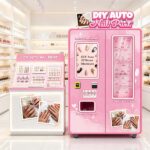
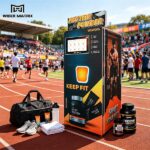
Two examples from our own order book. A nail printer in a Dubai shopping mall averaged around 45 orders a day and cleared its US$5,800 cost in about 15 days, after which the operator ordered three more units. A protein shake machine in a mid-size Miami gym sold roughly 45 cups a day at US$5.50, which worked out to about US$193 a day in profit and a payback under three months. Those are specific cases, not a guarantee for your location, but they show the kind of numbers these machines can reach in the right spot.
There is also a wider picture worth reading if you are comparing suppliers: a longer piece on who the top vending machine manufacturer in China actually is, and our about page, which covers the trade shows we attend in Saudi Arabia, Indonesia, the Netherlands, Russia, London, Italy, Spain, Orlando, Mexico, Shanghai and Hong Kong.
The remote management system is where cheap machines fall apart
A vending machine is a piece of software as much as a piece of hardware. The management platform decides whether you can check sales from your phone, update prices without visiting the site, and get told when a machine is running low on stock.
Before you buy, ask to see the dashboard live, not a screenshot. Currency settings, language options, sales reporting, live machine status and promotion scheduling should all be there. Every Wider Matrix machine ships with a cloud system that supports multiple currencies and languages, tracks daily, weekly and monthly revenue, and lets you manage a fleet from a PC or a phone. For an operator, that is the difference between running one machine and running twenty.
OEM and ODM: what can actually be customized
If you are building a brand, customization is a large part of the value of going factory direct, so be specific about what you need: cabinet color, machine skin, logo, screen interface, interface language, packaging, and the software behind the screen. A manufacturer with in-house design and engineering can do all of it. A trading company can usually only do the sticker.
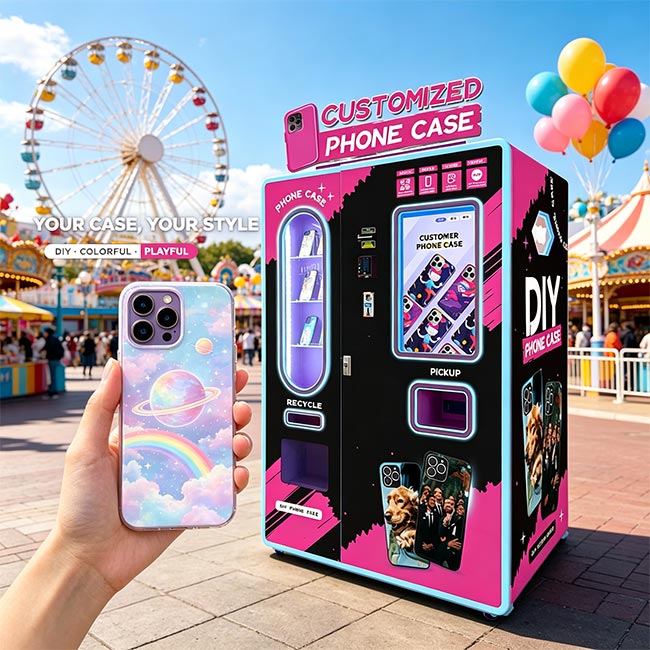
For a closer look at how far this goes in one category, our custom phone case vending machine page and the guide to customized vending machines exported to Europe show what a real build looks like. If phone cases are your category, it is also worth reading our notes on finding a reliable phone case vending machine supplier and on where to buy a phone case printing machine from China.
Questions buyers ask us most
What should I check before buying a vending machine directly from a China manufacturer?
Verify that the seller owns the factory, that their certifications cover your country, that the specifications are in writing with voltage and power, that payment goes to a company account matching the business license, and that warranty, spare parts, consumables and shipping terms are in the contract. If any of those is unclear, resolve it before paying a deposit.
Can I order just one vending machine to test the market?
Yes. Most genuine factories will sell a single unit, priced above the volume tier. Wider Matrix sells from one machine on models such as the popcorn and phone case ranges, so a first order can stay small while you test a location.
What certifications should a China vending machine have?
CE and RoHS for Europe, PSE for Japan, RCM for Australia and New Zealand, KC for South Korea, and CB plus ISO 9001 as general quality marks. Ask for the actual test reports rather than a logo on a brochure.
What payment terms are normal for a first order?
A 30% deposit to start production and 70% before shipment, paid by bank transfer to a company account. Letters of credit and escrow platforms are standard for larger orders, and any supplier who refuses a protected method on a first order is worth treating with caution.
How long does shipping from China take?
Production lead time is quoted in weeks, and sea freight adds more depending on your port and route. Ask for a quote on a defined Incoterm so you can see where the supplier’s responsibility ends and budget the duty and local delivery yourself.
What warranty should I expect on a vending machine from China?
One year is standard, often paired with longer technical support. The details that matter are who pays for spare parts shipping, whether there is a published parts price list, and whether the machine can take remote software updates.
Is it cheaper to buy directly from a China manufacturer?
Usually yes, because you remove the middleman margin and can negotiate volume pricing. Budget for shipping, customs duty and consumables on top of the machine price, since the invoice figure is rarely the final cost.
How do I verify a Chinese vending machine factory is real?
Cross-check the business license against the bank account and the invoice, ask for a live video walkthrough of the production line, look up the factory address, and test whether they can customize the hardware. Resellers can do none of those things comfortably.
Next step
If you already have a quote in hand and something on this list is still unanswered, get those answers before you send money. If you would rather talk to a factory directly, send us the machine type, your market and your quantity, and we will come back with specifications, pricing and a shipping estimate. Buying a vending machine directly from a China manufacturer can be the best decision you make in this business. It just goes better when you know which questions to ask first.