


A phone case vending machine earns its place in a shopping mall when the spot has steady weekday traffic, people linger near it, and the lease runs long enough to cover the hardware. This guide walks through the three mall formats that work best, the space and power a WM880 needs (1340 x 990 x 2170 mm, 380 kg, 410W), what a mall lease really costs against a case that retails for $10 to $25, and the checks worth doing before a single unit is ordered. If you have a specific site in mind, send the floor plan, the daily footfall estimate and the target country to Wider Matrix, and you will get a straight landed cost with shipping and a realistic read on whether that venue will pay.
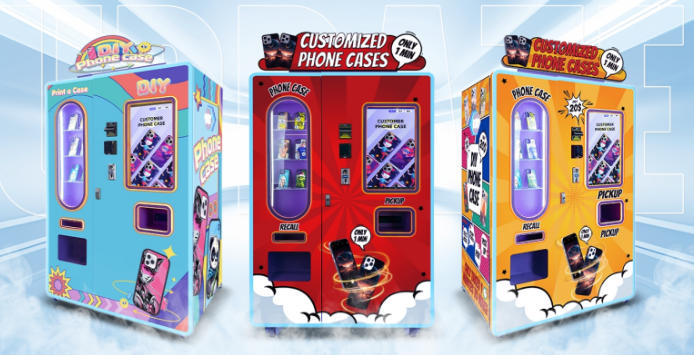
A phone case vending machine fits a shopping mall well when three things line up at once. The spot sees steady traffic on an ordinary Tuesday, not just at Christmas. People slow down near it long enough to notice a screen. And the mall will hand over a lease term long enough to pay the hardware off. Where those three are true, the machine prints a personalized case in about a minute and sells it for $10 to $25 with nobody standing behind a counter. Where they are not true, a 380 kg kiosk becomes expensive furniture in a corridor.
The honest answer is that malls are one of the stronger venues for this product, but only a certain kind of mall, and the spot inside the mall matters more than the building itself. A busy regional center with a cinema attached will usually outperform a quiet office mall a mile away, even if the office mall has more square meters. Foot traffic that is walking somewhere else is not the same as foot traffic that is willing to stop.
Most owners weighing whether a phone case vending machine suits a shopping mall already have a site in mind. They want to know whether it will work before they sign a lease and order the unit. That is a question with numbers behind it, and the numbers come from three directions: what the machine needs from the building, what the mall wants to see in return, and what a shopper actually does in the ninety seconds they stand in front of the screen.
What a phone case vending machine does in a mall setting
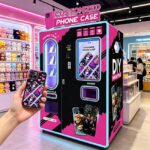
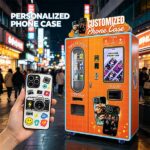
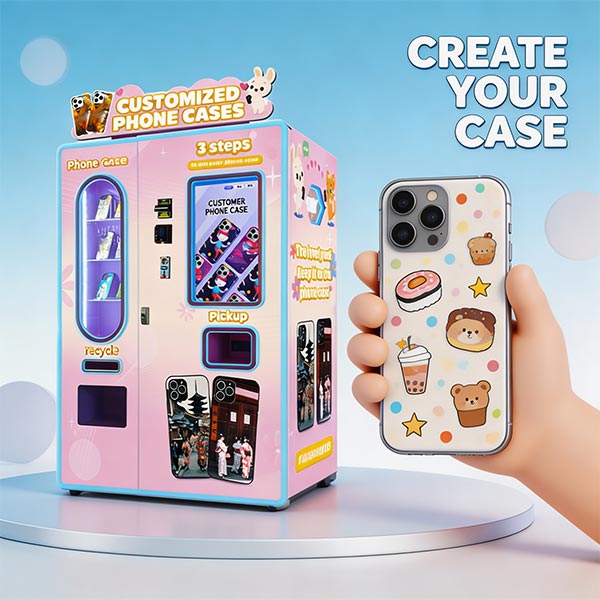
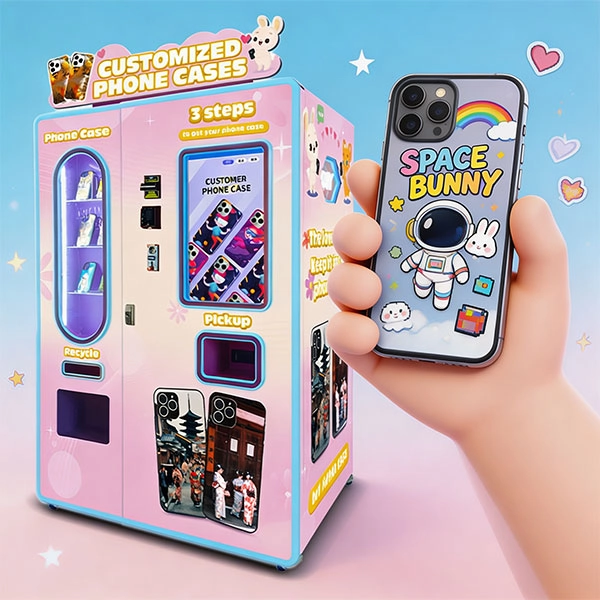
The machine found in most mall deployments is a self-service kiosk with a printer built into the cabinet. A customer picks their phone model on a touchscreen, uploads a photo, pays, and collects a finished case on the spot. The whole loop has four steps: scan the QR code on screen, choose the model (iPhone 16, iPhone 15, iPhone 11 and other current handsets), upload a picture, and pay. Nothing about the process requires an attendant, which is the single biggest reason malls tolerate it. There is no counter to staff, no queue to manage, and no till to balance.
The unit most mall operators end up specifying is the WM880 from Wider Matrix, a freestanding cabinet that combines the printer, the payment terminal and the blank case inventory in one body. Its dimensions are 1340 x 990 x 2170 mm, which is roughly the footprint of a large photo booth. It weighs 380 kg empty. It runs on a standard 110V to 220V supply and draws 410W, well within what a normal mall outlet circuit handles. Underneath the shell, the parts that decide whether the placement holds up over time are the print head tier, the case storage, and the way the machine is managed once it is on site.
| Model | WM880 |
| Dimensions (W x D x H) | 1340 x 990 x 2170 mm |
| Weight | 380 kg |
| Power | 410W, 110V to 220V |
| Ink capacity | 2000 ml |
| Case storage | 1,020 to 1,025 blanks |
| Print heads | Epson F1080-A1, i1600-U1, i3200-U1HD |
| Case material | TPU + PC composite |
| Payment | Coin, cash, card, NFC, QR |
| Management | PC and mobile app, remote monitoring |
Two rows in that table shape a mall deal more than the rest. Case storage of just over a thousand blanks means an operator can refill once a week rather than once a day, which matters because mall access is often restricted to set hours. The print head choice matters because it sets how fast a queue clears on a Saturday. The base Epson F1080-A1 has the sharpest photo detail. The i1600-U1 prints three times faster, lasts four times longer and doubles clarity. The i3200-U1HD is a further lossless upgrade on speed. A mall running several units across a weekend peak should be looking at the i1600 tier at minimum.
What a mall asks of the machine before it says yes
Mall management looks at a kiosk differently than a route owner does. Their concerns are structural and commercial, and if you cannot answer them in the first conversation the deal stalls. The questions repeat across almost every venue.
Floor loading comes first. At 380 kg, a WM880 is heavier than a snack machine and the mall will want to know the cabinet is not sitting on a raised access floor or a mezzanine with a light rating. A ground-floor corridor or a solid concrete slab handles it without a conversation. Height matters too, since 2170 mm leaves clearance under most mall ceilings but not under low wayfinding signs or sprinkler runs.
Power is usually the easy part. A 410W draw is modest, and a single standard outlet covers it. Most malls already have power drops for kiosks and pop-up stalls, so the install is often a plug-and-go once an outlet is allocated. What is worth confirming early is whether the outlet sits where the mall wants the machine, not where the electrician finds it convenient.
Payment is the next question, and this is where a cashless mall is actually easier. The WM880 takes coin, cash, credit card, NFC and QR payment, so an operator can run it card-only in a mall that has gone cashless, or leave cash enabled in a market where shoppers still carry notes. Multi-currency support in the software lets the same machine handle several currencies, which helps in airport-adjacent centers and tourist districts.
Then there is access for delivery. A 380 kg cabinet does not go up a passenger escalator. Whoever places a machine in a mall should map the delivery route before ordering: goods lift dimensions, door widths, corridor turns, and where the mall will allow a trolley to sit during install. That planning step gets skipped more often than any other, and it is the one that turns an install day into an install week.
Noise and light are minor but they come up. A machine that prints quietly and runs a screen at a sensible brightness causes no friction with neighbors. Sites that sit beside a bookstore or a jewelry counter tend to be sensitive to anything loud, and the printer inside the WM880 is not going to be the thing that annoys them.
Use case 1: a regional mall with steady weekday traffic
A regional shopping center is the format that most reliably feeds this machine, provided the weekday numbers are real. The defining trait is not the weekend peak, it is the baseline. If the center pulls a steady weekday crowd from nearby offices, a train station or a dense residential area, the machine has customers six and a half days a week instead of only Saturday.
A WM880 holds 1,020 to 1,025 blanks, so a regional mall turning over a normal mix of iPhone and Samsung models will not run dry midweek. With roughly a thousand cases on board and a print time of about a minute, the machine can serve a long continuous stream without a refill visit. The operator loads cases flat, back facing up, keeping each one under the red line indicator, and pushes it in. Refilling the whole bank is a short job that can be done in one visit, ideally before the doors open.
Where the regional mall format earns its money is repeat behavior. Phone models turn over every year, and the same shopper who buys a case for a handset in the spring often replaces the phone, and the case, the following year. A kiosk in a center people visit weekly builds that pattern faster than one in a center people visit twice a year. For an operator comparing venues, it is worth reading up on where vending machines are most profitable, because steady repeat traffic outperforms raw footfall as a predictor almost every time.
The regional mall also suits the version of the machine with the optional inventory identification camera. That add-on, priced at $200, reads stock per slot, so an operator running two or three units across a center can see which model lines are draining fastest without opening each cabinet. On a multi-unit install, that is a small line item that saves a lot of driving.
Use case 2: an entertainment or lifestyle mall with long dwell time
The second format that works is a mall built around experience: cinemas, family entertainment centers, food halls, arcades, bowling. These centers trade raw footfall for dwell time, and dwell time is where an impulse product lives. Somebody who is queuing for a film or waiting for a table has three to ten minutes to fill, and a screen offering a personalized case fills it.
In this setting the print head tier matters more than in a quiet corridor. An i1600-U1 head prints three times faster than the F1080, which is the difference between a case ready in about twenty seconds and one ready in around a minute. Near a cinema exit at the end of a busy screening, that speed keeps the queue moving instead of watching people walk away. The ink reservoir holds 2000 ml, enough for thousands of prints before a top-up, so a weekend of peak volume does not require mid-shift maintenance.
Entertainment malls often run late. The machine is built for unattended operation and remote monitoring, so it can keep selling after the last staff member leaves the floor and the operator can check sales, stock and machine health from a phone rather than driving to the site at midnight. That combination, an impulse audience plus a machine that does not need an attendant, is why the format suits operators who already run a route and want the mall to be one stop rather than a daily job.
One caution specific to entertainment venues: the audience skews younger and more price-sensitive in some markets, so promotional settings built into the management system are useful here. The software supports discount rules, time windows and quantity limits, which lets an operator run a midweek promotion during quiet hours without touching the base price at the weekend. The mall phone case vending machines profit breakdown covers how these levers change the revenue picture.
Use case 3: a tourist or outlet mall chasing keepsake buyers
The third format is the outlier that often posts the highest average sale: the tourist mall, the outlet center, or a mall in a destination district. The shopper here is not replacing a worn case. They are buying a souvenir, and a photo-printed case made on the spot is a better keepsake than anything on a shelf.
Souvenir buyers accept a higher price than local shoppers, which is where the magnetic case line becomes relevant. Magnetic TPU and PC cases cost more to stock, running $2.30 at 1,000 units, $2.20 at 5,000 and $2.10 at 8,000, against $1.30, $1.20 and $1.10 for the standard case across the same tiers. Selling the magnetic option at a premium in a tourist venue widens the margin without requiring a different machine. The 2000 ml ink tank supports that volume, and a six-color Epson UV hard ink set for the F1080 configuration lists at $160 per set against $100 for the four-color standard set.
The tourist format also rewards multilingual operation. The WM880 interface supports English, Russian, French, Arabic, Korean and others, so a machine in a center that draws international visitors does not rely on the customer reading English. For an operator running several sites in a destination city, the argument for a custom phone case vending machine for malls is strongest here, because the artwork, the language and the price point can all be tuned to a specific audience.
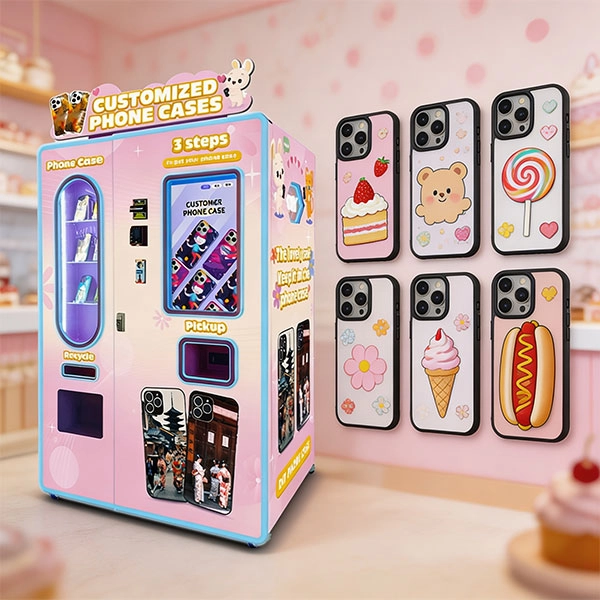
The catch with tourist venues is seasonality. A center that fills in July and empties in February will show a very uneven revenue line. That does not rule the site out, but it changes the lease structure an operator should be negotiating.
What separates a mall that works from one that does not
The format matters less than four variables. They decide whether a phone case vending machine in a shopping mall thrives or just sits there, and all four can be checked before a contract is signed.
Foot traffic is the first, but raw numbers mislead. A corridor with 30,000 people a day walking straight through to a car park does less for the machine than a smaller atrium where 12,000 people stop, sit and eat. What matters is the count of people who pause, not the count of people who pass. A day spent counting stops near the intended pitch is more useful than any footfall report a mall will hand over.
Dwell time is second. Malls that give people a reason to wait, whether a screen, food or a queue, convert better than malls engineered to move people through quickly. A machine placed near a seating zone or a food court entrance sits in front of people who are already static.
Demographics are third, and the useful signal is not income alone. It is phone turnover. Younger and family-heavy crowds replace handsets and cases more often, and a machine in front of them will refill more frequently. A high-income mall with an older, low-turnover crowd may still perform, but usually on gifting and souvenir purchases rather than replacement ones.
Mall rules are the fourth variable and the one that ends more deals quietly than any other. Some centers refuse any kiosk that competes with an existing tenant, some restrict where a floor-standing unit may sit, and some require the operator to use the mall’s own power and data infrastructure. All of that is negotiable before signing and immovable afterward. It is worth reading the general landscape on where to put vending machines before touring a shortlist, so the same questions get asked at every site and the answers can be compared side by side.
The money: cost, lease and payback in a mall
Any payback calculation for a phone case vending machine in a mall starts with two numbers and ends with a third. The first is the machine. List pricing for the WM880 runs $4,999 for the F1080 version and $5,999 for the i1600-U1 configuration at one to three units, with volume tiers above that. The optional inventory camera adds $200, and a later upgrade to the i3200 head adds $680 on a machine already owned, since the chassis and software stay the same.
The second number is the placement cost. Malls rarely give floor space for nothing. Some charge a fixed monthly rent, some take a percentage of revenue, and some do both with a minimum. This is the line that decides whether a mall site is worth taking, and it is the reason two identical machines in two centers can show very different returns. The general mechanics of what venues charge and why are worth understanding before negotiating, and whether vending machine locations are free is a fair place to start.
The third number is the case margin. Blanks cost $1.10 to $1.30 each in bulk for the standard TPU and PC case, and a finished custom case retails between $10 and $25 depending on the market and the venue. That spread, minus the lease and the case cost, is the working margin on every sale. The profitability of selling phone cases depends almost entirely on how many cases walk out per day, which is itself a function of the four variables above.
Put the three together and the arithmetic is simple but unforgiving. A machine that sells a modest handful of cases a day at a mall with a low fixed rent pays itself back in a reasonable window. The same machine in a high-rent prime pitch needs a much higher daily count to justify the same unit, and if the venue cannot demonstrate that count, the prime location is the worse bet even though it looks better on a map. An operator who has never run a route before will find the broader cost structure covered in this guide to starting a vending machine business, which is useful context before committing to a mall lease specifically.
For anyone comparing hardware before the lease question, the two cost references that resolve most of the ambiguity are a breakdown of how much a phone case printing vending machine costs and a tighter look at the price of a custom phone case printing vending machine once the spec moves away from standard.
Before signing a mall lease for a kiosk
A short list of checks separates a smooth install from a costly mistake.
Confirm the power drop and its location, and confirm the circuit can carry 410W alongside anything else sharing it. Confirm the floor rating where the machine will stand. Walk the delivery route with the goods lift dimensions in hand, because 380 kg does not go where a shopping bag goes. Confirm how the machine connects to the internet, since remote monitoring is what makes an unattended unit manageable, and mall WiFi is not always open to third-party hardware. Confirm the mall’s opening hours against your refill window. Confirm who carries public liability insurance and whether the mall requires a named vendor permit, which is a question that also matters outside malls and is treated in detail for one market in this look at vending machine licence rules in the UK.
Finally, confirm the exit terms. Mall leases for kiosks can be short, and an operator who cannot leave a poor site without penalty is stuck with it. A trial clause tied to a measurable daily sales floor is worth asking for, and many centers will grant it because they want a productive tenant rather than an empty pitch.
Mistakes that sink a mall placement
The failures repeat. The most common is choosing the mall by its reputation rather than by the specific spot, then discovering the allocated pitch is a dead corner two turns from the escalators. The second is under-ordering on the machine tier, buying the base F1080 unit for a high-traffic center and then watching a queue build while each case prints. The third is treating refills as an afterthought, running a thousand-case bank down to empty on a Saturday because the last top-up happened midweek. The fourth is failing to use the management system at all, which leaves an operator guessing at what sells and when, when the software already reports daily, weekly and monthly sales with charts, order status, and machine health.
None of these are machine faults. They are planning faults, and each is avoidable with information the operator has before the unit ships. That is also why the supplier choice matters as much as the venue: a factory that can answer questions about floor loading, print head selection and remote diagnostics before the sale is a different partner than one that only quotes a price. The differences are the subject of this guide to choosing the right phone case vending machine manufacturer, and the same ground is covered from the sourcing side in what separates a reliable phone case vending machine supplier from a reseller.
Why the machine behind the mall site matters
A mall placement is a long lease on a single physical asset, so the machine has to hold up for years without the operator being able to swap it out cheaply. Wider Matrix has been building vending equipment since 2016, with more than 3,000 units shipped and machines running in over 130 countries, and 50-plus engineers on staff, which is why non-standard requests come back as achievable rather than refused. The units carry CCC, CE, ISO, RoHS and PSE certification, along with more than five independent R&D patents and over thirty industry awards, the documentation a customs broker and a mall’s own compliance team will eventually ask for.
Two features make the difference in a mall specifically. The print visual recognition system uses AI-assisted positioning to print with no white borders, which matters when a shopper has chosen a photo and expects a clean result on the first try. And the optional inventory identification module reads stock per slot in real time, so an operator running a mall fleet can see exactly which slots are low before driving to the site. The front-end case quality supports that too: the TPU and PC composite case has two optional lens cover protection designs and full compatibility across Apple, Samsung, Google Pixel, Xiaomi, Huawei and OPPO handsets, so a mall machine is not limited to one brand’s customers. For a deeper look at the hardware, this breakdown of the Wider Matrix phone case printer goes further, and the full spec sheet sits on the WM880 phone case printing vending machine product page.
Questions mall operators and buyers ask
Q: Is a phone case vending machine a good fit for shopping malls?
A: For most full-line malls with steady weekday traffic, yes. The machine needs a modest pitch, a standard 410W power drop and access for a 380 kg cabinet, and it sells a personalized case in about a minute. The fit is poor in malls with no weekday baseline, in dead corridors off the main flow, and in centers that will not offer a lease term long enough to cover the hardware.
Q: How much space does one need in a mall?
A: The WM880 measures 1340 x 990 x 2170 mm and weighs 380 kg. A pitch roughly the size of a large photo booth is enough, with clearance above the cabinet and a solid floor beneath it. Most malls have existing kiosk pitches that fit.
Q: Does the machine need a dedicated power supply?
A: No. It runs on 110V to 220V and draws 410W, which a standard outlet circuit handles. The important step is confirming the outlet is where the mall wants the machine, not where it is easiest to install.
Q: Can it run without staff in a mall that closes at night?
A: Yes. The machine is built for unattended operation and reports sales, stock and printer status through a PC and mobile app, so an operator can monitor a late-night site remotely rather than visiting it. It accepts coin, cash, credit card, NFC and QR payment, so it also works in a mall that has gone cashless.
Q: How often does a machine in a mall need refilling?
A: It holds 1,020 to 1,025 blank cases and a 2000 ml ink reservoir, both sized for days of steady volume rather than a single session. Most mall sites allow a once or twice weekly visit. Everything can be topped up in one trip, and the optional inventory camera tells the operator which slots need attention before arriving.
Q: Which print head should a mall machine use?
A: It depends on expected volume. The F1080-A1 gives the sharpest photo detail and suits lower-traffic sites. The i1600-U1 prints three times faster, lasts four times longer and doubles clarity, and is the better choice for busy centers and weekend peaks. The i3200-U1HD is a lossless speed upgrade on the i1600, available at order or later on a machine already owned for $680.
Q: Is a mall placement expensive?
A: Malls rarely give floor space for free. Some charge fixed rent, some take a revenue percentage, some combine both, so the placement cost is what decides whether a site works. That cost has to be weighed against a case that costs $1.10 to $1.30 to stock and retails for $10 to $25. A cheap pitch with modest traffic can beat a prime pitch with high rent.
Q: Can the machine be branded for a specific mall or market?
A: Yes. OEM and ODM work covers the logo, exterior colors, interface and software, and the machine already supports multiple currencies and interface languages including English, Russian, French, Arabic and Korean. That matters when one order serves several regional malls or a tourist district.
Q: What happens if a machine develops a fault in a mall?
A: Wider Matrix provides one year of warranty with lifetime technical support, a response time within 24 hours, and a 7×24 after-sales line. Because the machine runs diagnostics and reports faults remotely, many issues are caught before a site visit, and spare parts are stocked so a replacement does not wait on the next container.
Q: Can a mall machine be ordered with a non-standard configuration?
A: Yes. Print head tier, branding, interface language and the optional inventory identification module can all be set at order. Anything outside the standard list can be described and the engineering team will confirm what is possible and what it adds to the price.
Next step for a specific mall site
If there is a particular mall under consideration, the useful next move is to put the actual numbers in front of the team that builds the machine. Send Wider Matrix the target country, the floor plan or pitch size, an estimate of daily foot traffic and how much of it pauses near the spot, and how many units the site could take. In return comes a quotation with a real landed cost, the print head and customization options that fit that traffic level, and shipping on FOB or CIF terms to the destination port. Where a site is a marginal fit, that is worth knowing before a lease is signed rather than after. The contact page is the fastest route to that answer, and a conversation with an operator already running a mall fleet is the fastest way to pressure-test the traffic estimate.