


The article answers the query “what are the best locations for a nail art vending machine” with a direct recommendation in the opening paragraph, then ranks six placement scenarios in order of realistic performance: shopping malls and lifestyle centers, beauty salons and cosmetics retail, airports and hotels, cinemas and entertainment centers, university campuses, and tourist or event venues. Each scenario carries the machine-level data that decides whether the site can actually support the unit, including the 720-pair press-on nail inventory, the 5-minute service cycle, the 30-second UV-LED cure, the 200 orders per day ceiling and the roughly 1.5 square meter footprint of the WM860. The guide then covers site requirements, unit economics at US$5,200 to US$5,800 per machine, revenue-share arithmetic for landlords, a list of locations that look promising but underperform, and a FAQ block.
The best locations for a nail art vending machine are enclosed shopping malls and lifestyle centers with steady female footfall, beauty salons and cosmetics retail floors where customers already pay for nail work, and long-dwell leisure venues such as cinemas, airports and university campuses. If only one site is available, take a kiosk position in a mid-size mall on the walking line between the food court and the women’s fashion section. Wider Matrix deployment records put mall units at about 45 orders a day, and the Dubai kiosk in those records recovered its US$5,800 purchase price in 15 days. Transit sites put more people in front of the machine. Salons put the right people in front of it.
Two location types reliably disappoint, and both look good on a map. Office tower lobbies with no seating and no evening traffic, and gym entrances where the customer is walking out with wet hands and a car key. Neither audience stands still long enough to upload a photo, pick a design and wait through a five-minute print cycle.
What follows ranks six placement scenarios, gives the traffic and dwell conditions behind each ranking, lists the machine specifications that constrain where a unit can physically go, and sets out the numbers a landlord conversation usually turns on. Every specification quoted here comes from the WM860 nail printer vending machine in the Wider Matrix range, and the performance figures come from the manufacturer’s own deployment records, which is worth remembering when a venue promises twice the footfall of the site next door.
What “best” means for a nail art vending machine
Most location guides score a site by visitor count. That number says very little here. An automatic nail art vending machine converts a specific kind of passer-by: someone with twenty spare minutes, a phone in hand, and an interest in wearing a printed press-on set that costs between US$8 and US$15. A site can process 40,000 people a day and still sell nothing if those people are late for a train.
Five conditions decide the outcome, and they carry different weight depending on the venue.
Audience match. The buyer is typically female, roughly 16 to 40, and shopping or waiting. A location with 20,000 daily visitors and a healthy share of that group outperforms a location with twice the traffic and none of it. Beauty-adjacent destinations score highest because the customer has already decided to spend on appearance before reaching the machine.
Dwell time against a five-minute service cycle. The WM860 finishes a set in about five minutes, against 60 to 120 minutes in a traditional nail salon chair. That speed only helps if people are standing around with nothing to do. At 200 orders a day, the machine’s ceiling, the cycle has to run roughly every four and a half minutes across a 15-hour trading window. At that rate the limit is the size of the crowd standing nearby, and only high-dwell venues supply one.
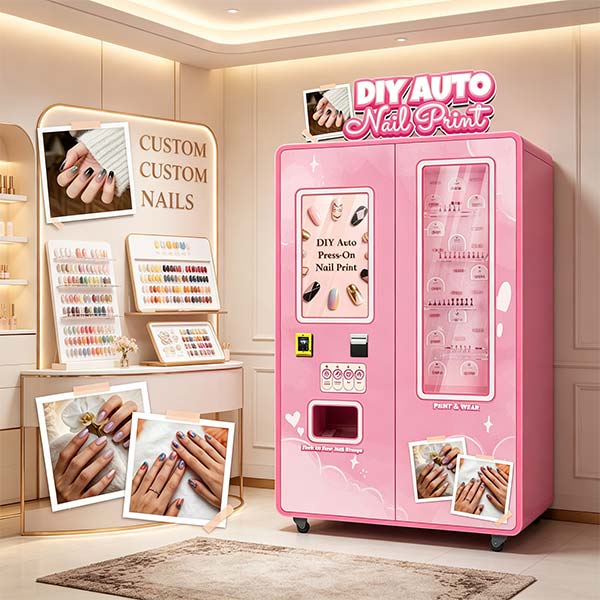
Payment behavior. The unit accepts bank cards, Apple Pay, Google Pay, WeChat Pay, Alipay, QR codes, NFC and the MDB protocol used by most vending payment peripherals. Airport and mall audiences rarely carry cash, and a card-only audience standing next to a coin-only kiosk is lost revenue. Cashless acceptance is covered in more depth in this guide to paying at a vending machine with a phone.
Restocking distance. The machine holds 720 pairs of press-on nails, mixing plain and pre-designed stock. Run it at the maximum 200 orders a day and the cabinet empties in under four days. At 45 orders a day it lasts around 16 days. One 250ml bottle of UV hard ink covers roughly 5,000 pairs, and a full six-bottle set (four colors plus two sealants) costs US$85. A site two hours from the warehouse is a different business from a site twenty minutes away.
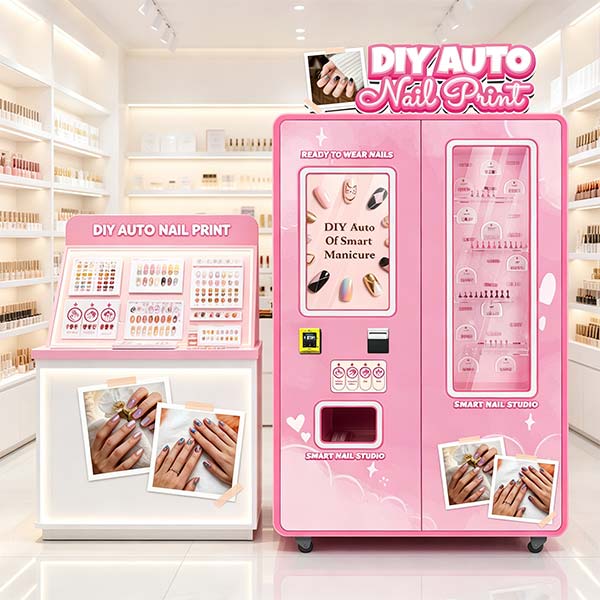
Physical fit. The cabinet occupies roughly 1.5 square meters of floor, against more than 10 square meters for a salon workstation doing comparable volume, and it runs unattended around the clock. That compactness opens up corridors, alcoves and underused corners that a lease normally writes off. It also means the site needs a real power drop close by, a network connection for photo uploads and the IoT dashboard, and permission to run a lit 27-inch screen in public view.
How this ranking was assembled
The order below comes from three inputs: the manufacturer’s published specification for the WM860, deployment records from installed units in mall and holiday-promotion settings, and the placement pattern reported across the Wider Matrix cabinet range, which has shipped to more than 130 countries since 2016. Where a figure is an estimate rather than a recorded result, it is labeled as one.
The headline ROI table issued by the manufacturer is useful as a planning baseline and should not be treated as a forecast. It assumes clean execution: no machine downtime, no stock-outs, a price point the local market accepts, and a site that performs at or above the average of the reference deployments. Operators who want a more neutral starting point should read up on whether vending machines are profitable before modeling returns on any single site.
| Scenario | Location type | Typical dwell | Main constraint | Specification that matters most |
|---|---|---|---|---|
| 1 | Shopping malls and lifestyle centers | 60 to 90 minutes | Kiosk rent and exclusivity clauses | 720-pair inventory supports high daily volume |
| 2 | Beauty salons, nail studios, beauty supply stores | 45 to 120 minutes | Floor space and staff buy-in | 5-minute cycle versus 60 to 120 minutes by hand |
| 3 | Airports, railway stations, hotel lobbies | 60 to 120 minutes | Rent, access permits, restocking escorts | Card, NFC and MDB payment support |
| 4 | Cinemas, arcades, family entertainment centers | 15 to 30 minutes before showtime | Weekday troughs outside school holidays | 200 orders per day ceiling during peaks |
| 5 | University campuses and student districts | 20 to 60 minutes between classes | Semester calendar leaves long dead periods | 48 built-in designs plus Wi-Fi photo upload |
| 6 | Tourist attractions, expos, seasonal events | 30 to 90 minutes | Short trading windows and weather exposure | Compact footprint and quick redeployment |
The dwell ranges are planning assumptions used to compare scenarios, not measured figures. Anyone comparing two specific sites should time the foot traffic directly. A practical method is set out in this guide on finding vending machine locations, and the broader catalogue of venue types sits in the company’s breakdown of the best locations for vending machines.
Scenario 1: Shopping malls and lifestyle centers
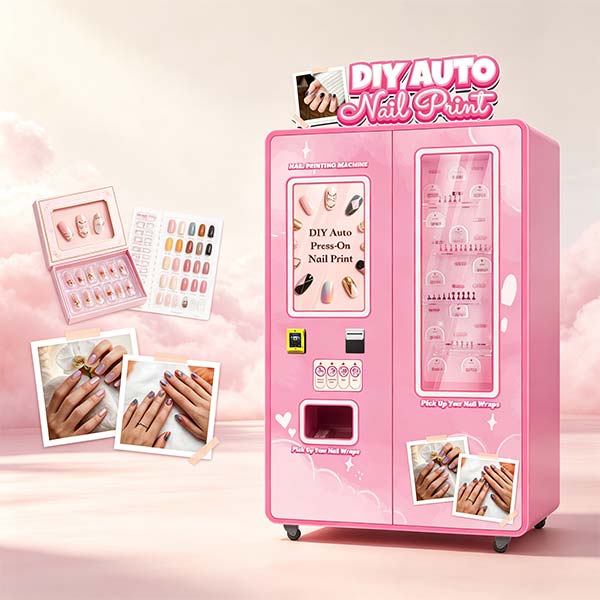
Malls remain the default answer because they supply all five conditions at once. Visitors arrive with time to spend, the female fashion and beauty tenant mix pre-selects the audience, and the food court and cinema extend the visit past the point where impulse spending happens. For a nail art vending machine in a shopping mall, the setting also solves the exposure problem: the customer sees the unit on the way in, thinks about it, and buys on the way out. The WM860 needs about 1.5 square meters, which in practice means a kiosk pod, an alcove beside a bank of escalators, or the corridor outside a restroom block, all of which mall managers treat as low-value space.
Placement inside the mall matters more than which mall. A unit facing the walkway between the food court and the women’s fashion section sees every visitor twice, once on the way in and once on the way out. A unit tucked beside a service lift sees staff. The 27-inch capacitive touchscreen at 1920 by 1080 resolution is bright enough to pull attention from several meters away, and the Wi-Fi photo upload flow gives passers-by something to watch, which is the closest thing this category has to free advertising.
The financial case rests on the price of a set. Press-on nails in the plain range cost around US$1.00 a pair at 1,000 units and US$0.80 at 8,000 units, with cat eye and gem styles running from US$1.50 down to US$1.30. Tool kits cost US$0.30. Against a retail price of US$10, that leaves roughly US$8.50 gross before venue costs. A site averaging 45 orders a day, which is what the Dubai mall record shows, produces about US$450 a day in revenue and US$315 after consumables and a 15 percent revenue share to the venue. That is the arithmetic behind the 15-day payback reported on that installation, and it is the number to take into a negotiation.
What to watch. Exclusivity is the first trap. Many malls have an existing nail salon or beauty kiosk tenant holding a clause that blocks competing services, and a printed press-on set can be argued either way. Get the clause reviewed before the deposit. The second trap is positioning the unit as a vending machine rather than a service: mall leasing teams price the two very differently, and the operator who walks in with a floor plan, a power requirement and a revenue share proposal tends to close faster than the one asking for a quote. The third is the temperature of the corridor. A mall corridor at 22 degrees Celsius is a fine home for UV ink. A semi-open walkway in summer heat is not, and the same restriction applies to other heat-sensitive units in the range, which is why the placement advice for a mall-based customization kiosk stresses shade, airflow and stable power.
Multi-site operators get one more advantage here. The IoT dashboard monitors sales, ink levels and inventory across more than 100 machines from a browser, so a chain of mall kiosks can be run by one person with a van and a restocking route. That detail decides how many sites a single operator can hold, and it is the practical reason the mall route scales in a way that static retail does not.
Scenario 2: Beauty salons, nail studios and beauty supply stores
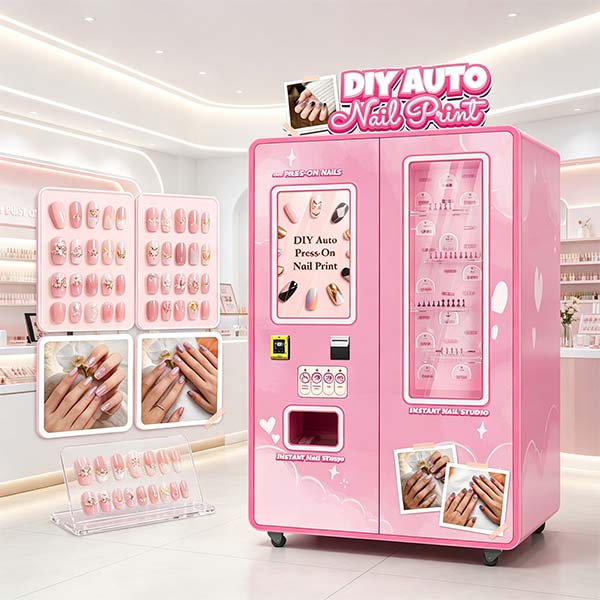
The second-best location for a nail art vending machine is a business that already sells nail services or nail products, because the customer arrives with intent and no persuasion is required. Conversion is high and marketing cost is close to zero. The trade-off is volume: a salon handles a fraction of the traffic a mall does, so revenue depends on capturing the walk-in and the “I don’t have time today” customer rather than on raw footfall.
The efficiency of the machine is the entire argument. A technician working by hand produces one set every 60 to 120 minutes. The WM860 produces one in about five minutes, with 30-second UV-LED curing that leaves the print dry to the touch straight out of the machine. A salon that puts the unit by the reception desk can serve the customer who wants nails today but cannot wait two hours, and it can serve her at 11pm when the shutters are down, because the unit runs unattended. Because the unit runs unattended, the salon keeps selling after the shutters come down, which is revenue the chairs cannot reach.
Beauty supply stores and cosmetics floors follow the same logic with a different revenue mix. The store sells the maintenance, the machine sells the set. The unit holds 720 pairs of press-on nails, plain and pre-designed, so the store can stock styles that match what is on the shelves and let the machine do the demonstrating. Run as a press-on nail vending machine, it also turns a shelf of packaged product into a service that a customer can walk away wearing. The 48 built-in designs cover French, 3D cat eye and similar patterns, and new designs can be pushed over the air without a technician visiting.
What to watch. A salon owner is not an operator, and a machine that runs out of stock on a Saturday afternoon damages the host brand as much as the machine owner’s revenue. The IoT inventory alert removes most of that risk, and a restocking agreement in writing removes the rest. Space is the second constraint. Salons are dense with equipment, and the unit needs a clear 1.5 square meters plus a standing area in front of it; the space beside the reception seating is usually the only viable option.
A custom branded nail art vending machine is what turns this scenario from a placement into a partnership. Panels, interface language and welcome screens can carry the salon’s identity, and a co-labeled set at a US$12 to US$15 price point usually beats the same machine running generic stock. Operators weighing that route will find the commercial logic in the discussion of the most profitable vending machine to own, where service and personalization kiosks consistently outrank snack and drink machines on margin per square meter.
Scenario 3: Airports, railway stations and hotel lobbies
Transit and hospitality sites offer the highest raw footfall on this list for a nail art vending machine, and the lowest conversion rate. An airport terminal moves tens of thousands of people a day, but most of them are focused on a gate, a bag or a boarding time. The venue earns its place through dwell rather than volume: the passenger who clears security two hours early is the single best captive audience in commercial property.
The machine fits that environment well. It is card and NFC native, which matters when the audience is international and the local currency is unfamiliar. A 27-inch screen reads from a distance in a busy concourse. The five-minute cycle is shorter than the average time a passenger stands in a coffee queue, and the output is small and dry, so it travels. The unit also runs unattended, which suits a site where staffed retail closes overnight even though people keep walking past.
Hotel lobbies sit in the same category with a different rhythm. A breakfast area at 8am is useless; the same space at 7pm, with guests waiting for a taxi or a table, is a captive audience with an hour to fill. Spa hotels do better still, because the guest has already scheduled self-care into the trip.
What to watch. Access is the real cost at these sites, not rent. Restocking an airside unit means a security pass, an escort and a scheduled visit; a unit that needs ink before a 5am flight and cannot get it is a dead unit. Plan the 720-pair inventory against the restocking window rather than against the sales rate. Concession contracts at airports are also typically awarded for longer terms with stricter performance clauses than a mall kiosk, so the pilot should run before the signature. Twenty-four-hour public areas in railway stations are more forgiving, though they come with vandalism exposure and a higher case for insurance.
Scenario 4: Cinemas, arcades and family entertainment centers
Entertainment venues have a shorter dwell window than a mall but far less competition for attention. The twenty minutes before a screening, the hour at a birthday party, the queue at an arcade machine: these are gaps where a group is standing around with phones out and nothing scheduled. That is precisely the moment a nail art vending machine monetises, and it is a moment that happens several times a day rather than once.
Concessions usually share a corridor, which makes the site work harder. A popcorn unit at an entrance pulls families in, and a nail printing unit fifty meters further along captures the teenage and young adult traffic that walks past the snack queue without buying. Site owners who already run a snack machine should read the placement notes for a candy vending machine, because the same logic applies here: put the impulse unit where people queue, not where they exit.
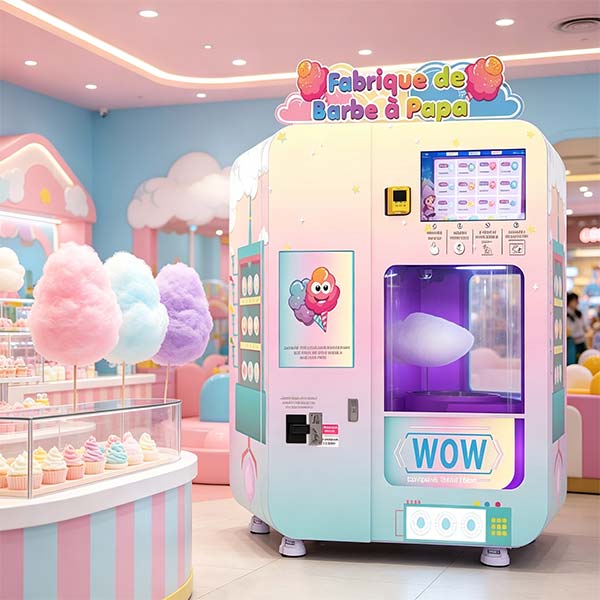
A nail art vending machine also does particularly well in family entertainment centers with a birthday party business. Parties produce clusters of eight to twelve guests arriving together, a parent who needs to fill twenty minutes, and a natural photo opportunity at collection. At a US$10 price point the maths per party is small, but the frequency is high and the labour is nil, which is more than can be said for most entertainment venue add-ons.
What to watch. Cinema sites live and die by the film slate and the school calendar. A strong release week can push a unit past 100 orders a day, and a quiet Tuesday in February can produce four. The 200 orders per day ceiling is not the constraint; the constraint is the length and frequency of the troughs. Venues that mix cinema with arcade, bowling or trampoline activity smooth this out considerably, and those hybrid sites are the better long-term placement. Power and floor load are usually simple here, and the cabinet’s roughly 1.5 square meter footprint fits the dead corner next to a change machine that most operators ignore.
Scenario 5: University campuses and student districts
Campuses are the strongest underrated placement on this list. The audience is young, heavily female in the relevant demographic, price-sensitive but highly responsive to novelty, and physically present in the same few buildings five days a week for months at a time. A nail art vending machine in a student union building, a library foyer or a campus gym does not need advertising after the first week, because the customer returns with friends.
The unit suits student behavior in two specific ways. Photo upload runs over Wi-Fi with no app to install, so a customer can print a photo of a friend, a pet or a design from a social feed in under a minute of setup. And the price band sits where student spending actually happens: a set printed from the machine costs a fraction of a salon appointment, which is the main reason the category competes well against a full manicure service on a campus. The 48 built-in designs also mean the walk-up customer who has no photo ready still has something to buy.
Long vacations are the obvious weakness. A campus that empties for three months needs the machine to earn its keep in the other two semesters, and clearing 720 pairs of stock out of the cabinet for a season is a job in itself. The workaround most operators use is a second location, typically a mall kiosk or a beauty store. The wider case for treating a unit as a portable asset rather than a fixed one is covered in this piece on running a vending machine as a side business, and it applies to student sites more than most.
What to watch. Contracts. Campus space is often controlled by a student union or an amenities body rather than a commercial landlord, and their procurement process has its own rules about permits, insurance and revenue split. Start the conversation a full term before the intended installation. Power and network access are usually excellent in newer campus buildings and occasionally nonexistent in heritage ones, so check the socket before believing the floor plan.
Scenario 6: Tourist attractions, expos and seasonal events
Event and attraction placement of a nail art vending machine trades stability for intensity. A holiday promotion generated 200 orders a day on a Bangkok unit, which is the fastest payback in the manufacturer’s records at roughly five days. That result came from a dense crowd, a festive mood and a short window in which nobody was doing anything else. Operators who chase that number should understand what they are buying: a spike followed by a decision about where the machine goes next.
The physical specification supports the tactic. The cabinet is compact enough to move on a pallet and light enough to reposition with the right equipment, and the 24-hour unattended operation means an event site does not need staff on the stand. Swap the press-on nail stock to seasonal styles before the event, push updated designs over the air, and the unit reads as local rather than imported. Tourism sites with a captive audience, such as a boardwalk, a theme park mid-route or a night market with a fixed walkway, behave closest to the Bangkok case.
What to watch. The WM860 is specified for indoor commercial use, so an outdoor pitch needs a sheltered kiosk with stable power and protection from direct sun and rain. UV ink and press-on adhesive both prefer a controlled temperature. Event organizers charge for the pitch, and a flat fee on a rain-affected weekend can wipe out the margin entirely, so a percentage arrangement is the safer structure. For cross-border work, check electrical certification: the unit ships with CE marking, which covers most European event sites but not every jurisdiction.
What a site has to provide before a nail art vending machine goes in
Placement decisions usually fail on logistics rather than on traffic. A short checklist before committing to a site prevents most of the expensive surprises.
- Floor area. About 1.5 square meters for the cabinet, plus a clear standing zone of roughly one meter in front for the customer to use the touchscreen and collect the set. Two people need to be able to stop there without blocking a walkway.
- Power. A dedicated circuit close to the pitch. Cabinet weights and power draw vary across the wider range, from 70 kg on the popcorn unit WM680 up to 640 kg on the ice cream model WM550, so a site that has hosted equipment before usually has the infrastructure already. Confirm the exact voltage configuration for the destination market on the unit being shipped, since the range supports both 110V and 220V depending on the model.
- Network. Wi-Fi or a wired connection for photo upload and for the IoT dashboard that reports sales, ink levels and inventory. Without it the machine still sells, but remote monitoring and over-the-air design updates stop working, which is most of the value of running a fleet.
- Floor loading and access. Ground floor or service lift access for delivery. Upper-floor pitches in older buildings need a floor-load check before the unit is ordered, particularly where the building was not designed for commercial equipment.
- Sightlines. The 27-inch screen should face the direction of the heaviest traffic flow, and the collection point should not open onto a walkway where a queue would block people. Vending placement in this category is a visibility problem before it is a sales problem.
- Permission to operate. Lease terms, insurance, signage rules and, in some markets, a vending or amusement license. The requirements differ by city and by venue type, and the general position is set out in this guide on where a vending machine can legally be placed.
Photo handling comes up at most site visits. Upload runs over Wi-Fi from the phone browser with no app to install, and the machine’s AI handles finger positioning, so a first-time customer can start in under a minute. The 48 built-in designs cover the customer who arrives with nothing prepared. More on the control system sits in this piece on how a smart vending machine works.
What a location has to produce for a nail art vending machine to pay
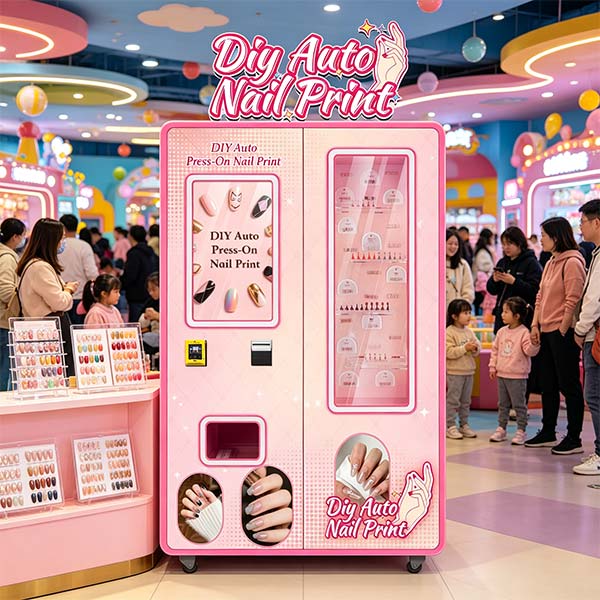
Unit pricing for the WM860 sits at US$5,800 for one to four machines, US$5,500 for five to nine, and US$5,200 for ten or more. Consumables are modest and predictable: US$1.50 or less per pair of nails depending on style and volume, US$0.30 for a tool kit, and US$85 for a six-bottle ink set that prints around 5,000 pairs. Full cost context for this category of equipment is summarised in the guide to how much vending machines cost.
| Daily orders | Retail price | Daily revenue | Daily profit | Monthly profit | Payback |
|---|---|---|---|---|---|
| 30 | US$8 | US$240 | US$195 | US$5,850 | About 30 days |
| 70 | US$10 | US$700 | US$595 | US$17,850 | About 15 days |
| 120 | US$10 | US$1,200 | US$1,020 | US$30,600 | About 8 days |
| 200 | US$12 | US$2,400 | US$2,100 | US$63,000 | About 5 days |
These are the manufacturer’s figures, calculated before venue payments, electricity, insurance, restocking labour and any local tax. Two adjustments make them usable in practice. First, subtract the venue’s cut, which in a mall is commonly a percentage of gross revenue rather than a fixed rent. At US$10 a pair with US$1.50 in materials, a 15 percent share leaves about US$7 in gross margin per set; a 30 percent share leaves US$5.50, and the difference over a year is larger than the price of the machine.
Second, treat the top row as the honest planning case. Thirty orders a day is a modest site, and it still returns the purchase price within a month on these margins. The 200-order rows reflect a promotional peak on an exceptional site, and no operator should sign a five-year lease against a holiday week.
One structural advantage is worth pricing in. The unit carries no staff cost and no dependence on counter opening hours, where a staffed nail bar needs a technician present for every transaction and pays rent on the floor space to host one. The manufacturer’s comparison puts payback at 5 to 15 days for the machine against 18 to 24 months for a salon fit-out. The first figure assumes everything goes right. The second is the cost base that most operators are trying to get away from.
Negotiating the pitch for a nail art vending machine
Most venue conversations come down to one of three structures: a flat monthly fee, a percentage of gross revenue, or free placement in exchange for footfall. Free placement exists, and the guide to whether vending machine locations are free sets out the cases where it is realistic, but it rarely applies to a machine that draws its own customers. A percentage arrangement is usually the better deal for the operator, because it aligns the venue’s incentive with the machine’s performance and puts a ceiling on a bad month.
Work out the acceptable ceiling before the meeting. Take the site’s realistic low-case daily orders, multiply by the ticket price, subtract consumables, and find the venue share at which the payback period stretches past 12 months. That number is the walk-away point. Operators who negotiate the other way around, starting with what the venue asks and working backwards, usually overpay, and the wider tactics are collected in this piece on how much to pay a location.
Whichever structure is agreed, ask for a short trial period. Thirty days at a clearly defined pitch gives both sides real data, and the machine can be moved. A trial also changes the conversation about exclusivity, because the venue is not granting a long-term right, and it lets the operator test the two variables that matter most: the actual order rate at that pitch and the actual time it takes to restock.
Track four numbers during the trial. Orders per day against footfall, to see whether the traffic is converting. Average order value, to see whether the local market accepts the US$8 to US$15 band or pushes back at the lower end. Stock consumption, to set the restocking cadence. And peak hours, because a site that sells everything between 6pm and 9pm needs a different staffing plan from one that sells evenly across the day.
Locations that look promising and rarely work
The same five conditions explain the failures as well as the wins. These are the placements that come up often in conversation and rarely in the success column.
- Office tower lobbies. Traffic arrives in two fifteen-minute bursts and leaves in one, and almost nobody lingers. A nail set takes five minutes and a decision, and the commuter at 8:50am has neither.
- Gym entrances. The audience is in a hurry, often wet, and has just handled equipment. The parallel case is instructive, because the machine that does work in a gym sells a product the member consumes on the spot; a protein shake unit dispenses in about 60 seconds from seven hoppers, which is a different transaction entirely from a printed nail set.
- Convenience stores and gas stations. High foot traffic, no dwell. The customer is on a task and the machine competes with a queue that moves faster than five minutes.
- Dead-end corridors and back-of-store alcoves. Cheap space is only cheap if someone walks past it. If the pitch is invisible from the main route, the saving on rent is worth less than the lost orders.
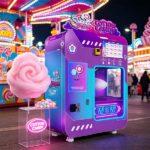
- Exposed outdoor pitches without a shelter. Heat, dust and direct sun work against UV ink, adhesive stock and screen reliability. The range includes hardware built for outdoor use, such as the WM668 cotton candy unit with its rainproof roof and high-brightness display, and the difference between indoor and outdoor specification is not cosmetic.
When the site suits a different machine
Not every host location wants nails, and forcing the fit costs more than it earns. A venue with strong family traffic but a weak beauty angle often performs better with a snack or novelty unit alongside the nail printer, or instead of it. The range covers most of those adjacencies, and the same IoT dashboard manages a mixed fleet as easily as a single product type.
| Model | Product | Unit price | Capacity and weight | Site that suits it |
|---|---|---|---|---|
| WM680 | Popcorn | US$1,800 | 5.6 kg corn, 140 cups, 70 kg | Cinema and entertainment corridors |
| WM688 | Balloons | US$3,200 | 360 balloons across 6 slots, 110 kg | Family venues, parks, seasonal events |
| Mini ice cream | Ice cream | US$4,400 | 90 cups per batch, 100 g serve, about 240 kg | Malls and tourist sites in warm markets |
| WM980 | Cotton candy | US$4,800 | 36 patterns, 28 to 30 g sugar per candy, 300 kg | High-dwell family and event traffic |
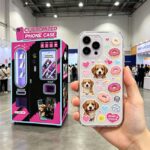
| WM880 | Custom phone cases | US$4,999 and up | 1,020 to 1,025 cases, 380 kg | Malls and commercial centers with young traffic |
| WM520+ | Photo jigsaw puzzles | US$5,500 | 208 puzzles, 140 frames, 370 kg | Gift shops, museums, tourist attractions |
| WM186 | Protein shakes | US$4,150 | 7 hoppers of 4 liters, 60 seconds per cup | Gyms and sports centers |
The pattern to notice is that personalization units and food units behave differently on the same site. Food sells to whoever walks past at the right moment. Personalisation sells to whoever has time to make a decision, which is why the nail printer belongs in the high-dwell part of a venue and a snack unit belongs where people queue. The full catalogue sits under the vending machine range, and individual configurations can be compared on the product shop page.
About the manufacturer behind these numbers
Wider Matrix, formally Wider Matrix (GZ) Technology Co., Ltd, has been building automated retail equipment in Guangzhou since 2016 and runs its own factory in Panyu District. That is why the specification sheets quoted in this article read as engineering documents rather than marketing copy. The company reports more than 3,000 units shipped to over 130 countries, an engineering team of more than 50 people, and a 1-year warranty with lifetime technical support on the machines themselves. The WM860 carries CE marking and accepts the payment rails that matter in most markets, including cards, Apple Pay, Google Pay, WeChat Pay, Alipay, QR, NFC and MDB peripherals.
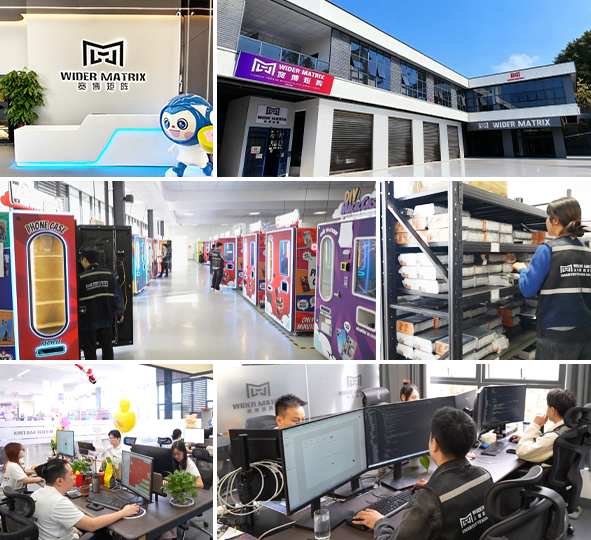
Two of those details matter for the placement decision rather than for the purchase. Factory-direct supply keeps consumable pricing stable, which is what makes the US$1.50 material cost per set defensible over a multi-year lease, and the cloud dashboard that monitors sales, ink and inventory across more than 100 machines is what makes a kiosk network manageable by a small team. Longer background on the company is available on the Wider Matrix profile page, and specification requests and floor-plan reviews go through the contact desk.
FAQ: nail art vending machine locations
Q: What is the single best location for a nail art vending machine?
A: A kiosk pitch inside a mid-size shopping mall, positioned on the walkway between the food court and the women’s fashion section. That position combines dwell time, audience match and existing footfall, and mall deployment records show about 45 orders a day at this kind of site.
Q: How much does a nail art vending machine cost?
A: The WM860 lists at US$5,800 for one to four units, US$5,500 for five to nine and US$5,200 at ten or more. Consumables run to about US$1.50 per set of nails, US$0.30 for a tool kit and US$85 for a six-bottle ink set that prints roughly 5,000 pairs.
Q: Is a nail printer vending machine the same product as a nail art vending machine?
A: The two names describe the same category. The unit prints onto press-on nails with a 600 dpi UV head, so suppliers may list it as a nail printer, a nail art printing machine or an automatic nail art vending machine. When comparing quotes, look at the print head model, the ink system and how many designs the software ships with.
Q: How much foot traffic does a nail art vending machine need to be profitable?
A: Traffic volume is less important than audience match and dwell. Thirty orders a day returns the machine’s purchase price in about a month on the manufacturer’s model, and thirty orders a day is a modest site. A venue with fewer visitors who stay longer will usually beat a venue with more visitors passing through.
Q: Do nail art vending machines work in beauty salons?
A: Yes, and conversion is high because the customer already intends to spend on nails. The volume is lower than a mall, so the machine’s value is in serving the walk-in and the after-hours customer that the salon’s chairs cannot reach, rather than in replacing the technician.
Q: How long does one customer spend at the machine?
A: About five minutes, against 60 to 120 minutes for a traditional salon appointment. The UV-LED curing step takes 30 seconds and leaves the print dry, so there is no waiting period after collection.
Q: How many sets can the machine produce in a day?
A: More than 200 orders a day at ceiling. In practice the queue decides, which is why the five-minute cycle and the site’s dwell time are the two numbers to check together.
Q: How often does the machine need restocking?
A: It holds 720 pairs of press-on nails. At 45 orders a day that is roughly 16 days of stock; at the 200-order ceiling it is under four days. Ink is lighter on labour, with one 250ml bottle covering about 5,000 pairs and a six-bottle set priced at US$85.
Q: What floor space and power does the machine require?
A: Roughly 1.5 square meters of floor plus a standing zone in front, and a dedicated power circuit close to the pitch. Cabinet weight and electrical configuration vary across the range, so confirm the exact voltage for the destination market before the site is approved.
Q: Can the machine take card payments, and does it need cash?
A: It accepts bank cards, Apple Pay, Google Pay, WeChat Pay, Alipay, QR codes, NFC and MDB peripherals. Cash support can be configured, but mall, airport and campus audiences increasingly expect cashless, and a card-ready machine loses nothing by skipping the coin mechanism.
Q: Can a venue brand the machine as its own?
A: Yes. Panels, interface language and welcome screens can carry the host’s identity, which is the arrangement most salons and beauty retailers prefer. It also allows co-branded press-on stock priced at the higher end of the US$8 to US$15 band.
Q: How many machines can one operator manage?
A: The cloud dashboard reports sales, ink levels and inventory for more than 100 machines from a browser, so the practical limit is the restocking route rather than the monitoring workload. Most operators start with one unit, prove the pitch, then add locations within the same restocking radius.
Q: How long does it take for a nail art vending machine to pay for itself?
A: The manufacturer’s model shows payback between 5 and 15 days on strong sites and around 30 days at 30 orders a day. Those figures exclude venue payments, electricity and labour, so a realistic plan should allow three months before treating an installation as proven.
Q: What should be checked at a site visit before signing anything?
A: Floor area, socket location and circuit capacity, network coverage, delivery access, sightlines from the main traffic route, the venue’s exclusivity clauses, and the time it takes to get a restocking van to the pitch. The last item is the one most often forgotten and the one that causes the most downtime.
Where to go from here
Take the shortlist for the nail art vending machine, apply the five conditions in the order they appear above, and time the foot traffic at the two or three best candidates rather than trusting a leasing agent’s visitor numbers. Then run the rental arithmetic at a low order estimate, not the average one, and take the result into the venue conversation. A pitch that works at 30 orders a day survives a bad quarter. A pitch that only works at 120 does not.
For site-specific numbers, including the specification sheet for the WM860, consumable pricing at volume, and a review of a proposed floor plan, the manufacturer’s team handles enquiries directly and can usually say within a day whether a pitch is viable.