




How long does a jigsaw puzzle vending machine take to make one custom puzzle?
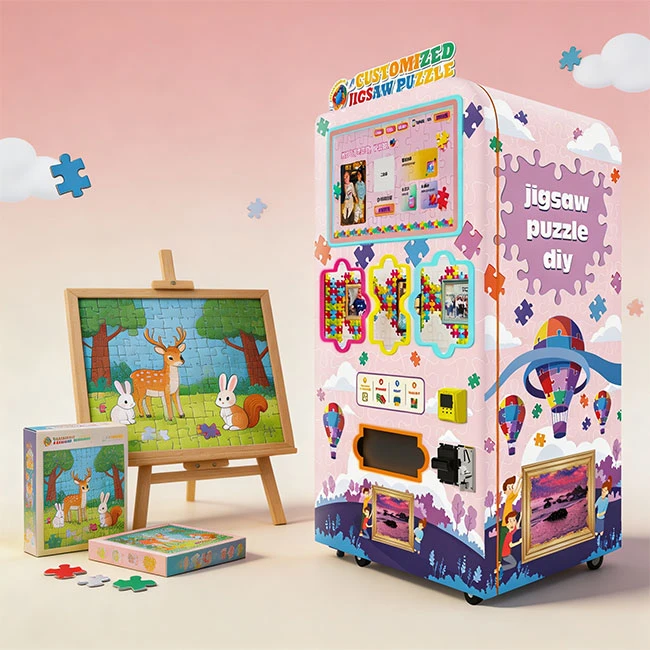
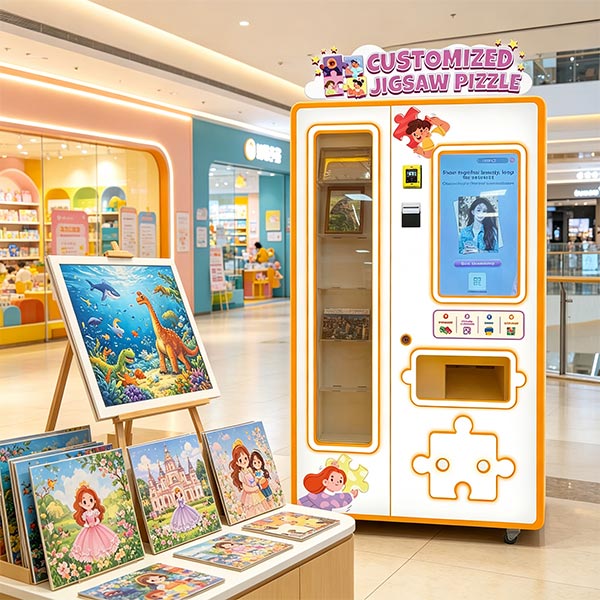
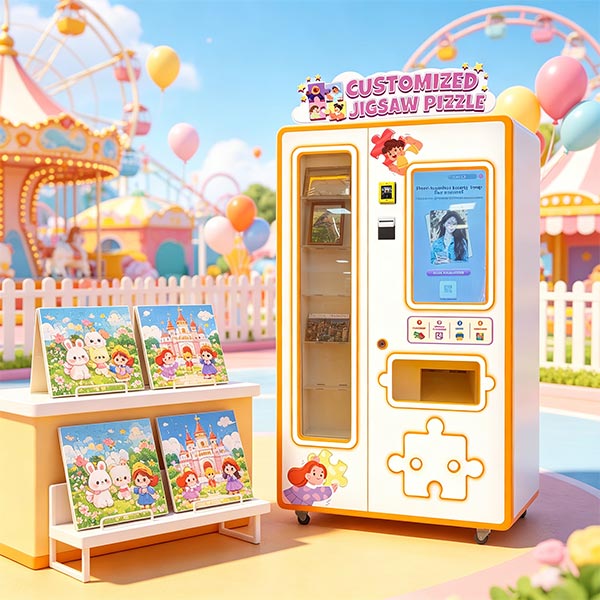
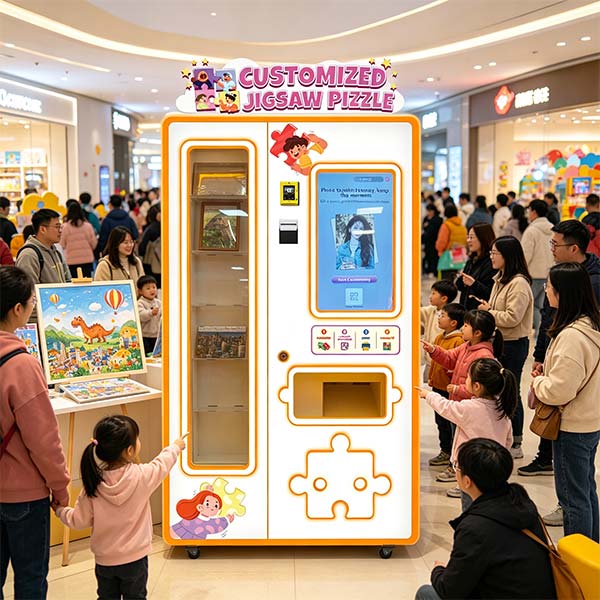
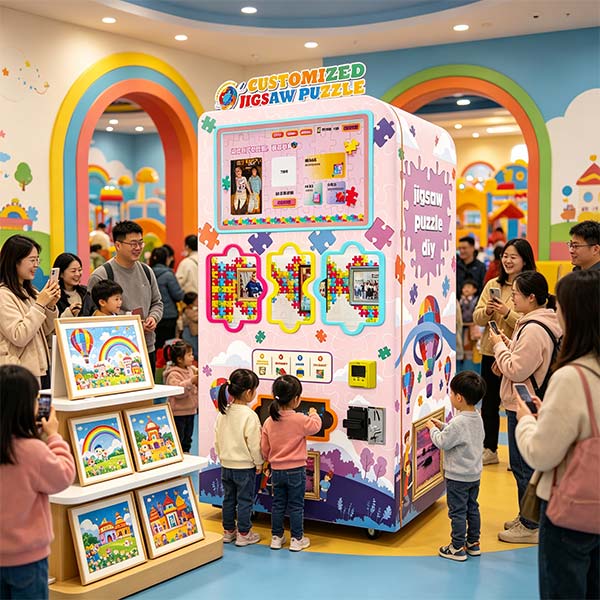
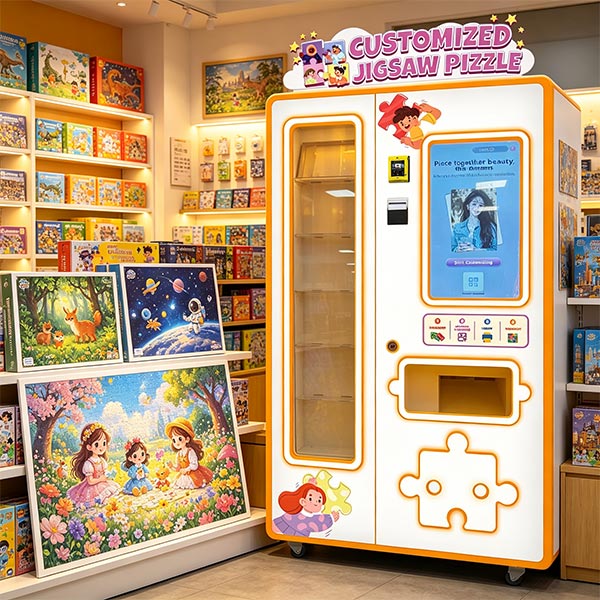
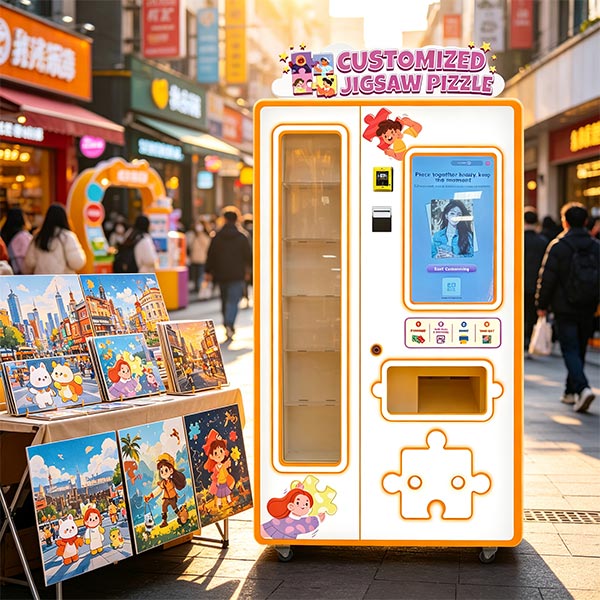
Every project is unique — tell us your needs and we'll provide a tailored solution.
- 🧩 Hundreds of puzzle designs, seasonally updated
- 🌍 Shipped to 130+ countries worldwide
- 🤝 Dedicated account manager for your project
- 💰 Contact us for the latest promotional pricing
Our partners typically recover their investment within 2–4 months. Start earning from day one with a proven, low-maintenance puzzle vending solution.
About three minutes. That is the number worth building a plan around, and it is the figure that decides how many customers a single machine can serve before the queue forms. On the WM520 and the newer WM520+ built by Wider Matrix, a customer’s photo becomes a finished A5 jigsaw puzzle in roughly 180 seconds of print time, and the full visit, from the first tap on the screen to walking away with the puzzle in a frame, usually runs five to six minutes.
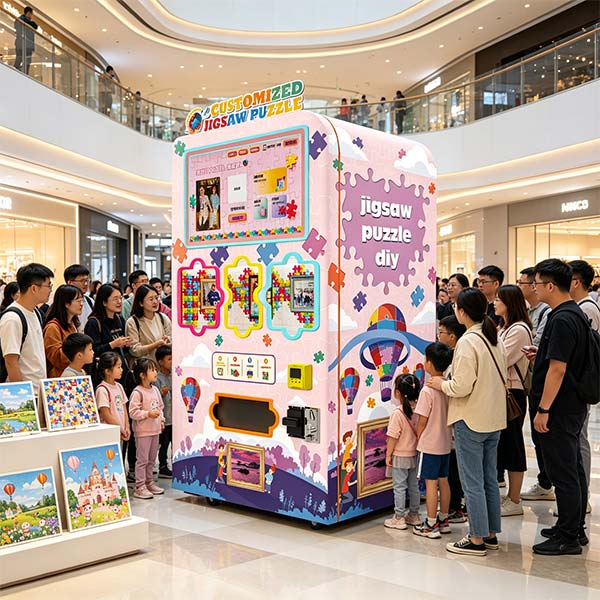
For most buyers weighing a purchase, the WM520+ is the model to look at first, because it prints on paper stock with a six-color head and carries a 27-inch touchscreen, while the older WM520 suits operators who already sell wooden puzzles and want the lower entry price. Anyone quoting “a few seconds” is describing a sticker printer, and anyone quoting ten minutes is describing a machine doing something else entirely. Below is what sits inside those three minutes, where the time goes when the machine is busy, and what realistic hourly output looks like at three different kinds of site.
What the three minutes actually cover
The print itself is only one part of the cycle, and buyers who conflate the two end up with the wrong throughput projection. A customer walks up to the interface, chooses a puzzle size and a frame style, uploads a photo from a phone or USB stick, pays, and then waits while the machine prints and drops the puzzle and the frame through the dispenser. The printing stage is the three-minute figure. Everything around it adds the rest.
Two details inside that stage are worth knowing. The WM520+ runs an F1080 print head with a six-color scheme, CMYK plus light cyan and light magenta, at a resolution of 1748 x 2480 dpi, and the machine’s software adjusts contrast, sharpness and color balance before the file reaches the head. The WM520 uses an XP600 head with four-color CMYK at 5760 x 1440 dpi and prints on wooden blanks with pigment ink. Both run at the same three minutes per sheet, so the difference between the generations shows up in finish quality and materials rather than in speed. That is a useful thing to understand early: paying more for the WM520+ does not buy a faster machine, it buys a better-looking puzzle on a stock most operators find easier to sell.
| Print speed | 3 minutes per sheet (both generations) |
| Resolution, WM520+ | 1748 x 2480 dpi, six-color CMYK + LC + LM |
| Resolution, WM520 | 5760 x 1440 dpi, four-color CMYK |
| Print media | Paper puzzle on German blue card stock (WM520+) or wooden puzzle (WM520) |
| Puzzle size | A5, 210 x 148 mm |
| Machine weight | 370 kg |
| Power | 245W, 220V standard or 110V optional |
| Display | 27-inch touchscreen (WM520+), touchscreen (WM520) |
| Puzzle capacity | 208 puzzles |
| Frame capacity | 140 frames, two styles (WM520+) |
| Inkwell capacity | 600 puzzles per fill |
| Payment | Nayax card, banknote, coin and code support |
| Monitoring | SRRS cloud system with remote status and predictive maintenance |
If the plan is to sell these as a route rather than run one machine, the numbers that matter most on that list are the 208-puzzle capacity and the 600-puzzle inkwell, because both determine how often someone has to drive to the site and refill it. More on that in the third use case below.
Use case one: a mall kiosk on a busy weekend
A shopping mall is where most people first see a jigsaw puzzle vending machine working, and it is also the easiest place to underestimate the queue. On a Saturday afternoon with steady foot traffic, the constraint is not the printer, it is the customer standing in front of it deciding which photo to use. The three-minute print runs while the next person is still choosing, so a machine does not sit idle between sales unless the site is dead.
Work the numbers on a busy day. If a customer spends about two minutes on selection, upload and payment, and the machine then prints for three minutes, one cycle is roughly five minutes. That allows up to twelve puzzles an hour if people keep arriving, and a realistic mall figure is closer to six to ten, since traffic never flows evenly and the machine can only serve one person at a time. At ten puzzles a day across a full trading week, a machine produces around 300 puzzles a month. At a retail price of $9.90 to $20 per custom puzzle, that is the kind of volume that recovers the machine cost inside the first few months, which is why the manufacturer quotes a one-to-three month payback period for high-traffic sites.
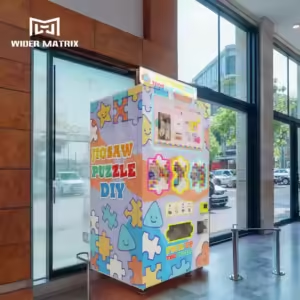
The physical spec matters here more than it does in a quieter venue. At 370 kg, the machine does not move once positioned, so the flooring and the loading route into the mall need checking before delivery. The footprint on the WM520+ is 970 x 1100 mm, and the machine stands 2200 mm tall, which puts the 27-inch screen at eye level for most adults and makes the upload step fast. Those dimensions are worth measuring against a mall’s allowance for kiosk space before signing a placement agreement, because a machine that does not fit the allocated spot is a problem no amount of good software can fix.
Use case two: a tourist attraction, zoo or aquarium
Tourist sites behave differently from malls. Traffic is spikier, the crowd changes week to week, and visitors are often buying a memento rather than a product. A photo turned into a puzzle, framed and taken home the same afternoon, fits that behaviour well, and the three-minute print is fast enough that families do not walk away mid-purchase.
The feature that carries the most weight in this setting is the frame. The WM520+ holds 140 photo frames in two styles, on top of the 208 puzzles on board, so a visitor can buy a finished, ready-to-hang object rather than a loose puzzle. That changes the price point a site can charge, because a framed puzzle sells as a gift and an unframed one sells as a toy. Two frame styles also give the operator something to test: if one style sells out every weekend and the other stalls, the reorder mix is obvious within a month.
Payment flexibility is the other thing to check at a tourist venue, because the crowd is international. The machines accept Nayax card payments, banknotes, coins and code-based payment, and the WM520+ handles multiple currencies and interface languages, including English, Russian, French, Arabic and Korean. A site near a cruise terminal or an international airport draws people who carry three different currencies in a day, and a machine that only takes coins will lose a meaningful share of them. Operators pricing a machine for this kind of venue should treat payment coverage and language options as specification items, not afterthoughts.
The unattended side of the design matters too. A tourist site often wants a machine running before staff arrive and long after they leave, and the machine is built for 24-hour operation without an attendant. Remote monitoring through the SRRS cloud system reports equipment status and flags faults, which means a jammed dispenser at 11 pm gets noticed before the morning crowd finds it.
Use case three: a distributor running several machines in one region
This is where the details that barely register on a single machine start to decide whether a route is worth running. An operator with eight machines in a city does not judge each unit on how fast it prints. They judge it on how often it needs a visit, how easy it is to see which site is struggling, and how much of the fleet can be serviced without a technician driving across town.
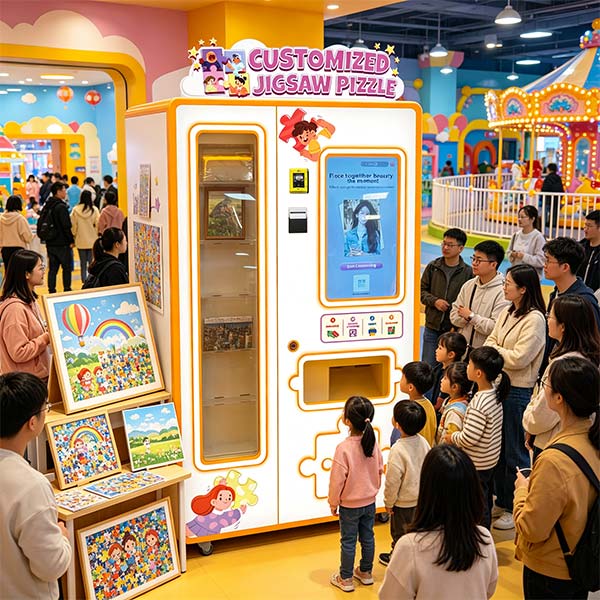
Start with the refill math. One inkwell fill covers 600 puzzles, and the machine holds 208 puzzles at a time, so the consumable load is roughly three full inventory turns per ink set. In a mall selling twenty puzzles a day, the puzzle stock needs topping up about every ten days and the frames every week. That is a manageable schedule for a route, and it is the reason consumables are where a distributor’s repeat revenue sits rather than the machine sale itself. A5 paper puzzles run $1.20 each at 1,000 to 4,999 units and fall to $1.00 at 10,000 to 20,000, while synthetic wood frames run $1.80 down to $1.50 across the same quantities. Against a retail price of $9.90 to $20, the spread per puzzle is wide enough that the route pays for its own running costs well before the machines are paid off.
Fleet visibility is the second lever. The SRRS cloud system puts equipment status, inventory template distribution and remote monitoring on a phone or PC, so a distributor can see which machine is low on frames, which one is printing fewer puzzles than last month, and which one has a fault developing. Predictive maintenance alerts are part of the WM520+ package, and on a fleet this is the difference between replacing a print head on schedule and finding out about a clogged head from an angry venue manager. Standard parts are shared across the range, and spare print heads, cards readers, bill validators and coin collectors are all stocked as items, which shortens the gap between a fault and a fix.
The third lever is branding. A distributor selling into several venues rarely wants every machine to look identical, and OEM and ODM work covers exterior wraps, machine skins, luminous character customization, user interface language, packaging and the vending software. A fleet can carry the distributor’s brand on the kiosk and the operator’s brand on the screen. For buyers comparing the cost of that work against a stock machine, the write-up on jigsaw puzzle making machine price sets out what changes the number and by how much.
How many puzzles can one machine really produce in an hour?
The honest answer sits between six and twelve, and the range depends on the venue rather than the hardware. The math is simple. Three minutes of printing plus roughly two minutes of customer interaction gives a cycle of about five minutes, and five minutes of cycle time allows twelve completed puzzles in an hour. No real site hits that ceiling for a full hour. A more useful planning figure is eight per hour during a genuine peak and two to four per hour across an ordinary trading day.
What the three-minute figure does not include is everything that happens before the machine starts printing. A customer who cannot find a good photo, or who uploads one at the wrong resolution and re-ups it, can add a minute or two on their own. The software on the WM520+ handles some of that by auto-adjusting the image, which reduces the number of customers who restart the upload, but it cannot help someone who is still scrolling through camera roll. The practical lesson is that throughput at a site is governed as much by the interface and the customer’s own preparation as by the print head.
Print resolution has no effect on the three-minute time on either generation, which surprises some buyers. The WM520+ prints at 1748 x 2480 dpi and the WM520 at 5760 x 1440 dpi, and both list three minutes per sheet. The trade the manufacturer made is quality per pass rather than speed, and for a vending environment that is the right call, because a customer will not stand at a kiosk for eight minutes even if the result is sharper.
WM520 and WM520+: what actually changes between the generations
| Model | WM520 (Generation 1) | WM520+ (Generation 2) |
| Print head | XP600, four-color CMYK | F1080, six-color CMYK + LC + LM |
| Resolution | 5760 x 1440 dpi | 1748 x 2480 dpi |
| Print media | Wooden puzzles, pigment ink | Paper puzzles, UV hard ink on German blue card stock |
| Print speed | 3 minutes per sheet | 3 minutes per sheet |
| Screen | Touchscreen | 27-inch touchscreen |
| Frame capacity | Not applicable | 140 frames, two styles |
| Smart features | PLC control, SRRS monitoring | AI image optimization, predictive maintenance, anti-clog design |
| Ink set | Pigment ink, 3000 ml, $100 per set | UV hard ink, six-color cartridge, $160 per set |
| Reference price | $5,550 | $5,500 |
| Weight | 370 kg | 370 kg |
The paper versus wood distinction is the one that tends to settle the decision. Wooden puzzles photograph well and feel substantial, but the material costs more and the four-color print shows less detail in gradients. Paper puzzles on the WM520+ reproduce photos more accurately, cost less per blank, and take a frame neatly, which is why the second generation is the model most new buyers choose. The wooden option still has a market, and operators already selling to collectors should weigh it seriously rather than defaulting to the newer machine. A closer look at the customized jigsaw puzzle vending machine WM520 covers the wooden route in more detail, and the head-to-head hardware breakdown sits in this comparison of the jigsaw puzzle printer machine.
What can slow a print down, and what cannot
Very little about the machine itself slows the three minutes down, which is worth saying plainly because it is the opposite of what many buyers expect. The print speed is fixed by the head and the media, and neither generation varies it by load, temperature or battery state. There is no charging cycle to plan around, since the machines run on mains power at 245W and stay plugged in.
The delays that do occur come from three places. The first is the customer, as covered above, when a photo has to be re-uploaded or a frame style has to be reconsidered at the payment screen. The second is the queue, which is not a slowdown in the machine but a limit on how many people it can serve in a given hour. The third is consumable management: a machine that runs out of frames mid-afternoon stops selling framed puzzles until someone restocks it, and the 140-frame capacity means a genuinely busy site can go through a shelf in under a week. None of these are faults in the printing process. They are the ordinary operating constraints of a vending business, and planning for them is what separates a machine that earns steadily from one that keeps disappointing the venue.
Genuine print faults do happen, and the design has answers for the common ones. The F1080 head on the WM520+ uses an anti-clog maintenance design, and the cloud system raises alerts when performance drifts, so a clog is usually caught before it ruins a customer’s puzzle. Wider Matrix provides a one-year warranty with lifetime technical support, a response time inside 24 hours, and a 7×24 after-sales line, along with installation guidance and operator training at handover. For a distributor, that support layer is the part that gets tested hardest, because the distributor is the one its own customers call.
Choosing a supplier before the three-minute figure matters
Speed is easy to quote and hard to verify, and a buyer who leads with the three-minute number will hear it echoed back by every supplier in the market. The more useful filter is whether the company selling the machine builds it. A trading company can quote a price and a print time, but it cannot explain where the head is integrated, which spare parts are stocked, or how the software handles a failed payment. A factory can answer all three, and it can show a production line rather than a catalogue photo.
Wider Matrix is the manufacturer behind the WM520 range, with equipment built in Guangzhou and units running in more than 130 countries. The company has shipped over 3,000 machines since 2016 and keeps more than 50 engineers on staff, which is why custom work is a routine order rather than a special request. Buyers who want to compare that against other suppliers will find a structured set of questions in this guide to choosing the right vending machine manufacturer, and the background on the company itself is on the Wider Matrix about page.
It also helps to know the shape of the market being sold into. The jigsaw puzzle market size has grown steadily, and the custom and personalised end of it is where a vending machine competes, rather than against mass-produced puzzle boxes on a retail shelf. That distinction matters at the pricing stage, because a machine selling a one-off personalised puzzle is not competing with a $15 box in a gift shop. Operators who want the revenue side spelled out can read through how money is made selling jigsaw puzzles, and the blunt version of whether it works at all is covered in this analysis of whether selling jigsaw puzzles is profitable.
Preparing a site around the three-minute cycle
The print takes three minutes, but the machine still has to be installed somewhere that lets it run. A few site details come up on almost every order, and getting them wrong costs more time than any difference between suppliers.
Power is the first. The machine draws 245W and runs on 220V as standard, with a 110V option for markets that need it. That is a modest load, closer to a large television than to commercial kitchen equipment, but it still needs a dedicated outlet rather than an extension lead shared with other kiosks. On a site where the machine runs unattended for long hours, an unswitched socket that nobody can accidentally turn off is worth arranging in advance.
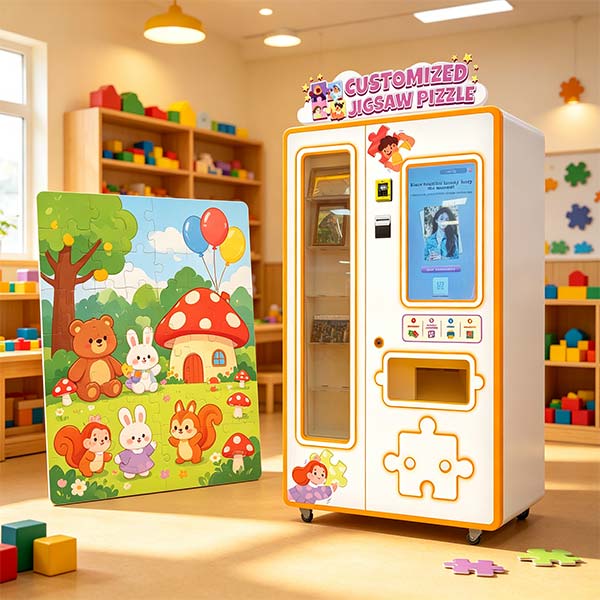
Space is the second, and weight sits behind it. The WM520+ measures 970 x 1100 x 2200 mm and the WM520 measures 1100 x 970 x 1950 mm, and both weigh 370 kg. A 370 kg unit on a soft or raised floor needs a load check, and the route from the delivery truck to the final position has to clear doors, lifts and corners. Buyers who have watched a machine get stuck in a service corridor once tend to measure twice on the next order, and it is a simple thing to avoid.
Connectivity is the third, and it is often left until the last minute. The SRRS cloud system reports equipment status and inventory to a phone or PC, and the payment terminal handles card transactions, so the machine wants a stable network connection at the site. Where a venue has reliable Wi-Fi, that is usually enough after a signal test at the exact position rather than at the door. Where it does not, a local SIM router is the common fallback. The point to settle is not which solution to use but whether anyone has stood at the intended spot and confirmed the connection works there, because a machine that cannot report a fault or take a card payment is only half installed.
What to confirm before committing to a container order
Most of the decisions that turn a good order into a bad one are made before the deposit, and they are cheap to get right at that stage. Four of them come up repeatedly.
Confirm the model against the material, not against the price. The WM520 and the WM520+ sit within a hundred dollars of each other at small volumes, so the choice is really wooden puzzles against paper puzzles, four-color print against six-color, and a standard screen against a 27-inch one. Deciding on price alone tends to put a buyer on the wrong side of that line.
Confirm the consumable supply, because the machine is a one-time purchase and the puzzles and ink are not. A5 paper puzzles run $1.20 each at 1,000 to 4,999 units and $1.00 at 10,000 to 20,000, and frames run $1.80 down to $1.50. A buyer should know the reorder pricing and the lead time before the first machine ships, since a delayed consumable order stops the machine, not just the supply chain.
Confirm the certification and paperwork the machine ships with. Import rules differ by market, and a machine that stalls in customs while paperwork gets sorted costs far more than any price difference between two suppliers. Wider Matrix units carry CCC, CE, ISO, RoHS and PSE certification, and buyers entering a new market should ask which documents a customs broker in that country will actually request.
Confirm what the support looks like on a bad day, not on a good one. The warranty runs one year with lifetime technical support behind it and a 24-hour response window, and installation guidance and operator training are part of handover. Ask what happens when a print head clogs on a Saturday evening and how a replacement part reaches the site. The answer to that question tells a buyer more about a supplier than any specification table.
Getting the numbers for a specific site
The three-minute print is fixed, but almost everything that follows from it is not. A machine in a downtown mall with steady foot traffic and a machine in a seasonal attraction with one good month a year are working from the same hardware and very different revenue curves. The details that decide which machine fits a plan, how many units justify a container, and what the landed cost will be are usually settled in one exchange rather than through a specification sheet. Buyers who send Wider Matrix their target market, the number of units under consideration, and the site type can get a quotation with real figures and a realistic output estimate rather than a generic pitch. That conversation starts on the contact page, and for buyers still comparing models, the range is detailed on the WM520 puzzle vending machine product page and the broader best puzzle making machine comparison.
Note: Product specifications, pricing, and configurations are subject to change as we continuously improve our technology. Contact our sales team for the latest pricing, promotions, and a custom quote.
Specifications
| Model | WM520 |
| Dimensions | 100cm × 79cm × 175cm |
| Maximum Power | 245W |
| Net Weight | 240 KG |
| Voltage | 220V / 110V (Optional) |
| Payment Methods | Coin / Cash / Credit Card / NFC |
| Water Tank Capacity | 2000ml |
| Display | Video & Poster Advertising |
| Remote Management | Supports cloud monitoring and management |
Product Certificates
CE
JAT2209011545EC-1
2022.09 – 2027.09
CE
JAT2209011545SC-1
2022.09 – 2027.09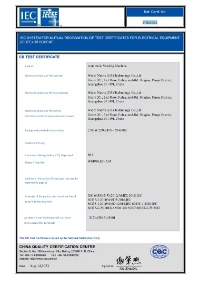
CB
CN61098
2023.08 – 2028.08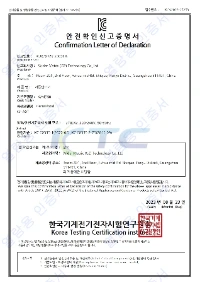
KC
XU070729-23001A
2023.08 – 2028.08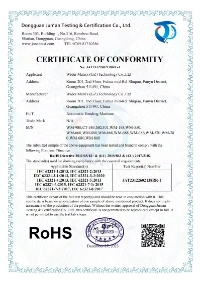
RoHS
JAT23122602138RC-1
2023.12 – 2028.12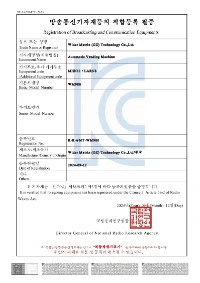
KC
R-R-wMT-WM980
2024.09 – 2029.09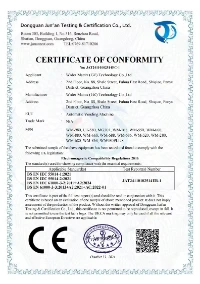
UKCA
JAT24110102514EC-1
2024.10 – 2029.10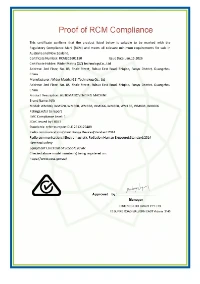
RCM
RCM202601150
2026.01 – 2031.01Company Introduction
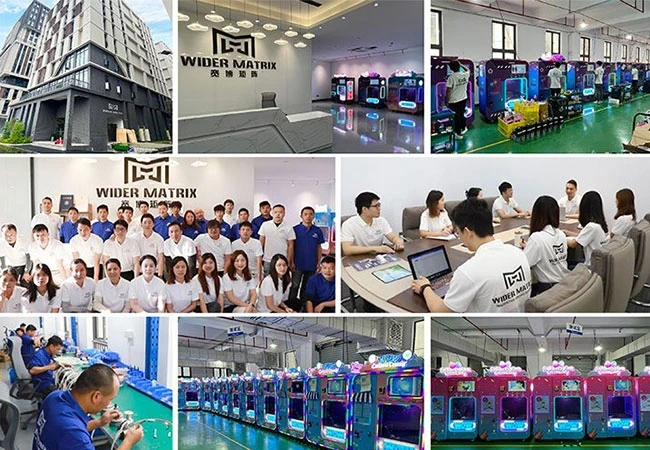
Wider Matrix (Guangzhou) Technology Co., Ltd. is a scientific and technological enterprise that attaches importance to R&D and user experience. We started to research and develop automated vending solutions in 2016, and achieved a leading position in the field of interactive vending machines.
With years of experience in automated retail technology, we've perfected our puzzle vending machines through rigorous testing and continuous innovation. Our commitment to quality and user experience has allowed us to expand globally, with our products now operating successfully in more than 130 countries including the United States, Canada, Europe, Southeast Asia, Australia, and Israel.
All machines support remote cloud management, which has the advantages of easy operation, convenient maintenance and high operating efficiency.
Exclusive Services
Overseas Support Service
Local transfer warehouse support, ensuring your operational stability.
Custom Design
We offer machine appearance customization, branding, and large-scale custom packaging services.
Initial Tools & Spare Parts Kit
Machine comes with complementary tools and spare parts kit, including initial consumables package for early operations.
Functional Customization & Software Optimization
Custom functionality based on client needs, including hardware and software optimization updates.
Lifetime Technical Support & Updates
We provide lifetime technical support and software update services for all customers.
Frequently Asked Questions
Q: How long does a jigsaw puzzle vending machine take to make one custom puzzle?
Q: Can it print a larger puzzle than A5?
Q: How many puzzles can the machine hold before it needs restocking?
Q: Does the machine print on wood or on paper?
Q: How much does the machine weigh, and what does that mean for installation?
Q: What is the power requirement?
Q: How many puzzles can one machine sell in an hour?
Q: How long until the machine pays for itself?
Q: Do operators need technical training to run one?
Q: What happens if a print head fails or a machine goes down?
Q: Can the machine be branded and customised for a specific market?
Q: Is a paper puzzle or a wooden puzzle the better seller?
Q: What is the price difference between the two generations?
User Reviews
ok so honestly I was kinda nervous dropping this much money on a vending machine but gotta say the WiderMatrix puzzle machine has been a GAME CHANGER for my mall location. shipping took about 3 weeks to get here in Phoenix and the crate was super well packed, no damage at all. setup was maybe 30 min? my brother helped me bolt it down and we were live that same afternoon. sales started slow first week but now im doing like 15-20 puzzles a day which is pretty solid. people LOVE watching the machine cut the puzzle right there, thats half the appeal honestly. only thing is i wish the screen was a lil bigger but whatever, it works great
Bought this for our family business, we run a small arcade in San Antonio and wanted something unique. the WiderMatrix machine fit right in near the entrance. customers actually line up to watch it make puzzles lol. my kids think its the coolest thing ever. build quality is solid, feels commercial grade not like some cheap toy. had one question about the software and support got back to me same day. would def recommend to anyone thinking about it
Very good machine, I am in Thailand and shipping was longer than expect, about 5 weeks, but company communication was good the whole time. machine working very well in my shop in Bangkok. customer like to see puzzle cutting, many take video. I make good profit already in two months. One small issue is the instruction manual only in English, my English is ok but some part hard to understand. Overall I am very happy with purchase. thank you WiderMatrix
So yeah the machine itself is great, no complaints about build quality or the puzzle cutting mechanism, thats all legit. BUT the payment system setup was kind of a pain?? took me a whole weekend to get the card reader working with my merchant account. the instructions werent super clear on that part. once it was working tho, smooth sailing. placed it in a bookstore cafe here in Portland and people buy puzzles while waiting for their coffee. pretty genius location if i do say so myself lol. 4 stars just bc of the payment setup headache
Man where do I even start. I've been doing vending as a side hustle for about 3 years now, mostly snacks and drinks. decided to take a risk on this puzzle machine from WiderMatrix and wow, best decision ever. put it in a busy tourist area near Navy Pier in Chicago and the thing just PRINTS money. weekends are insane, sometimes 40+ puzzles a day. the custom photo puzzle option is what really sells, people go crazy for that. machine has been running 2 months now zero issues. already planning to buy a second one
Honestly 10/10 purchase!! Was looking at 3 different companies before going with WiderMatrix and so glad I did. The puzzle vending machine arrived faster than promised, packaging was like military grade lol. My wife and I run a small gift shop in Asheville NC and this machine has become our star attraction. Tourists love it. The puzzles actually come out really clean cut too, not rough edges like I was worried about. Support team answered like 100 of my questions before I bought, never got impatient with me haha. GET ONE
good machine overall, been running it in my bowling alley for about 4 months now. kids love it and it does decent numbers on weekends. only complaints are the price is pretty steep up front, took me like 5 months to break even, and the puzzle stock restocking process is a bit fiddly. also wish it came in different colors lol, the grey is kinda boring. but it works, it makes money, and WiderMatrix has been responsive when i had questions. so yeah, recommended if you got a good location
ok so my situation is maybe a lil different, im a retired teacher in rural Ohio and bought this machine as a post-retirement project. placed it in the community center lobby. was worried itd be too techy for me to manage but honestly the interface is super simple, even an old lady like me can handle it lol. the kids in town go BONKERS for this thing, parents are always messaging me asking when im restocking. WiderMatrix people called me twice to check if everything was going ok, which i thought was really nice. glad i took the plunge
Why Choose Us
Why Operators Choose WiderMatrix
See how we compare to the industry average
| Feature | WiderMatrix | Industry Average |
|---|---|---|
| Machine Lifespan | ✓ 2× longer than standard machines | Standard lifespan |
| Maintenance | ✓ Ultra-low cost + remote diagnostics & alerts | High maintenance cost |
| Build Quality | ✓ Premium materials + patented technology | Standard manufacturing |
| Certifications | ✓ CE, UKCA, RoHS, KC, PSE, ISO (7+) | 1–2 certifications |
| Technical Support | ✓ 24/7 dedicated team + video guidance | Email only |
| AI Management Platform | ✓ Real-time monitoring, analytics & remote control | Basic / no dashboard |
| Software Updates | ✓ OTA lifetime free updates | Paid upgrades |
| Warranty | ✓ 1 year (no part return required) | 3–6 months |
Latest Articles
 NEW
NEW
What is the best location to place a cotton candy vending machine?
A shopping mall food court is the best location to place a cotton candy vending machine. Theme parks...
Sep 19, 2026 NEW
NEW
How Does a Protein Shake Vending Machine Work? WM186 Guide
If you run a gym or a fitness venue, what matters is whether the machine pays for itself...
Sep 19, 2026 NEW
NEW
What is the minimum order quantity for a phone case vending machine?
The minimum order quantity for a phone case vending machine is one unit, and there is no deposit,...
Sep 19, 2026Popular Picks
 HOT
HOT
Phone Cases (TPU+PC )
Key Features: ✅ Dual-layer protection (TPU + PC) ✅ Strong magnetic compatibility ✅ Precise fit & lightweight ✅...
Sep 01, 2025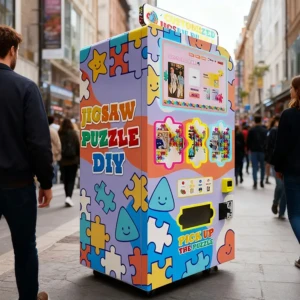 HOT
HOT
Jigsaw Puzzle Making Machine Price: The Ultimate 2025 Investment Guide
Entering the personalized gift and entertainment market with a jigsaw puzzle making machine is an exciting venture. However,...
Sep 22, 2025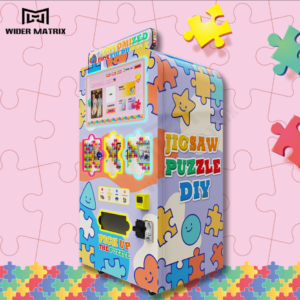 HOT
HOT
How Big Is the Jigsaw Puzzle Market? Size, Trends & Forecast (2024-2032)
The global jigsaw puzzle market has seen remarkable growth in recent years, transforming from a traditional pastime into...
Jul 07, 2025