

Stocking a vending machine looks simple until the first slow month. The wrong snack mix ties up cash in product that expires on the shelf, while the right mix can lift weekly sales without adding a single machine. The short answer: salty chips, chocolate bars, candy and gum, cookies, and meat snacks still drive most snack sales, with Lay’s, Doritos, Cheetos, Snickers, KitKat, Twix, Oreos, and Jack Link’s appearing on operator reorder lists again and again. Below is a ranked table, location-specific mixes, and the operational details that decide whether those products sell.
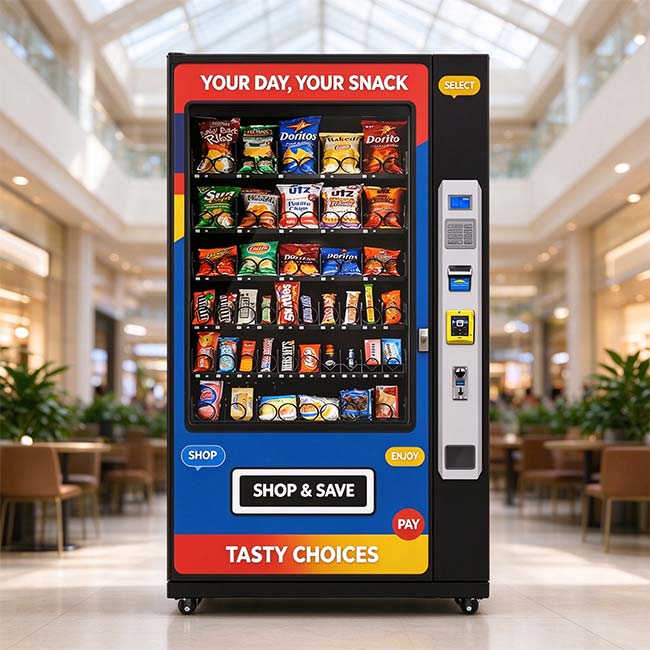
The 18 snacks operators reorder most
These are the SKUs that show up in route trucks, warehouse-club runs, and distributor order sheets week after week. Costs are typical U.S. wholesale ranges for early 2026, based on warehouse-club and distributor price checks. They vary by region, case size, and promo cycle. Margins are before machine commission, payment fees, and spoilage.
| Rank | Snack | Category | Typical wholesale cost | Suggested vend price | Gross margin | Velocity tier |
|---|---|---|---|---|---|---|
| 1 | Lay’s Classic (1 oz) | Salty chips | $0.35 to $0.45 | $1.25 | 64 to 72 percent | Very high |
| 2 | Doritos Nacho Cheese (1 oz) | Salty chips | $0.40 to $0.50 | $1.25 | 60 to 68 percent | Very high |
| 3 | Cheetos Crunchy (1 oz) | Salty chips | $0.40 to $0.50 | $1.25 | 60 to 68 percent | High |
| 4 | Snickers (1.86 oz) | Chocolate | $0.65 to $0.80 | $1.75 | 54 to 63 percent | Very high |
| 5 | KitKat (1.5 oz) | Chocolate | $0.60 to $0.75 | $1.75 | 57 to 66 percent | High |
| 6 | Twix (1.79 oz) | Chocolate | $0.65 to $0.80 | $1.75 | 54 to 63 percent | High |
| 7 | Oreo (2 oz pack) | Cookies | $0.55 to $0.70 | $1.50 | 53 to 63 percent | High |
| 8 | M&M’s Peanut (1.74 oz) | Chocolate | $0.70 to $0.85 | $1.75 | 51 to 60 percent | High |
| 9 | Reese’s Peanut Butter Cups (1.5 oz) | Chocolate | $0.70 to $0.85 | $1.75 | 51 to 60 percent | High |
| 10 | Skittles (2.17 oz) | Candy | $0.60 to $0.75 | $1.50 | 50 to 60 percent | Medium-high |
| 11 | Starburst (2.07 oz) | Candy | $0.60 to $0.75 | $1.50 | 50 to 60 percent | Medium |
| 12 | Jack Link’s Beef Jerky (1.25 oz) | Meat snack | $1.00 to $1.20 | $2.50 | 52 to 60 percent | Medium |
| 13 | Planters Peanuts (1.5 oz) | Nuts | $0.45 to $0.60 | $1.25 | 52 to 64 percent | Medium |
| 14 | Nature Valley Crunchy Granola Bar (1.5 oz) | Better-for-you | $0.45 to $0.60 | $1.50 | 60 to 70 percent | Medium |
| 15 | KIND Bar (1.4 oz) | Better-for-you | $0.90 to $1.10 | $2.25 | 51 to 60 percent | Medium |
| 16 | Rice Krispies Treats (0.78 oz) | Cookies and baked | $0.35 to $0.45 | $1.00 | 55 to 65 percent | Medium |
| 17 | Pop-Tarts (1 pastry) | Cookies and baked | $0.50 to $0.65 | $1.50 | 57 to 67 percent | Medium |
| 18 | Takis Fuego (1 oz) | Spicy chips | $0.45 to $0.60 | $1.25 | 52 to 64 percent | Medium-high, regional |
The pattern is clear. Single-serve salty snacks and chocolate bars do most of the heavy lifting. They have strong brand recognition, a familiar price point, and a shelf life that survives a normal restock cycle. The best percentage margin often comes from chips and granola bars, while chocolate and meat snacks carry higher tickets.
Why these snacks sell: five rules behind a fast-moving slot
Snack vending is a small-space business. Every slot has to earn its rent. The products that survive share five traits.
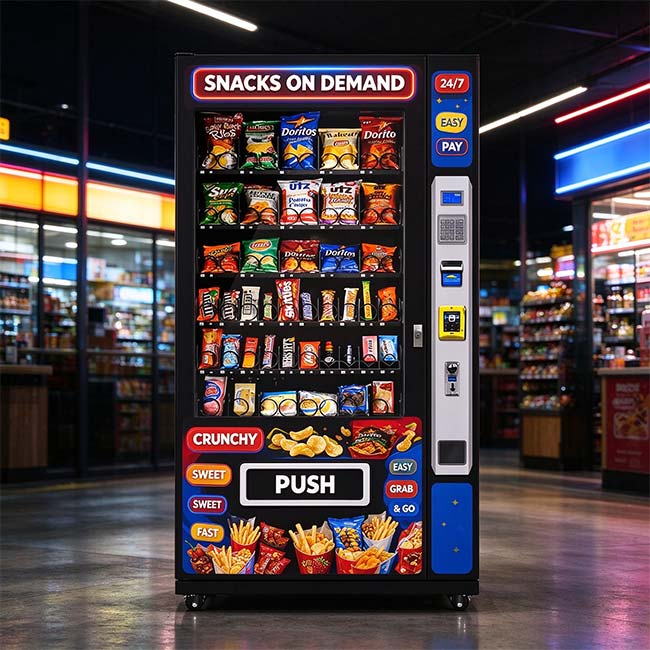
- Shelf stability. A snack needs to survive four to eight weeks in a machine without going stale, melting, or crushing.
- Compact packaging. Bags that are too wide waste coil space, and boxes that are too tall jam the delivery chute.
- Brand recognition. A customer who sees a familiar logo does not need to read a label. That speeds up the purchase.
- A price that fits the machine. Most snack sales sit between $1.00 and $2.50. If the product cannot hit that band with a healthy margin, it belongs somewhere else.
- Repeat appeal. The best SKUs are boring in the right way. People buy them again without thinking.
A simple mix for a 30-slot machine is 50 percent proven sellers, 30 percent rotating variety, and 20 percent better-for-you or regional items. That is not a fixed rule. It is a starting point you adjust after four weeks of sell-through data. If you are still choosing between machine formats, the guide to the most popular vending machine types explains how coil, glassfront, and fresh-food machines change the product list.
A location-by-location snack mix that fits the site
Every location has a different customer, a different break pattern, and a different tolerance for price. The table below gives a starter mix for six common sites. Adjust it after one restock cycle.
| Location | Core sellers | Better-for-you share | Avoid | Stocking note |
|---|---|---|---|---|
| Office breakroom | Lay’s, Doritos, Snickers, KitKat, Oreos, KIND bars | 25 to 30 percent | Large sharing bags, messy snacks | Stock two or three protein bars and one or two meat sticks for the afternoon crowd. |
| Warehouse | Cheetos, Doritos, Snickers, M&M’s, Jack Link’s, Pop-Tarts | 10 to 15 percent | Small premium bars that do not fill workers | Focus on calories and $1.25 to $2.00 price points. |
| School | Compliant baked chips, pretzels, granola bars, fruit snacks, plain nuts | 40 to 50 percent | Regular chips, full-sugar candy, most cookies | Verify each SKU against USDA Smart Snacks limits and local policy. |
| Gym | Protein bars, meat sticks, peanuts, trail mix, rice cakes | 50 to 60 percent | Candy and regular chips | Pair with protein shakes and check for peanut allergies. |
| Hospital | Granola bars, crackers, peanut butter crackers, pretzels, fruit cups | 30 to 40 percent | Strong-smelling snacks | Staff and visitors buy at odd hours, so keep price points simple. |
| Hotel | Snickers, M&M’s, Pringles, Oreos, KIND bars | 20 to 25 percent | Large sharing bags | Late-night candy and salty snacks move well near check-in. |
The biggest mistake is copying an office mix into a warehouse or a school. Warehouse workers buy calories and value. Office workers buy convenience and a small treat. Schools buy compliance first. A machine that ignores those differences will have slow slots no matter how good the snacks are.
School vending: compliance before popularity
School vending is the one location type where the best-selling snack can be the wrong snack. The USDA Smart Snacks in School standards set limits for snacks sold during the school day. In general, a snack item must be 200 calories or less, 230 mg sodium or less, 35 percent or less of calories from fat, 10 percent or less from saturated fat, and 35 percent or less of sugar by weight. Entrée items have a different set of limits, including 350 calories and 480 mg sodium.
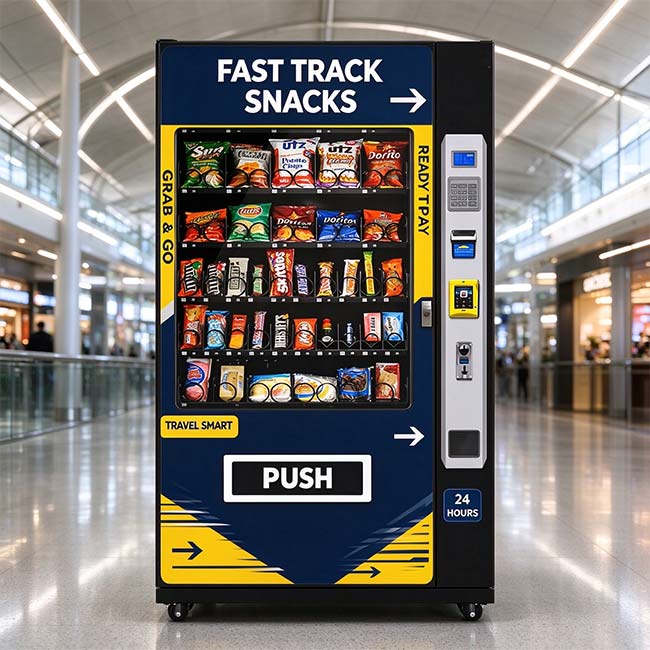
That rules out most regular chips, candy bars, and full-sugar cookies. Compliant options include baked chips, pretzels, some granola bars, fruit snacks, and plain nuts, but you have to check each SKU against the current standards. Districts can set stricter rules, and some schools ban nuts entirely because of allergies. If schools are part of your route, keep a compliance file for every product and review it when recipes or package sizes change. The data-driven guide to what sells best in vending machines has more on product selection by venue.
The 30-slot planogram: how to place snacks so they sell
Placement changes sales more than most operators expect. Eye-level slots get the most attention. Top rows are harder to reach and bottom rows get overlooked. Use the table below as a base planogram for a 30-slot snack machine.
| Category | Slots | Example SKUs | Placement |
|---|---|---|---|
| Salty chips | 8 | Lay’s, Doritos, Cheetos, Takis | Eye level and waist level |
| Chocolate | 8 | Snickers, KitKat, Twix, M&M’s, Reese’s | Eye level |
| Candy and gum | 4 | Skittles, Starburst, gum | Middle rows |
| Cookies and baked | 3 | Oreos, Rice Krispies Treats, Pop-Tarts | Middle rows |
| Meat and nuts | 3 | Jack Link’s, Planters | Lower middle |
| Better-for-you | 2 | Nature Valley, KIND | Top row or eye level |
| Rotating test | 2 | New SKUs | Bottom row |
Give your top five SKUs two facings each. Give test items one facing. If a product cannot sell one unit per facing per week after four weeks, cut it or move it to a lower-traffic slot. Measure your product dimensions before you load. A standard 1 oz chip bag is roughly 7 by 5 inches, and a standard candy bar is roughly 6 by 1 inch. Coil spacing and chute depth vary by machine, so check the manual rather than guessing.
Glassfront machines handle wider bags and odd shapes better. Coil machines are faster to restock but less forgiving with crushed or oversized packaging.
Pricing, margin, and the coin-friendly price ladder
Snack vending works on small margins repeated many times. A $1.25 sale with a $0.45 product cost leaves $0.80 before fees. A $2.50 sale with a $1.10 product cost leaves $1.40. The second sale looks better on paper, but it may sit in the machine longer. Track gross profit per slot per week, not just margin percentage.
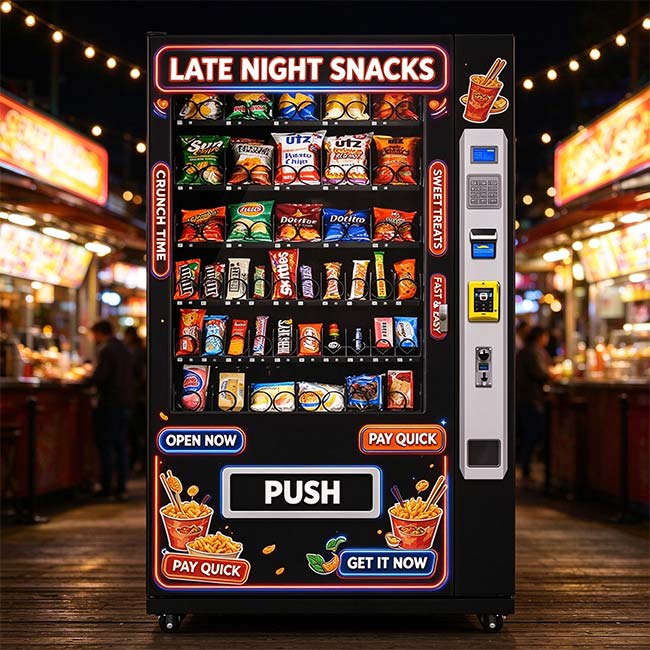
Use a simple price ladder: $1.00, $1.25, $1.50, $1.75, $2.00, $2.25, $2.50. Quarter increments keep cash handling simple and match most coin mechanisms. If your machine is card-only or cashless, you can test $0.05 increments, but expect slower adoption at first. Payment fees matter. A 3 percent card fee on a $1.25 sale takes about $0.04. That is small per transaction, but it adds up across a route.
Review margins every quarter. Wholesale costs move, package sizes shrink, and a snack that made sense at $1.50 may need a $1.75 price or a smaller pack. Do not wait for a slow month to reprice.
Sourcing and restock cadence
Most operators buy from a mix of warehouse clubs, cash-and-carry stores, and broadline distributors. Warehouse clubs are good for testing a new SKU without a large commitment. Distributors are better once a product proves itself and you need consistent case packs. Direct-store-delivery works for large routes, but it can limit your control over the mix.
Check code dates on every delivery. Snacks have a long shelf life compared with fresh food, but chocolate can bloom in heat, chips can go stale, and nuts can turn rancid. Use first-in, first-out rotation. Restock high-velocity slots every one to two weeks and slower slots every two to four weeks, depending on machine location. Keep a small buffer of top sellers so you do not run out between deliveries.
Watch for shrink. Broken bags, expired product, and theft all cut into margin. A machine with a clear glassfront makes it easier for customers to see what they are buying and harder for product to get crushed in the chute.
A four-week test protocol for new snacks
Testing a new snack should answer one question: does this product earn its slot? Run the test for four weeks and log the same numbers each week.
- Week 1: Add the new SKU in one facing at eye level or waist level. Record units sold, price, and any spoilage.
- Week 2: Compare units per facing against the machine average. If the new SKU is below half the average, move it to a different slot before cutting it.
- Week 3: Check repeat sales. A product that sells once to curious customers but does not come back is not a keeper.
- Week 4: Decide. Keep it, move it, or cut it. If you keep it, give it a second facing only when it beats the machine average for two weeks in a row.
The metrics that matter are units per facing per week, gross profit per slot per week, and spoilage rate. A snack that sells well but expires before it moves is a loser. A snack that sells slowly but carries a high ticket can still be worth one slot if it does not spoil.
Better-for-you, spicy, and regional: what is trending in 2026
Demand for better-for-you snacks keeps growing, but the category is not a license to stock only protein bars. Customers still want taste. The strongest better-for-you sellers are bars with recognizable brands, meat sticks, plain nuts, baked chips, and lower-sugar candy. Protein bars work best in gyms, hospitals, and office buildings with a health-conscious crowd. They struggle in warehouses where customers want calories per dollar.
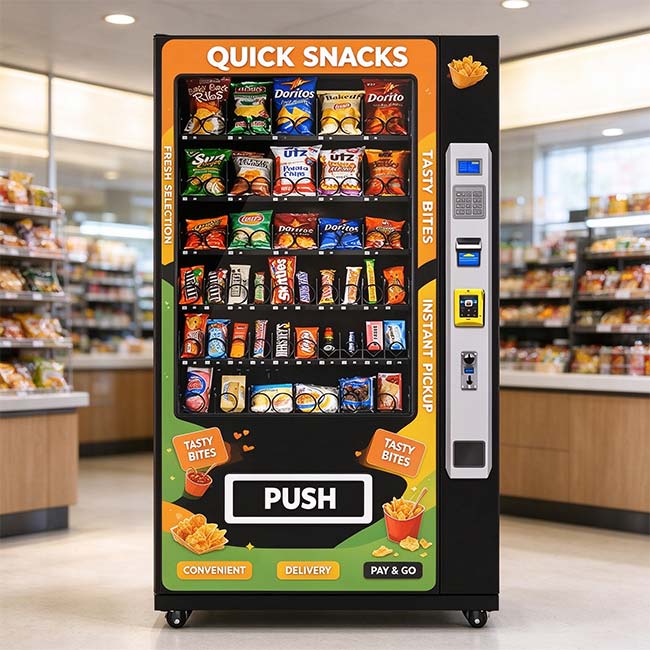
Spicy snacks are strong in younger-skewing locations, especially near schools, colleges, and urban breakrooms. Takis is the obvious example, but regional spicy chips and chamoy-flavored candy can also move. Test them in one or two facings before committing to a full row. Regional preferences matter. A snack that sells in Texas may sit on the shelf in the Midwest. Ask your route driver which SKUs are moving and which are coming back.
Package size is another trend to watch. Manufacturers have been shrinking pack sizes while holding price points, which can protect your margin but also annoy customers who notice. If a product gets smaller, consider moving it to a lower price tier rather than pretending nothing changed.
Fresh-made snacks: a premium add-on for the right location
Packaged snacks win on convenience. Fresh-made snacks win on experience, and they can lift the average ticket in the right location. A popcorn machine turns a short wait into a $3 to $5 sale, and the smell does more for foot traffic than most signage. The Wider Matrix WM680 holds 5.6 kg of corn and 140 cups, produces a serving in about 120 seconds, and is priced at US$1,800 per unit. For family-heavy locations, the WM980 cotton candy machine offers 36 designs and uses 28 to 30 grams of sugar per candy, with a single-unit price of US$4,800.
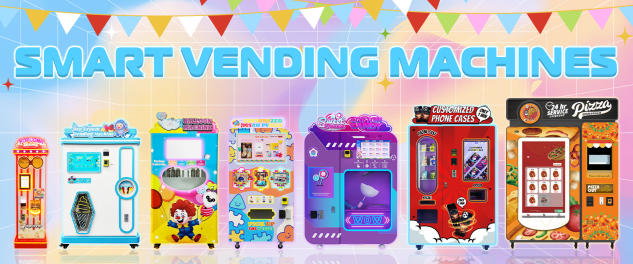
Wider Matrix has shipped 3,000+ machines to 130+ countries since 2016, and its machines carry CE, RoHS, and other market certifications. These units work best next to a packaged snack machine, not as a replacement for it. If you want the full equipment comparison, see the guide to commercial popcorn vending machines and the guide to cotton candy vending machines. If frozen snacks fit your site, the ice cream vending machine price guide breaks down the numbers. For multi-unit orders, contact the sales team for a personalized quote.
Common stocking mistakes that kill snack sales
- Stocking too many niche SKUs at once. You cannot tell what sells if every slot is a test.
- Ignoring code dates. Expired product is a cost, and a customer who buys stale chips does not come back.
- Using one price for every snack. A $1.25 candy bar and a $2.50 meat stick should not share a price point.
- Filling the machine with what you like. The customer decides what sells, not the operator.
- Changing the whole planogram at once. Change one or two slots at a time so you know what worked.
- Forgetting the chute. A bag that is too wide or a box that is too tall can jam the machine and cost you a sale.
FAQ
What are the most popular vending machine snacks?
Salty chips, chocolate bars, candy, cookies, and meat snacks lead most routes. Lay’s, Doritos, Cheetos, Snickers, KitKat, Twix, Oreos, M&M’s, and Jack Link’s are common top sellers. The exact order depends on the location, the price ladder, and the customer base.
What snacks sell best in school vending machines?
Compliant baked chips, pretzels, granola bars, fruit snacks, and plain nuts can work if they meet the USDA Smart Snacks limits and local district rules. Regular chips, full-sugar candy, and most cookies do not qualify. Check every SKU and keep a compliance file.
How many snack SKUs should a vending machine have?
A 30-slot machine usually works well with 18 to 24 active SKUs, with a few duplicate facings for top sellers. Too many SKUs makes restocking harder and hides which products sell. Start with a focused mix and add variety after you have sell-through data.
What is a good profit margin for vending machine snacks?
Most snack slots run a gross margin of 50 to 70 percent before commission, payment fees, and spoilage. Chips and granola bars often sit at the higher end. Meat snacks and premium bars have lower percentage margins but higher dollar profit per sale.
How often should I restock snacks?
High-velocity slots every one to two weeks, slower slots every two to four weeks. The right cadence depends on machine volume, shelf life, and how far the route is. Use the first two months to find the pattern, then set a schedule.
Are healthy snacks profitable in vending machines?
They can be, but they are not automatically better. Better-for-you snacks sell well in gyms, hospitals, and some offices. They struggle in locations where customers want calories per dollar. Test them in two facings and compare units per facing against your machine average.
What is the best snack for an office vending machine?
A mix of familiar chocolate, salty snacks, and a few better-for-you bars works for most offices. Oreos, KitKat, Lay’s, Doritos, and KIND bars are common picks. Keep the price ladder simple and avoid large sharing bags that do not fit the machine.
What to do next
Start with the 18-SKU table and pick a location mix that matches your site. Give your top sellers two facings, test new items one at a time, and track units per facing per week. Review margins every quarter and cut any slot that cannot cover its cost. If you are comparing machine types or adding fresh snacks, use the vending machine ROI guide to check the numbers before you buy. The snack mix is the easy part. The discipline to measure it is what separates a busy machine from a profitable one.
Want the machine behind the numbers? Ask for today’s price
Every mix on this page assumes you already have a machine to fill. If you are still comparing units, do not leave the price to guesswork. Machine cost, freight, and availability move month to month, and a number you saw in a forum thread is rarely what you will pay today.
One short message gets you a usable answer. Tell us which unit you are considering — a snack vending machine, the WM680 popcorn machine, or the WM980 cotton candy machine — plus your city and country, and we will reply with a dated factory-direct quote, freight and duty to your door, and current lead time. If you are planning two or more units, ask for volume pricing in the same message.
Leave your name and email or WhatsApp and we will send the quote within one business day. No follow-up spam, no obligation. You can also compare the full lineup in the new vending machines for sale guide before you decide.