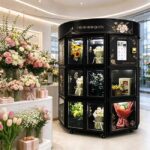


Most people who type this phrase are doing homework before they commit money: a florist testing a second sales channel, an operator hunting for a site that runs itself, or a venue manager wondering whether a glass box in the lobby earns its corner.
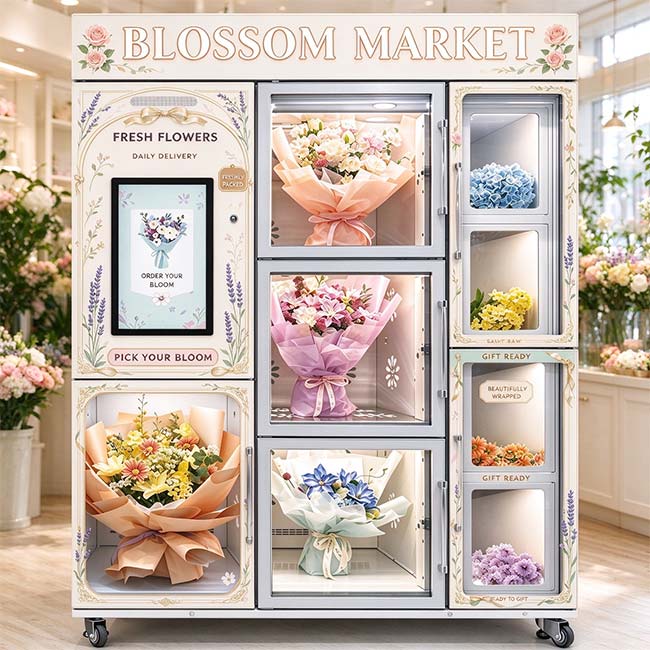
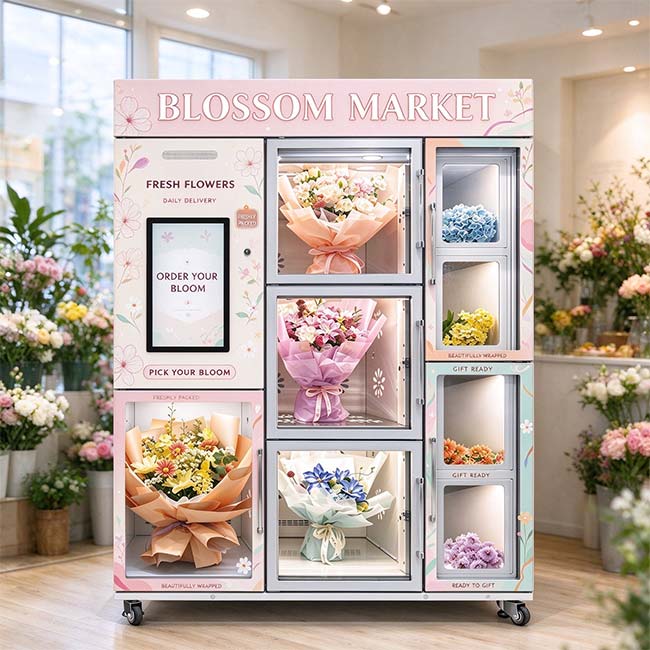
The short answer is that a refrigerated flower vending machine is a glass-front cabinet with its own compressor, individually locked compartments, a touchscreen and a card terminal. It keeps cut stems at roughly 2 to 5°C, sells pre-made bouquets around the clock with no staff on site, and a single factory-direct unit usually runs between about US$3,000 and US$6,500 depending on slot count.
What the machine is, in practical terms
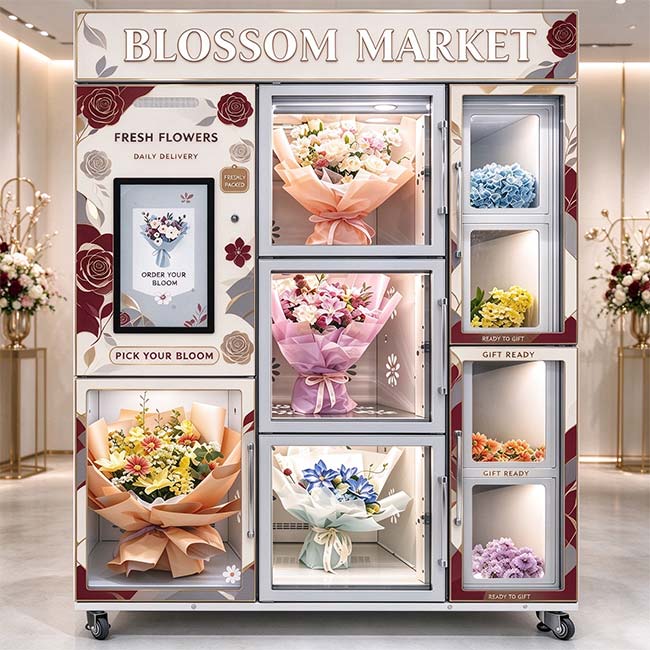
Strip away the marketing and you have a fridge with a shop attached. The cabinet is insulated, the glass carries an electric anti-fog film, and a compressor plus evaporator fan holds the interior at a set temperature. Inside, each bouquet sits in its own compartment with its own lock, so only the door the customer paid for opens.
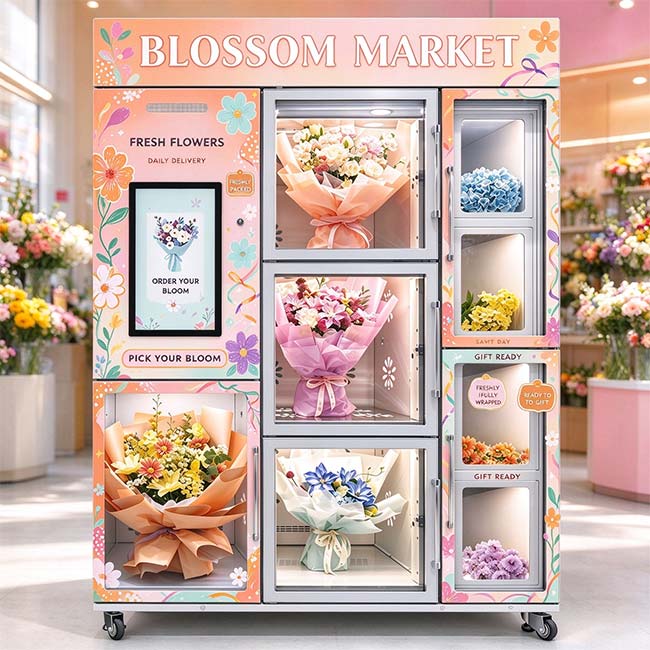
Stock loads pre-made and pre-hydrated, usually wrapped with a water tube at the stem end. Buyers see the actual bouquet rather than a product photo, which is the reason the format works at all for something perishable and gift-shaped. A touchscreen handles selection and payment, and a telemetry module pushes sales, stock and cabinet temperature to a dashboard you can open on a phone.
Why the temperature range on the datasheet deserves a second look
Cut flowers keep respiring after harvest. Cold slows that process; warmth speeds it up, and every hour spent warm shaves vase life you cannot put back. Florists hold most temperate stems at 2 to 4°C with high humidity. Vending datasheets often quote something much wider, such as 2 to 25°C, which describes what the thermostat can be set to, not what a rose wants. Run a mixed bouquet cabinet at the top of that band and you have bought a heated display case with a payment terminal.
Humidity matters almost as much. Most cut stems want 90 to 95% relative humidity. Dry air pulls water out of the petals faster than the stem can replace it, so flowers wilt while the bucket underneath is still full. That is also why anti-fog systems exist on serious floral cabinets: hold that much moisture behind glass and it fogs within minutes without one.
Ethylene is the third variable, and the one operators forget. Carnations, gypsophila, lilies and alstroemeria drop petals or yellow after exposure to the gas, and a fruit display next door is enough to set it off. If your site sits beside a supermarket produce section, look for an integrated ethylene filter or budget for faster rotation.
Then there is airflow. One evaporator fan at the back of a tall cabinet can leave the top row several degrees warmer than the bottom. Ask for a temperature log from a loaded unit rather than an empty one. Two loggers, top slot and bottom slot, run for 72 hours, will tell you more about a machine than any spec sheet.
| Flower group | Target temperature | Relative humidity | Notes |
|---|---|---|---|
| Roses, carnations, chrysanthemums, alstroemeria, gypsophila | 2 to 4°C | 90 to 95% | Ethylene sensitive; keep clear of ripening fruit |
| Tulips, lilies, stock | 2 to 5°C | 85 to 90% | Store dry-ish and cool; stems bruise if packed too tight |
| Tropicals such as anthurium, orchids, protea, bird of paradise | 10 to 13°C | 85 to 90% | Chilling injury below 10°C shows up as blackened petals |
| Mixed bouquets, temperate plus tropical | 8 to 12°C | 85 to 90% | A compromise setting; expect shorter vase life on the temperate stems |
How a purchase runs, start to finish
The customer flow is short by design, because a gifting purchase at 9pm in an airport should take under a minute.
- The buyer browses the real bouquets behind the glass and picks one on the touchscreen.
- Payment goes through cash, bank card or a mobile wallet and QR code, depending on the payment module fitted for that market.
- The controller unlocks the matching compartment. The rest stay shut.
- The buyer takes the bouquet and the door re-locks once closed.
What matters behind the scenes is the failure path. Payment succeeds and the door does not open is the one error that generates complaints fast. Look for a system that alerts you within seconds, supports a remote unlock, and has a printed or digital route to a refund. Any supplier who waves that question away has not run a fleet.
Locker, carousel, open shelf: matching the format to the site
Refrigeration is only half the decision. The dispensing mechanism changes how evenly the cold air reaches each bouquet and how exposed your stock is.
| Configuration | Typical capacity | Cold air distribution | Shrink risk | Fits best at |
|---|---|---|---|---|
| Per-slot locker cabinet | 5 to 24 bouquets | Even; every slot has its own exposure to the air loop | Low, only the paid door opens | Transit hubs, hospitals, office lobbies, petrol forecourts |
| Carousel or spiral | 15 to 40 items | Uneven at the edges, warm pockets near the glass | Higher, one open door gives access to everything | Supermarkets, convenience stores with staff nearby |
| Open refrigerated display with a side kiosk | 30 or more items | Good when closed, but dumps cold air every time it opens | High without staff on the floor | Staffed shop extensions, hotel lobbies |
| Ambient cabinet, no compressor | Any | None | Very high in warm climates | Short pop-ups where stock turns over in a day |
For unattended sites, the locker format wins on shrink and on cold uniformity, which is why most purpose-built floral machines use it. The trade-off is capacity: a 5-slot unit can empty on a Saturday afternoon and sit useless until Monday unless you schedule a weekend top-up.
Cost, revenue and the break-even maths
Machine price is the number everyone asks about and the least useful one on its own. Freight, electrical work, the first stock load and the venue’s revenue share move payback more than a few hundred dollars off the purchase price.
| Cost line | Typical range | What drives it |
|---|---|---|
| Machine, 5 to 24 slots | US$3,000 to US$6,500 | Slot count, screen size, payment module, factory-direct versus distributor |
| Freight and import duty | 5 to 15% of machine value | Sea versus air, destination country, Incoterms |
| Electrical connection | US$150 to US$800 | Dedicated circuit, distance from the distribution board, floor works |
| Opening stock | US$150 to US$400 | Bouquet cost, mix of single stems and wrapped bunches |
| Power | US$1 to US$2.50 per day | A 950W nameplate unit cycles its compressor, so average draw is well below peak |
| Payment fees | 1.5 to 3.5% of sales | Acquirer and terminal provider |
| Venue revenue share | 8 to 20% of sales | Location quality and exclusivity |
| Spoilage | 5 to 12% of stock loaded | Restock cadence, temperature discipline, season |
Here is a worked example with every assumption stated. Average bouquet sells for US$18, flowers and wrapping cost US$6.50, power is US$1.50 a day, payment fees run 2.5% of sales, the venue takes 12%, and the installed machine cost US$5,700.
| Bouquets sold per day | Daily revenue | Daily net after costs | Monthly net | Payback on machine |
|---|---|---|---|---|
| 4 | US$72 | US$34 | about US$1,020 | roughly 5.5 months |
| 10 | US$180 | US$87 | about US$2,620 | roughly 2 months |
| 20 | US$360 | US$176 | about US$5,290 | roughly 5 weeks |
Those figures exclude your own restocking labour and any fixed rent beyond the revenue share. Real operator records sit in a similar range: we published a set of six documented flower vending machine results with sales, spoil rates and payback for comparison. The pattern across them is that site quality explains most of the spread, not the machine.
If you want the same maths laid out line by line before you talk to a supplier, this cost and ROI breakdown for 2026 covers lease versus buy and what each line item usually looks like on a quote.
Site selection: where a glass cabinet actually converts
Flowers sell where a gifting occasion is already in the air. That single idea sorts good sites from bad ones faster than footfall counts do.
- Hospitals and clinics. Visitors arrive without a gift far more often than they plan one, and the flower shop shuts at six.
- Transit hubs and metro exits. Commuter traffic peaks when people are heading to dinner or home to an apology.
- Office lobbies. Birthdays, farewells and client visits happen on a schedule, and nobody keeps a spare bouquet at their desk.
- Petrol forecourts and 24-hour convenience stores. Weekend evening demand from people who left it late.
- Malls near fashion and food, not near the loading bay. The purchase is incidental, so it happens where people already linger.
- Hotel and resort lobbies. Guests buy same-day, often for an anniversary they booked months ago.
As a planning rule of thumb, a small 8-slot unit needs a few hundred people passing within a couple of metres of the glass each day to clear five sales on a normal weekday. Treat that as a screening filter, not a forecast: gifting context beats raw volume every time, and a quiet hospital lobby can outsell a busy concourse.
Before signing, settle the boring parts of the venue agreement: restocking access hours, which can be brutal in malls, who pays for the power, whether you have category exclusivity, and what happens if the outlet loses power overnight. A machine that cannot be opened until 10am is a machine that runs empty all morning.
Location logic also shifts by market. Operators expanding into dense Asian cities tend to work cluster by cluster; if that is your plan, this guide to the best Singapore locations for 2026 walks through the site types that carry the format.
The restock routine that keeps waste low
Spoilage is a labour problem disguised as a refrigeration problem. The machine holds temperature; somebody still has to rotate stock.
- One visit a week, 30 to 60 minutes, is enough for most sites. Move to two or three visits during Valentine’s, Mother’s Day, graduation season and December.
- Load oldest stock at the front and label each bouquet with its load date. Sell or mark down anything past day four, and pull it by day six.
- Top up water tubes at every visit. Humidity keeps stems from drying out, but it does not replace the water in the stem.
- Clean the glass inside and out. A cabinet that looks smudged reads as stale, and stale is fatal for a gift purchase.
- Vacuum the condenser coil monthly. Dust on the coil is the most common cause of a cabinet drifting warm in summer.
- Reconcile stock against sales data before you leave. A slot that sells nothing for two weeks is a product problem, not a machine problem.
- Check the temperature log, not just the current reading. A slow climb overnight is the early sign of a failing fan.
What to verify before you pay a deposit
- Certification for your market, not a generic certificate. CE and UKCA for Europe and the UK, FCC for the United States, plus RoHS.
- Voltage and plug configuration matched to your grid, confirmed in writing on the order.
- Compressor and controller spare parts held in stock, with a stated lead time. Ask what the air freight cost would be if a compressor fails.
- Whether the telemetry needs a SIM card and a software subscription, and what happens to the machine if you stop paying.
- The payment terminal model and its fee structure, since this is the one cost that follows you forever.
- A 72-hour temperature log from a loaded unit, top slot and bottom slot.
- Refund and failed-vend policy, written down rather than promised on a call.
- Warranty length, what it excludes, and whether labour is covered or just parts.
- Shipping terms. FOB and DDP produce very different final numbers once duty and port charges land.
This buyer’s guide to where flower vending machines are sold goes deeper on vetting suppliers and reading a quotation.
How it stacks up against a shop, a cart and pre-order pickup
| Refrigerated vending machine | Staffed flower shop | Mobile cart | Pre-order pickup point | |
|---|---|---|---|---|
| Hours | 24/7 | 8 to 12 hours | 4 to 8 hours, weather dependent | Staffed hours only |
| Labour per site | Restocking only | 1 to 3 staff | 1 person on site | 0.5 to 1 person |
| Space and rent | 1 to 2 m² plus power | 40 to 100 m² fit-out | Street permit | Counter space |
| Custom bouquets | No | Yes | Limited | Yes, ahead of time |
| Freshness control | 2 to 5°C, monitored remotely | Cooler plus display cases | Depends on the day | Good |
| Sales data | Per slot, per hour | Point of sale | Manual | Order records |
| Scales by | Adding machines | Opening shops | Adding routes | Adding pickup points |
The honest limitation: a machine sells what is already made. It cannot take a custom order, cannot advise a nervous partner on what to buy, and cannot upsell a vase. If your business depends on design work, treat it as an out-of-hours outlet rather than a replacement for the shop.
One factory-direct option that fits the spec
Wider Matrix (GZ) Technology Co., Ltd. manufactures floral cabinets in nine models, from a 5-slot compact unit to a 24-slot wide body, and the specification lines up with the checklist above. Refrigeration runs 2 to 25°C, which covers a tight florist setting of 2 to 5°C as well as the warmer compromise a mixed tropical bouquet needs, and cut flowers hold for 5 to 7 days between restocks.
The build details that matter on an unattended site include one-piece moulded polyurethane foam insulation, electric anti-fog glass, an air-cooling loop that circulates cold air across every slot, and individually locked compartments so only the purchased door opens. Screens come in 10.1, 15.6 and 21.5 inches depending on model. Draw is 950W on the 5 to 13 slot models and 1900W on the 24-slot unit, with voltage configurable for the destination market.
Management is remote: per-slot stock, sales by slot and live cabinet temperature from a phone, which is what lets one person run several locations. Units carry CE, FCC, RoHS, SGS and ISO 9001 certification, and the company has shipped more than 3,000 machines to over 130 countries. Reference pricing sits between US$3,000 and US$6,500 per unit depending on model. For orders of multiple units, contact the team for a personalized quote with volume discounts. The full flower vending machine range has dimensions and slot counts side by side.
Where to go next
Three things decide whether this works: the cold chain, the site and the restock discipline. Get the temperature wrong and you are selling dying flowers at full price. Get the site wrong and no amount of good refrigeration helps. Skip the restock routine and both problems arrive at once.
If you are still at the stage of comparing machine configurations and installed cost, start with the 2026 price, specs and ROI guide to buying one. Operators planning a first US location will find the US startup guide covers licensing, venue contracts and the electrical side in more detail.
Frequently asked questions
How long do flowers stay fresh in a refrigerated vending machine?
Five to seven days is realistic for temperate stems held at 2 to 5°C with water tubes and high humidity. Tropical flowers last less and need a warmer setting. An ambient cabinet without a compressor gives you a day or two at best.
What temperature should I set the machine to?
Two to five degrees Celsius for roses, carnations, chrysanthemums and other temperate stems. Ten to thirteen for tropicals, which suffer chilling injury below ten. If you sell mixed bouquets, eight to twelve is the usual compromise.
How much does a refrigerated flower vending machine cost?
Factory-direct units generally fall between US$3,000 and US$6,500 per machine depending on slot count and payment options. Budget another 15 to 30% for freight, duty, electrical work and the first stock load before you count the machine as installed.
How many bouquets a day do I need to sell to break even?
At an average ticket of US$18 and a flower cost of US$6.50, two to three sales a day covers power, payment fees and a typical venue commission. Paying off the machine is a separate question: ten sales a day clears a US$5,000 unit in around two months on those assumptions.
Do I need a licence or permit to operate one?
Most places require a standard business or vendor licence, and the venue will want a signed agreement plus proof of product liability insurance. Flowers are rarely treated as food, but rules vary by city, so confirm with your local authority before you order.
Can the machine hold tropical flowers like orchids?
Yes, provided the thermostat reaches ten to thirteen degrees Celsius. The problem is mixing them with roses in the same cabinet. Do that and one group is either too warm or too cold, which shows up as shorter vase life within a few days.
What happens if a customer pays and the door does not open?
A decent control system flags the fault to your phone within seconds and allows a remote unlock. You still need a written refund route. Failed vends are rare, but they are the complaint that spreads fastest when they are handled badly.
What power and floor space does one need?
A dedicated circuit, since the cabinet runs continuously, and roughly one to two square metres of level floor with clearance for the door swing. Keep it out of direct sunlight, which pushes the compressor harder and warms the glass.
Can one person operate several machines?
Yes, if the telemetry is good. Remote stock, sales and temperature data turn restocking into a route rather than a daily visit. Most operators start with one unit, learn the demand pattern, then add sites along the same route.
Do the flowers need water inside the machine?
Each bouquet should be loaded with a water tube or a small reservoir at the stem end. High humidity slows moisture loss from the petals, but it does not replace the water the stem is drinking through.