


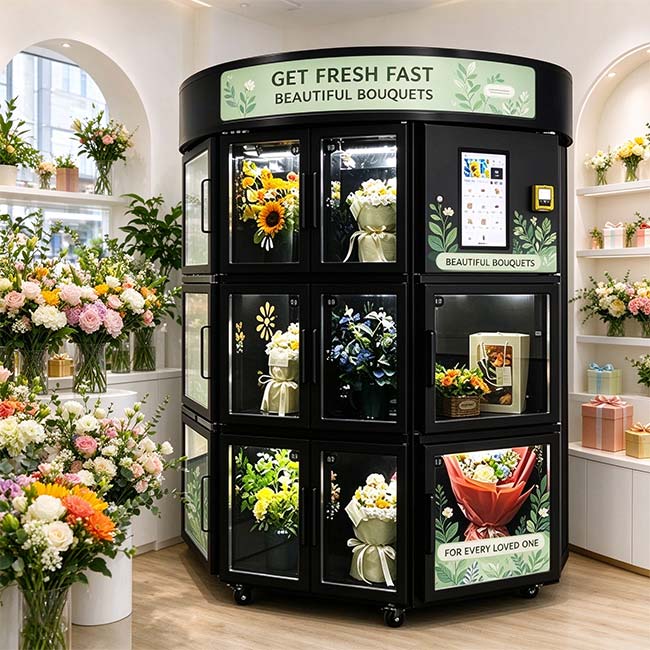
Flower vending machines sell a gift with a short shelf life, from a box that has to stay cold and safe without staff. That mix makes the profit question more practical than exciting. The short answer is yes, a flower vending machine can be profitable, but only when it sells enough bouquets to cover spoilage, venue commission, payment fees and restocking time. A realistic plan is a gross margin after flowers and waste of about 40% to 60%, net profit around $300 to $2,500 per machine per month, and payback in 1 to 3 months for an average site. Strong transit sites can do better. Weak sites can lose money every month.
Quick answer: the profit range most operators should plan for
A flower vending machine is profitable when daily sales clear the break-even line by a wide enough margin to absorb a bad flower delivery or a slow month. In most planning models, a machine selling 6 bouquets a day at $15 is marginal. At 15 bouquets a day at $18, the business can work. At 25 bouquets a day in a strong transit site, it can produce real cash flow, but venue commission and theft risk climb.
| Site type | Bouquets per day | Monthly net after all costs | What it means |
|---|---|---|---|
| Low-traffic office | 6 | About $100 | Marginal. One bad spoilage week can wipe out profit. |
| Hospital or mall | 15 | About $1,350 | Viable if commission stays near 15%. |
| Strong transit hub | 25 | About $3,800 | Good, but commission and theft risk rise. |
These are not brochure numbers. They include flower cost, spoilage, card fees, venue commission, restocking labor, insurance, maintenance and depreciation. For a deeper set of operator records, see real flower vending machine records.
A monthly P and L that adds up
Most pages stop at revenue. A flower machine needs a line-item profit and loss model because the costs that kill profit are easy to miss: waste, commission, payment fees and your own restocking hours.
| Line item | Low-traffic office | Hospital or mall | Strong transit hub |
|---|---|---|---|
| Price per bouquet | $15 | $18 | $20 |
| Bouquets per day | 6 | 15 | 25 |
| Monthly revenue | $2,700 | $8,100 | $15,000 |
| Flower cost | $1,260 | $3,150 | $5,250 |
| Spoilage | $420 | $791 | $924 |
| Payment fees | $132 | $370 | $660 |
| Venue fee and commission | $435 | $1,965 | $3,750 |
| Power | $60 | $75 | $100 |
| Software | $25 | $25 | $25 |
| Restock labor | $100 | $200 | $300 |
| Insurance | $25 | $25 | $30 |
| Maintenance reserve | $50 | $60 | $80 |
| Depreciation | $83 | $83 | $83 |
| Total costs | $2,590 | $6,744 | $11,202 |
| Monthly net | $110 | $1,356 | $3,798 |
| Payback | 3 months | 2 months | 1 month |
Assumptions: flower and wrapping cost is $7 per bouquet. Spoilage is 25% of stocked bouquets in the low case, 20% in the mid case and 15% in the high case. Payment fees are 2.9% plus $0.30 per transaction. Venue terms are $300 plus 5% in the low case, $750 plus 15% in the mid case and 25% commission in the high case. Labor is valued at $25 an hour. Depreciation uses a $5,000 machine over 60 months.
The low-traffic office is not a disaster at 6 sales a day, but it is close. A single week of heat damage or a 25% commission can turn a small profit into a loss. The hospital or mall case works because 15 sales a day spreads fixed costs across more bouquets. The transit case looks strong, but a 25% venue commission already takes $3,750 a month.
Break-even math you can run before you buy
Use this formula: break-even bouquets per month = fixed monthly costs divided by price per bouquet minus flower cost minus spoilage cost per sold bouquet minus payment fee minus venue commission per bouquet.
Example for the mid-traffic site: fixed costs are about $1,218 a month. At $18 per bouquet, flower cost is $7, spoilage at 20% adds about $1.75 per sold bouquet, card fees are about $0.82, and a 15% commission is $2.70. Contribution per bouquet is about $5.73. Break-even is roughly 213 bouquets a month, or 7 a day. At 15 a day, the site has room to absorb a slow week.
Run the same math with your own quote. If the result is more than 60% of your realistic daily sales, the site is too tight. If break-even is 4 a day and you expect 10, you have a cushion.
Sensitivity: where the model breaks
Spoilage is the variable most new operators underestimate. The table below uses the mid-traffic assumptions and changes only spoilage and daily volume.
| Spoilage rate | 8 bouquets per day | 15 bouquets per day | 25 bouquets per day |
|---|---|---|---|
| 10% | $390 | $1,797 | $3,808 |
| 20% | $157 | $1,360 | $3,078 |
| 30% | -$143 | $797 | $2,141 |
At 30% spoilage, 8 bouquets a day loses money in this model. At 15 a day, it still works, but the cushion is thin. This is why a location that looks busy at lunch can still fail if most of the traffic is browsing, not buying.
What actually drives profit
Location and the venue deal
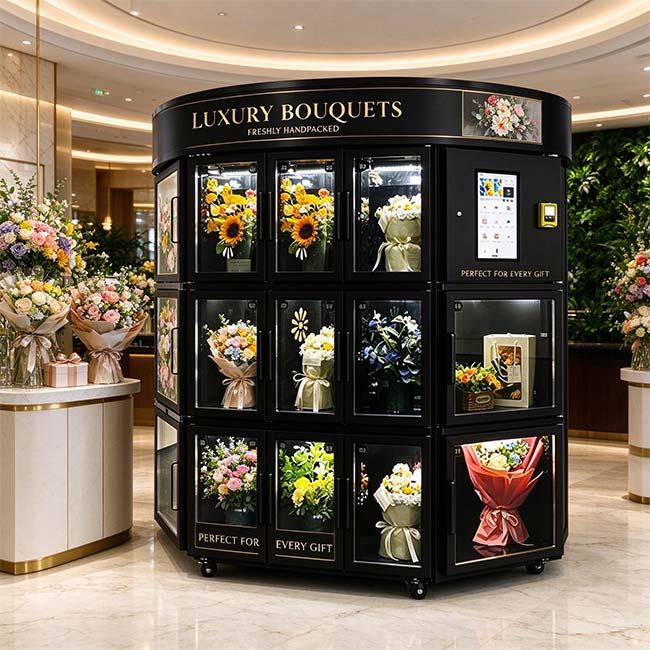
Flower vending works best where people already have a reason to buy a gift: hospitals, transit stations, hotels, malls, campuses and office lobbies. The venue deal matters as much as foot traffic. A 10% commission on $8,000 revenue is $800. A 25% commission is $2,000. That difference can be the entire profit.
Ask for a trial period with a revenue share instead of a long lease. Confirm who pays for power, who handles trash, and whether the venue will let you place a second machine during peak season. Get the termination terms in writing.
Spoilage and cold chain
Fresh flowers are not snacks. They need a stable cool temperature, water or hydration packs, and gentle handling. A machine that runs at 2 to 25°C can hold cut flowers for about 5 to 7 days between restocks, but that depends on the variety and how the bouquet was treated before it reached the machine.
| Flower type | Typical vase life | Restock note |
|---|---|---|
| Roses | 5 to 7 days | Check stems for bent necks. |
| Carnations | 7 to 10 days | Good for slower sites. |
| Tulips | 3 to 5 days | Move fast in warm weather. |
| Lilies | 5 to 7 days | Sell before open blooms drop pollen. |
| Mixed bouquets | 4 to 6 days | Watch the weakest stem in the mix. |
| Orchids | 7 to 14 days | Higher price, slower turnover. |
Markdown rules help. Move day-three bouquets to a lower price or bundle them with a card. Do not wait for visible wilt. A discounted bouquet at $10 recovers more than a dead bouquet at $18.
Pricing and product mix
A single-stem rose at $4 to $6 can pull impulse buyers who will not spend $18. A mixed bouquet at $18 to $25 lifts the average order. Holiday bundles can go higher. Track sales by slot, not just total revenue. If one slot sells out every week and another sits for five days, change the mix.
Restocking labor and route density
A weekly restock takes 30 to 60 minutes per machine in a good location. During Valentine’s Day and Mother’s Day, plan for two or three visits a week. If you run several machines, group them by route. A machine that takes 90 minutes to reach is rarely worth the trip unless it sells at least 15 bouquets a day.
Scaling changes the math. One machine can be a side business. Five machines in the same city can support a route, a small van and a part-time restocker. For a route-size model, see how many vending machines you need to be profitable.
Location scorecard: score before you sign
Use a simple scorecard before you pay a deposit. Walk the site at three different times: morning, lunch and evening. Count people, not cars. Check whether a flower shop or grocery store is within a short walk.
| Factor | Weight | Score 1 to 5 | What to check |
|---|---|---|---|
| Gift-buying traffic | 30% | ___ | Hospital visitors, hotel guests, commuters, students. |
| Venue commission and rent | 25% | ___ | Total monthly cost below 15% to 20% of revenue. |
| Restock access | 15% | ___ | Loading door, parking, lift access. |
| Power and temperature | 15% | ___ | Dedicated outlet, shade, no heat trap. |
| Competition | 10% | ___ | Nearby florist, grocery or gift shop. |
| Theft and security | 5% | ___ | Camera coverage, staff presence, locked slots. |
Score each item from 1 to 5 and multiply by the weight. A site under 3.5 is a pass. A site under 2.5 is a hard no, even if the rent looks cheap.
When a flower vending machine is not profitable
There are clear warning signs. If daily sales are below 5 bouquets and the venue wants more than 10% commission, the model usually fails. If spoilage runs above 30% for two months, fix the cold chain or leave. If the machine is down for a week at 15 bouquets a day and $18 average price, you lose about $1,890 in revenue, plus the flowers inside.
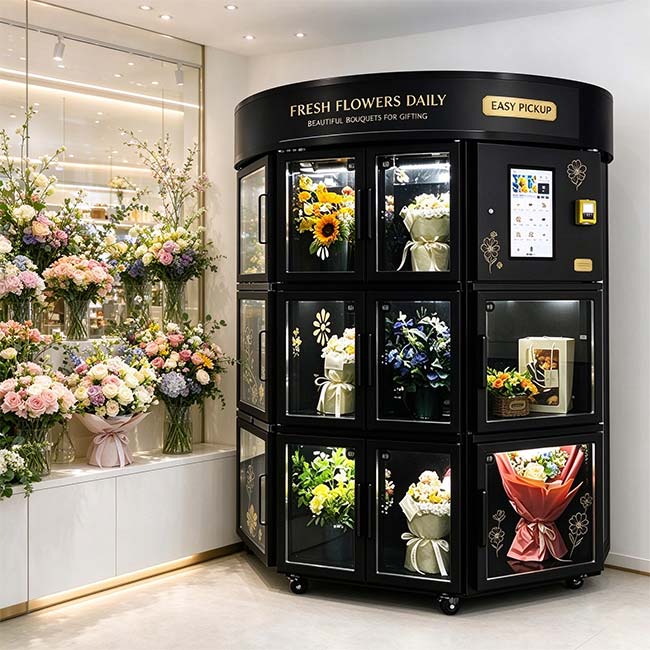
- Traffic is high but almost nobody carries a gift. A commuter station at 7 a.m. can be worse than a hospital lobby at 3 p.m.
- The venue takes a high commission and also charges rent, power and a signage fee.
- You cannot restock within 48 hours when a heat wave hits.
- The machine is outdoors without shade or a reliable power supply.
- You are paying for a premium mall spot but selling only single stems.
Machine choice changes your cost base
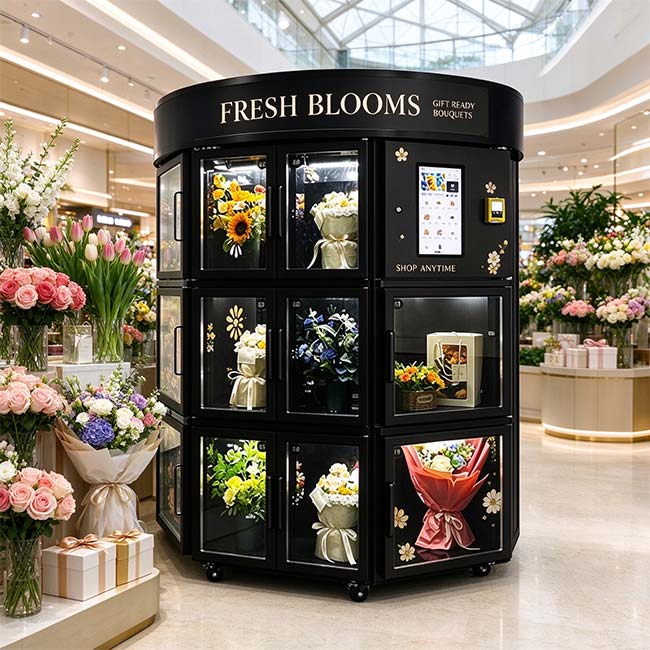
Not every refrigerated flower machine is built for the same job. A 5-slot compact unit fits a convenience store corner. A 24-slot wide unit fits an airport or a large mall, but it also needs more stock, more restocking time and a higher-traffic site to justify the space.
One example from the factory side is the Wider Matrix flower vending machine line. It has nine models with 5 to 24 bouquet slots, a 2 to 25°C freshness zone, touchscreen ordering, cash, card and mobile payment, individually locked compartments and anti-fog glass. The reference price range is US$3,000 to US$6,500 per unit depending on model and configuration. The machines are certified to CE, FCC, RoHS, SGS and ISO 9001, and Wider Matrix has built vending machines since 2016, with 3,000+ units exported to more than 130 countries.
The spec that matters for profit is not the screen size. It is temperature stability, slot count, restock access and whether you can see per-slot sales from your phone. A machine that holds temperature well and tells you which slot is empty saves more money than a bigger machine that sells the same 10 bouquets a day.
If you are comparing machine types beyond flowers, this breakdown of the most profitable vending machine types puts the margins in context.
Startup costs and lease versus buy
A flower vending machine business is not just the machine. Budget for shipping, installation, first stock, a venue deposit, permits, insurance and working capital. A realistic startup range for one machine is $5,300 to $12,000, depending on the model, market and venue.

| Cost | Low | High | Note |
|---|---|---|---|
| Machine | $3,000 | $6,500 | Reference range for standard flower models. |
| Shipping and install | $300 | $1,200 | Varies by market and site access. |
| First stock | $400 | $800 | Bouquets, wraps, water tubes and cards. |
| Venue deposit | $500 | $2,000 | Often one to three months of fees. |
| Permits and insurance | $100 | $500 | Local rules vary widely. |
| Working capital | $1,000 | $2,000 | Cash for restocks and slow weeks. |
Buying gives you depreciation and a resale asset. Leasing lowers the upfront cash but adds a monthly payment that must be covered before profit. If a lease is $300 a month and your machine nets $500, the lease takes 60% of the profit. Run the break-even with the lease payment included, not after it.
Permits, insurance and contracts
Rules vary by city and country. Most operators need a general business license, a sales tax registration and a vending or signage permit. Some venues require proof of liability insurance. Flowers are not usually treated as food, but processed or packaged gifts may fall under local labeling rules.
Insurance should cover general liability, property damage and business interruption. A small machine can still cause water damage if a cooler leaks, and a theft claim without coverage can wipe out months of profit.
Contract clauses to check: commission percentage, minimum monthly fee, exclusivity, power costs, restock access hours, termination notice, damage responsibility and what happens if the venue changes ownership. A handshake deal is not enough when a new manager takes over.
How flower vending compares with a shop, grocery and online delivery
| Model | Upfront cost | Labor | Best use case | Main weakness |
|---|---|---|---|---|
| Flower vending machine | Low to medium | Low staff, regular restock | Impulse gifts after hours | Spoilage and location dependence |
| Flower shop | High | High | Custom work and relationships | Rent and staff costs |
| Grocery bouquets | Very low for the buyer | Store staff | Cheap everyday flowers | Low perceived gift value |
| Online delivery | Medium for the operator | Fulfilment and delivery | Planned gifts and wide selection | Delivery cost and lead time |
A flower shop can build relationships and handle custom work. A vending machine cannot. Grocery stores beat you on price for simple bouquets. Online delivery beats you on selection and convenience for planned gifts. The vending machine wins on immediate, unattended, after-hours convenience. That is a narrow lane, so the location has to match it.
Scaling from one machine to a route
One machine is a test. A route is a business. Before you buy a second machine, check route density. Two machines 20 minutes apart can share one restock trip. Two machines 90 minutes apart usually cannot. Track revenue per restock hour, not just revenue per machine.
At five machines, you may need a small van, a cold box, a payment dashboard and a part-time helper for peak weeks. At ten machines, software and route planning matter more than machine price. For a wider view of vending economics, see are vending machines profitable and how profitable are vending machines.
A 30-day validation plan
- Pick three candidate sites and count foot traffic for a week at three times of day.
- Ask each venue for commission, rent, power and contract terms in writing.
- Call two local florists and ask for wholesale bouquet cost and delivery days.
- Run the break-even formula with a 20% spoilage assumption, not 10%.
- Test one machine for 60 days if the venue allows a trial. Track sales by slot and waste by variety.
- Review the numbers after week four and week eight. If break-even is above 60% of sales, renegotiate or move.
Do not sign a 12-month lease before you have four weeks of real sales data. A trial with a revenue share is worth more than a cheap rent in a bad spot.
FAQ
How much does a flower vending machine make per day?
At $15 to $20 per bouquet, 6 sales a day is $90 to $120 in revenue. After flower cost, spoilage, fees and commission, the net can be close to zero in a low-traffic site. At 15 sales a day, revenue is $225 to $300 and net profit might be $40 to $90 a day. Location decides the range.
How many bouquets per day do I need to break even?
For a mid-traffic site with $1,200 in fixed monthly costs and about $5.70 contribution per bouquet, break-even is roughly 7 bouquets a day. A low-traffic site with lower fixed costs might break even at 5 a day. A high-commission site may need 10 or more.
Do you need a license to operate a flower vending machine?
Usually you need a general business license and a sales tax registration. Some cities add a vending permit, signage permit or fire inspection. Check with your local business office and the venue before you install. Insurance is often required by the venue even when the city does not mandate it.
How long do flowers last in a vending machine?
At a stable 2 to 25°C, most cut flowers stay display-ready for about 5 to 7 days. Carnations and chrysanthemums can last longer. Tulips and delicate spring flowers are shorter. The machine slows decline, but it cannot rescue flowers that were already old when you loaded them.
Is flower vending passive income?
No. It is low-staff, not passive. You still restock, check temperature, manage spoilage, clean the machine and handle payment disputes. A single machine might take 4 to 8 hours a month. A route of ten machines can become a part-time job.
What spoilage rate should I expect?
Plan for 15% to 25% in a normal month and higher in hot weather or slow weeks. If spoilage is above 30% for two months, change your order size, restock frequency or location. Do not assume you can sell every bouquet you load.
What is the biggest reason flower vending machines fail?
Weak location economics. A site can look busy and still have few gift buyers. High commission, low conversion and poor restock access usually matter more than machine reliability. The second most common reason is spoilage from a temperature or supply problem.
Can I run a flower vending machine without a shop?
Yes. Many operators restock from a small cold room, a van with a cooler, or a wholesale flower supplier. You do not need a retail storefront, but you do need a clean place to hold stock and assemble bouquets. If you cannot keep flowers cool before they reach the machine, the machine will not fix that.
Bottom line
Flower vending machines can be profitable, but the business is made by the site and the spoilage rate, not by the machine alone. Use a full profit and loss model, include commission and waste, and walk away from any site that needs more than 60% of your realistic sales just to break even. Start with one machine, track sales by slot, and renegotiate before you scale.
If you are still comparing models, start with the real flower vending machine records and then run the numbers for your own location. The operators who do well are usually the ones who treated the first machine as a test, not a guarantee.