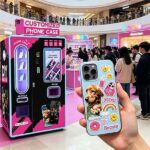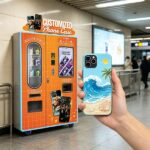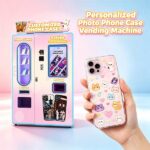



The minimum order quantity for a phone case vending machine is one unit, and there is no deposit, tooling fee or contract keeping a first-time buyer from starting with a single kiosk. The real decision sits a step later: at what order size does the unit price actually fall, and what does the buyer have to take on to reach it. A single WM880 from Wider Matrix holds 1,020 to 1,025 cases, prints through an Epson F1080 or i1600-U1 head, weighs 380 kg and runs on 410W, so a pilot machine in one mall is enough to prove a location before any batch is committed. Send over the market you are selling into, how many units you are weighing, and whether the machines need your own branding, and Wider Matrix will return a firm quotation with tier pricing on FOB or CIF terms rather than a range. Everything below covers the same ground in detail: what one unit costs, what changes at four, seven and eleven machines, the MOQ on cases and ink, and how to test a supplier who claims there is no minimum at all.
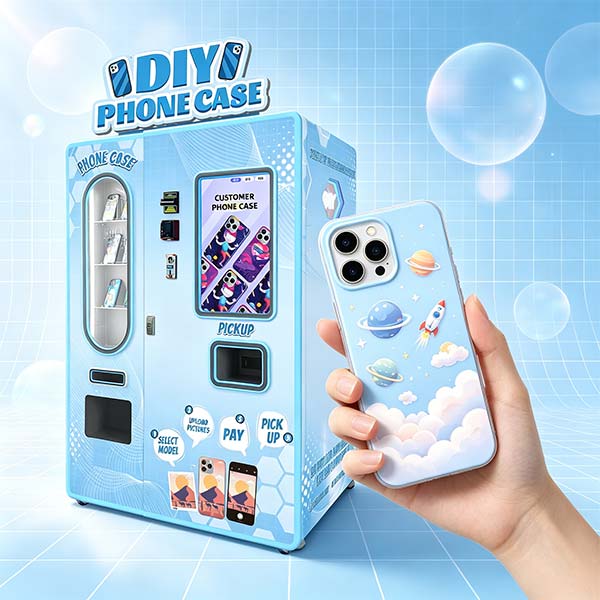
The minimum order quantity for a phone case vending machine is one unit. A buyer can place a single machine, run it in one venue, and order more only if the takings justify it. Wider Matrix builds the WM880 on exactly that basis. A single unit lists at US$4,999 with the Epson F1080 print head, or US$5,999 with the i1600-U1 head. Volume pricing starts at four machines, steps again at seven, and again at eleven. Nothing in the process, no tooling charge, no batch commitment, no deposit structure, forces a first-time buyer to take more than the one kiosk they came for.
That answer usually does not close the question, because “minimum order quantity” means three different things depending on who is saying it. For the machine itself, the floor is one. For the phone cases that go inside it, the floor is 1,000 pieces. For the ink, it is a single color set. Buyers who ask a supplier for “the MOQ” and get a single number back are usually being given the answer to only one of those three, and it is rarely the one that decides their cash flow. A distributor importing into a new country has a different problem from a mall operator adding a second site, and the number that matters to each of them is not the same.
Why the minimum order question gets a muddled answer
A phone case vending machine is not a warehouse product. The WM880 is 1,340 x 990 x 2,170 mm and weighs 380 kg. It is assembled to order, configured with a print head, loaded with a payment stack and shipped as a single crate. There is no shelf of discounted stock, no overrun inventory being cleared, and no container that has to be filled before the factory will talk to a buyer. When a supplier in this market says “minimum order”, the word is doing the work of a commercial decision rather than a manufacturing constraint.
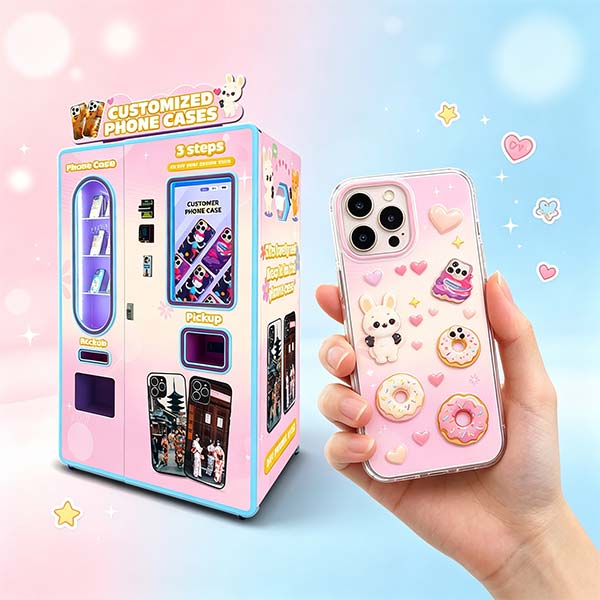
The muddle comes from three separate minimums that get reported as one. The machine minimum is set by what the factory is willing to build and ship. The consumable minimum is set by the case molding and ink packing process. The customization minimum is set by what the branding and software work costs to set up. A single machine can carry the buyer’s logo without an order of ten, because the artwork is applied per unit rather than per batch. Cases, by contrast, are moulded in runs, which is why a case order starts at four figures. Treat the three separately and the decision becomes straightforward.
What one machine actually means
An order of one is a real order, not a sample. The WM880 that arrives after a single-unit purchase is identical to the units in a batch of twenty: same chassis, same Epson head options, same payment terminal accepting coin, cash, credit card, NFC and QR, same 2,000 ml ink tank, same 1,020 to 1,025 case capacity depending on whether the F1080 or i1600-U1 head is fitted. The optional stock identification camera, which reads inventory slot by slot, adds US$200 (or ¥1,350) whether it is ordered with one machine or with eleven.
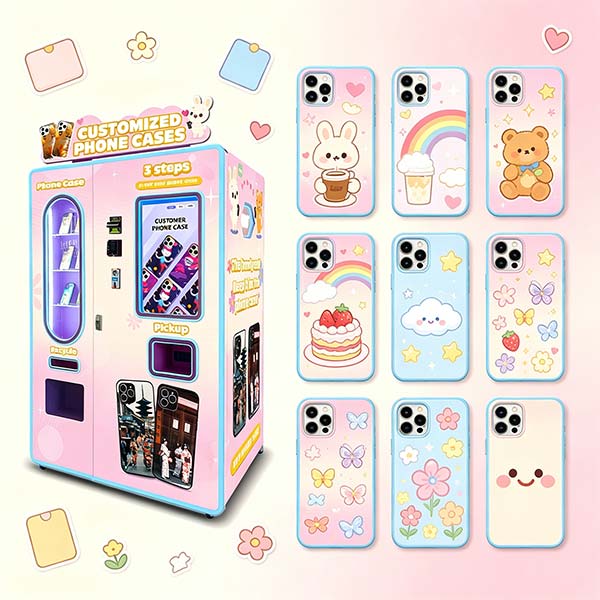
There is one practical difference between a single unit and a batch, and it is freight rather than price. One 380 kg kiosk can move by air when speed matters, and a buyer testing a market often finds that worth paying for. A batch of four or more almost always goes by sea, because the per-unit freight cost collapses once machines share a container. So the honest answer to “can I buy just one” is yes, and the follow-up a buyer should ask is not whether one is allowed, but whether one is the cheapest way to reach the market in question.
What the minimum order quantity buys at each tier
Wider Matrix publishes list pricing at the one-to-three-unit band and quotes above it on request. The published figures are enough to show how the structure works.
| Configuration | Print head | Case capacity | Price, 1 to 3 units |
| WM880 F1080 version | Epson F1080-A1 | 1,020 cases | US$4,999 |
| WM880 i1600 version | Epson i1600-U1 | 1,025 cases | US$5,999 |
| WM880 with i3200 upgrade | Epson i3200-U1HD | 1,025 cases | add US$680 |
| Inventory identification camera | fitted on top of machine | per-slot stock reading | add US$200 |
The head is where the two versions separate. Epson rates the i1600-U1 at roughly three times the printing speed of the F1080, four times the lifespan and twice the clarity. The i3200-U1HD is a further step up in speed, and both upgrades are lossless, which means the same chassis and the same software carry the newer head. For a buyer placing one machine in a quiet lobby, the F1080 build is usually the sensible start. For a site expected to run hard from day one, the i1600 build pays back the extra US$1,000 quickly, because a faster head cuts the queue that forms on a Saturday afternoon.
Above three units the published list stops and the quotation begins. The bands are four to six, seven to ten, and eleven or more. Each band has its own price level, and the exact figure depends on the head mix across the batch, the shipping terms, and the destination port. Working through what those bands typically look like is worth doing before a first enquiry, and this breakdown of how much a phone case printing vending machine costs covers the line items that sit behind the number. Buyers who want the custom-spec side priced separately can read the tighter view of the price of a custom phone case printing vending machine, which is where non-standard builds get explained.
Use case one: one machine proving one location
This is the most common first order, and it is almost always placed by someone who has already identified a site. A mall concourse, a cinema foyer, a university building, a transport hub. The logic is simple. Prove the footfall converts before committing capital, and use the first machine’s takings to fund the second.
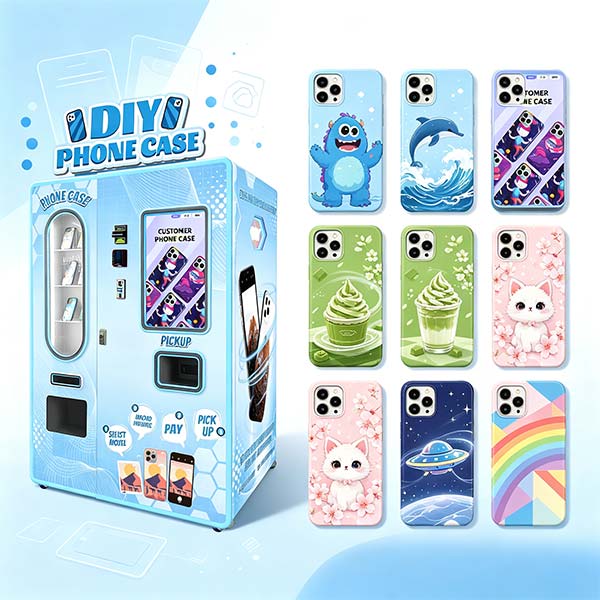
The WM880 suits the test because it carries 1,020 to 1,025 blank cases on board. At a site moving fifteen cases a day, that is a refill roughly once every ten weeks. At a busy weekend venue doing forty a day, it is closer to three weeks. Either way, the operator is not driving to the site every few days, which is the hidden cost that kills single-machine businesses. The 2,000 ml ink tank stretches across thousands of prints, and the machine reports fault states and stock levels remotely through the PC dashboard and mobile app, so a problem surfaces before a customer stands in front of a dead screen.
Footprint matters here too. At 1,340 mm wide and 990 mm deep, the WM880 needs roughly 1.4 square meters of floor plus circulation space in front. Airport authorities and mall leasing teams ask for that figure early, and a machine that does not fit the approved slot is not a machine. The power draw is 410W on a 110V to 220V supply, which is a standard single-phase feed in most retail units and needs no dedicated circuit in many venues.
The placement decision carries more of the risk than the machine does. Malls produce steady, repeat traffic, and the impulse to buy a personalized case is already there. Airports and stations give a captive audience with time to spare. Campuses work because phone models turn over annually and students replace cases far more often than the general public. The write-up on custom phone case vending machines for malls goes into the venue that most single-unit buyers end up choosing.
One caution for anyone planning a pilot. A single machine still needs the consumable minimums behind it. That means at least 1,000 cases and a color set of ink at the point of first order, so the true entry cost is the machine plus one starter load rather than the machine alone.
Use case two: four to ten machines across a route
The second order in this pattern is where the economics change, and it is the one where the MOQ question is most worth asking properly. Four units opens the first volume band. Seven units opens the second. Each step down in unit price is real, and each one also multiplies the fixed costs on the operator’s side, because a route means transport, refilling logistics, and a person responsible for a spread of sites.
Route operators tend to standardize. Same head across the fleet, same case range, same software settings. That matters for two reasons. A mixed fleet pushes the spare parts inventory up, because a head that fits one machine does not fit another. And staff training gets harder when machine behaviour differs site to site. Standardising on the i1600-U1 build is the common choice at this tier, since three times the printing speed relative to the F1080 keeps queues down in high-traffic sites without going to the i3200 price.
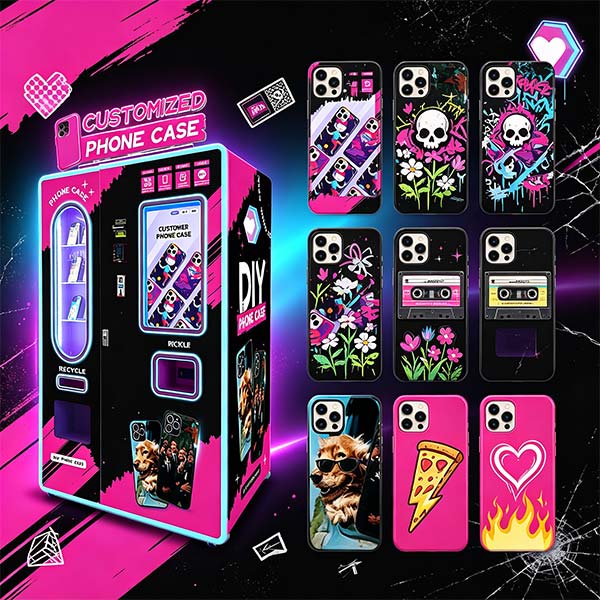
Capacity planning is where the four-to-ten band earns its keep. A batch of six machines at 1,025 cases each is 6,150 blanks on hand, which is enough to run a small route through a peak season without an emergency case order. Case pricing also drops with volume: TPU and PC blanks run US$1.30 each at 1,000 pieces, US$1.20 at 5,000, and US$1.10 at 8,000. Magnetic cases sit higher at US$2.30, US$2.20 and US$2.10 across the same quantities. A route buying 5,000 cases at a time is saving US$500 against the 1,000-piece price on standard blanks alone, before any machine discount is applied. The TPU and PC phone cases themselves are the consumable that keeps this tier profitable, and the spread between blank cost and retail price is covered in the analysis of the profit margin on phone cases.
Operationally, four to ten machines is also the point where remote management stops being a convenience and becomes the job. One screen showing sales, stock and machine health across every site lets an operator move cases to where they are selling and catch a failing print head before a week of downtime. Wider Matrix builds that into the standard machine rather than selling it as an add-on, on both the PC dashboard and the mobile app.
Use case three: eleven units and up for import and resale
The third pattern is the importer, distributor or brand owner. This buyer does not run machines. They bring a batch into a market and either sell the units on or operate them under their own label. At eleven units and above the price band is the lowest published tier, and the questions shift away from unit price toward tooling, branding, certification and container planning.
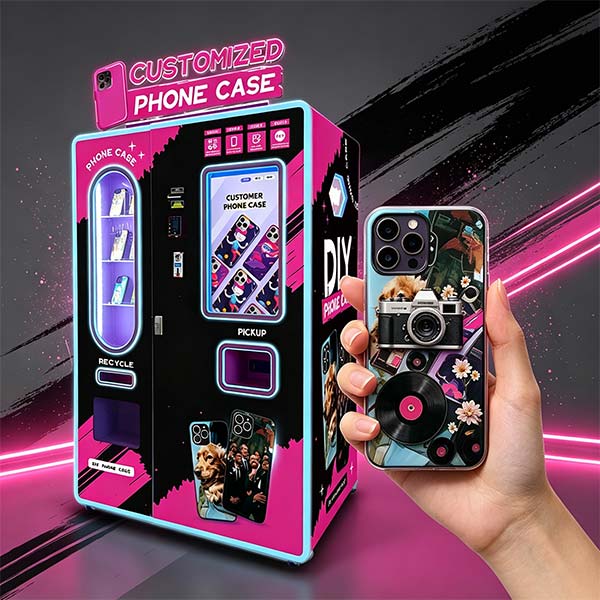
Branding is the first conversation. A distributor shipping unbranded kiosks into a market is competing on price alone. Wider Matrix handles OEM and ODM work as standard, covering the logo on the cabinet, the exterior color scheme, the on-screen interface and the software settings. The machine already supports multiple currencies and interface languages including English, Russian, French, Arabic and Korean, which matters when one container is headed for several markets at once. How that process runs from artwork to shipping is set out in the guide to factory customization for phone cases.
Certification is the second. An imported machine without the right paperwork can sit at a port while the buyer argues with a broker about testing. WM880 units carry CCC, CE, ISO, RoHS and PSE marks, backed by more than five independent R&D patents and over thirty industry awards. Those documents are what a customs broker asks for, and they are the reason a batch clears into the EU, the UK, Japan or North America without a rush order for extra testing.
Container maths is the third, and it is the strongest argument for reaching the eleven-unit band rather than ordering in two batches of six. Freight, insurance and inland delivery all spread across the units in the shipment. A distributor weighing this step should price the landed cost per machine rather than the factory price per machine, because the two can differ by more than the volume discount is worth. Wider Matrix quotes on FOB or CIF terms so the two figures stay visible as separate lines, and buyers who want the sourcing context for this tier will find it in the overview of China phone case printer manufacturers.
The MOQ on the parts that keep running
The machine is a one-time purchase. Cases and ink are not, and their minimums matter more to a long-run operator than the machine minimum does. Case ordering starts at 1,000 pieces, and the price steps at 5,000 and 8,000. Ink comes as a color set: a four-color Epson UV hard ink set at US$100 for the standard configuration, and a six-color set at US$160 for the F1080 version. Details on both are on the Epson UV hard ink for phone case printing page.
The trap here is ordering cases to match the machine count rather than the refill cycle. A five-machine route going through thirty cases a day per site needs roughly 54,000 blanks a year. Ordering that in 1,000-piece drops means paying the highest per-piece rate all year. Ordering it in 8,000-piece drops means a storage room and a cash commitment up front. Most operators settle somewhere in the middle and adjust after two or three cycles, once they know how the sites actually behave. Build a buffer on ink regardless. A delayed ink shipment stops every machine on the route, and that is a costlier week than carrying an extra set in the stockroom.
Freight, duties and the real minimum
Two buyers can place the same one-unit order and end up with very different total costs. The difference is where the machine is going and how it gets there. A single 380 kg kiosk moving by air is fast and expensive. The same unit moving by sea alongside a batch is slow and cheap. Insurance, import duty and inland delivery to the final site all scale with the order too, and none of them appear in the factory list price.
This is why the question “what is the minimum I can order” is best answered alongside “what is the minimum that makes economic sense for my market”. A buyer in a country with straightforward import rules and a nearby port can start with one. A buyer in a market with a long inland leg and steep duty may find that two machines in one shipment cost less in total than one machine shipped twice. Running that comparison before ordering is worth an hour of arithmetic, and it is the same comparison a supplier should be willing to help with. Buyers comparing factories on this point will find useful context in this walkthrough of choosing the right phone case vending machine manufacturer, and in the companion piece on what separates a reliable phone case vending machine supplier from a reseller with a polished website.
Lead time, payment and the trial order
Order size and lead time are linked. A single configured machine can be built and prepared faster than a batch of twelve, because a batch is assembled as a run rather than one unit at a time. Buyers planning around a launch date should raise that date at the point of enquiry rather than after the order is confirmed, since the head choice affects build scheduling. An i3200 upgrade adds work to a completed machine, while the same head chosen at the point of order is simply specified into the build.
On payment, the structure that gets a first-time buyer comfortable is a trial unit followed by a batch. Wider Matrix has taken single-unit orders from buyers testing a location, and those buyers have returned with larger orders once the site proved itself. That path is available because the machine minimum is one, not because of any special arrangement. Anyone weighing a larger commitment should ask for two things before signing: a reference from an operator closest to their own market and machine type, and a clear statement of what the price covers. The annual running numbers behind that decision, including the spread between a finished custom case selling at US$10 to US$25 and blanks costing US$1.10 to US$1.30 in bulk, are worked through in the guidance on how to start a custom phone case business.
How to test a supplier’s MOQ claim
A supplier who says there is no minimum but cannot show a production line usually means they will buy the machine elsewhere and resell it, which adds a margin and a layer of delay when something breaks. Four questions sort that out quickly.
Ask where the machine is assembled and who integrates the print head. Ask which Epson head options the factory stocks and whether the upgrade from i1600 to i3200 is done on the buyer’s own machine without replacing the chassis or software. Ask for the certification list in writing, because a supplier without CE or PSE documents is not shipping to Europe or Japan at any MOQ. And ask what happens on a bad day: who answers when a head clogs at month fourteen, how fast parts ship, and whether the machine’s own diagnostics can be read remotely before anyone travels to the site.
Wider Matrix has been building vending equipment since 2016 out of a factory in Guangzhou’s Panyu district, with more than 3,000 units shipped and machines running in over 130 countries. A 50-plus engineer team is why non-standard builds are a routine order rather than an exception. On support, the commitment is a one-year warranty with lifetime technical support behind it, a 7×24 after-sales line, and remote diagnostics through the PC dashboard and mobile app. Whether that matters depends on the buyer’s situation, but a distributor will feel it first, because a distributor is the one their own customers call. A wider look at how the unit is positioned in the product line sits in this overview of the Wider Matrix phone case printer.
One last comparison worth making, since it comes up in almost every first conversation. A desktop UV printer and a vending kiosk are priced in different worlds, and a phone case maker machine kit sold for home use is not a substitute for a self-service unit that takes payment and dispenses a finished case with nobody standing next to it. Before comparing MOQs from two suppliers, confirm that both are quoting the same category of product.
Questions buyers ask before a first order
Q: Can I order just one phone case vending machine?
A: Yes. The minimum is one unit. A single WM880 lists at US$4,999 with the Epson F1080 head or US$5,999 with the i1600-U1 head, and nothing about the order structure requires a batch. Volume pricing simply rewards larger orders, starting at four machines.
Q: What is the MOQ on the phone cases used inside the machine?
A: 1,000 pieces. TPU and PC blanks run US$1.30 each at 1,000 units, US$1.20 at 5,000 and US$1.10 at 8,000. Magnetic cases cost US$2.30, US$2.20 and US$2.10 across the same quantities. A machine ordered on its own still needs at least one starter load of cases and ink behind it.
Q: Is there a different minimum for machines ordered under my own brand?
A: No separate floor applies to branding itself. Wider Matrix handles OEM and ODM work covering the cabinet logo, exterior colors, the on-screen interface and software settings, and the artwork is applied per unit. Buyers wanting significant custom development should describe the requirement at enquiry so the engineering team can price it properly.
Q: How much does a single machine cost all in?
A: The factory price is US$4,999 or US$5,999 depending on the print head, with two options that can be added: the inventory identification camera at US$200 and the i3200 head upgrade at US$680. Freight, insurance, duty and inland delivery sit on top and vary by destination. Wider Matrix quotes on FOB or CIF terms so factory price and landed cost stay separate.
Q: How many machines should a new operator start with?
A: One, unless a site is already secured with the footfall to support more. A single unit at US$4,999 to US$5,999 is the cheapest way to find out whether a location converts. A 1,020 to 1,025 case capacity means the refill cycle stays manageable even at a busy site, and the machine can be added to later rather than replaced.
Q: Does ordering more than ten machines change the specification?
A: No. A machine in a batch of eleven is built to the same specification as a single unit, on the same chassis with the same Epson head options, the same 2,000 ml ink tank, the same 410W draw on a 110V to 220V supply, and the same payment options covering coin, cash, card, NFC and QR. The difference is price per unit and shipping economics.
Q: Can the print head be upgraded after delivery instead of at the point of order?
A: Yes. The upgrade from i1600-U1 to i3200-U1HD is lossless and costs US$680, and the chassis and software stay the same. That makes it a viable route for a buyer who wants to start at the lower head tier and move up once a site’s volume is known.
Q: What certifications come with the machine?
A: CCC, CE, ISO, RoHS and PSE, backed by more than five independent R&D patents and over thirty industry awards. These are the documents a customs broker asks for, and they are the reason a batch clears into the EU, the UK, Japan or North America without extra testing being arranged at the port.
Q: How long does delivery take for one unit versus a batch?
A: A single configured machine is prepared more quickly than a batch of twelve, since a batch is assembled as a run. Transit time depends on air or sea freight and on the destination port. Raise the target launch date at the point of enquiry and the build can be scheduled around it.
Q: Do I need a licence to operate a phone case vending machine?
A: It varies by country and by venue. Some markets require a general trading or vendor registration, and most sites will ask for public liability cover before signing a lease. Check the local rules for the specific location, and confirm what the venue operator requires, because those two sets of conditions are not always the same.
Q: Is it cheaper to build a phone case vending machine than to buy one?
A: Usually not. The frame and the printer are the easy parts. Payment integration, inventory handling and the software tying it together are where the cost lands, and by the time those are solved the total tends to approach the price of a finished kiosk without carrying a warranty. Buying from a factory that has already shipped more than 3,000 units is the shorter route to a working site.
Q: Where is the machine made, and can I visit before ordering?
A: Wider Matrix manufactures in Guangzhou’s Panyu district, has been building vending equipment since 2016, and has shipped more than 3,000 units to over 130 countries. Buyers who want to see a unit running before committing can ask for the reference closest to their market, and factory visits can be arranged through the contact page.
Next step on a first order
The minimum order quantity is one, and the price of that one machine is published rather than negotiated in the dark. What a buyer needs before committing is a number that reflects their own situation: destination port, unit count, head mix across the batch, and whether the machines carry a brand of their own. Send those four details and Wider Matrix will return a quotation with tier pricing on FOB or CIF terms instead of a range and a follow-up call. Buyers still comparing sources will find that the useful questions are the same whether one machine or twenty is on the table, and this look at where to buy a phone case printing machine from China covers the sourcing side of the same decision. Ask for a reference from an operator running the closest thing to your own site, and the answer you get back will be worth more than any specification sheet.