

The WMT-I01 from Wider Matrix makes cube ice on site, bags it automatically into 2 kg or 4 kg portions and sells it around the clock with no staff. This page covers what arrives in the crate, what the bags cost, where bagged ice sells, the site work needed, and how an order moves from an enquiry to a running machine. Send your country, unit count, voltage and payment setup through the form on this page for a landed price and the current build schedule.
A customer walks up at half past nine at night, taps a 4 kg bag on a 21.5-inch screen, pays, and waits a few seconds. Inside the cabinet a bag drops into place, the ice gate opens, and the chute lights up and swings open with a sealed bag of cube ice sitting in it. There is nobody behind a counter, and the shop next door shut two hours ago.
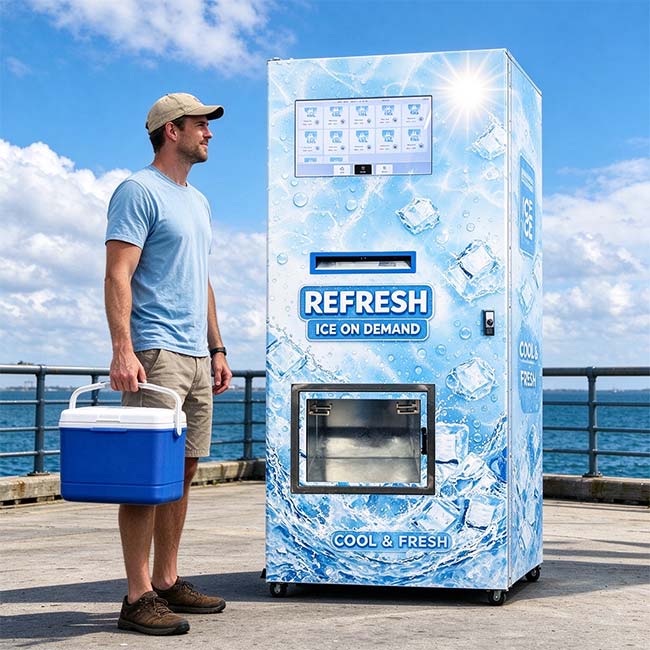
Wider Matrix has a bag of ice vending machine for sale, the WMT-I01, listed at US$4,600 for a single unit. It freezes cube ice inside the cabinet from filtered water, bags it automatically, and can also dispense loose ice into a container the customer brings. Output is 150 kg per 24 hours on the standard build, with a 200 kg configuration where the site demands it. Minimum order is one machine.
Almost every question we get before an order comes back to the bag: what goes in it, what it costs, how many the machine can sell in a day, and where bagged ice actually sells well enough to bother.
Bag of ice vending machine for sale: what is in the crate
The WMT-I01 is a self-service cabinet with the ice maker built in, so there is no external ice supply to arrange and no delivery to wait for. Water comes from a mains line through a standard 1/2 inch fitting or from a bottled barrel, passes a 3-stage filtration set, and freezes into cube ice in batches that take 6 to 8 minutes. Finished ice sits in a 9 kg bin until somebody buys it.
| Specification | WMT-I01 |
|---|---|
| Ice type | Cube ice, made on board |
| Selling format | Bagged ice or bulk ice in the customer’s own container |
| Output | 150 kg per 24 hours standard, 200 kg configuration available |
| Ice storage bin | 9 kg |
| Batch time | 6 to 8 minutes |
| Bagging | Automatic, with food grade bags |
| Dimensions | 1920 (H) x 800 (W) x 1060 (D) mm |
| Screen | 21.5-inch capacitive multi-touch, 1920 x 1080 |
| Power | 1,000 W maximum, single phase |
| Voltage | 220 to 240V 50Hz or 110V 60Hz, built to your market |
| Payment | Coin, note and change-giving standard; card and contactless per market; MDB protocol |
| Connectivity | 4G or WiFi module, optional |
| Body | Titanium plate or galvanized spray-coated plate |
| Certifications | CE, FCC, RoHS, ISO 9001 |
| Warranty | 1 year plus 24-hour online support |
| Minimum order | 1 unit |
One machine ships assembled, filled, run and ice-tested before packing, with the 3-stage filtration set, the standard bagging module, a user manual, an installation video and the one-year warranty. Freight, duty, bags and the work on your site are separate. The cabinet stands 1920 mm tall on an 800 x 1060 mm footprint and runs on adjustable feet, which is worth checking against your doorway before the crate lands.
How a bag gets filled and handed over
The customer picks a portion on the touch screen and pays by coin, note or card, with the machine giving change where that module is enabled. The bagging module drops a bag into position, the ice gate opens, and the ice falls by gravity into the bag with the chute lit by LED. When the portion is complete the collection door opens by itself, and the machine resets for the next customer.
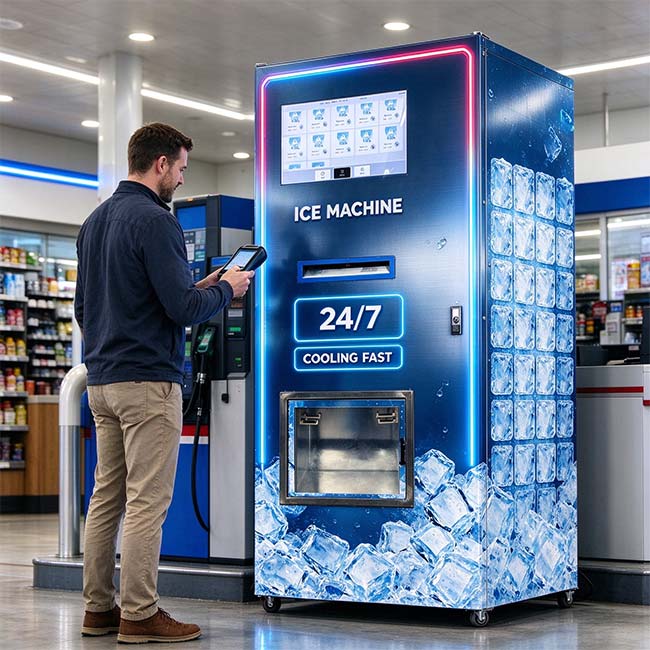
Two details of this machine matter more than they sound. The ice never touches a hand on the way from the ice maker to the bag, which is the hygiene argument for bagging over scooping. And because customers are served from the 9 kg bin rather than straight from the ice maker, a sale takes seconds instead of the 6 to 8 minutes a fresh batch needs.
Bag sizes, bag quality and what a bag costs
Bags are sized to the portion you set, typically 2 kg, which is about 5 lb, or 4 kg, about 10 lb. Both are food grade, and both can be printed with your logo. If you would rather not sell bags at all, the machine runs in bulk mode and dispenses into whatever the customer brings, and some operators never buy a bag.
Bag pricing depends on size, printing and how many you order, so it is quoted rather than listed. Ordering them with the machine is the practical route, because the bag dimensions have to match the dispensed portion and finding that out later means a reorder and a delay. We ship bags in bulk alongside the machine so you are not hunting for a local supplier in week two.
Per bag, your running cost is water, power and the bag itself. The factory example puts consumables at about $0.40 for a 2.5 kg portion, and your own water tariff and power rate will move that up or down. The ice maker draws 1,000 W at most, so an hour of continuous freezing is one kilowatt hour, and it cycles rather than running flat out.
Where bagged ice sells, and where loose ice sells better
Bagged ice wins where the customer is walking out with it. Drivers at a highway stop filling a cooler, campers at a resort, shoppers grabbing drinks at a liquor store, families at a beach or an event: all of them want something sealed they can carry, and none of them want to bring a container. A printed bag also leaves the site with your name on it.
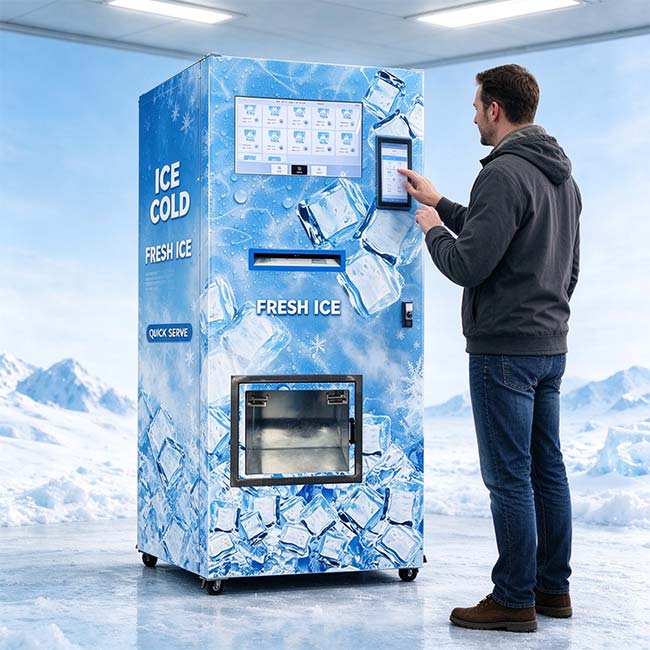
Bulk mode wins where the buyer is not a member of the public. Fish stalls icing a catch, produce traders, market vendors and catering kitchens turn up with their own tubs and buy by the kilo. They do not want to pay for packaging, and they do not care what is printed on it.
The mode is a machine setting, so you can run bagged in summer at a beach kiosk and switch to bulk if you move the unit to a fish market. Placement is the bigger variable, and it is covered in detail in where to put vending machines. The short version: ice is heavy, so the machine has to sit where someone can pull a car up close, and it needs light and safe access because a lot of ice is sold after dark.
Price, and the options that move it
The bag of ice vending machine for sale at US$4,600 is the standard 150 kg build with coin, note and change modules fitted. Orders from two units upward are quoted per order, since the number depends on quantity, destination and configuration. Six things move the quote:
- The 200 kg output configuration, which uses a larger ice maker.
- Payment hardware. Card and contactless are configured per market, and a local terminal can usually be added through MDB instead of shipping one.
- The 4G or WiFi module for sales reports, bin level and fault alerts.
- OEM and ODM work: cabinet graphics, logo, screen language and printed bags.
- Voltage and plug type for your country.
- Shipping terms, since ex-works, FOB and CIF produce three different numbers for the same machine.
Ask for the machine price, packing and freight as separate lines, and ask for copies of the CE, FCC, RoHS and ISO 9001 documents that match the configuration you are buying. Customs officers do ask, and a certificate for a different build is a delay you pay for. If you are still working out what equipment in this class costs generally, how much vending machines cost covers the wider range.
How to place an order
Start with five details in one email: your country and nearest port, how many units you want, the voltage and plug standard, the payment methods customers use, and whether you want bagged or bulk as the default. That is enough for a landed quote that includes packing and freight rather than a machine price that means nothing at your dock.
From there the order for each ice vending machine runs in a fixed sequence. The order sheet confirms capacity, voltage, payment modules, bag sizes, language and any branding, and that document is what the machine is built to. After the deposit, the unit is built, then filled and run through water and ice tests at the factory, and you can ask for the test record before it is packed. Export packing is included, shipping is arranged to most destinations, and duty, VAT and clearance are paid by the importer, so get a broker estimate before you commit.
On your side the work is small: a plumber for the mains line or barrels of water if there is no line, an electrician to confirm the circuit, and a floor drain within reach. Most installations are half a day of trade labor, and the installation video plus the training session cover the commissioning run. Choosing who you buy from is the other half of this, and choosing the right vending machine supplier goes through what to check before money moves.
What the site has to provide
Power is the easy part. The machine draws 1,000 W at most on single phase, which is under 5 amps at 220V, so a normal circuit can carry it, though a dedicated one is worth having so nothing else can trip it at night. Water is either a mains line with a standard 1/2 inch fitting or bottled barrel water, and barrel water suits piers, temporary sites and any building where running a line is not allowed.
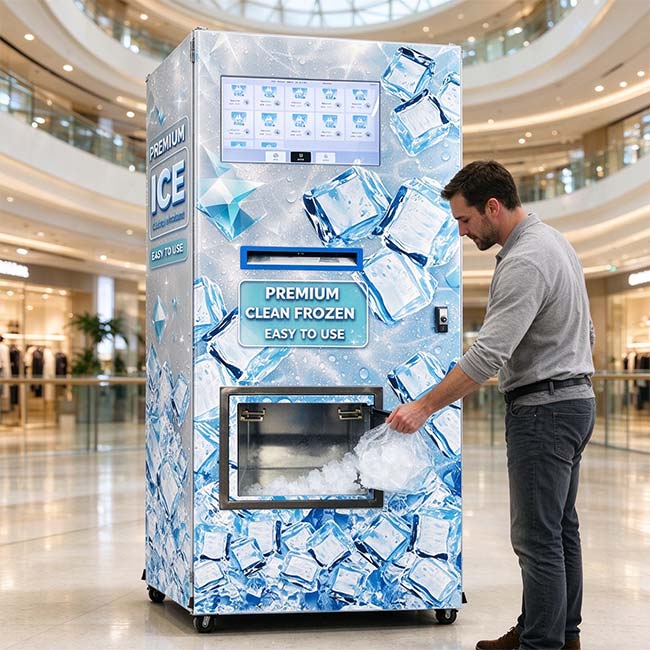
Beyond power and water, an ice vending machine needs four things from the site. Leave at least 30 cm clear at the rear and sides for heat exchange, put the unit on a flat load-bearing surface, give it a floor drain for condensate and cleaning water, and keep it shaded or indoors. the 150 kg rating assumes about 25 degrees ambient and inlet water near 20 degrees, and output drops where afternoons run past 35 degrees. All of that is easier to do at installation than to fix after the first heat wave.
Support, warranty and spare parts
Every ice vending machine we ship is assembled, water-tested and ice-tested before it is packed, which is why a machine arriving dead is a factory problem rather than yours. The warranty runs for a year with 24-hour online support, installation and maintenance training, and video guides for the jobs that come up later. Consumable and wear parts are supplied at cost, and it is worth asking for that parts list and its prices with the quotation rather than in year two.
The optional 4G or WiFi module is what keeps small problems small. It reports sales, bag counts, production state, bin level, water supply and fault codes, and pushes an alert when production stops or water runs low. Without it the machine still runs standalone and is serviced locally. Wider Matrix builds the WMT-I01 in house rather than rebadging someone else’s cabinet, so voltage, language, payment setup and portion sizes are set for your market instead of taken as fixed. If you are comparing factories rather than machines, China vending machine manufacturers and suppliers covers what to look for on an audit.
Bagged ice from a machine versus bagged ice from a supplier
Plenty of sites already buy bagged ice by the pallet. An ice vending machine only earns its place if it fills that same bag more cheaply or more reliably, so the comparison below is between two ways of filling one bag.
| Category | Ice made on site | Ice bought in |
|---|---|---|
| Cost per bag | Water, power and the bag, about $0.40 in the factory example | Purchase price plus delivery, handling and storage |
| Supply | Made on demand, day and night | Set by the delivery schedule, and stocks run out in hot weather |
| Freshness | Frozen in 6 to 8 minute batches and sold from a 9 kg bin | Made elsewhere, transported, stored and handled again |
| Labour | None at the point of sale | Ordering, receiving, carrying bags, restocking a freezer |
| Space | One cabinet, roughly 1.7 square meters with access room | A chest freezer plus somewhere to stack deliveries |
The case for making it on site is strongest where delivered ice is expensive, unreliable, or simply unavailable at the hours people want it. Where a supplier is cheap and always in stock, the machine has to earn its keep on convenience and night sales instead. Run the numbers against your own bag price before deciding either way.
If you want more than ice from the same site
For an ice vending machine, demand is seasonal in a lot of markets, and a unit that earns hard for four months and idles for eight is a fixed cost carried through all of it. One option is to add a second machine from the Wider Matrix range to the same location, cotton candy, popcorn, ice cream, phone cases, puzzles, balloons, nail art, smoothies, protein shakes or fries, so the space keeps earning when the weather turns. Two machines also share a container, which brings the freight per unit down.
If a frozen dessert suits your customers better than a bag of ice, the buying logic is set out in our ice cream vending machine for sale guide.
Frequently asked questions
How much is the bag of ice vending machine for sale?
US$4,600 is the list price for one WMT-I01, including the filtration set, the bagging module, a manual, an installation video and a one-year warranty. Orders of two or more are quoted per order. Freight, duty, bags and site work are extra.
What bag sizes can the machine dispense?
Bags are sized to the portion you set, typically 2 kg, about 5 lb, or 4 kg, about 10 lb. They are food grade and can be printed with your logo. Bag pricing depends on size, printing and order volume, so it is quoted with the machine rather than listed.
Can it sell loose ice as well as bagged ice?
Yes. Bulk mode dispenses straight into a container the customer brings, and bagged mode uses the automatic bagging system. Switching between them is a setting on the machine, not a hardware change.
Does an ice vending machine need staff on site?
No. Customers select, pay and collect on their own, and the chute opens by itself when the portion is ready. The optional 4G or WiFi module lets one person watch sales, bin level and fault alerts across several machines.
What does installation involve?
A water connection, either a mains line with a standard 1/2 inch fitting or bottled barrel water, plus a single phase circuit and a floor drain nearby. Most sites need half a day from a plumber and an electrician, and the installation video and training session cover the first run.
How many bags can it sell in a day?
Output is rated at 150 kg per 24 hours at about 25 degrees ambient, and the 9 kg bin holds roughly four 2 kg bags or two 4 kg bags at a time, refilling every 6 to 8 minutes. In sustained heat above 35 degrees the daily figure drops, so size the machine for your hottest month.
Do you ship to my country, and who pays the duty?
Shipping is arranged to most destinations with export packing included. Duty, VAT and destination charges are paid by the importer, so ask for FOB and CIF figures from us and a duty estimate from your broker before you commit.
Can I put my own branding on the machine and the bags?
Yes, under OEM and ODM. Cabinet graphics, your logo, the screen interface and language, and printed bags can all be customized, and the 21.5-inch screen can carry your own product images between sales.
Ask for a price in your market
Send your country and nearest port, the number of units, the voltage and payment setup, whether you want bagged or bulk as the default, and roughly how many bags you expect on a busy day. Wider Matrix will come back with the bag of ice vending machine for sale priced for your order, the packing and freight figures, and the current build schedule.
If the site is already chosen, say so. Bag sizes, language, voltage and printing are all set before the unit is built, and deciding them early is cheaper than changing a finished machine. For a broader look at buying equipment of this kind, our guide to buying a vending machine covers types, costs and what to expect after delivery.