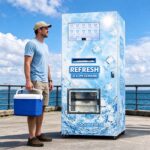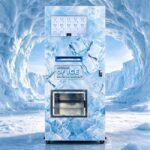


A WMT-I01 ice vending machine costs US$4,600 for one unit and makes 150 kg of cube ice every 24 hours, bagged or loose, with no staff on site. The price is the easy part. What decides whether the machine earns is the 9 kg bin in front of the customer, the ambient temperature where it stands, and whether anyone can answer a spare parts email in year two. Send your country, quantity and payment setup through the form on this page and you will get a landed price, the packing spec for your order and the current build schedule in one reply.
Ice is one of the few products where a supply failure is visible within the hour. A cooler with no ice means a spoiled catch, warm drinks at a party, or a tray of seafood that goes in the bin. That is the gap a machine on your own site fills, and it is why most people looking to buy an ice vending machine turn out to be operators with a location in mind rather than hobbyists.
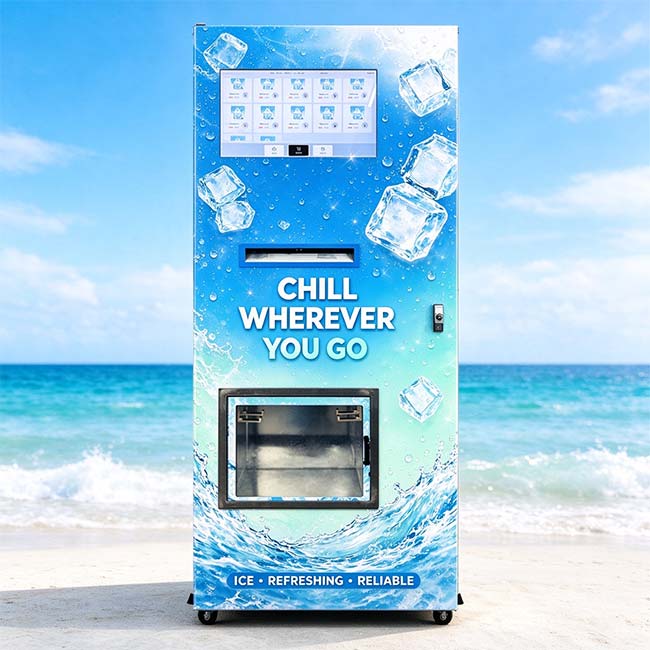
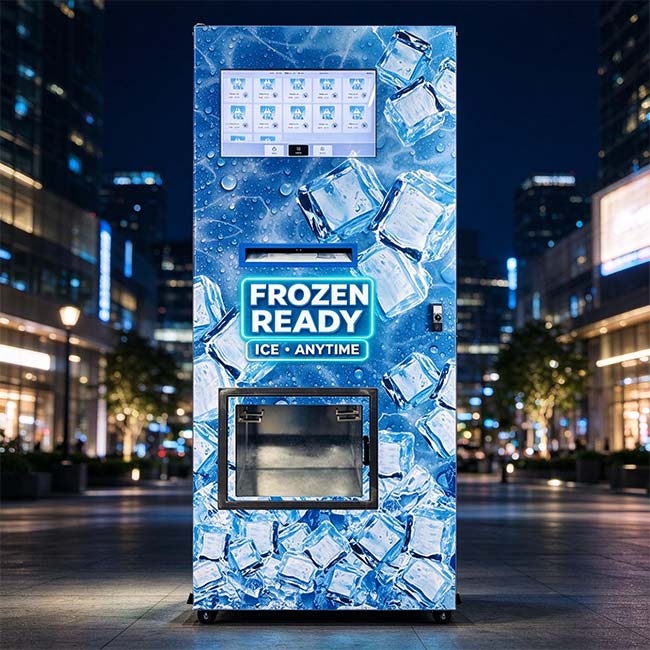
The short version: the WMT-I01 from Wider Matrix is a self-service cabinet that freezes its own cube ice, bags it or drops it loose into a customer’s container, and sells it through a 21.5-inch touch screen. List price is US$4,600 for a single unit. Output is 150 kg per 24 hours on the standard build, with a 200 kg configuration for busier sites. Maximum draw is 1,000 W on a normal single-phase supply, and the minimum order is one machine.
The number that decides whether the thing works is not on the price list. It is the 9 kg bin sitting between the ice maker and the customer, and how fast that bin refills at 38 degrees in midsummer.
What the $4,600 actually covers
Buyers often compare a $4,600 quote with a $3,900 quote and assume the difference is margin. Sometimes it is. More often the cheaper machine has a smaller ice maker, no bagging module, or a payment stack that cannot take the notes used in your market. It helps to know exactly what ships in the crate before comparing anything.
| Model | WMT-I01 |
| Ice type | Cube ice, made on board |
| Selling format | Bulk (customer’s container) or bagged |
| Output | 150 kg / 24h standard, 200 kg / 24h high-output option |
| Storage bin | 9 kg |
| Batch cycle | 6 to 8 minutes |
| Dimensions | 1920 (H) x 800 (W) x 1060 (D) mm |
| Screen | 21.5-inch capacitive multi-touch, 1920 x 1080 |
| Power | 1,000 W maximum |
| Voltage | 220 to 240V AC 50Hz, or 110V AC 60Hz, set to your market |
| Water | Mains line with a standard 1/2-inch fitting, or bottled barrel water |
| Filtration | 3-stage |
| Bagging | Automatic |
| Payment | Coin, note and change-giving standard; card and contactless per market; MDB protocol supported |
| Connectivity | 4G or WiFi module, optional |
| Body | Titanium plate or galvanized spray-coated plate |
| Certifications | CE, FCC, RoHS, ISO 9001 |
| Warranty | 1 year, plus 24-hour online support |
| Minimum order | 1 unit |
One unit arrives assembled and tested, with the 3-stage filtration set, the standard bagging module, a user manual and an installation video. Every machine is filled, run and ice-tested at the factory before it is packed, which is the part of the price that does not show up in a spec sheet. What is not in the price: freight, duty, the plumber and electrician on your side, and installation labor.
That last point catches first-time importers. A machine that costs $4,600 at the factory gate can land at $5,300 or $6,000 depending on destination and shipping terms. The landed cost of an ice vending machine is the only figure worth comparing across suppliers. Ask for the machine price and the landed cost as two separate numbers, from everyone you talk to. A quote that gives one number is hiding something, usually the freight.
How much does it cost to buy an ice vending machine?
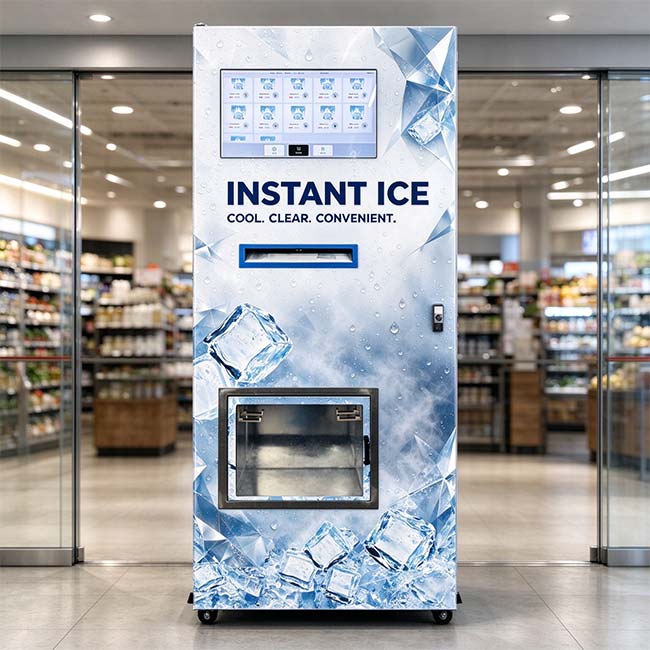
The list price for one WMT-I01 is US$4,600. From two units upward, pricing is quoted per order, and the discount depends on quantity, destination and the configuration you pick. There is no fixed public price ladder, which is annoying if you are building a budget on a spreadsheet, but it is normal for equipment in this class.
Six things move the number:
- Output configuration. The 200 kg build uses a larger ice maker and costs more than the standard 150 kg unit.
- Payment hardware. Coin, note and change modules are standard. Card readers and contactless terminals are configured per market, and local terminals are usually cheaper to source in-country than to ship.
- The 4G or WiFi module, if you want sales and fault reporting on a phone.
- OEM work: body graphics, logo, screen interface language, bag printing.
- Voltage and plug type for your market.
- Shipping terms. Ex-works, FOB and CIF produce three different numbers for the same machine.
Certified copies of CE, FCC, RoHS and ISO 9001 documentation should be requested with the quote, matched to the voltage and payment setup you ordered. Customs officers do ask, and a generic certificate for a different build creates a delay you will remember. If you want a wider sense of where machine prices sit across categories, our breakdown of how much vending machines cost covers the range from snack units to robotic machines.
The 150 kg figure, and the 9 kg number most buyers ignore
The 150 kg per 24 hours on the ice vending machine datasheet is a real number, but it is measured under test conditions: roughly 25 degrees ambient and inlet water at about 20 degrees. Put the same machine on a sunlit forecourt in a market where afternoon temperatures pass 38 degrees and daily output drops. The compressor works harder, cycles stretch out, and the machine produces less ice in the same 24 hours. Above 35 degrees, plan for a lower yield rather than the brochure figure.
Now the part that matters at the point of sale. The storage bin holds 9 kg. Bagged portions are typically 2 kg or 4 kg, so the bin holds about four small bags or two large ones before it needs to refill. A batch takes 6 to 8 minutes. That means a queue of five customers buying 4 kg bags can empty the bin faster than the ice maker refills it, and the sixth customer waits.
Most of the time this is fine. Ice sales arrive in waves, and between waves the bin catches up. The problem shows up at genuine peaks: a hot weekend at a beach kiosk, a fishing pier at dawn, a highway stop on a holiday. If your location has a hard 30-minute rush, you have three options. Set smaller portions so each sale uses less bin stock. Place a second unit rather than pushing one machine past its rating. Or accept the wait and keep the screen showing a clear message instead of leaving people guessing.
If your site regularly moves more than 150 kg a day, order the 200 kg configuration and size the machine around your peak hour, not your daily average. Final capacity, ambient rating and configuration are confirmed on the order sheet, and it is worth asking for that in writing before you pay.
Bagged or bulk: pick a default mode before you order
The ice vending machine can sell both. Bulk mode drops ice into whatever container the customer brings. Bagged mode uses the automatic bagging module, which places a food-grade bag, fills it and seals the ice away from hands and dust. Mode selection is a machine setting, so you can switch by season or by customer type.
Which one to run as your default depends on who is buying. Fish markets, produce traders and catering kitchens usually want bulk, because they arrive with insulated boxes and care about kilos, not packaging. Convenience stores, gas stations and liquor stores do better with bags: a customer walking out with a sealed 4 kg bag is a clean, fast sale and the bag carries your logo home.
Bags are optional. Some operators run bulk only and never buy a bag. If you do go bagged, order bags in bulk with the machine instead of hunting for a local supplier later, because bag dimensions have to match the dispensing portion. Printed bags with your logo are available, and pricing depends on size, printing and volume, so it is quoted rather than listed.
Water, power and the site work that stalls installations
Two water options exist: a direct mains connection with a standard 1/2-inch fitting, or bottled barrel water. Mains is the better long-term choice where water quality is reasonable, because nobody has to carry barrels. Barrel water makes sense on a pier, at a temporary site, or in a building where running a line is not allowed. Either way, water passes a 3-stage filtration system before it freezes.
Power is undemanding. Maximum draw is 1,000 W on single phase, which at 220V is a bit under 5 amps, so an ordinary circuit can carry it. A dedicated circuit is still recommended, not because the machine is hungry but because you do not want a shared circuit tripping at 11pm on a Saturday when the machine is your only salesperson. Confirm the voltage build for your country before the order is placed, since a 110V machine will not run on a 220V supply without a transformer.
The site details that cause delays are boring and predictable:
- Floor drain or drainage outlet near the unit, for condensate and cleaning water.
- At least 30 cm clearance at the rear and sides. Enclosing the machine in a tight alcove traps heat and cuts output.
- A flat, load-bearing surface. The unit stands on adjustable feet, so slight unevenness is manageable, but a slope is not.
- An 800 x 1060 mm footprint, which works out to about 1.7 square meters of usable floor once the space in front of the chute is counted.
- Height clearance. The cabinet is 1920 mm tall, so check the door, the corridor and the ceiling before the crate arrives, and measure the turn into the space. A pallet on a pallet truck needs more room than the machine itself.
- Shade or indoor placement. Direct sun on a dark cabinet in a hot climate is the fastest way to lose capacity.
Running costs, and an example that is not a forecast
On an ice vending machine, each bag costs water, electricity and packaging. That is the whole consumable list, which is the main economic argument for making ice on site instead of buying it in. At full draw the machine uses 1,000 W, so an hour of continuous freezing is one kilowatt hour. Actual consumption is lower because the ice maker cycles rather than running flat out, but the figure gives you a way to check your local tariff.
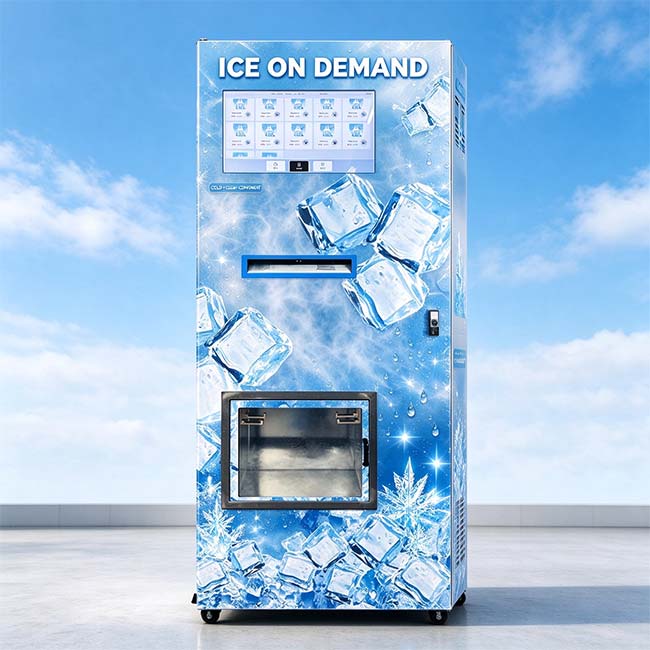
The factory’s reference example: 60 bags a day at $2.50 a bag, with about $0.40 of consumables per bag. That works out to roughly $126 of gross profit a day, or about $3,780 across 30 days, using 150 kg of production a day at 2.5 kg per bag. It is an illustration, not a projection. It assumes a location that sells 60 bags every single day, local ice prices that support $2.50, and a climate where the machine holds its rating.
Before you trust any payback number, including ours, do one afternoon of homework. Find out what a 5 lb bag of ice sells for within five kilometers of your site, and whether it is available after 9pm. If delivered ice is cheap and always in stock, an ice vending machine is a harder sell. If the local store sells out by noon in summer, or closes at eight, the gap is your business. The wider arithmetic of machine ownership, including labor and site costs people forget, is covered in our look at the real ROI on a vending machine.
Where an ice vending machine pays, and where it sits idle
Demand for an ice vending machine follows heat, traffic and the absence of alternatives. The locations that work share at least two of those three.
Gas stations and highway stops are the classic case: drivers buy ice for coolers before a trip, often outside shop hours. Liquor stores and bottle shops capture the customer who has just bought drinks and needs ice in the same trip. Fish piers and seafood markets buy in bulk every morning and care about freshness, not branding. Campgrounds, resorts and beaches sell to guests filling coolers, with demand concentrated in evenings and weekends when staff may not be around. Construction sites and factories buy for crew drinking water and cold storage. Event venues and parks hit their peak exactly when mobile ice sellers have run out.
The weak locations are just as predictable. A cold-climate seasonal site earns for three months and sits for nine. An office lobby has foot traffic but almost no ice demand. A hotel with a free ice machine on every floor has already solved the problem for its guests. And a site where delivered ice is cheap, reliable and someone else’s job to carry will not convert, no matter how good the machine is.
Placement matters more than floor area. Ice is heavy, and a 4 kg bag plus a cooler is an awkward carry. Put the machine where a car can stop within a few meters, light the area properly for night sales, and keep the collection chute unobstructed. If customers have to park, walk through a lobby and carry a bag back, they will buy from the shop instead. For a wider comparison of what different machine types earn, see which vending machine types are most profitable.
Where to buy ice vending machine equipment: factory or trading company?
Plenty of trading companies sell ice machines, and some of them are good at it. The risk is not the label on the company. It is the distance between the specification you approved and the unit that arrives, and what happens when a water valve fails in month fourteen.
Four questions separate a manufacturer from a reseller quickly:
- Where is the unit tested, and can you send the test record for my machine before it is packed? A factory can show water and ice testing on your serial number. A reseller forwards a video of somebody else’s machine.
- Who supplies wear parts in year two, at what price, and can I see a parts list now? Consumable and wear parts sold at cost is a very different answer from a parts catalog with a markup on top.
- Can you build my voltage, payment configuration and language, or only ship what is in stock? OEM and ODM capability shows up here, not in a brochure.
- Who answers technical questions at 2am my time? A named engineer with a phone number beats a shared inbox.
Certificates belong in this conversation too. CE, FCC, RoHS and ISO 9001 documents should exist for the configuration you are buying, and copies should reach you before the container is booked, not after customs asks. If a supplier hesitates on any of these four points, that hesitation is your answer. More on vetting in our piece on how to pick a vending machine supplier.
What to ask before you send a deposit
Put these in one email and see how the replies compare. Suppliers who answer all of them in writing are easier to work with for the next five years.
- Confirmed daily output at my ambient temperature and inlet water temperature, in writing.
- Voltage, phase and plug type for my country.
- The portion sizes I can set, and the bag specification if I choose bagged mode.
- Which payment modules are included, and whether a local card terminal can be integrated through MDB.
- Water connection type, and whether a barrel kit is supplied.
- What is tested before packing, and can I have the test record.
- The spare parts list with prices, and which parts count as wear items.
- Warranty terms in writing: what is covered, for how long, and who pays freight on replacement parts.
- Packing specification, and how many units fit in a 20ft or 40ft container.
- Lead time from deposit to departure, and the shipping terms quoted.
Two of these are where deposits go wrong. Lead time quoted as “about a month” without a start date is not a lead time. Warranty quoted as “one year” without saying whether it covers the compressor, the board or only labor is not a warranty. Get both in the order sheet.
Shipping, duty and the first week on site
Export packing is included with every unit, and shipping is arranged to most destinations. The importer pays duty, VAT and destination charges, and the rates vary enough between countries that no supplier can quote them accurately. Ask a customs broker for a landed cost estimate before you commit, and ask the supplier for FOB and CIF figures so you can compare the two.
The machine arrives assembled. What it needs is a plumber for the water line or a barrel filled, an electrician to confirm the circuit, and a floor drain within reach. Most installs are a half day of trade labor. Fill the system, run a batch, check for leaks at the inlet and drainage, and confirm the collection chute opens cleanly before you put it into service. The installation video and the training session cover this, and it is worth watching the video before the technician arrives rather than after.
Keep a small stock of bags, filter cartridges and the wear parts on your list from the start. A machine that stops for a $12 part and waits three weeks for shipping costs more than the part ever will. That is also the argument for the optional 4G module: a text message about low water or a stopped production cycle is cheaper than a customer complaint.
Working with Wider Matrix
Wider Matrix builds automated retail machines, and the ice vending machine is one of the models we build in house, alongside frozen dessert, snack and other self-service equipment. The WMT-I01 is our own build, not a rebadged unit, which is why voltage, language, payment setup, portion sizes and body graphics can be changed for a specific market rather than offered as a take-it-or-leave-it list.
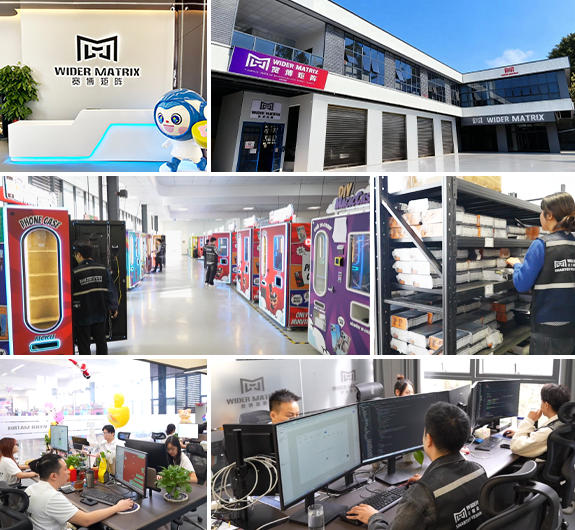
What that means in practice for an ice buyer: one-year warranty, 24-hour online support, installation and maintenance training included, and consumable and wear parts supplied at cost. Every unit is assembled, water-tested and ice-tested before shipment, so a machine that arrives dead on arrival is a factory problem rather than your problem. Minimum order is one unit, so a single-site operator and a distributor placing a container order get the same product.
We also do not pretend the machine suits every site. If your location has low foot traffic, no shade and cheap delivered ice next door, we will tell you that during the quote rather than after the deposit.
Frequently asked questions
How much does it cost to buy an ice vending machine?
US$4,600 for one WMT-I01 at list price. Orders of two units and above are quoted per order, and promotions change through the year, so the figure you get today may be better than the list price. Ask for a quote that separates the machine, packing and freight.
How much ice does it make in a day?
150 kg per 24 hours on the standard build, or 200 kg on the high-output configuration. Both figures assume about 25 degrees ambient and inlet water at 20 degrees. In sustained heat above 35 degrees, output falls, so size the machine for your hottest month rather than your average.
Does it need a plumber?
It needs water, not necessarily plumbing. A mains connection uses a standard 1/2-inch fitting and is routine work for any plumber. If a water line is not practical, the machine runs on bottled barrel water instead.
Can it sell both loose ice and bagged ice?
Yes. Bulk mode dispenses into the customer’s container, bagged mode uses the automatic bagging module. The mode is a machine setting, so you can change it without buying different hardware.
How long does a customer wait?
A portion taken from the 9 kg bin takes seconds. A fresh batch takes 6 to 8 minutes, which is the reason the bin exists: sales come from storage while the next batch freezes. During a hard rush, the bin, not the daily rating, is what limits you.
Does the ice pick up a taste or smell?
Water passes a 3-stage filtration system before freezing, and ice is produced and bagged inside a closed path. Ice made from filtered water should have no odor or aftertaste, though the result depends on your incoming water quality, which is worth testing if the supply is questionable.
Can I take card and contactless payments?
Coin, note and change-giving modules are standard. Card and contactless are configured per market, and the controller supports MDB protocol so a local terminal can usually be integrated instead of shipping one from China.
Can I monitor the machine remotely?
With the optional 4G or WiFi module, yes. It reports sales, bag counts, production state, bin level, water supply and fault codes, and can push an alert when production stops. Without the module the machine runs standalone and is serviced locally.
Can I put my brand on it?
Yes, under OEM or ODM. Body graphics, logo, screen interface, language and bag printing can all be customized. Screen content can also run your own product images or paid advertising between transactions.
What does the warranty cover?
One year, with 24-hour online support, video guides for installation and maintenance, and spare parts at cost. Ask for the written terms before ordering, since coverage of specific components such as the compressor or controller should be stated on the order sheet rather than assumed.
What is the minimum order, and do you ship worldwide?
One unit, and yes, with export packing included. Duty, VAT and destination charges are paid by the importer, so get a broker estimate for your country before you commit to a landed budget.
How long does delivery take?
It depends on the build queue, the configuration and the shipping route to your port, so we quote the current schedule against your order rather than publish a number that would be wrong half the year. Ask for it in the same email as your price request.
Get a price for your site
Send five things and the reply will be useful instead of generic: your country and nearest port, the number of units you are considering, the voltage and payment setup used locally, whether you want bagged or bulk as the default mode, and roughly how many bags or kilos you expect to move on a peak day. With those, we can tell you whether the 150 kg build is enough, what the landed cost looks like, and what the current build schedule is.
If you are still comparing categories before you settle on ice, start with our ice vending machine for sale overview, or read up on starting a vending machine business if this is your first machine. Either way, the questions above are the ones worth asking before money moves.