


Wondering whether a flower vending machine can actually work in a US airport? It can, but the machine is the easy part. The real work is getting a concession agreement, passing security badging, and keeping flowers fresh in a terminal that runs 24 hours a day. Expect 2 to 4 months for approval, budget 10 to 15 percent of gross sales for rent or revenue share, and plan for a 6 to 12 month payback period.
Why airports are a natural fit for flower vending
US airports handle over 900 million passengers a year, and travelers arrive early. The average passenger spends 1 to 2 hours in the terminal before boarding, and that time is spent walking, browsing, and buying. Flowers are one of the most common impulse gifts for people meeting loved ones at arrivals, and for business travelers who forgot a gift or want to bring something home.
Airports also operate around the clock. A staffed flower shop closes at 8 pm, but flights land at 2 am. A vending machine keeps selling. That is the core advantage: you capture sales that a traditional florist simply cannot reach.
Flowers also have a psychological pull in transit environments. A fresh bouquet in a sterile terminal is a small moment of color and life, and travelers respond to it. Machine owners who place units near baggage claim or in arrivals halls see the gifting moment, not the impulse moment, drive most sales.
How the airport approval process actually works
This is where most operators get stuck. You cannot just show up with a machine and plug it in. US airports have a formal concession process, and you need to work through it before you can place anything.
Concession agreements vs. leases
Most airports do not lease floor space like a mall. They use concession agreements, where the airport takes a percentage of your gross sales as rent. Typical ranges run from 8 to 15 percent of gross, depending on the airport and the location within the terminal. Some airports also require a minimum annual guarantee (MAG), which means you owe a set amount each year even if sales fall short.
The RFP process
Large airports issue Requests for Proposals (RFPs) for concession space. The RFP will specify the location, the term length, and the revenue share, and it will ask for your business plan, financial projections, and experience. You respond, the airport reviews proposals, and you negotiate a final agreement. This process typically takes 2 to 4 months from RFP to signed contract.
Smaller airports may handle concessions more informally, but they still require a written agreement, proof of insurance, and a background check for anyone working on site.
ACDBE and DBE participation
Many US airports are required to participate in the Airport Concessions Disadvantaged Business Enterprise (ACDBE) program. This means a portion of concession opportunities are set aside for businesses owned by socially and economically disadvantaged individuals. If you qualify, this can be a significant advantage. If you do not, you may need to partner with an ACDBE-certified business to bid on certain contracts.
Insurance and badging
You will need commercial general liability insurance, typically $1 million or more per occurrence, and the airport must be named as an additional insured. You will also need to obtain an airport ID badge, which requires a TSA background check. This can take 2 to 6 weeks. If you will be restocking airside (past security), everyone who enters the secure area needs a badge and may need an escort for deliveries.
Landside vs. airside: where the machine goes
Placement is the single biggest factor in whether your machine makes money. There are two main zones in a US airport, and they have very different economics.
Landside (pre-security)
This includes the ticketing area, the arrivals hall, and baggage claim. The advantages are simple: anyone can access the machine without a badge, restocking is easy, and you can reach it 24/7 without security escort. The disadvantage is that traffic is lower than airside, and you miss the passengers who are already through security and have time to kill.
Airside (post-security)
This is the concourse area near the gates. Traffic is much higher, and passengers have dwell time. But you need a badge to restock, deliveries may need an escort, and you have to coordinate with airport security. Some airports also restrict what you can bring through security for restocking, which can complicate flower deliveries.
Where the best sales happen
The highest-performing airport flower vending locations are usually:
- Arrivals hall: people meeting loved ones, often with a gift in hand
- Baggage claim: high dwell time while waiting for bags
- Gate areas: passengers with 30 to 60 minutes before boarding
- Airport hotels: guests attending events or visiting family
For a deeper look at placement strategy, check out this guide to the best locations for flower vending machines and this data-driven guide to high-traffic vending locations.
The real unit economics of airport flower vending
Competitors talk about revenue potential, but they skip the costs that actually eat your margin. Here is a realistic P&L model for a single airport machine.
| Item | Assumption | Monthly Amount |
|---|---|---|
| Daily bouquets sold | 15 | 450 bouquets |
| Average retail price | $20 | $9,000 |
| Gross revenue | – | $9,000 |
| Cost of goods (flowers + wrapping) | $6 per bouquet | ($2,700) |
| Concession fee (12%) | 12% of gross | ($1,080) |
| Card processing (2.7%) | 2.7% of gross | ($243) |
| Spoilage (8%) | 8% of inventory | ($216) |
| Restock labor | 2 visits/week, 2 hours | ($320) |
| Electricity | 950W machine | ($85) |
| Maintenance reserve | ~$50/month | ($50) |
| Net monthly profit | – | $4,306 |
That works out to about $51,700 a year in net profit, which means a $6,000 machine pays for itself in about 2 months at this volume.
The variance between a good airport location and a bad one is enormous. A machine in a low-traffic corner of a regional airport might sell 3 bouquets a day. A machine in the arrivals hall of a major international hub can sell 30 or more on peak days. Before you sign anything, ask the airport for passenger counts at the specific location, not just the terminal average.
For a more detailed breakdown of payback periods, read our flower vending machine payback period guide.
Keeping flowers fresh in a terminal
Freshness is what separates a profitable flower vending operation from a money pit. Cut flowers are perishable, and a terminal environment is hostile: dry air, temperature swings, and constant foot traffic.
Temperature and humidity
A refrigerated machine should hold 2 to 25°C, which is the same range florists use for storage. Wider Matrix flower vending machines use a polyurethane one-piece molded foam cabinet with air-cooling circulation across all slots. That keeps the internal temperature stable even when the terminal ambient temperature fluctuates.
Humidity matters too. Most cut flowers prefer 70 to 90 percent relative humidity. A machine that dries out the air will shorten vase life by a day or two. Look for a machine with an electric dehumidification system that also prevents condensation on the glass, so customers can actually see the bouquets.
Vase life by flower type
Not all flowers hold up equally in a vending machine. Here is a rough guide to vase life after cutting:
| Flower | Vase life (days) |
|---|---|
| Roses | 5 to 7 |
| Lilies | 7 to 10 |
| Alstroemeria | 7 to 10 |
| Carnations | 10 to 14 |
| Chrysanthemums | 10 to 14 |
| Gerbera daisies | 5 to 7 |
| Tulips | 3 to 5 |
| Hydrangeas | 4 to 6 |
The practical takeaway: stock a mix of hardy flowers (carnations, chrysanthemums, lilies) that survive a week in the machine, and rotate them out before they peak. Plan to restock once a week, or twice a week in peak gifting season. A 30 to 60 minute restock visit should be enough to replace sold slots and check for wilting stems.
Ethylene and storage tips
Ethylene gas accelerates flower aging. Keep flowers away from ripening fruit, and make sure the machine has good airflow. Some operators add a small ethylene absorber to the cabinet. Also, cut stems at a 45-degree angle before loading, and use flower food in the water tubes or wrapping. These small steps can add 2 to 3 days of display life.
What to look for in a flower vending machine for an airport
Not every flower vending machine is built for airport duty. These are the specs that matter when choosing hardware for a terminal.
Capacity and slot count
You want enough slots to hold a good variety without overcommitting to inventory. A 10 to 13 slot machine is a solid starting point for a mid-size airport. A 24 slot machine works for a large international hub or a high-traffic arrivals hall. Wider Matrix offers 9 models ranging from 5 to 24 slots, so you can match capacity to the location.
Refrigeration and freshness
The machine must have built-in refrigeration. Look for a temperature range of 2 to 25°C with a sealed insulated cabinet. The Wider Matrix flower machine uses polyurethane one-piece molded foam insulation and an air-cooling freshness system that circulates airflow across every slot.
Payment options
Airport customers expect to pay by card and mobile wallet. Cash is less common in terminals. Make sure the machine supports credit card, NFC, and QR payment. Wider Matrix machines ship with payment modules configured for your market, and they support cash, bank card, and mobile payment.
Size and power
Terminal space is tight. Check the machine footprint against your allocated space. Wider Matrix flower machines range from 1,500 mm to 3,000 mm wide and 750 to 985 mm deep, with heights from 2,067 to 2,266 mm. Power draw is 950 W for most models and 1,900 W for the 24-slot Wide Series. You will need a dedicated 220-240V AC outlet, which the airport concession office will need to approve.
Remote management
You will not be on site every day. Remote monitoring is essential. Look for a machine that lets you check per-slot inventory, sales data, and cabinet temperature from your phone. Wider Matrix flower machines include a smart management system with stock monitoring, sales tracking, live temperature monitoring, and multi-machine operation support.
Certifications
Airports require certified equipment. Wider Matrix flower machines are CE, FCC, RoHS, SGS, and ISO 9001 certified, which covers the main international standards for electrical safety, electromagnetic compatibility, and quality management.
Price range
Wider Matrix flower vending machines are factory direct, priced between US$3,000 and US$6,500 per unit depending on the model and slot count. That is a reasonable range for airport-grade refrigerated equipment. For orders of multiple units, contact the sales team for a personalized quote with volume discounts.
Before you buy, read our cost and model guide for flower vending machines for sale online and this checklist for evaluating flower vending machine suppliers.
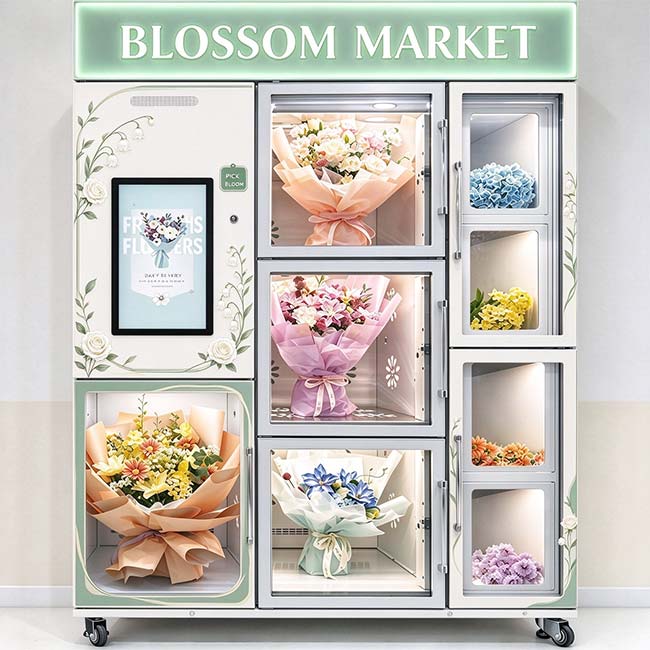
Flower vending machine vs. staffed florist kiosk in an airport
| Factor | Flower vending machine | Staffed florist kiosk |
|---|---|---|
| Operating hours | 24/7 | 8-12 hours per day |
| Labor | None on site | 1-2 staff per shift |
| Space required | 1-2 m² plus power | 10-20 m² kiosk |
| Upfront cost | US$3,000-6,500 | $30,000-100,000+ |
| Freshness control | 2-25°C refrigerated | Depends on display case |
| Sales data | Per-slot, real-time | Manual or POS |
| Scalability | Add machines per location | New kiosk per location |
| Peak season flexibility | Restock twice a week | Full staff available |
For most airports, a vending machine wins on cost, flexibility, and hours. The main tradeoff is that a staffed kiosk can build relationships, offer custom arrangements, and handle large orders. If your airport location is mainly about impulse gifting, the machine is the better fit. If you want to serve weddings or corporate events from the same location, a kiosk has an edge.
What kills airport flower vending installs
Knowing what goes wrong is as useful as knowing what works. Here are the most common failure modes.
- Signing a lease before you have passenger data for the exact location
- Placing the machine where no one walks past (a dead-end corridor is a death sentence)
- Skipping the concession process and getting shut down in week one
- Stocking large bouquets when travelers want single stems or small arrangements
- Restocking too rarely and selling wilted flowers
- Not accounting for spoilage in the financial model
- Choosing a machine without real refrigeration and losing flowers to heat
Launch checklist for an airport flower vending operation
- Research the airport’s concession program and RFP calendar.
- Submit a proposal or bid with a business plan and financial projections.
- Negotiate the agreement: revenue share, MAG, term length, and placement.
- Secure insurance and apply for airport badging.
- Choose the right machine for the space (10-24 slots depending on traffic).
- Source flowers from a local wholesaler with reliable delivery.
- Plan the restocking schedule around flight banks and security access.
- Install the machine, test payment and refrigeration, and load the first inventory.
- Monitor sales data weekly and adjust the product mix.
FAQ: Flower vending machines in US airports
Can you put a flower vending machine in a US airport?
Yes. You need a concession agreement with the airport, which usually involves an RFP process, insurance, and security badging. The approval process typically takes 2 to 4 months.
How much does a flower vending machine for an airport cost?
A refrigerated flower vending machine with 5 to 24 slots costs between US$3,000 and US$6,500 from a factory-direct manufacturer. You also need to budget for shipping, installation, insurance, and the concession fee.
How much money can an airport flower vending machine make?
At 15 bouquets per day with an average price of $20, gross revenue is about $9,000 per month. After cost of goods, concession fees, card processing, spoilage, and labor, net profit can be $3,000 to $5,000 per month. Results vary widely by location.
Do you need a TSA badge to restock?
If the machine is landside (pre-security), no badge is needed. If it is airside (post-security), you need an airport ID badge and a TSA background check, and deliveries may require an escort.
How often do you need to restock?
Plan for once a week in normal periods and twice a week in peak gifting seasons like Valentine’s Day and Mother’s Day. Each visit takes 30 to 60 minutes.
What flowers sell best in an airport?
Hardy flowers with good vase life: carnations, chrysanthemums, lilies, and alstroemeria. Roses sell well but need careful rotation. Single stems and small arrangements outsell large bouquets in most airport locations.
How long does it take to get approval?
Typically 2 to 4 months from submitting a proposal to signing a concession agreement. Badging and insurance add 2 to 6 weeks on top of that.
Is a flower vending machine better than a staffed florist kiosk in an airport?
For impulse gifting, yes. A vending machine costs a fraction of a kiosk, runs 24/7, and needs no staff. A staffed kiosk can handle custom orders and large arrangements, but costs 10 to 20 times more to set up.
Final thoughts on airport flower vending
Airport flower vending in the USA is a real opportunity, but it is not passive income. You need to navigate concessions, secure badging, manage a cold chain, and monitor sales data. The operators who succeed treat it like a small business, not a side project.
Start with the airport, not the machine. Talk to the concession office, get passenger counts for your target location, and build a financial model with realistic spoilage and fees. Then pick a machine with real refrigeration, remote monitoring, and enough slots for the traffic you expect. If the numbers work on paper and the location has foot traffic, the rest is execution.
For a broader look at starting a flower vending business in the US, read our complete 2026 flower vending startup guide.