

Flower vending works when the machine sits where people already feel a gift-buying urge. A refrigerated cabinet in a low-traffic corridor can still fail, while a smaller unit beside a hospital exit or transit gate can sell out before the weekend. The best locations for flower vending machines are transit hubs, hospital lobbies, malls, hotel lobbies, campuses, gas stations, and 24-hour convenience stores. The ranking below weighs gifting occasion, dwell time, rent, and restock distance, then shows the unit economics behind each choice.
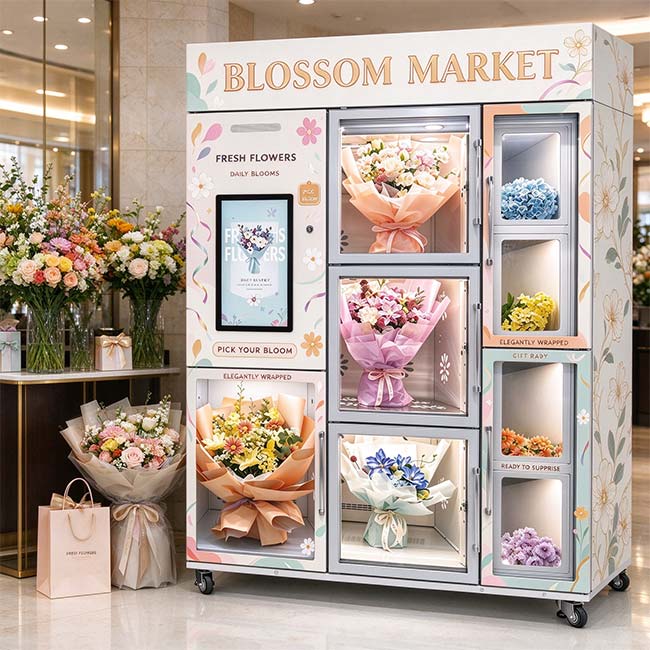
The ranked shortlist: 12 locations that fit flower vending
The table is a starting point, not a guarantee. It assumes a site with a real gifting occasion nearby, card payment, and two to three restocks a week. A busy corridor with no reason to buy flowers will underperform a quieter spot next to a hospital exit.
| Rank | Location | Why it works | Typical rent model | Modeled bouquets per day | Setup difficulty | Best slot range |
|---|---|---|---|---|---|---|
| 1 | Transit hubs (train, metro, airport) | Commuters and travelers buy on the way to someone | Concession fee or 12 to 30% revenue share | 12 to 30 | High | 13 to 24 |
| 2 | Hospitals | Visitors arrive after gift shops close | Flat US$300 to US$900 a month or small commission | 8 to 20 | Medium | 8 to 13 |
| 3 | Shopping malls | Gift decisions happen near fashion, jewelry, and food | US$600 to US$2,000 a month or 10 to 20% of sales | 10 to 25 | Medium to high | 10 to 24 |
| 4 | Hotel lobbies | Guests need same-day gifts and event flowers | Revenue share or modest flat fee | 5 to 15 | Low to medium | 8 to 13 |
| 5 | University campuses | Students buy dates, apologies, and graduation flowers | Low flat fee or small commission | 4 to 12 | Low | 5 to 10 |
| 6 | Gas stations and highway services | Weekend and holiday drivers grab a last-minute gift | US$100 to US$500 a month | 3 to 10 | Low | 5 to 8 |
| 7 | 24-hour convenience stores | Late-night buyers need a gift when florists are shut | Rent or small revenue share | 3 to 8 | Low | 5 to 8 |
| 8 | Office towers and business districts | Birthdays, promotions, and client visits create weekday demand | US$200 to US$700 a month | 3 to 9 | Medium | 8 to 13 |
| 9 | Wedding and event venues | Event days bring strong, date-driven demand | Commission or event fee | 2 to 8 average, with spikes | Medium | 10 to 24 |
| 10 | Cemeteries and memorial parks | Remembrance flowers sell on predictable dates | Low flat fee | 2 to 6 | Low to medium | 5 to 10 |
| 11 | Tourist districts | Souvenir and hotel-gift demand in peak season | High rent or revenue share | 5 to 15 in season | High | 8 to 13 |
| 12 | Residential towers | Convenience for birthdays and building events | Small rent share | 1 to 4 | Low | 5 to 8 |
How to score a site before you sign
Foot traffic alone is a weak signal. A rail station with 10,000 daily passengers can underperform a hospital entrance with 2,000 visitors if those passengers are commuting home with no gift occasion. Score each site on the factors below and write down the evidence.
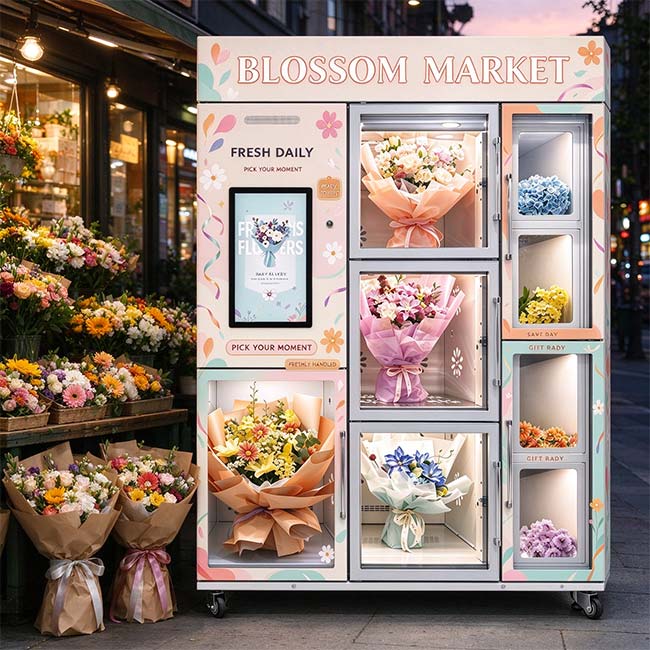
| Factor | Weight | What a strong site looks like |
|---|---|---|
| Gifting occasion nearby | 20% | Hospital, celebration venue, transit exit, or a florist that closes early |
| Foot traffic | 15% | 300 or more people an hour at peak, with repeat weekday flow |
| Dwell time | 10% | People wait 10 minutes or more near the machine |
| Disposable income | 10% | Buyers accept US$15 to US$25 for a wrapped bouquet |
| Rent to sales ratio | 15% | Rent under 10 to 12% of projected monthly sales |
| Access and visibility | 10% | Eye-level spot, 24-hour access, good lighting |
| Power and space | 5% | Dedicated outlet, level floor, 1 to 2 square meters |
| Security | 5% | Camera coverage and staff nearby during busy hours |
| Restock distance | 5% | Under 30 minutes from cold storage |
| Competition | 5% | No cheaper florist at the same entrance |
A score below 60 usually means the site needs a lower rent or a smaller machine. For a wider data-driven view of high-traffic sites, see where the best places for vending machines are.
Venue deep dives: where each location earns its rent
Transit hubs: sell on the way to someone
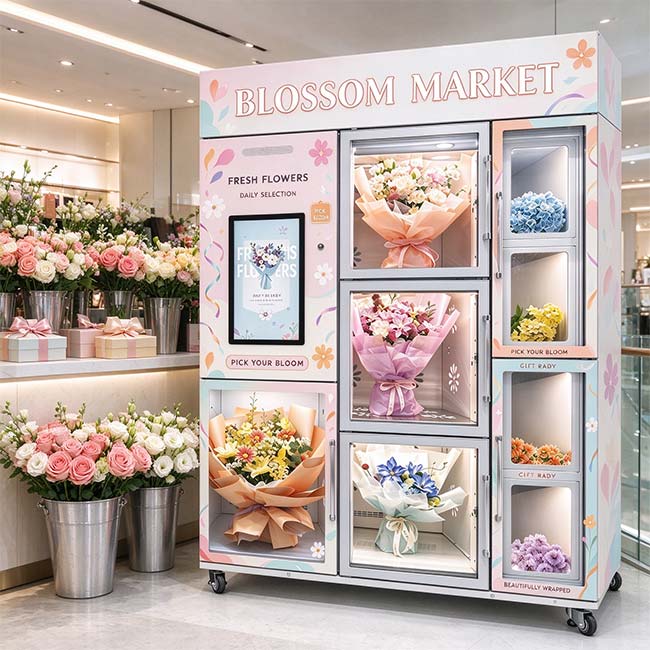
Train stations and airports work because the buyer is already moving toward a person or an event. A commuter who forgot a birthday can grab a wrapped bouquet at 7 p.m., and a traveler can arrive with flowers instead of buying them at a hotel gift shop. These sites also carry the highest cost and the most rules. Airports often require a concession bid, insurance, and approved signage. Train operators may limit access to platforms. Check card and mobile payment coverage because cash is fading in many transit systems. A 13 to 24 slot machine fits a main concourse or near ticket gates. Keep bouquets at US$15 to US$25 and restock two to three times a week. The risk is a high fee against modest volume. If the contract asks for 30% of sales and the site sells eight bouquets a day, the math gets thin. If you are planning a Singapore site, see flower vending machine Singapore locations.
Hospitals: the gift shop closes before visiting hours end
Visitors often arrive after the hospital gift shop closes. A machine near the main entrance, cafeteria, or visitor parking can catch that demand. Hospital rules matter more than traffic. Some wards ban lilies, strong scents, or soil, so stock low-scent bouquets and wrapped stems. Confirm the policy with the facilities team before you sign. Rent can be a flat US$300 to US$900 a month, or a small commission. An 8 to 13 slot unit is usually enough. Restock twice a week and remove tired stems. The risk is an exclusivity clause with the gift shop or a policy change that limits flowers in patient rooms.
Shopping malls: put the machine where the gift decision happens
A mall has traffic, but not all traffic is gift traffic. A machine near jewelry, fashion, cinema, or the food court will outperform one in a service corridor. Mall management may ask for a flat rent, a revenue share, or both. For a first site, ask for a three to six month pilot with a 30-day exit. A 10 to 24 slot machine can show enough variety for birthdays and anniversaries. Price at US$18 to US$28. Restock before weekends and holidays. The risk is rent. A mall that charges US$1,500 a month needs roughly eight to ten bouquets a day just to cover rent, before flowers and labor.
Hotel lobbies: a premium price for a forgotten gift
Hotel guests buy flowers for business dinners, apologies, and events. A lobby machine works when the front desk mentions it, so train the staff and leave a small sign. A Bloom Box Series 8 or Showcase Series 10 fits a lobby without taking floor space. Keep bouquets at US$20 to US$30. Volume is lower than a hospital or transit hub, often five to fifteen a day, so rent must stay modest. A revenue share of 10 to 15% is safer than a high flat fee. The risk is that concierge desks already sell flowers or can order them. Ask about that before you install.
University campuses: single stems and small bouquets
Students buy flowers for dates, apologies, and graduation. A machine near a student union, library, or dorm cluster can sell single stems and small wraps at US$8 to US$15. A Compact Series 5 or Grid Series 8 is enough. Rent is often low, sometimes a flat fee or a small commission. Volume follows the academic calendar, so expect quiet weeks during exams and holidays. The risk is a long summer break with no traffic. If the campus empties for three months, the payback period changes.
Gas stations and 24-hour stores: the late-night save
Drivers buy flowers on the way home, especially on Fridays, weekends, and before Mother’s Day. A machine at a gas station or 24-hour convenience store can catch that impulse when a florist is closed. A 5 to 8 slot unit keeps the offer simple: roses, mixed wraps, and a few seasonal bunches. Rent can be US$100 to US$500 a month or a small share. Volume is often three to ten a day, so keep costs low. The risk is heat and sun if the machine sits outside. Use an indoor spot or a shaded area and check the machine temperature range.
Offices and business districts: corporate gifting and desk celebrations
Office towers have weekday traffic and a steady stream of birthdays, promotions, and client visits. A machine in a lobby or near a coffee shop can sell US$18 to US$30 bouquets. An 8 to 13 slot unit works well. Rent is often US$200 to US$700 a month. The risk is weekend and holiday volume dropping to zero, so the site needs strong weekday sales. If the building has a concierge or mailroom, ask whether they will accept deliveries for restocking.
Event venues and memorial parks: date-driven demand
Wedding venues, banquet halls, and memorial parks have predictable dates and strong emotional demand. A machine near a chapel or reception entrance can sell remembrance stems or guest bouquets. Volume is uneven: two to eight a day on average, with spikes on event days. Rent is usually low because the venue sees the machine as a guest service. Keep 5 to 10 slots and stock white and neutral bouquets for memorial sites. The risk is a venue that already has an exclusive florist. Get the agreement in writing.
The unit economics that decide whether a location is good
A busy location can still lose money. Rent, spoilage, and restock time decide whether it works. Here is a modeled example for three sites using the same machine and price. The numbers are estimates, not a promise. Your flower cost, wages, and rent will change the result.
| Line | Strong site | Average site | Weak site |
|---|---|---|---|
| Bouquets sold per day | 18 | 8 | 3 |
| Average bouquet price | US$18 | US$18 | US$18 |
| Monthly revenue | US$9,720 | US$4,320 | US$1,620 |
| Flower and wrap cost | US$3,240 | US$1,440 | US$540 |
| Spoilage cost | US$390 | US$260 | US$160 |
| Payment fees at 3% | US$292 | US$130 | US$49 |
| Rent or commission | US$700 | US$350 | US$150 |
| Energy | US$90 | US$80 | US$70 |
| Restock labor | US$200 | US$200 | US$200 |
| Monthly profit before tax | US$4,808 | US$1,860 | US$451 |
| Upfront cost | US$5,400 | US$5,400 | US$5,400 |
| Simple payback | 1.1 months | 2.9 months | 12 months |
The upfront cost includes a US$4,500 machine, US$600 for shipping and installation, and US$300 for initial stock. Spoilage is set at 12%, 18%, and 30% of flower cost. Labor is 10 hours a month at US$20. If the weak site pays US$700 rent instead of US$150, it loses money. That is the pattern to watch: low volume plus fixed rent. See Are Flower Vending Machines Profitable? 6 Real Records for more operator numbers.
Seasonality: plan for the spikes and the quiet weeks
Flower demand is not flat. Valentine’s Day and Mother’s Day can be two to three times a normal week. January and late summer are slow. Use a simple demand index to plan stock and restocks.
| Month | Demand index (100 = average) | What to do |
|---|---|---|
| January | 70 | Load fewer bouquets and push single stems |
| February | 150 | Stock extra roses and mixed wraps two weeks ahead |
| March | 95 | Return to normal stock |
| April | 100 | Watch Easter and school events |
| May | 140 | Plan Mother’s Day restocks and extra labor |
| June | 90 | Reduce stock after graduation peaks |
| July | 85 | Keep bouquets small and fresh |
| August | 85 | Watch heat and travel schedules |
| September | 90 | Back-to-school and campus demand |
| October | 95 | Normal stock with autumn colors |
| November | 100 | Normal stock |
| December | 120 | Holiday parties and year-end gifts |
During slow weeks, load fewer bouquets and check sell-through every day. Empty slots cost less than spoiled stock. Use water tubes, keep the cabinet at 2 to 25°C, and remove tired stems before they affect the display. A machine that looks full of dead flowers will lose trust faster than a machine with a few gaps.
Permits, contracts, and the boring details that kill a site
Most flower vending sites need a business license, a sales tax registration, and a signed host agreement. Some cities treat vending machines as a separate permit. Hospitals and airports may ask for insurance, background checks, and approved vendor status. Ask for the host insurance requirements before you buy the machine.
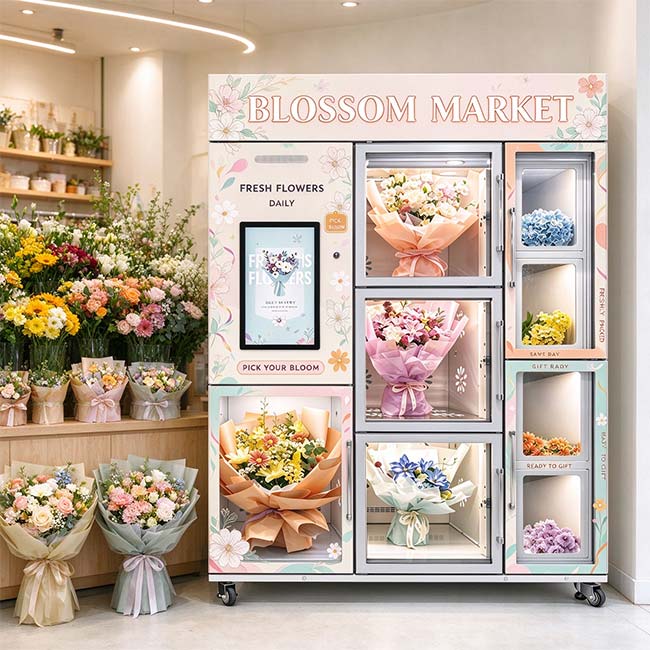
Choose the rent model with care. A flat fee is better when sales are strong and predictable. A revenue share is safer when you are testing a new venue. A common mall range is 10 to 20% of sales. Airports can be higher because of passenger volume and competition for the space. Never sign a 12-month lease without a 30-day exit or a pilot clause.
Check the practical details: a dedicated power outlet, a level floor, 1 to 2 square meters of space, lighting, cellular signal for payments and remote monitoring, and a restock route that does not require a security escort every time. If the site has no signal, card payments fail. If the machine sits in direct sun, the cooling system works harder and flowers fade faster. Our guide to finding vending machine locations covers contracts and site visits in more detail.
Match the machine to the location
Wider Matrix builds nine flower vending models with 5 to 24 slots. The lineup uses 2 to 25°C refrigeration, holds cut flowers for 5 to 7 days between restocks, and supports touchscreen ordering with cash, card, and mobile payment. Remote monitoring shows stock, sales, and cabinet temperature from a phone. The machines carry CE, FCC, RoHS, SGS, and ISO 9001 certification. Reference prices run from US$3,000 to US$6,500 per unit depending on model and slot count. The company has shipped more than 3,000 machines to over 130 countries. For orders of multiple units, contact the team for a personalized quote with volume discounts.
| Location | Suggested model range | Why it fits |
|---|---|---|
| Narrow corner or convenience store | Compact Series 5, Grid Series 8 | Small footprint and a simple offer |
| Mall or transit hub | Grid Series 10, Grand Series 13 | More slots and a larger screen |
| Airport or large mall | Wide Series 24 | High capacity for peak days |
| Hotel lobby or gift shop | Bloom Box Series 8, Showcase Series 10 | Display-focused cabinet |
| Large bouquets and gift boxes | Tall Series 8 | Tall compartments |
| Premium statement site | Arc Series 11 | Design-led cabinet for an atrium or plaza |
A 30-day pilot before you sign a lease
- Count foot traffic for seven days at 8 a.m., noon, 6 p.m., and 9 p.m. Write down how many people pass and how many carry gifts or stop at the gift shop.
- Ask the host for two weeks of gift shop or concierge data. If they will not share it, ask how many flower orders they send out per week.
- Install a small machine or run a pre-order table for 30 days. Track sales per slot, average ticket, and sell-through.
- Set a go/no-go rule before you start. Example: six or more bouquets a day at US$18, rent under 12% of sales, and spoilage under 15%.
- Review the data with the host and negotiate a longer lease only if the numbers hold.
For more placement checks, read where to put vending machines.
Locations to avoid
- Dead corridors and basement food courts with no gift context.
- Hospital wards with a flower ban or strong scent restriction.
- Outdoor spots in direct sun or heavy rain.
- Venues with an exclusive florist contract.
- High-rent malls that need ten or more bouquets a day before the first flower is sold.
- Transit spots with no camera coverage and a history of theft.
For a broader view of site strategy, see the best locations for vending machines.
What to do next
Start with the occasion. Then choose the machine. Pick three sites from the ranked shortlist, score them with the worksheet, and ask for a 30-day pilot. Model the rent against 6, 10, and 18 bouquets a day. If the weak-case payback is longer than 12 months, keep looking. When a site passes, match the slot count to the venue and set a restock route you can actually run.
Frequently asked questions
What is the best location for a flower vending machine?
Transit hubs, hospitals, malls, hotel lobbies, and campuses top the list because they combine a gifting occasion with steady foot traffic. The best site for you depends on rent, restock distance, and local rules. Use the scorecard above before you sign.
How many bouquets does a flower vending machine sell per day?
A strong site can sell 18 to 30 bouquets a day. An average site sells 6 to 10. A weak site sells 2 to 4. The range is wide because a hospital entrance and a quiet office lobby are not the same business.
Are flower vending machines profitable?
They can be. In the modeled example above, a strong site pays back in about 1.1 months and an average site in about 2.9 months. A weak site takes about a year. The difference is rent, volume, and spoilage. See our flower vending machine profitability records for more numbers.
How much does a flower vending machine cost?
Wider Matrix flower vending machines have reference prices from US$3,000 to US$6,500 per unit depending on model and slot count. Shipping, installation, and payment modules add to the upfront cost. Ask for a quote with your destination and payment needs.
Do I need a permit to place a flower vending machine?
Most sites need a business license and a host agreement. Some cities add a vending machine permit. Hospitals, airports, and malls may ask for insurance and approved vendor status. Check with the local business license office and the host before you order.
How often should I restock a flower vending machine?
Most operators restock once or twice a week. During Valentine’s Day and Mother’s Day, plan for two to three visits a week. A machine with 5 to 8 slots may need more frequent visits than a 13 to 24 slot unit, but the smaller machine also carries less spoilable stock.
Can a flower vending machine handle Valentine’s Day?
Yes, if you plan ahead. Increase rose and mixed bouquet stock two weeks before the date, schedule extra restocks, and use single stems to fill gaps. Do not load every slot with red roses. Some buyers want mixed bouquets, and unsold roses are expensive waste.
What payment methods should I offer?
Offer card and mobile payment as the default. Cash is still useful in some markets, but cash-only machines lose sales in transit hubs and hospitals. A machine with a card reader and remote monitoring is easier to manage across several sites.
How do I test a location before signing a lease?
Run a 30-day pilot with a small machine or a pre-order table. Count traffic, track sales per slot, and set a go/no-go rule before you start. A pilot costs less than a bad 12-month lease.