

Buying a flower vending machine made in China can lower the unit cost compared with many European or domestic suppliers, but the machine only works if the cooling, compartment layout, and payment setup fit your market. The practical answer is to shortlist Chinese factories that build refrigerated flower cabinets as a core product, confirm the 2 to 25°C freshness zone and slot count, check CE, FCC, RoHS and spare parts support, and ask for a live video walkthrough of the exact model before you send a deposit.
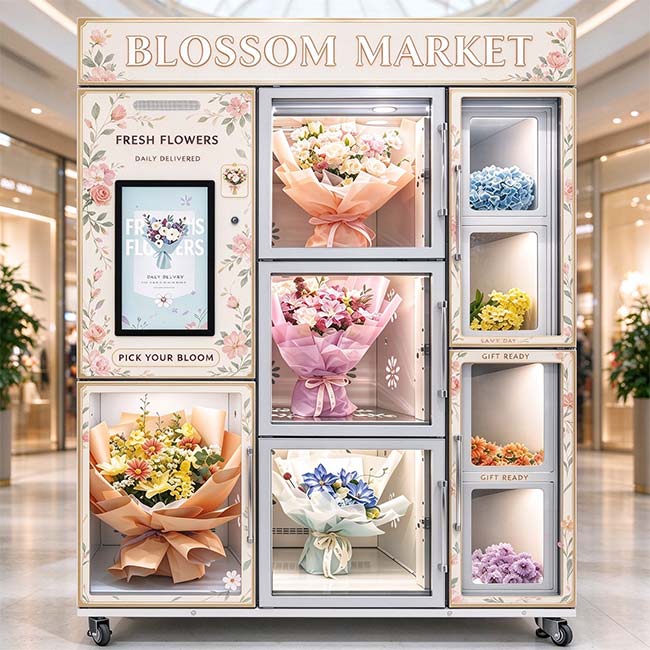
What a flower vending machine made in China actually is
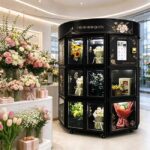
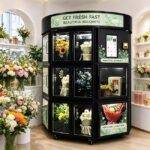
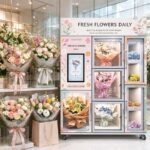
A flower vending machine is a refrigerated self-service cabinet that holds bouquets or single stems behind glass. The customer chooses a compartment on a touchscreen, pays by cash, card, or mobile wallet, and the machine unlocks that compartment so the flowers come out without staff involvement.
Chinese factories build these units in much the same way they build refrigerated snack and drink machines, with a few changes that matter for flowers. The cabinet needs even airflow, anti-fog glass, sealed compartments, and a temperature band that slows wilting without freezing petals. Wider Matrix, for example, builds nine flower models with 5 to 24 slots and a 2 to 25°C freshness zone.
The made in China part matters because component supply, cost, and customization options differ from local suppliers. You can get custom voltage, branded signage, and payment modules set for your country, but you also take on more supplier vetting and shipping work. That trade is reasonable when you compare like-for-like machines and check the factory before you pay. Our guide on why buy a vending machine from China covers that trade in more detail.
The main configurations and where each one works
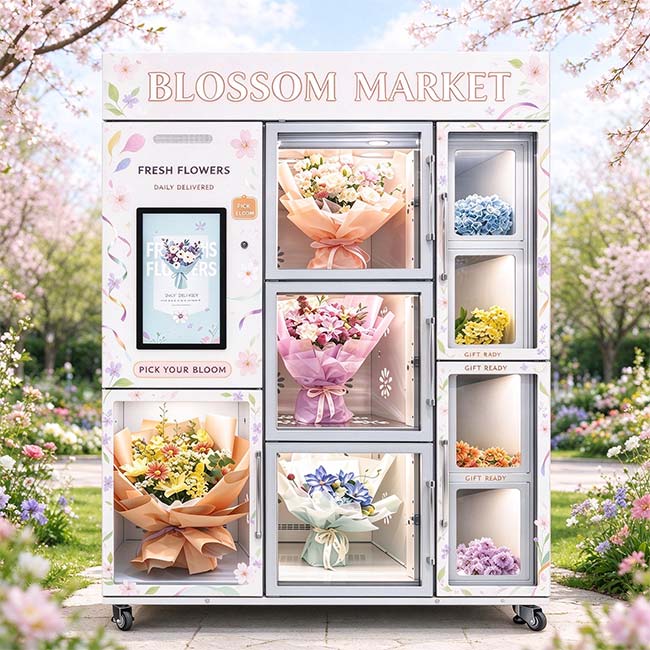
Most flower vending machines fall into a few practical layouts. The right choice depends on how many bouquets you plan to sell per day, how much floor space you have, and whether you sell single stems or full wrapped bouquets.
| Configuration | Typical slot count | Best for | What to check |
|---|---|---|---|
| Compact grid cabinet | 5 to 8 | Convenience stores, metro stations, hospital lobbies, small gift corners | Door swing, depth, and whether the slots fit your bouquet height |
| Showcase cabinet | 10 to 13 | Malls, hotel lobbies, flower shops without late hours | Anti-fog glass, lighting, and how easy it is to restock from the front |
| Wide multi-slot cabinet | 24 | Airports, large malls, festivals, high-traffic gifting spots | Power draw, restock labor, and whether you can fill 24 slots with fresh stock |
| Single-stem layout | Varies | Universities, offices, quick apology purchases | Stem support, water tube fit, and price point per stem |
| Bouquet layout | Varies | Weekend gifting, holidays, premium locations | Compartment width, wrapping clearance, and visible bouquet condition |
A 24-slot machine looks efficient on paper, but it only makes sense if you can restock it with fresh flowers several times a week. A smaller 8-slot cabinet often fits a first location better because it limits spoilage while you learn the local sell-through rate.
Freshness engineering: what keeps stems saleable
Temperature is the first spec to check. Cut flowers do best in a cool, stable range, and a cabinet that swings too warm or too cold will shorten vase life. The Wider Matrix flower line uses a 2 to 25°C range, which is the same band florists use for short-term storage and display.
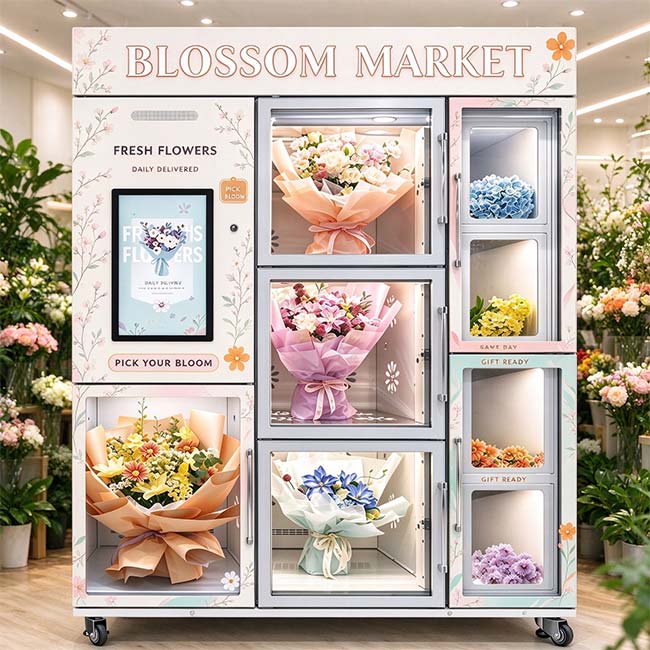
The second factor is airflow. A small fan that moves air around the cabinet helps keep every slot at a similar temperature. If the cold air only reaches the top row, the bottom bouquets will age faster and you will see uneven sell-through.
Glass matters too. Anti-fog glass or an electric dehumidification system keeps the window clear when the cabinet is cold and the room is humid. A fogged window makes bouquets look older than they are and kills impulse sales.
Insulation is easy to ignore until you see the power bill. One-piece molded foam cabinets hold temperature better than cabinets built from loose panels. Ask the supplier for the cabinet construction, not just the compressor brand.
Finally, plan the flower workflow. Bouquets should go in pre-hydrated with water tubes or florist wrapping. Wider Matrix rates its flower cabinets for 5 to 7 days between restocks, but that assumes you start with healthy stems and keep the cabinet clean. If you buy flowers that are already several days old, no cabinet will rescue them.
The specs that decide whether a unit fits your site
These are the numbers to put in your comparison sheet. Do not rely on a product photo alone.
| Spec | Why it matters | What to ask |
|---|---|---|
| Slot count and compartment size | Determines how many bouquets you can sell between restocks | Width, height, and depth of a loaded compartment, not just the empty slot |
| Dimensions | Decides whether the machine fits your corner, corridor, or lobby | Full H×W×D and the clearance needed to open the door |
| Power draw | Affects the electrical circuit and monthly operating cost | Running watts and startup load. A 24-slot Wider Matrix unit draws 1900 W, while most smaller models draw 950 W |
| Voltage | A 220 to 240V machine may need a different setup in a 110V market | Whether the factory can set the unit for your local voltage before shipping |
| Payment modules | Cash, card, and mobile payment habits vary by country | Which modules are installed and whether they are tested with your local processor |
| Remote monitoring | Cuts restock visits and helps you spot temperature faults | Can you see per-slot stock, sales, and cabinet temperature from a phone? |
| Compartment locks | Protects inventory and stops customers opening the wrong door | Whether each compartment locks independently |
| Warranty and spare parts | A cheap machine with no parts support becomes dead stock | Warranty length, parts list, and shipping terms for replacements |
If you are comparing several models, write the specs down in one table before you ask for prices. It is hard to compare a quote for a 10-slot showcase cabinet with a quote for a 24-slot wide cabinet unless you line up capacity, power, and payment features first.
Price ranges and what moves the quote
There is no single price for a flower vending machine made in China. The quote changes with slot count, refrigeration design, screen size, payment modules, branding, and shipping terms. As a factory-direct reference point, Wider Matrix flower vending machines are quoted at US$3,000 to US$6,500 per unit depending on the model and slot count. That is not a landed cost, and it does not include freight, duty, or local taxes.
For orders of multiple units, contact our team for a personalized quote with volume discounts. The same applies if you need custom colors, a branded screen interface, or a payment module that is not standard for your market.
| Cost driver | Effect on the quote |
|---|---|
| Slot count | More compartments mean more doors, locks, shelving, and cabinet material |
| Refrigeration and insulation | Better insulation and even airflow cost more than a basic cooling box |
| Screen size | A 21.5-inch touchscreen costs more than a 10.1-inch or 15.6-inch panel |
| Payment hardware | Card readers, cash acceptors, and mobile payment modules add cost and need market testing |
| Branding and UI | Custom signage, colors, and translated software add design and setup work |
| Voltage and plug type | Custom voltage for your market can add a small engineering charge |
| Shipping terms | FOB, CIF, and DDP quotes are not comparable because they include different costs |
Ask for a quote that separates the machine price from freight, insurance, and destination charges. That makes it easier to compare suppliers. If price is your main question, our 2026 cost and ROI guide breaks down the numbers in more detail.
Certifications and compliance checks
For a flower vending machine, the basic documents to request are CE, FCC, RoHS, SGS, and ISO 9001. Wider Matrix holds these for its flower line. Across the wider product range, the company also works with UKCA, KC, BRC, Kosher, and HALAL certifications, but you should still ask for the certificate that names the exact model you are buying.
A logo on a brochure is not enough. Ask for the test report or certificate with the model number and the testing lab. If you import into the EU, check that the CE documentation covers the electrical safety and RoHS requirements for the machine as configured. For the US, ask for the FCC documentation for the control and payment electronics.
Customs classification and duty rates are destination-specific. Give your freight forwarder the machine specs and let them confirm the classification before you finalize the landed cost. A vending machine with a refrigeration unit may not classify the same way as a simple display cabinet.
OEM and branding: what Chinese factories can customize
Most Chinese vending machine factories offer some level of OEM or ODM work. The common changes are top signage, exterior colors, screen interface, language, voltage, plug type, and packaging. Some factories can also change the slot layout or add a logo panel.
Ask for an artwork proof before production and a short video of the user interface in your language. If your brand depends on a specific color match, request a physical sample or a painted panel photo under daylight. Custom work usually adds a few weeks to the schedule, so get the timeline in writing.
MOQ for custom work varies by factory and by the change you request. A standard model may ship as a single unit. A custom cabinet color, a new screen flow, or a private-label payment module may require a larger run. Ask the supplier to state the MOQ in the quote, not in a later email.
How to vet a Chinese supplier before you wire money
Supplier checks matter more than the product brochure. A factory that builds vending machines every day will have a production line, test records, and spare parts on the shelf. A trader may have none of those.
- Ask for the business license and export license. Match the company name to the bank account.
- Ask whether the flower cabinet is built in-house or assembled from another factory’s shell.
- Request a live video call with the production line and the exact model you plan to buy.
- Ask for a spare parts list with prices and lead times for glass, locks, cooling parts, control boards, and payment modules.
- Ask for two or three reference customers in your region or in a similar market.
- Confirm the warranty terms, who pays return freight, and how technical support is handled across time zones.
- Test the payment module with your local processor before the machine ships, not after it arrives.
Our checklist on what to check before buying directly from a China manufacturer is a useful second set of eyes before you sign.
Shipping, duties, and landed cost
Most flower vending machines ship by sea because the cabinet is large and heavy. Air freight is possible for a sample or a rush order, but the cost per unit is much higher. The factory should pack the machine in an export crate with foam protection and include an English manual and a wiring diagram.
Ask for a door-to-door quote if you are new to importing. FOB gives you the lowest supplier price but leaves you to arrange freight, insurance, and customs. DDP gives you one number but hides the breakdown. Compare the total landed cost, not the machine price alone.
Before the machine arrives, confirm the power supply at your site. Check the circuit capacity, the plug type, and whether the location has a drain or a level floor. A refrigerated cabinet needs stable power and a little clearance for airflow.
A simple ROI model you can run before buying
Use your own local numbers. The sample below is illustrative and not a promise of results.
| Item | Sample range |
|---|---|
| Bouquet retail price | US$15 to US$25 |
| Flower and wrapping cost per bouquet | US$4 to US$8 |
| Gross profit per bouquet | US$10 to US$17 |
| Daily sales at a mid-foot-traffic site | 10 to 30 bouquets |
| Sample daily gross profit | US$100 to US$450 |
| Sample monthly gross profit | US$3,000 to US$13,500 |
Now subtract rent or revenue share, power, payment fees, spoilage, and the labor cost of restocking. If the machine lands at around US$5,000 and your monthly gross profit is US$3,000, the simple payback is under two months before operating costs. With rent and spoilage included, the real payback is longer. Run the model with your own rent and sell-through rate before you buy.
Our article on whether flower vending machines are profitable includes more operating scenarios.
Where Wider Matrix fits in this sourcing decision
Wider Matrix (GZ) Technology Co., Ltd. is a Guangzhou-based vending machine manufacturer. Since 2016, the team has exported more than 3,000 machines to over 130 countries. The company builds its own hardware and software, which helps when you need a custom payment module or a branded screen flow.
The Wider Matrix flower vending machine line has nine models with 5 to 24 slots. All models use a 2 to 25°C freshness zone, anti-fog glass, independently locked compartments, and remote monitoring for stock, sales, and cabinet temperature. The cabinets are rated for 5 to 7 days between restocks, depending on flower type and starting condition. Payment support includes cash, card, and mobile QR, with modules configured for your market before shipment.
The flower line carries CE, FCC, RoHS, SGS, and ISO 9001 certification. Wider Matrix quotes a factory-direct reference range of US$3,000 to US$6,500 per unit depending on model and slot count. For multiple units or custom branding, contact the sales team for a personalized quote with volume discounts. Our 2026 price, specs and ROI guide has the full model table if you want to compare slot counts side by side.
China vs Europe and Italy suppliers: a quick comparison
| Factor | China factory | European supplier |
|---|---|---|
| Unit cost | Usually lower for the same slot count and cooling setup | Higher labor and overhead costs are built into the price |
| Customization | Broad OEM and ODM options, but you must manage the process | Less flexible on small custom runs |
| Lead time | Production plus sea freight, so plan for weeks not days | Shorter delivery inside the EU, but stock models may be limited |
| Certification | CE, FCC, RoHS, SGS, ISO 9001 are available from established factories | EU documentation is usually easier to verify locally |
| Spare parts | Cheaper parts, but shipping takes longer | Faster local support, higher part prices |
| Communication | Good factories respond in English and send video updates | Same time zone and local contract terms |
Neither option wins every time. A European supplier may be better if you need a machine next week or a local service contract. A Chinese factory is usually better if you want a custom slot layout, a lower unit cost, or a branded cabinet. Our guide to China vending machine manufacturers and suppliers covers the sourcing process in more depth.
Common mistakes buyers make
- Buying on unit price alone and skipping the spare parts list.
- Choosing a 24-slot machine before testing sell-through at a smaller site.
- Forgetting to check the door swing and corridor width before delivery.
- Assuming every payment module will work with the local bank or processor.
- Ordering a 220V machine for a 110V site without a voltage plan.
- Skipping a live video check of the exact unit before the deposit.
- Underestimating restock labor during holiday peaks.
Next steps before you request a quote
Write down your site details first: daily foot traffic, available floor space, power supply, and the payment methods your customers already use. Then decide whether you need a small cabinet for a first location or a larger unit for a proven high-traffic spot.
Send those details to two or three factories and ask for a quote that separates the machine, freight, and certification documents. Ask for a video of the model running, a spare parts list, and the warranty terms in writing. That package gives you a fair comparison and a clearer landed cost.
FAQ
How much does a flower vending machine made in China cost?
Most quotes depend on slot count, refrigeration design, screen size, payment modules, and shipping terms. As a factory-direct reference, Wider Matrix flower vending machines are quoted at US$3,000 to US$6,500 per unit depending on the model. Freight, duty, and local taxes are extra. Ask for a landed-cost quote if you want a true budget number.
What is the MOQ for a flower vending machine?
Many Chinese factories quote a single unit for a standard model. Custom colors, a new screen interface, or a private-label payment module may require a higher MOQ. Ask the supplier to state the MOQ for your exact configuration in the quote.
Can a vending machine keep fresh flowers alive?
Yes, if the cabinet holds a stable cool temperature and good airflow. The Wider Matrix flower line uses a 2 to 25°C range and is rated for 5 to 7 days between restocks. Actual vase life depends on flower type, hydration before loading, and how often customers open the door.
What certifications should I ask for?
Ask for CE, FCC, RoHS, SGS, and ISO 9001 for the machine model you are buying. Check that the certificate or test report names the exact model and configuration. For EU imports, confirm the CE documentation covers electrical safety and RoHS. For the US, confirm the FCC documentation for the control and payment electronics.
Can the machine accept my local payment methods?
Most factories can install cash, card, and mobile QR modules, but the module must match your local processor and currency. Test the payment flow with your provider before the machine ships. A card reader that works in China may not work with your bank in another country.
How long does shipping take?
Sea freight is the usual choice for a full cabinet. Transit time depends on the port, the shipping line, and whether you choose FOB, CIF, or DDP. Ask for a door-to-door estimate with the machine dimensions and weight so the forwarder can quote accurately.
Can I put my brand on the machine?
Yes. Common customizations include top signage, exterior colors, screen interface, language, voltage, and packaging. Ask for an artwork proof before production and a video of the final interface. Custom work usually adds time to the production schedule.
How many bouquets should I stock at first?
Start with fewer slots than you think you need. A smaller cabinet limits spoilage while you learn the local sell-through rate. Once you know how many bouquets sell per day and which price points move, you can add a larger machine or a second location.
What spare parts should I order with the machine?
Ask for a parts list that covers glass, compartment locks, cooling components, control boards, and payment modules. Order the parts that are most likely to fail or that take the longest to ship. A spare lock or control board can save a week of downtime.
Is a flower vending machine profitable?
It can be, but the result depends on rent, foot traffic, spoilage, and restock labor. Use a simple model with your own numbers. If a bouquet sells for US$20 and costs US$6, the gross profit is US$14. At 20 bouquets per day, that is US$280 per day before rent and power. Run the same model for your site before you buy.