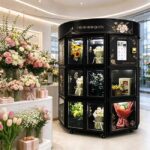


China builds a large share of the refrigerated flower vending machines sold worldwide, and most searches for a factory start with a quote nobody can verify or a location somebody wants to fill. Finding suppliers takes an afternoon. The harder part is telling a factory that builds these cabinets apart from a trading company that forwards your email, and knowing which specifications decide whether a rose is still sellable on day six. This guide covers what Chinese flower vending machine factories actually produce, what the machines cost in 2026, how to vet one before you wire a deposit, and what the landed cost looks like once freight and duty land on top.
What a flower vending machine factory in China actually builds
Three product families come out of the same workshops in Guangdong, Zhejiang and Jiangsu, and buyers routinely mix them up in the first email.
| Type | What it dispenses | Cooling | Typical buyer |
|---|---|---|---|
| Refrigerated bouquet cabinet | Wrapped bouquets and single stems in locked glass compartments | 2 to 25°C, active airflow | Florists, vending operators, malls |
| Flower locker | Online orders collected by code | Ambient or lightly cooled | E-commerce florists running pickup points |
| Ambient gift cabinet | Preserved flowers, dried arrangements, flower boxes | None | Gift shops, souvenir retail |
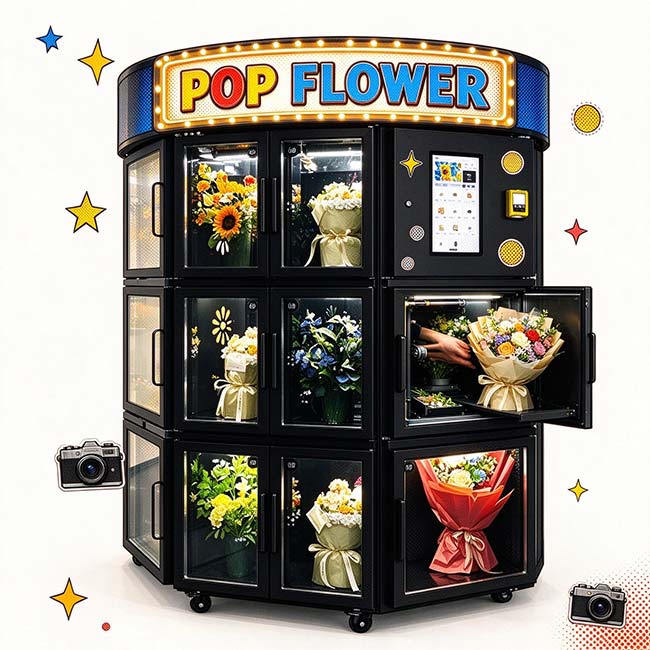
The refrigerated cabinet is the one most people mean when they say flower vending machine. It holds real, perishable bouquets behind glass, keeps them cool, and unlocks only the compartment the customer paid for. Everything below applies to that family unless stated otherwise.
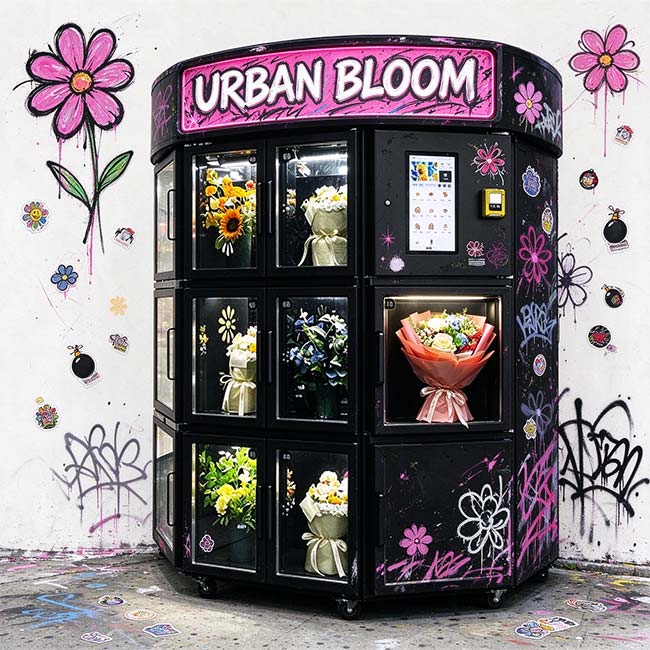
One structural detail matters more than the styling. Compartments have to be deep enough and tall enough for the bouquets you actually plan to sell. A cabinet rated for eight slots of 60 cm stems is useless if your supplier sells 80 cm wrapped bouquets. Ask for the internal clear dimensions of a single compartment, not the external cabinet size.
The specifications that decide whether flowers survive
Set the temperature for the species you sell
Most refrigerated cabinets run a 2 to 25°C band, which is wide because one machine has to serve several flower types. Roses, lilies, carnations and most temperate cut flowers last longest near 4 to 8°C. Tropicals are the exception: orchids, anthurium and bird of paradise suffer chilling injury below roughly 10 to 12°C, so a cabinet set for roses will shorten their vase life. If your mix includes tropicals, either set the cabinet higher or split the range across two machines.
Airflow, fog and condensation
Cool glass in a warm mall fogs within minutes unless the cabinet deals with it. Electric anti-fog systems and air-cooling circulation across every slot do most of the work, and a one-piece molded foam cabinet holds the setpoint far better than a cabinet assembled from panels with seams. Ask how the machine defrosts and where the drain water goes. A cabinet with no drain plan will drip onto the bouquets below it in humid climates.
Humidity and hydration
Cut flowers want high relative humidity, around 90 to 95%, and most vending cabinets control temperature without measuring humidity at all. Be direct about this with any supplier: does the machine monitor RH, and how do you keep stems hydrated? In practice, bouquets go in pre-hydrated with water tubes or florist wrap, exactly as a florist would deliver them, and the cabinet slows decline rather than reversing it. A machine that claims to keep unwrapped stems alive for two weeks is telling you something about its sales pitch.
Compartment security
Each compartment needs its own electric lock, so only the purchased bouquet opens. Shared-door designs get raided in unattended locations within weeks. Ask for the lock module model and the price of a replacement, because locks are the part that fails first.
Price bands from Chinese factories in 2026
These are reference bands for standard factory-direct builds, not quotes. A card terminal, a custom wrap and DDP shipping all sit on top of the ex-works number.
| Configuration | Reference factory price | What drives the number |
|---|---|---|
| 5 to 8 compartments, 15.6 to 21.5 inch screen | US$3,000 to US$4,200 | Smallest cabinet, single cooling circuit, basic payment module |
| 10 to 13 compartments | US$4,200 to US$5,500 | Larger insulated body, more lock modules, bigger display |
| 20 to 24 compartments, wide body | US$5,500 to US$6,500 | Double-door layout, heavier cooling load, roughly double the power draw |
Five things move the price more than anything else: compartment count, the payment terminal you specify, screen size, custom graphics, and the voltage and plug configuration for your market. On request, some factories will drop the card reader and ship a QR-only machine, which saves money but limits you to mobile payment customers. For a full breakdown of machine cost against operating cost, the 2026 cost and ROI guide walks through the arithmetic.
The specification sheet to demand before you pay a deposit
Send this list to every supplier and compare what comes back. The gaps tell you as much as the answers.
| Field | Why you need it in writing |
|---|---|
| Model code and compartment layout | Makes the quote comparable across suppliers |
| Internal clear size per compartment | Decides which bouquets fit |
| Temperature range and factory setpoint | Setpoint is what the machine ships at, not the brochure range |
| Refrigerant type | R290 and R134a carry different servicing and import rules |
| Insulation construction | Molded foam holds temperature; panel assembly leaks |
| Glass type and anti-fog method | Condensation kills the display in humid markets |
| Running and peak power draw | Sizing the circuit and estimating electricity cost |
| Voltage and plug standard | Wrong plug means a site visit from an electrician on day one |
| Net and gross weight with crate | Freight quotes are meaningless without it |
| Payment terminal make and model | Determines settlement, fees and currency support |
| Telemetry: SIM, WiFi, dashboard access | You want stock and temperature on your phone |
| Warranty length, response time, parts pricing | The two-year number on the brochure is rarely the real one |
If a supplier will not put weight and refrigerant type in writing, that tells you more than any brochure will.
Factory or trading company: how to check in one afternoon
- Ask for the business license and the unified social credit code, then check the company name against the name on the proforma invoice. Mismatches are common and costly.
- Ask for a customs registration number and one redacted bill of lading from a previous export. A real exporter has both.
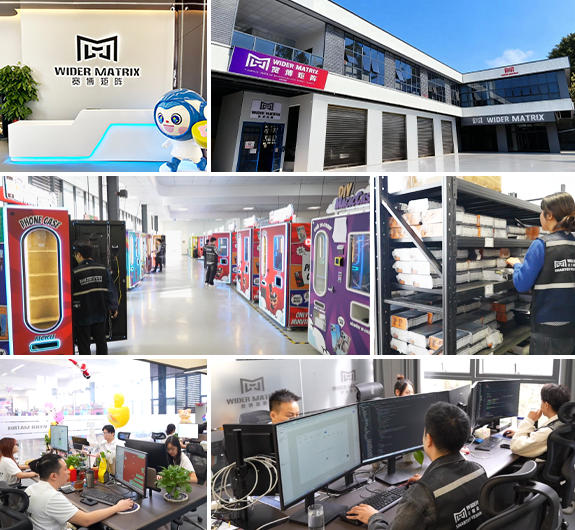
- Book an unedited video walkthrough. Ask the camera to start at the loading bay, pass the sheet metal shop and assembly line, and finish at the QC bay where finished cabinets are powered on and cooled. A trading company cannot show a line it does not own.
- Ask for component provenance: compressor brand, controller, lock modules, screen supplier. A factory knows its bill of materials and can tell you when a compressor brand changed.
- Get an engineer on the call, not a salesperson. The person who handles refrigeration or firmware will answer questions a reseller cannot.
- Verify certificates properly. Pull the certificate number and the model listed on it. A CE certificate whose model number does not match the machine you are buying is decoration.
- Order one unit first, or hire a third-party inspector such as SGS, BV or TÜV for a pre-shipment check on the first container.
- Agree payment structure. Deposit against a proforma invoice to the company account, balance against a copy of the bill of lading. Requests for full payment upfront, or payment to a personal account, end the conversation.
Red flags worth walking away from: a supplier who quotes six unrelated machine categories, no engineer available on any call, certificate scans with no readable numbers, prices far below the market band, refusal of a video audit, and pressure for 100% telegraphic transfer before production starts.
Certifications by destination market
| Market | What to ask for | Practical note |
|---|---|---|
| European Union | CE marking under LVD and EMC, RoHS compliance, EU declaration of conformity, test reports from a recognized lab | Self-declared CE is widespread. The test report is the document that protects you |
| United Kingdom | UKCA marking, alongside CE during the transition period | Check which regime your importer accepts |
| United States | FCC Part 15 for the digital controller, UL or ETL listing for the electrical assembly | Listing is not legally mandatory, but landlords and insurers often require it |
| Canada | cUL or ULC listing | Ask for the file number, not a logo |
| Australia and New Zealand | RCM | Includes electrical safety and EMC |
| South Korea | KC | Required for the electrical assembly |
| Japan | PSE for the power supply | Specify 100V if you are shipping to Japan |
| Gulf states | SASO and SABER registration | Handle before shipment, not after |
Machines going into the United States also run into payment network rules, tariff classification and state-level electrical codes. The US startup guide covers those in more detail.
OEM and ODM: what is cheap to customize and what is not
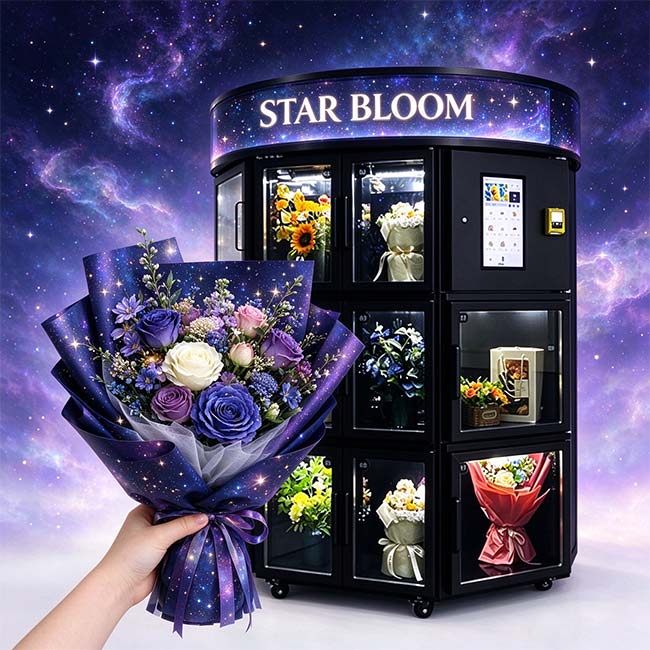
Graphics, top signage light boxes, interface language, currency, voltage, plug type, payment terminal choice and divider layout are all inexpensive changes that a factory handles on the standard chassis. Ask for a digital mock-up before production and approve the print file in writing.
A new cabinet shape is a different project. New sheet metal tooling or a new mold carries a real tooling budget and usually a volume commitment, and it adds weeks to the schedule. Unless you are ordering enough machines to justify it, work with the existing chassis and put your money into the wrap, the interface and the location.
Shipping, HS codes and container fit
Refrigerated vending machines usually clear customs under HS 8476.81, the heading for vending machines that incorporate heating or refrigerating devices. Ambient models fall under 8476.89. Confirm the code with your customs broker before you book freight, because duty treatment varies by country and by the code your broker files.
Container fit catches people out. These cabinets stand around 2.1 to 2.3 m tall, and a standard dry container has a door opening of roughly 2.28 m. That leaves almost no clearance, and a compressor should not travel lying on its side. Most buyers book a 40ft high cube, where the door opening is about 2.58 m, and ship the machine upright on a skid inside a crate. If you ship less than a container load, expect your crate to be handled repeatedly and specify corner protection.
Incoterms matter here. FOB gives you control of freight and insurance. CIF puts the booking in the supplier’s hands, which is convenient but harder to audit. DDP is the easiest to budget and the easiest to overpay, so ask for the duty and clearance line items broken out. After arrival, let the unit stand upright for 12 to 24 hours before powering it on if it was tilted at any point in transit.
Landed cost: a worked example
Numbers below are illustrative for a 10-compartment cabinet with a card terminal, shipped to a port in a market with a low single-digit duty rate. Get real quotes before you build a business plan on them.
| Line item | Example amount |
|---|---|
| Machine, factory-direct | US$4,800 |
| Export crating and inland haulage to port | US$250 |
| Ocean freight, one unit LCL | US$600 |
| Marine insurance | US$30 |
| Import duty | US$0 to US$240 |
| Customs clearance and broker fee | US$150 |
| Inland delivery to site | US$200 |
| First spares kit | US$200 |
| Indicative total | US$6,230 to US$6,470 |
That is roughly 30% on top of the ex-works price for a single unit. The percentage drops fast on a multi-unit order, because freight and clearance are shared. For orders of multiple units, ask each supplier for a personalized quote with volume discounts rather than assuming the unit price scales linearly.
What Wider Matrix builds
Wider Matrix (GZ) Technology Co., Ltd. is a Guangzhou-based vending machine manufacturer that has been developing automated retail hardware since 2016. The company has exported more than 3,000 machines to over 130 countries, and its machines and consumables carry CE, UKCA, RoHS, KC, BRC, Kosher and HALAL certification.
The flower line covers nine models from 5 to 24 compartments. Every model uses the same core platform: 2 to 25°C refrigeration, a one-piece molded foam cabinet, electric anti-fog glass, individually locked compartments, air-cooling circulation across all slots, and remote monitoring of stock, sales and cabinet temperature from a phone. Payment runs on cash, card or mobile QR, configured for the destination market before shipment. Cut flowers stay display-ready for 5 to 7 days between restocks under normal conditions. The line carries CE, FCC, RoHS, SGS and ISO 9001 certification, and reference pricing runs from US$3,000 to US$6,500 per unit depending on model and compartment count.
| Model | Compartments | Screen | Height x Width x Depth (mm) | Power |
|---|---|---|---|---|
| Compact Series 5 | 5 | 21.5 in | 2122 x 1640 x 750 | 950 W |
| Bloom Box Series | 8 | 21.5 in | 2122 x 1500 x 797 | 950 W |
| Grid Series 8 | 8 | 15.6 in | 2122 x 1500 x 797 | 950 W |
| Tall Series 8 | 8 | 10.1 in | 2266 x 2210 x 756 | 950 W |
| Grid Series 10 | 10 | 10.1 in | 2122 x 1760 x 797 | 950 W |
| Showcase Series 10 | 10 | 15.6 in | 2122 x 1500 x 797 | 950 W |
| Arc Series 11 | 11 | 15.6 in | 2067 x 1715 x 985 | 950 W |
| Grand Series 13 | 13 | 15.6 in | 2122 x 1500 x 797 | 950 W |
| Wide Series 24 | 24 | 21.5 in | 2122 x 3000 x 750 | 1900 W |
Voltage is 220 to 240V AC at 50Hz as standard and can be customized for the destination market. Signage, exterior color, screen interface and voltage are all customizable on the standard chassis. Full model detail sits on the flower vending machine product page, and the 2026 price, specs and ROI guide compares configurations side by side if you are still choosing a compartment count.
The operating numbers: what a machine earns and what it wastes
The revenue side is the easy half. The waste side is where operators get surprised.
| Item | Sample value |
|---|---|
| Bouquet retail price | US$15 to US$25 |
| Flower and wrapping cost per bouquet | US$4 to US$8 |
| Gross profit per bouquet | US$10 to US$17 |
| Daily sales, mid foot-traffic site | 10 to 30 bouquets |
| Sample daily gross profit | US$100 to US$450 |
| Sample monthly gross profit | US$3,000 to US$13,500 |
| Restock visit | 30 to 60 minutes, once a week, two to three times a week in gifting season |
Treat those as sample estimates drawn from operator experience, not a forecast for your site.
The real variable is sell-through inside the freshness window. A bouquet loaded on Monday that is still sitting there the following Sunday is a full write-off, and three of those a week eats most of a small site’s margin. Two habits fix it. Load fewer units of a popular bouquet rather than a wide spread of slow sellers, and set a discount tier for the last 48 hours of the window so the machine clears stock instead of composting it. Operators who track per-compartment sales data tend to run 15 to 25% less waste than operators who restock by eye. Far more on this sits in our breakdown of whether flower vending machines are profitable.
Maintenance, spare parts and the questions that save you later
Ask every supplier for a spare parts price list before you order, not after something breaks. The parts that fail on a refrigerated flower cabinet are predictable: compartment lock modules, the door sensor on each compartment, the control board, the screen and the compressor. Knowing the price of each one turns a warranty argument into a purchase order.
Four other things are worth pinning down in the contract: the warranty period and what it excludes, the response time for remote diagnosis, who pays freight on warranty parts, and whether firmware updates are free and remote. A machine that needs a technician on site to change a price or a screen layout will cost you more in travel than in parts.
Cleaning is simple and gets skipped. Glass gets fingerprints, the drain line gets blockage, and the compartment interiors need a wipe between restocks. Build that into the restock route rather than treating it as a separate job.
Where these machines earn their keep
| Location | Why it works | What to check first |
|---|---|---|
| Gas stations and 24-hour convenience stores | Late-night impulse buying with no florist open | Foot traffic after 9 pm |
| Shopping malls | Gifting occasions cluster near fashion and jewelry | Power access and mall approval |
| Hospitals | Visitors need flowers outside shop hours | Which entrance visitors actually use |
| Metro and rail stations | Commuters buying on the way home | Dwell time and restock access |
| Hotel lobbies | Guests and event attendees buy same day | Concierge buy-in |
| University campuses | Single stems sell fast around exams and holidays | Term dates and campus rules |
| Tourist attractions | High margin in peak season | Seasonality of the site |
Location quality beats machine quality, but only up to a point. A well-placed cabinet with mediocre refrigeration will still lose stock to spoilage. If you are evaluating a specific market, the Singapore location analysis shows how the site-by-site math works for a dense, high-rent city.
Wrapping up
A flower vending machine factory in China is easy to find and harder to qualify. The three things that separate a good buy from a bad one are a spec sheet you wrote yourself, a video audit that shows a real production line, and a landed cost estimate that includes freight, duty and the first spares kit.
Practical next steps: write the spec sheet from the table above, send it to three factories and ask for quotes at one unit and at five units, book a 20-minute video walkthrough with an engineer on the call, and plan your restock route before the machine clears customs. If you are still deciding what to buy rather than from whom, the buyer guide on where to purchase covers the alternatives to importing direct.
FAQ
How much does a flower vending machine cost from a Chinese factory?
Standard refrigerated cabinets run about US$3,000 to US$6,500 per unit factory-direct, with compartment count, payment terminal and screen size doing most of the work. Landed cost typically adds 20 to 30% for a single unit and much less per machine on a multi-unit order.
What is the minimum order quantity?
Most flower vending factories will quote from a single unit. Volume matters most for custom wraps, custom voltage runs and price. Ask for a written quote at one, five and ten units so you can see where the price actually breaks.
How long do flowers stay fresh inside the machine?
Cut flowers stay display-ready for about 5 to 7 days between restocks at a proper setpoint, and longer at the cooler end of the range. Tropical flowers need a warmer setpoint and a shorter window.
Can I put my own brand on the machine?
Yes. Exterior graphics, top signage, interface language, currency and voltage are routine customizations on a standard chassis. A new cabinet shape needs tooling and a volume commitment, which most first orders cannot justify.
Which certifications do I actually need?
It depends on the destination. The EU needs CE with test reports and RoHS, the UK needs UKCA, the US needs FCC for the controller and usually UL or ETL listing for the electrical assembly, and Australia needs RCM. Check with your insurer and landlord as well, because they sometimes ask for more than the law does.
What is the HS code for a refrigerated flower vending machine?
Usually 8476.81, which covers vending machines incorporating heating or refrigerating devices. Ambient models typically fall under 8476.89. Confirm the classification with your customs broker before booking freight.
How many machines fit in one container?
It depends on the model footprint and height. A wide 24-compartment model takes far more floor space than a 5-compartment unit, and cabinets around 2.2 m tall need a high cube container to load upright through the door. Ask the factory for packed dimensions and crate weight, then let your forwarder do the loading plan.
What power supply does the machine need?
Typical refrigerated flower cabinets draw around 950 W, with wide multi-door models closer to 1,900 W, on 220 to 240V AC at 50Hz. Voltage can be customized for markets on 110V or 100V, so confirm the configuration before production rather than after arrival.
What happens when a compartment jams?
Most machines report the fault through the remote dashboard, and a jammed lock module is usually a swap rather than a repair. That is why the spare parts price list matters: keep one lock module and one door sensor per ten machines on hand.
Will it work in a hot or humid climate?
Yes, with the right setup. Humid markets need working anti-fog glass, a functioning drain line and a cabinet that holds its setpoint through the hottest part of the day. Ask the supplier what ambient temperature the cabinet is rated for and test the first unit through a full week before ordering more.