

Before you put $5,000 to $12,000 into a cotton candy vending machine, you want to see what the income actually looks like. A well-placed cotton candy vending machine in the USA can gross $1,500 to $7,500 per month and pay for itself in 2 to 12 months, with first-year ROI in the 30% to 150% range. The spread is wide for a reason. Location, price point, and operating costs matter more than the machine itself.
What a realistic 2026 ROI looks like
Every ROI model starts with three inputs: servings per day, retail price, and monthly operating costs. Change any one and the payback period shifts by months. The scenarios below match real US venue categories, not an idealized mall.
| Scenario | Daily sales | Retail price | Monthly revenue | Monthly net after costs | Payback on $9,000 project |
|---|---|---|---|---|---|
| Low-traffic venue | 8 | $5.00 | $1,200 | $510 | 18 months |
| Typical entertainment venue | 20 | $6.00 | $3,600 | $1,960 | 5 months |
| Prime tourist location | 35 | $7.00 | $7,350 | $4,280 | 2 months |
Assumes a $9,000 all-in project cost, venue commissions of 15% to 25%, ingredients at $0.40 per serving, payment fees around 4.5%, electricity of $80 per month, and a $75 monthly maintenance reserve.
These are planning numbers, not promises. A machine in a quiet spot can lose money; a machine in the right spot can pay for itself faster than most snack vending routes. If you want to see the payback math in harder detail, our guide on cotton candy vending machine ROI and the passive income myth digs deeper.
Your real startup cost: the line items nobody lists
Published ROI guides often compare the list price to a monthly profit. That math ignores shipping, permits, insurance, electrical work, payment terminals, and consumables. On paper, a $4,800 machine becomes a $7,000 to $12,000 project before the first sale.
| Cost item | Low estimate | High estimate |
|---|---|---|
| Machine, fully automatic indoor model | $4,800 | $5,300 |
| Freight, customs, local delivery | $900 | $2,200 |
| Electrical and site prep | $250 | $1,200 |
| Permits and health department fees | $50 | $700 |
| Insurance, first year | $400 | $1,500 |
| Payment terminal setup | $100 | $400 |
| Initial sugar, sticks, and supplies | $300 | $600 |
| Spare parts and maintenance reserve | $200 | $500 |
For a machine to be delivered anywhere in the US, plan on $900 to $2,200 for shipping, customs clearance, and local delivery. Electrical work usually runs $250 to $1,200, because these machines draw up to 3,000W while making candy. Permits and health department fees run $50 to $700 depending on the state and city, and insurance for a single machine often costs $400 to $1,500 for the first year.
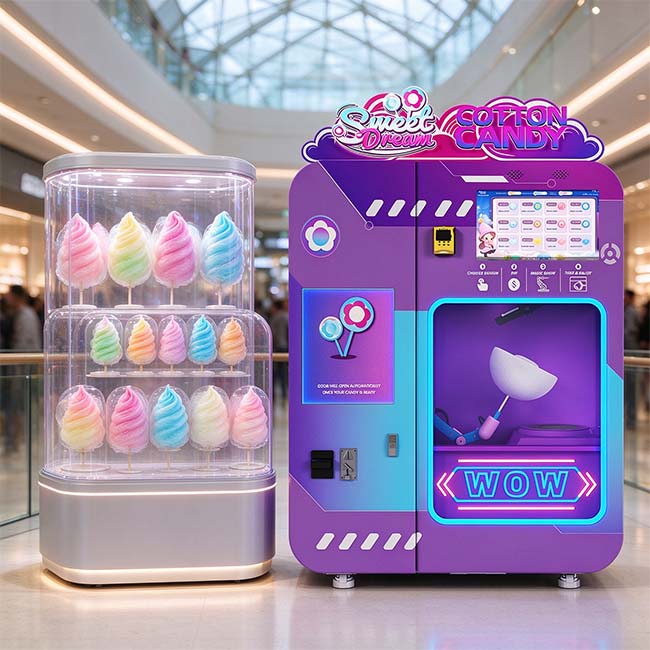
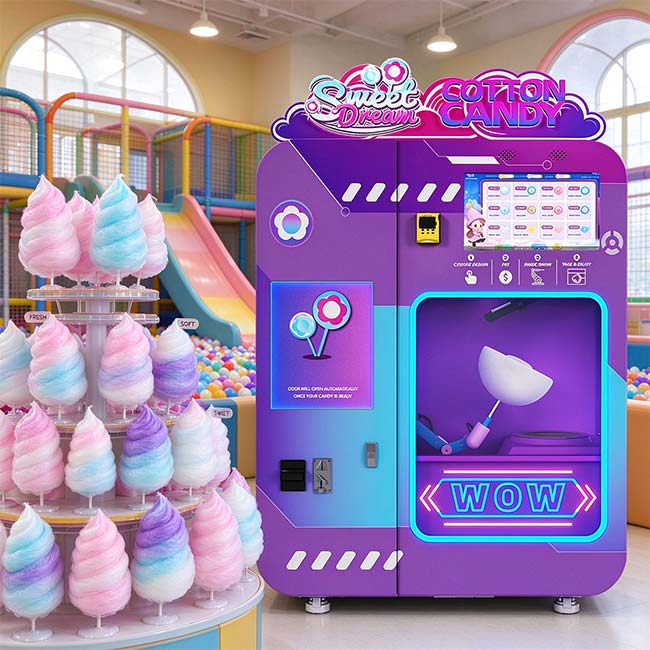
On the machine side, Wider Matrix makes the WM980 indoor cotton candy machine, the WM980+ with upgraded cabinet and ambient light ring, and the WM668 outdoor model. The WM980 base price is US$4,800, the WM980+ is US$4,999, and the WM668 is US$5,299. The WM980 and WM980+ hold four 2kg sugar tanks; the outdoor WM668 holds six. All use 28 to 30 grams of sugar per candy, accept coin, cash, credit card, and NFC, and run a cloud management system. The factory has exported more than 3,000 machines to 130 countries since 2016. If you want to compare features and pricing tier by tier, the high-end cotton candy vending machine price guide for 2026 walks through it.
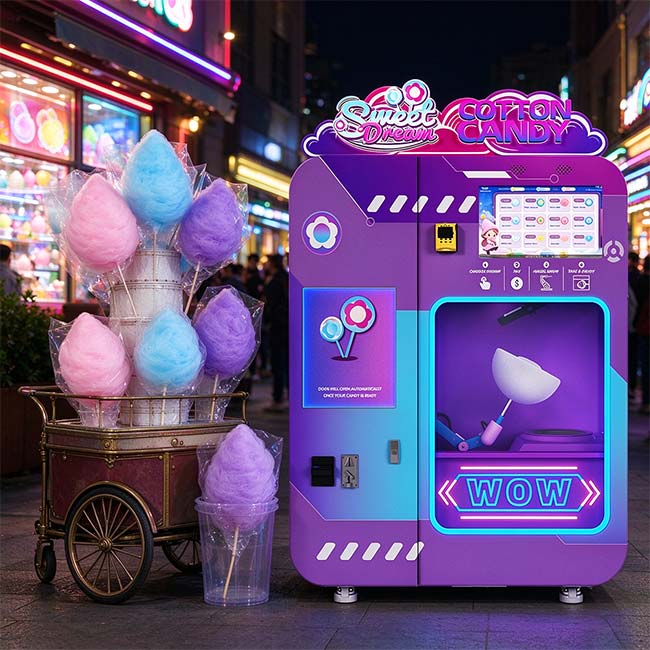
Consumables look small per serving but you buy them in batches. Wider Matrix cotton candy sugar is US$3.25 per bag at 96-bag volume, and paper sticks cost US$0.05 per stick at 2,000. That works out to a per-serving ingredient cost around $0.35 to $0.50 once you add stick and normal waste. For orders of multiple units, contact our team for a personalized quote with volume discounts.
Why location is the whole game
A fully automatic cotton candy machine can make a consistent product, but it still depends on foot traffic and impulse. Most venues convert 0.2% to 0.5% of passersby into buyers. A 2,000-person daily foot traffic gives you 4 to 10 servings; a 10,000-person tourist spot gives you 20 to 50.
| Location type | Realistic daily sales | Typical venue commission | Seasonality |
|---|---|---|---|
| Family entertainment center | 12 to 30 | 10% to 20% | Year-round with weekend peaks |
| Movie theater | 8 to 20 | 15% to 25% | Weekend heavy |
| Shopping mall common area | 10 to 25 | 15% to 30% | Summer and Q4 strong |
| Amusement park or boardwalk | 25 to 45 | 10% to 25% | Spring and summer peak |
| Zoo or aquarium | 10 to 25 | 10% to 20% | Seasonal outdoors, indoor exhibits steady |
| Airport | 15 to 35 | 20% to 35% | Steady all year |
Commission ranges are before tax. Most venue deals are revenue share with 15% to 25% going to the host. Airports and prime mall spots can push 30%. You can find more location-level profit detail in our guide to how profitable a cotton candy vending machine is in the USA.
How to negotiate with a venue
Do not accept the first commission offer. A few moves will improve the deal:
- Count foot traffic for two hours on a Friday and a Saturday before you pitch.
- Ask for a 90-day trial at a lower commission, then a step-up after proof.
- Ask for a small monthly minimum instead of a big fixed rent.
- Get exclusivity in writing so a second cotton candy machine does not appear nearby.
- Agree on who pays for electricity, who cleans around the machine, and what happens if the machine is down.
Try to include a 30-day notice clause for both sides. A dead location will not trap you in a bad contract.
Seasonality: plan your cash flow around the calendar
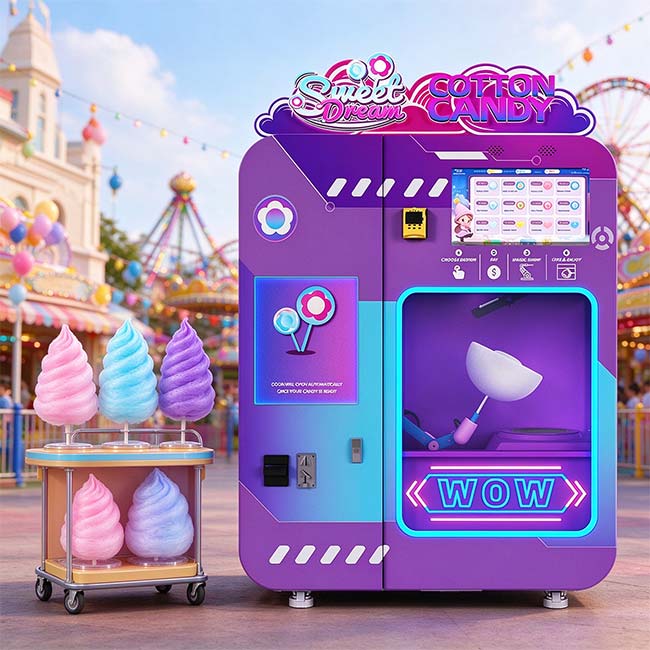
Cotton candy is weather-sensitive. Outdoor locations boom from late spring through summer and can stall in winter. Indoor malls and entertainment centers stay steadier, but still peak in March, summer, and Q4.
If your venue is outdoors, expect winter revenue to drop to near zero in states with freezing temperatures. Keep a second indoor location lined up, or be ready to move the machine. A practical rule is to set aside two months of operating costs before launch, not one.
For rough planning, January and February are the weakest months. April through August are strongest. November and December are strong for malls because of holiday foot traffic.
Permits, taxes, and food safety rules
Cotton candy is a prepared food, so it triggers food safety rules. The FDA covers the ingredients, but state and local agencies inspect the machine and the operator.
Fee ranges vary. California county health permits can run $200 to $800 a year. New York City requires a vending permit and a food protection certificate. Florida regulates vending machines through the Department of Agriculture, often at a smaller flat fee. Some states also require a sales tax permit, and a few cities require a site plan review before you plug in. Build 2 to 8 weeks into your timeline for permits, and call the local health department before signing a lease.
Total cost of ownership over 12 months
Instead of focusing only on payback, look at yearly ownership costs. The table below covers a machine doing 4,000 to 10,000 servings a year.
| Cost category | How it scales | 12-month range |
|---|---|---|
| Sugar and sticks | $0.30 to $0.50 per serving | $1,300 to $5,000 |
| Venue commission | 10% to 30% of gross | $1,800 to $9,000 |
| Payment processing | 2.9% plus $0.10 per transaction | 3% to 6% of gross |
| Electricity | 500W standby, 3,000W while producing | $480 to $1,440 |
| Maintenance and spare parts | Monthly reserve | $600 to $1,200 |
| Insurance | Annual policy | $300 to $900 |
Add these to any model before you believe a payback calculation. A clean machine with deep margins can still produce weak cash flow if the rent and processing fees eat the spread.
A worked example: one month in a family entertainment center
Here is a realistic month for a mid-tier indoor location:
- 18 servings per day at $6 each
- 30 days equals $3,240 gross
- Venue commission at 20% is $648
- Ingredients at $0.40 per serving is $216
- Card and mobile payment fees at 4.5% are $146
- Electricity runs about $80
- Maintenance reserve is $75
Total costs come to $1,165. Net profit is $2,075. Against an $8,000 project cost, that is a 3.9-month payback. Drop to 8 servings per day and the same math leaves about $650 a month, which makes the project a much harder sell. The machine is not the business; the location is.
Machine options and what they really cost
You can start with a staffed cart, a semi-automatic machine, or a fully automatic machine. The tradeoffs are clearer when you put them side by side.
| Type | Upfront cost | Labor required | Typical payback |
|---|---|---|---|
| Staffed cart | $1,500 to $7,000 | One worker per shift | 3 to 12 months |
| Semi-automatic machine | $2,500 to $4,000 | Part-time supervision | 6 to 18 months |
| Fully automatic WM980 line | $4,800 to $5,299 | Almost none | 2 to 12 months |
The WM980 line adds a 4-DOF robotic arm, 36 candy designs, and a touchscreen selection flow. That creates the show factor that turns a simple sugar sale into an impulse buy. Because it makes each candy automatically, one operator can manage several machines in different venues.
Risks and how to handle them
- Downtime: keep spare heating elements, sugar boxes, and a backup payment terminal. Remote monitoring helps catch faults early.
- Dead locations: set a 90-day sales target before signing a long lease, and move the machine if it fails.
- Seasonality: line up indoor and outdoor locations for different parts of the year.
- Theft or vandalism: place the machine in view of security cameras and avoid isolated spots.
- Payment issues: test card readers after software updates and check settlement reports daily.
Sample 30-day launch checklist
- Week 1: call the state and local health department, and get a food handler or vending permit.
- Week 2: shortlist two or three venues, count foot traffic, and negotiate commission.
- Week 3: order the machine and consumables, and confirm the site electrical supply.
- Week 4: install, test payment systems, load sugar, and schedule your first restock.
Use the 2026 buyers guide and profit calculator to run your own numbers before you commit.
Frequently asked questions
How much does a cotton candy vending machine make in the USA?
Gross monthly revenue typically runs $1,200 to $7,500 depending on location, daily sales, and pricing. Net profit after costs is usually 40% to 65% of gross in mid to high traffic venues.
What is the payback period for a cotton candy vending machine?
Most operators see payback in 4 to 12 months. Prime locations can see it in 2 to 3 months, while low-traffic spots may never pay back.
Are cotton candy vending machines passive income?
No. They are semi-passive. A machine still needs restocking, cleaning, payment reconciliation, and maintenance. Automation removes the labor of making each candy, but not all of the work.
Do I need a permit to run one?
Yes. In most states you need a vending machine license or food service permit, plus a sales tax permit if you collect tax. Check with the local health department before installation.
How many servings can a cotton candy vending machine sell in a day?
Realistic numbers are 8 to 30 servings in normal venues and 35 or more in high-traffic tourist spots. The machine can make more, but foot traffic and impulse buying drive the final number.
Treat a cotton candy vending machine as a small food business with a lease, not as a set-and-forget ATM. The numbers above give you a way to test any sales claim before you invest. If a location cannot pass the 90-day test, move the machine. In the right spot, cotton candy vending is one of the better small-scale vending opportunities in the US; in the wrong spot, no machine will save it. For a deeper look at the same data, see our data-driven profitability guide.