

A toy balloon vending machine is an automated kiosk that inflates character balloons on the spot while customers watch. If you are evaluating one for a mall, arcade, cinema, or family venue, the short answer is that these machines can pay for themselves in 2 to 7 months at typical sales levels, but the margin depends on your purchase price, location, and consumables. This guide walks through how they work, what they cost, how to calculate profit, and what to check before signing an order.
What is a toy balloon vending machine?
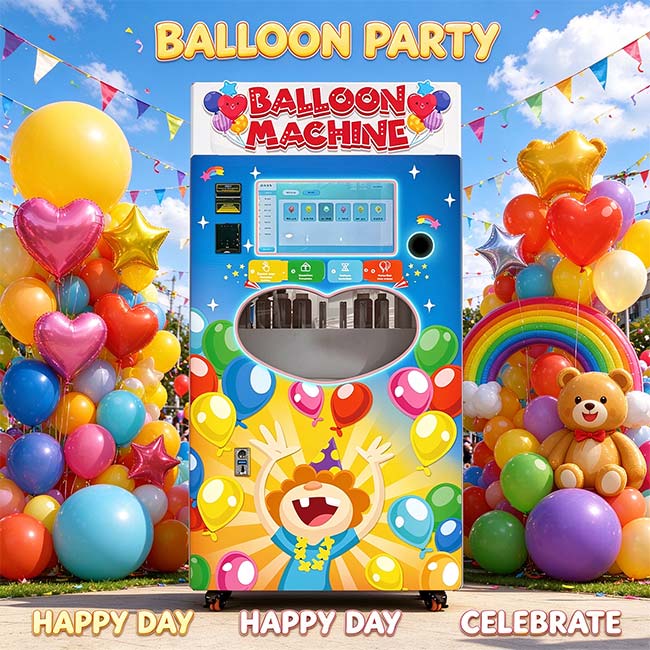
A toy balloon vending machine is a self-service robotic balloon maker. It stores balloon and stick combinations, lets a customer choose a design on a touchscreen, and then inflates that balloon inside a clear compartment. The finished balloon comes out with a stick attached, ready to carry.
This is different from a plain balloon inflator. An inflator only fills a balloon. A vending machine combines selection, payment, production, and dispensing in one unit, so it runs unattended 24/7. It also needs no helium because the balloons are filled with air. That removes a recurring supply cost and a safety permit issue.
How does a toy balloon vending machine work?
- The customer browses designs on the touchscreen.
- They pay by coin, cash, card, or QR code.
- The machine picks the matching balloon and stick from a slot.
- It inflates the balloon, seals it, and attaches it to the stick.
- The finished balloon drops into the pickup compartment.
The entire process is a small show. Kids like watching the balloon grow into a character, and that often turns a single purchase into an impulse buy for siblings. The production cycle on most newer machines is around 30 seconds, which keeps the line from building up.
Toy balloon vending machine vs helium tank vs balloon artist
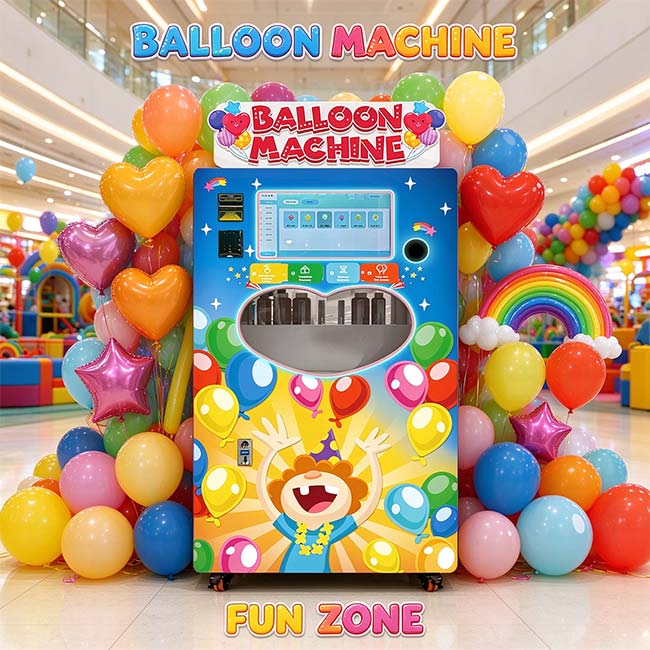
Before you buy, compare all three ways to sell character balloons. The table uses typical market ranges from supplier listings reviewed in early 2026.
| Option | Upfront cost | Cost per balloon | Labor | Uptime | Best for |
|---|---|---|---|---|---|
| Robotic balloon vending machine | $3,200 to $13,500 | $0.10 to $0.30 plus electricity and payment fees | No staff needed, just restocking | 24/7 | Malls, arcades, cinemas, family entertainment centers |
| Helium tank and staff | $500 to $2,500 for tank and supplies | $0.50 to $2.00 depending on helium cost | One trained staff member per shift | Business hours only | Stores with existing staff and counter space |
| Balloon artist | $50 to $150 per hour or $300 per event | $2.00 to $5.00 per sculpted balloon | Artist on site | Event hours only | Birthday parties, corporate events, festivals |
A vending machine wins on labor and hours. A human balloon artist wins on variety and complex designs. If you already pay counter staff, a helium tank might make sense. If you want a side business without payroll, a machine is usually the better fit.
What does a toy balloon vending machine cost in 2026?
New machines range from about $3,200 for a compact 6-slot unit to $13,500 for a large premium unit. The gap comes from capacity, screen size, payment hardware, and brand licensing.
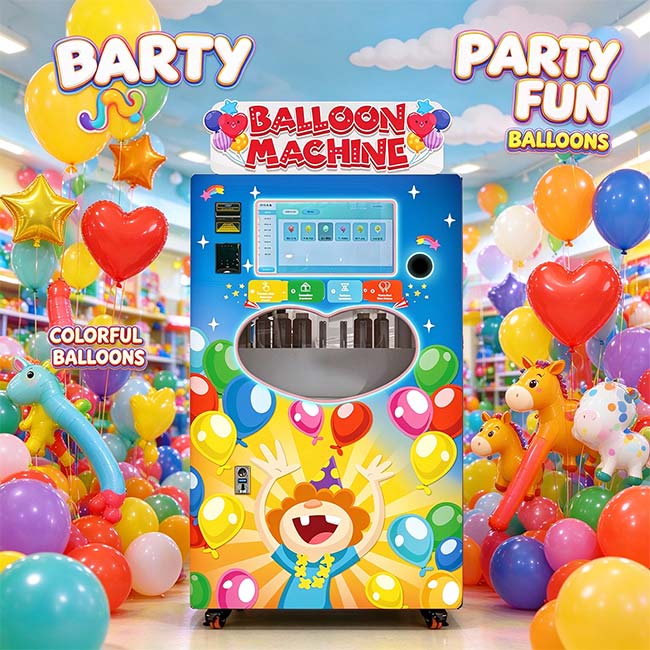
As a reference, the Wider Matrix WM688 is a 6-slot machine with a 21.5-inch touchscreen and a 360-balloon capacity. The single-unit reference price is $3,200. Add shipping and optional custom graphics, and you still stay below most premium units.
For a full price breakdown with different configurations, see our balloon vending machine price guide.
Total cost of ownership: beyond the sticker price
The purchase price is only the start. Budget for the following costs as well:
| Cost item | Typical range | Notes |
|---|---|---|
| Machine | $3,200 to $13,500 | Includes the kiosk, touchscreen, and payment system |
| Shipping and installation | $500 to $2,000 | Sea freight, liftgate delivery, and positioning add up |
| Venue revenue share | 10% to 20% of gross | Or a fixed monthly rent, depending on the location |
| Card processing fees | 2% to 4% of card sales | Payment platforms charge per transaction |
| Electricity | $10 to $30 per month | The WM688 max power is 250W, so running costs stay low |
| Balloons and sticks | $0.10 to $0.30 each | Bulk purchasing gets you closer to $0.10 |
| Restocking labor | $60 to $180 per month | One to three hours per week at $15 per hour |
Get a written delivery quote before you order. Check whether the price includes a liftgate, room-of-choice placement, and export packaging. A 110 kg machine can still be a challenge if your location has stairs or narrow doorways.
New machine vs used machine vs lease
Your cost depends partly on whether you buy new, buy used, or lease.
| Option | Upfront cost | Monthly cost | Pros | Cons |
|---|---|---|---|---|
| New machine | $3,200 to $13,500 | Only consumables and fees | Warranty, latest software, full customization, no hidden wear | Higher upfront |
| Used machine | $1,000 to $6,000 | Repair fund | Lower entry cost | Older payment hardware, no warranty, worn mechanics |
| Lease | Low or zero | $100 to $400 | Preserves cash | Total payments exceed purchase, contract lock-in |
Leasing is less common for balloon machines than for coffee machines. If a supplier offers it, compare the total lease payments with the purchase price. A tempting monthly rate can turn into a high effective cost over three years.
Is a toy balloon vending machine profitable? Sales scenarios
Let’s model three realistic sales levels. Assumptions: a $5 vend price, $0.30 per balloon and stick, 15% venue share, 3% average card fees, $15 per month electricity, and restocking labor at $15 per hour. These numbers line up with the operator feedback we receive on typical mall units: weekday sales of 5 to 20 balloons, with weekends two to three times higher.
| Scenario | Balloons per day | Monthly revenue | Monthly costs | Monthly profit | Payback on $3,200 |
|---|---|---|---|---|---|
| Low | 5 | $750 | $255 | $495 | 6.5 months |
| Mid | 15 | $2,250 | $675 | $1,575 | 2.0 months |
| High | 30 | $4,500 | $1,290 | $3,210 | 1.0 month |
At 15 sales per day, the machine spends about $675 a month and earns about $1,575 in profit. That payback assumes you purchased at the $3,200 reference price. A premium unit at $11,000 would take roughly 7 months in the same mid scenario.
These are planning figures, not guarantees. Actual sales depend on location, season, competition, and vend price. For a more detailed analysis with different price points, read our balloon vending machine profitability report.
How to increase daily sales
- Keep the glass clean and the machine lit. A dark or dirty machine reads as out of order.
- Set a round price in local currency. $3, $4, and $5 all work; avoid awkward coin change.
- Rotate designs seasonally. Santa, Easter bunny, and Halloween themes push impulse buys.
- Place a small sign showing the price and the show element. Let parents know it takes about 30 seconds.
- Track your best-selling slots and keep them full. If one design sells out, replace it with a similar theme.
Seasonal planning and holiday demand
Balloon sales are not even through the year. Weekends, school holidays, and holidays with character tie-ins drive the biggest spikes. Christmas, Easter, and Halloween can double or triple weekday sales. Plan your restock schedule and spare part inventory around those peaks.
During low season, lower your vend price to $3, run a buy-one-get-one promotion, or move the machine to a different venue. Keep cash reserves at two months of operating costs so a slow month does not force a fire sale.
What to look for before buying a toy balloon vending machine
When you compare models, focus on these specs:
- Capacity: 360 balloons means fewer restock trips than a 200-balloon unit.
- Slot count: six slots let you offer a true lineup of designs. Four or fewer limits your menu.
- Production time: customers will not wait forever. Look for a cycle around 30 seconds.
- Payment: coin and cash are not enough. Card and QR payment are table stakes in 2026.
- Power: choose a machine that runs on 110V to 220V and draws under 500W where possible.
- Footprint and weight: a 100 x 82 x 210 cm footprint fits in about one square meter, but check doorways and floor load.
- Remote management: a good app shows sales, inventory, and alarms so you do not visit blind.
- Warranty and support: one year is standard, but check response times and video guides.
- Customization: custom skin, logo, and balloon designs help the machine fit your venue.
Need a more practical walkthrough of self-service operation? See our self-service balloon vending machine guide.
Payment systems: why cashless matters
In 2026, a large share of vending transactions are cashless. A machine that accepts only coins and bills is leaving money on the table. Look for a payment stack that handles NFC, credit and debit cards, and QR codes.
The WM688 accepts coin, cash, credit card, and QR payment. That covers both tourists with cards and kids with coins. If you buy an older used machine, make sure you can upgrade the payment module later.
Balloon designs and licensing matters
Character recognition drives toy balloon sales. Kids ask for the exact design they know. Generic shapes still sell, but licensed characters such as Hello Kitty, Spiderman, or Batman usually perform better. You need to confirm your supplier owns the rights or has a licensing agreement. Selling counterfeit licensed balloons can get your machine removed from a mall.
Good suppliers update their design catalog. The WM688 supports custom shapes and designs, and the catalog can be updated over time. Ask for a written list of designs and confirm which ones are licensed for your region.
Balloon quality and material choices
The balloons you use affect the customer experience and your repair rate. Thick latex holds air longer and looks glossy. Cheap balloons wrinkle and pop more often. Foil balloons look premium but cost more and do not stretch into character shapes. For a toy balloon vending machine, latex is the standard choice.
Check the valve and the stick quality too. A weak stick bends under the balloon weight, and a stiff one can hurt a child’s hand. The WM688 is designed around a 25 x 60 cm balloon and stick combo that fits its automatic clamping system.
Ask your supplier for a sample batch before ordering thousands. Test how long the balloons hold air, whether the colors fade, and how the stick attaches.
Where should you place a toy balloon vending machine?
The best spots combine high foot traffic with a family audience. Shopping malls, amusement parks, cinemas, family entertainment centers, supermarkets, and event venues all work. In a mall, place it near the food court, cinema exit, or kids play area. In an amusement park, put it on the main path between rides.
Use 5,000 to 10,000 daily visitors as a rough starting point. You do not need every visitor to buy; you need a steady stream of parents with small children. Weekends and school holidays will make up a large share of sales, so plan restock trips around those peaks.
Talk to the venue manager about the contract. Ask about the revenue share percentage, whether you can move the machine if it underperforms, and who handles electricity and cleaning. A short trial period protects you until the numbers prove the spot.
Run a 30-day trial if the venue allows it. Track hourly sales through the machine app. If weekday sales stay below five balloons, the location may not pay off. Move the machine to another spot before signing a long contract.
For park-specific guidance, see our amusement park balloon vending buyer guide.
How to negotiate a fair venue deal
Venue managers have seen a lot of vending machines, so come prepared with numbers. Show them your expected daily sales and the revenue share you can afford. Offer a flat rent if the venue prefers predictable income, or a percentage if they want to share the upside.
Ask for a 30-day trial, the right to move the machine, and a renewal option based on performance. Avoid signing a one-year contract on a high rent without an exit clause. Most successful operators start with a simple revenue share and keep the contract short.
How to choose a supplier
When comparing suppliers, ask for a spec sheet, a video of the machine running, and contact details of other operators in your country. A supplier that cannot answer questions about spare parts, lead time, and warranty is a red flag.
Factory-direct manufacturers can usually offer better support because they control the hardware and software. Wider Matrix, for example, provides installation videos, remote app access, and 24-hour online support with every machine.
A closer look at the Wider Matrix WM688
The WM688 is one of the machines our team designs and builds. It is a compact, low-power unit with a large design menu, and its clear production window turns every sale into a mini performance.
| Spec | WM688 |
|---|---|
| Model | WM688 (6-slot) |
| Balloon capacity | 360 balloons (6 slots x 60) |
| Screen | 21.5-inch HD touchscreen |
| Dimensions | 100 x 82 x 210 cm |
| Weight | 110 kg |
| Power | 250W max, 110V to 220V |
| Payment | Coin, cash, credit card, QR |
| Management | PC and mobile app with sales, inventory, and alerts |
| Certifications | CE, ISO 9001, RoHS |
| Reference price | US$3,200 per unit |
The WM688 uses 25 x 60 cm balloon and stick combos, with 60 pieces per slot. It supports custom graphics and logo, and the balloon catalog can be refreshed over time. Wider Matrix has shipped 3,000+ vending machines to 130+ countries since 2016, and every WM688 includes a 1-year warranty, 24-hour online support, and installation and training videos.
If you want to dig into the full spec sheet, costs, and UK market notes, visit our WM688 specifications and profit guide.
Maintenance and troubleshooting
- Refill each slot with balloon and stick combos. On the WM688 that is 60 per slot.
- Wipe the exterior and touchscreen each week. Use a dry microfiber cloth.
- Clear jams as soon as they happen. A quick reset usually fixes a stuck balloon.
- Check inventory remotely before you drive to the location.
- Keep the machine away from direct sunlight and high humidity, which can make latex brittle.
- Schedule a monthly deep clean: door seals, sensors, payment slots, and the dispensing area.
Most repairs involve simple parts like hinges, sensors, or the clamping mechanism. A machine with remote diagnostics will tell you the error code before you arrive, so you can bring the right spare part.
Safety and compliance
Place the machine on stable, level ground. Keep electrical cords away from wet floors. Some venues require the machine to be anchored, especially where children gather. Check your local code for vending machine security requirements.
If you operate in the EU, look for CE marking. For other markets, ask for relevant certifications. Wider Matrix machines carry CE, RoHS, and ISO 9001, and the company can provide compliance documentation for export.
Risks to plan for
- Downtime kills revenue at holidays. Book maintenance ahead of peak weekends.
- Venue contract lock-in. Review the cancellation clause before signing.
- Competition. Another balloon machine or a kids entertainment startup can appear nearby.
- Seasonal dips. Sales drop on weekdays and outside holiday periods, so cash-flow your first quarter carefully.
- Theft and vandalism. Put the machine where staff and cameras can see it, and check your business insurance.
Common mistakes new operators make
- Choosing a location with foot traffic but no children.
- Buying a used machine without checking the card payment module.
- Ignoring venue revenue share until the first bill.
- Selling only generic designs in a market that wants characters.
- Restocking too rarely and losing weekend sales.
Avoid these and the business gets simpler. The machine is a retail product with a show, not a set-and-forget ATM. Regular attention keeps it profitable.
The bottom line
A toy balloon vending machine is a practical side business for high-traffic family venues. The low cost of goods, unattended operation, and short payback make it one of the more accessible vending opportunities in 2026. Choose a machine with enough capacity, modern payment, and remote management, then start with one location and track the numbers before expanding.
For a broader market overview, read our 2026 balloon vending machine roundup.
Frequently asked questions
How much does a toy balloon vending machine cost?
New machines typically cost $3,200 to $13,500. The Wider Matrix WM688 has a single-unit reference price of $3,200. A premium machine with a larger cabinet and more licensed designs will cost more.
Is a toy balloon vending machine profitable?
At a $5 vend price and 15 sales per day, the WM688 could return roughly $1,575 per month after materials, fees, electricity, and venue share. That puts payback at about two months. Results vary by location and season.
Does the machine use helium?
No. Toy balloon vending machines inflate with air. That removes helium refill costs and the need for gas cylinder permits.
How often do I need to refill it?
A 360-balloon machine at 15 sales per day lasts about 24 days, but you should restock weekly so you never run out during a busy weekend.
What maintenance does it require?
Weekly cleaning, jam clearing, and restocking. The smart app shows inventory and alarms, so you can plan visits instead of reacting. The WM688 comes with a 1-year warranty and online support.
Can I use my own balloons?
Custom balloon designs are available from most suppliers. Check that the balloon and stick size matches your machine. The WM688 uses 25 x 60 cm balloons and sticks, and the catalog can be updated.
Are latex balloons safe for children?
Latex balloons are a choking hazard for children under 8 and can trigger allergies in sensitive people. Place the machine where parents are present and do not market it to infants.
Do I need a permit to operate a toy balloon vending machine?
It depends on your city, venue, and business structure. Some municipalities require a vending license, a sidewalk permit, or a sales tax registration. Check with your venue manager and local business office before you buy.
What happens if the machine breaks down?
Most suppliers provide a 1-year warranty and remote diagnostics. The WM688 includes 24-hour online support, video guides, and spare parts. Keep contact details for your supplier handy and order spare parts before you need them.
What price should I charge per balloon?
The most common vend price is $3 to $5. At $5 with $0.30 material cost, the gross margin is strong. In high-income malls, $6 works. Test a price for two weeks and watch the sales count.