

Anyone looking into a high profit vending machine USA cotton candy is usually trying to figure out one thing: is it a real business or a marketing story? It can be real, but the profit comes from the location, the machine’s reliability, and how carefully you budget the costs that sit outside the machine itself. This guide walks through a full profit model, the expenses most sales pages skip, and the steps that actually get a machine placed in a good spot.
What makes cotton candy vending such a high-margin business?
Cotton candy vending starts with a simple economic advantage: the consumables are cheap and the finished product carries a retail price that feels like an impulse buy. A typical fully automatic machine uses roughly 28 to 30 grams of sugar per candy. When you add the paper stick and packaging, the direct cost of each serving stays low. The bigger expenses are the ones around the machine: rent or commission, electricity, card fees, maintenance, and your own restocking time.
That is why the phrase high profit needs context. A machine can have a strong gross margin on ingredients and still lose money if it sits in a location with no foot traffic, or if the location owner takes a large cut of every sale.
For a longer look at income potential, see how profitable a cotton candy vending machine is in the USA.
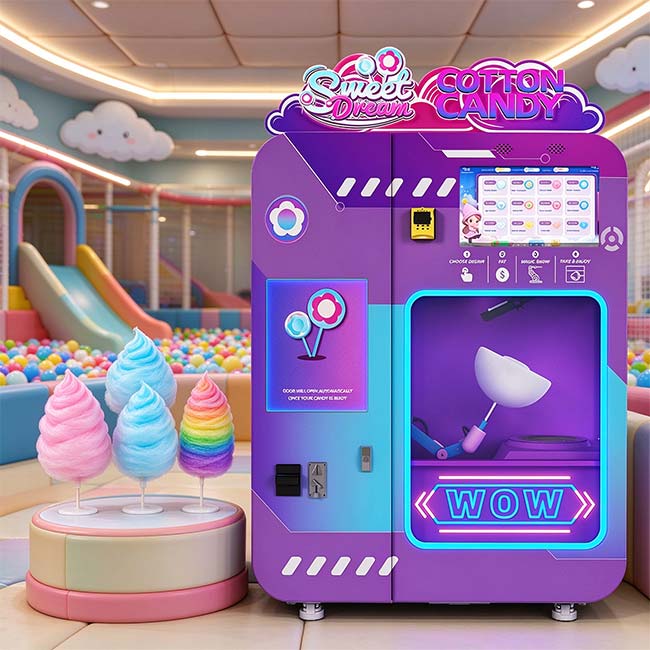
The cost breakdown most buyers see too late
Let’s build a complete cost picture. Start with the machine itself. For a fully automatic cotton candy vending machine, a factory-direct unit like the Wider Matrix WM980 has a single unit price of $4,800. The upgraded WM980+ is $4,999, and the outdoor WM668 is $5,299. For multiple units, contact the sales team for a personalized quote with volume discounts.
| Cost item | What to plan for |
|---|---|
| Machine | $4,800 for a widely used fully automatic model; larger outdoor versions run higher. |
| Shipping and import | Sea freight, port handling, customs, and last-mile delivery; get a door-to-door quote before you buy. |
| Location rent or commission | Often 10% to 30% of gross sales, sometimes with a minimum monthly fee. Fixed rent is riskier when sales are slow. |
| Electricity | A 3000W machine only hits peak draw while producing candy, but your monthly bill still depends on local rates and hours of use. |
| Payment processing | Card and NFC transactions cost about 2% to 4% plus a small per-transaction fee. Cashless sales usually raise revenue, so this fee is worth paying. |
| Maintenance and parts | Burner cleaning, robotic arm calibration, sugar refills, and occasional spare parts. A small repair fund keeps small problems from becoming long outages. |
| Permits and insurance | Food vending permits, sales tax registration, and liability insurance. Costs vary by state and municipality. |
If you want the full cost picture with more scenarios, check the ultimate guide to cotton candy vending machine costs and profitability in 2026.
Revenue scenarios: what 5, 10, 20, or 50 sales a day look like
No one can promise a daily sales number, especially before you have a location. The table below is a calculation model, not a guarantee. It uses a retail price of $4 per serving, a direct COGS of $0.30 per serving, a 15% location commission, 3% payment fees, and $160 per month for electricity, maintenance, insurance, and other fixed costs.
| Sales per day | Monthly revenue | Estimated monthly net profit | Payback on a $4,800 machine |
|---|---|---|---|
| 5 | $600 | $287 | ~17 months |
| 10 | $1,200 | $734 | ~6 to 7 months |
| 20 | $2,400 | $1,628 | ~3 months |
| 50 | $6,000 | $4,310 | ~1 to 2 months |
If the only price the market supports is $3, the same math changes quickly. At 5 sales per day, monthly net profit drops to about $164, which pushes payback toward 29 months. At 20 sales per day it still clears about $1,100 a month, so price testing matters.
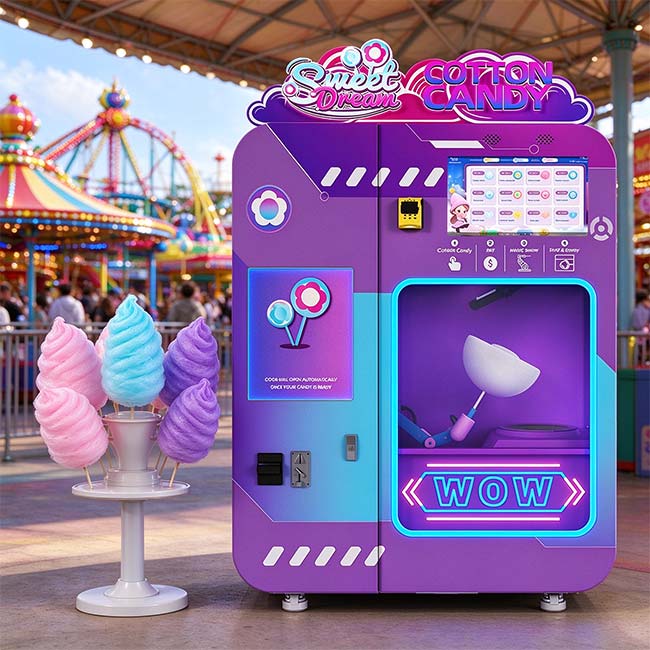
The hidden costs that quietly eat into profit
- Restocking labor: sugar tanks need refilling, paper sticks need loading, and the machine needs cleaning. If you value your time at $25 an hour, a weekly visit that takes 90 minutes is about $150 a month.
- Seasonality: outdoor locations, fairs, and tourist spots can have strong summer months and weak winter months. Indoor malls and theaters are steadier but still see dips.
- Machine downtime: a broken machine earns nothing. Ask the seller about spare parts availability, response times, and warranty coverage before you pay.
- Location risk: a venue owner can ask for a higher commission after they see you doing well. Get the terms in writing.
What to compare on a fully automatic cotton candy machine
Price alone is the wrong way to choose. The machine has to fit the venue, survive cleaning, and keep making consistent candy under constant use. Here is a baseline from the Wider Matrix WM980 so you know what to ask other suppliers to match.
| Spec | WM980 reference value |
|---|---|
| Dimensions | 132 x 195 x 67 cm |
| Net weight | 300 kg |
| Power consumption | 500W standby / 3000W during processing |
| Sugar consumption | 28 to 30 grams per candy |
| Candy designs | 36 designs, updated through system upgrades |
| Payment methods | Coin, cash, credit card, NFC |
| Single unit price | $4,800 |
What to look for in any machine:
- A sealed production chamber so people do not touch the candy before it is collected.
- A robotic arm that can shape different designs without hand assembly.
- Cloud monitoring so you can check sales, errors, and inventory from your phone.
- Clear after-sales support, including video guides and spare parts.
For a shopping checklist, see this no-nonsense buyer’s guide for cotton candy vending machines for sale in the US.
How to actually land a good location
- Make a list of venues where people wait or wander: malls, movie theaters, arcades, zoos, stadium concourses, family entertainment centers, and festival grounds.
- Start with a revenue share offer, not a fixed rent. Something like 15% of gross sales gives the venue owner a reason to say yes without putting all the risk on you.
- Ask for a trial period of 30 to 60 days. Commit to reviewing sales together and keeping the machine clean.
- Get written confirmation on the exact spot, power access, storage space, hours you can service the machine, and what happens if the machine needs repairs.
- Track everything from day one. Foot traffic counts, busy days, weather, and best-selling designs all help you negotiate a better spot later.
For the full startup route, read how to start a cotton candy vending machine business in the USA.
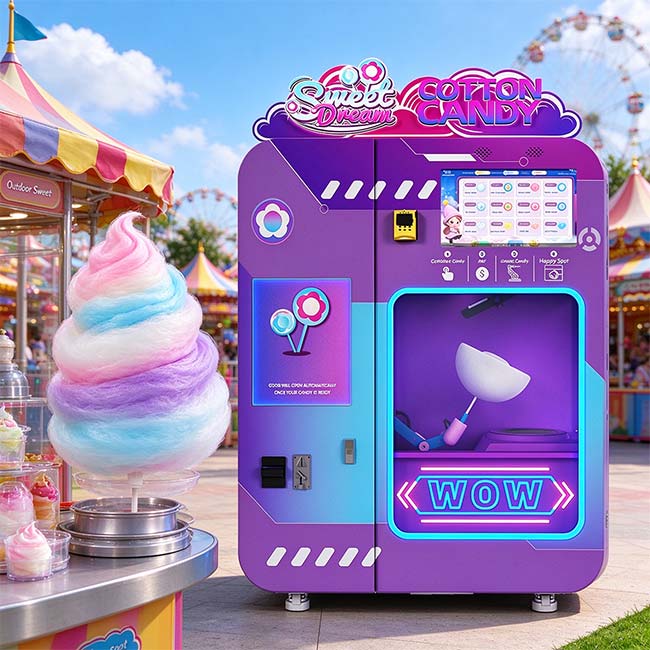
US rules you need to check before you plug in
Selling food through a vending machine is a regulated business in most of the United States. The rules are local, not national. Contact the city or county health department where you plan to operate and ask about:
- Food vending permits or mobile food establishment licenses.
- Health department inspections for the machine and its ingredients.
- A resale or sales tax permit for collecting state sales tax.
- Liability insurance if the venue manager asks for a certificate of insurance.
Some states treat cotton candy as a low-risk food item, but they still require a license. A few calls to local offices will save you from a costly surprise after the machine arrives.
Risk check: when the math stops working
The most common reason a cotton candy vending machine underperforms is not the machine. It is a bad location with high rent, no impulse traffic, or a commission structure that leaves you with nothing. The second reason is downtime; a machine that jams or waits for parts kills profit faster than electricity costs.
Before you commit, run the worst-case numbers. If the machine sells only 3 servings a day at $4, you still have costs. Make sure the location allows you to move the machine somewhere else if it does not work.
The Wider Matrix option: one factory-direct reference
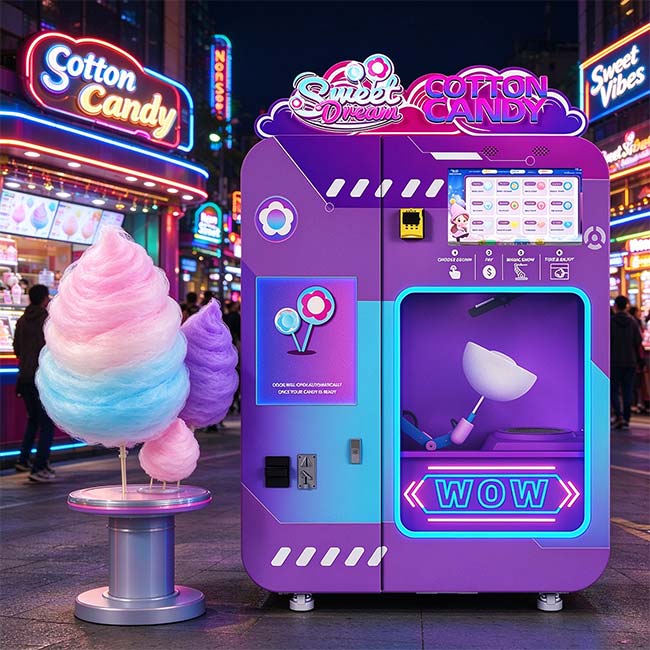
Wider Matrix has been building vending machines since 2016 and has shipped more than 3,000 machines to over 130 countries. For cotton candy specifically, the WM980 is the fully automatic model. It uses a 4-DOF robotic arm, an auto-cleaning burner, and a magnetic door lock that keeps the production window secure while the candy is being made. The machine also has a cloud control system for remote monitoring and a multi-language display.
These are not claims every supplier can prove, so ask the same questions we listed above before you buy any machine.
Final take
A cotton candy vending machine can be a high-profit business in the US if you treat it like a location-based investment rather than a cash machine. Start with conservative numbers, choose a machine with low downtime and remote monitoring, negotiate a revenue share, and get local permits sorted before you buy the machine.
If you want another operator’s view on the risks, read this honest breakdown of cotton candy vending profitability.
FAQ
Is cotton candy vending profitable in the USA?
Yes, in the right location. The per-serve cost is low and the retail price is high, but the real profit only shows up when the machine gets steady foot traffic and the overhead costs stay controlled.
How much does a cotton candy vending machine cost?
A fully automatic machine like the Wider Matrix WM980 has a single unit price of $4,800. The upgraded WM980+ is $4,999, and the outdoor WM668 is $5,299. Shipping, taxes, and any venue fees come on top.
How long does it take to pay back?
At 20 sales per day, the calculation model above shows about 3 months on machine cost alone. At 5 sales per day, it can take over a year. The answer depends on pricing, location terms, and operating costs.
What permits do I need?
Usually a food vending permit, sales tax registration, and sometimes liability insurance. Contact the city or county health department in the city where the machine will operate.
What should I look for in a used machine?
Check the burner, robotic arm, sugar tanks, and payment readers. Ask for maintenance history and spare parts availability. A used price is only a deal if the machine does not sit broken for weeks.
Can I run it as a passive business?
A single machine still needs restocking, cleaning, and monitoring. Remote management features make it easier to handle from your phone, but someone has to visit the machine regularly.