

Most mall visits do not start with a balloon on the shopping list. A child spots a bright machine, a parent gives in, and the sale happens on the spot. That is the simple case for a mall balloon vending machine: it turns foot traffic that already exists into small impulse purchases, with no counter staff and no helium tank. A realistic six slot unit like the Wider Matrix WM688 costs about $3,200 factory direct, stores 360 balloons, and earns back its cost only when the location pulls enough family traffic and the operator keeps rent, venue share, and refill costs under control.
What a mall balloon vending machine actually does
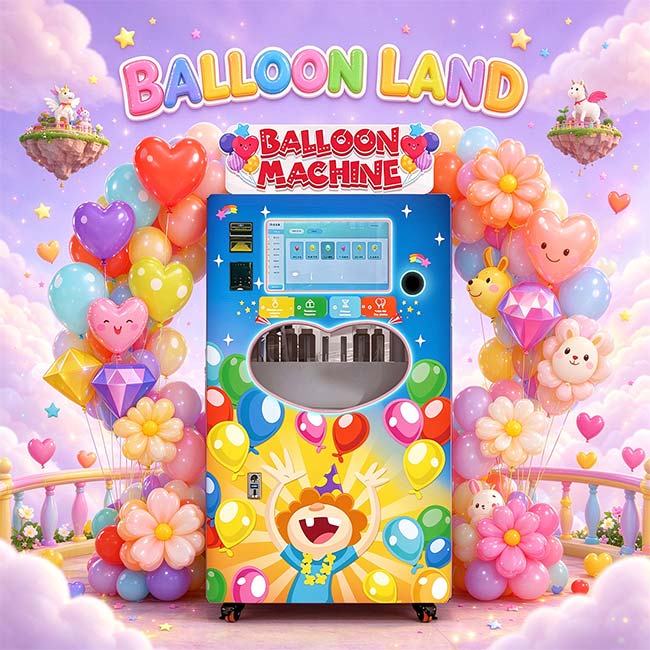
These machines sell latex or foil balloons mounted on sticks. The customer picks a design on a touchscreen, pays with cash, card, or a mobile wallet, and watches the machine inflate and tie the balloon inside a transparent chamber. The finished balloon drops into a delivery port. There is no helium tank or pump rental, and no employee needs to stand at a cart.
The process itself is part of the product. Kids stop to watch the mechanical arm work, which lengthens the moment a parent can say yes. A connected machine can send sales and inventory alerts to your phone, which is what operators usually mean by a smart balloon vending machine. The screen also plays advertising when idle, so the unit can earn a little extra from local sponsors.
Why malls work, and why some malls do not
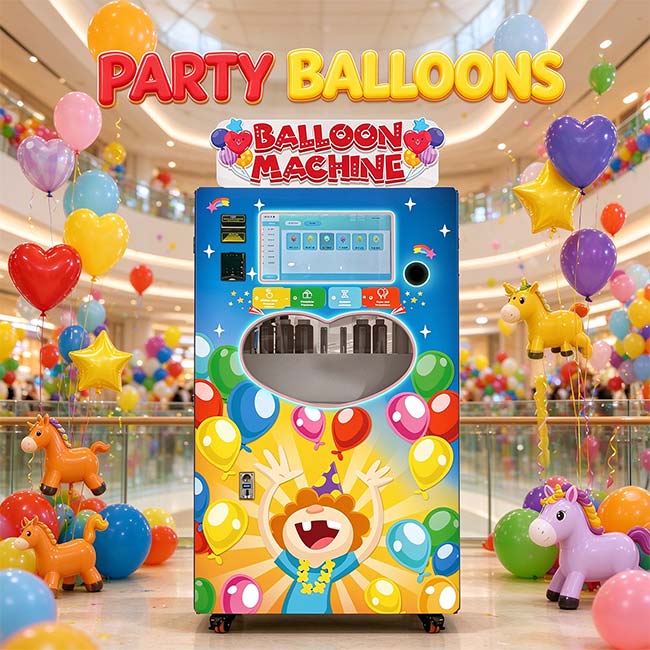
Malls give balloon vending the two things it needs most: visitor counts and children. The catch is placement. A machine near a food court, children’s play area, or main entrance can outsell one in a quiet corridor by a wide margin even when the visitor numbers are the same.
Look for a spot with at least 5,000 daily visitors, clear sight lines, and parents who naturally pause. Ask the mall team for foot traffic counts by hour, not just a monthly total. A unit that sells 8 or 10 balloons a day in the wrong spot can do 30 or 40 in the right one, and that gap is mostly placement.
Mall management also cares about appearance and maintenance. A clean, lit, custom wrapped machine is easier to negotiate into a prime position than a bare metal box. The same placement logic carries over to theme parks and family entertainment centers, which a separate amusement park buyer’s guide covers in more detail.
What you actually pay before the first sale
The machine price is only part of the number. Build a full cost picture so the payback estimate does not surprise you later.
| Cost item | Typical amount | Notes |
|---|---|---|
| 6 slot machine with 360 balloon capacity | US$3,200 | Factory direct reference price for the WM688. Multiple units get volume pricing from the manufacturer. |
| Balloons and sticks | US$0.10 to US$0.30 per piece | Small orders cost more; 10,000 plus costs less. |
| Shipping, customs, taxes | Varies by country | Ask for a landed quote that includes delivery to the mall. |
| Venue rent or revenue share | Varies | Fixed rent, percentage of sales, or a minimum plus percentage. |
| Electricity | Low | The WM688 draws 250W max, similar to two monitors. |
| Payment processing | 2% to 5% of card and QR sales | Cash sales avoid most of this. |
| Maintenance reserve | Small monthly amount | Balloon jams and worn parts eventually happen. |
If you operate in California, the California price breakdown walks through state specific costs and taxes.
Revenue scenarios for a mall location
Use these numbers as planning ranges, not promises. A good mall spot might sell 15 to 30 balloons a day. A slow corridor might produce 5 to 10. Most operators price balloons between $4 and $6.
| Scenario | Sales per day | Price | Monthly gross revenue | Gross margin before venue costs |
|---|---|---|---|---|
| Slow spot | 8 | $4 | $960 | 70% to 85% |
| Average mall spot | 18 | $5 | $2,700 | 75% to 88% |
| Strong family zone | 35 | $6 | $6,300 | 80% to 90% |
Gross margin here means after the cost of balloons and sticks, before rent, revenue share, and payment fees. The rough math works this way: if a machine nets $20 a day after every cost, it pays off a $3,200 machine in about 5 months. At $40 a day, around 3 months. At $8 a day, the numbers stop working.
Seasonality matters too. Weekends, school holidays, and mall promotions can triple sales, while January weekdays can be quiet. A monthly average hides these swings, so run the payback math on a worst month, not a best month.
The Wider Matrix WM688 at a glance
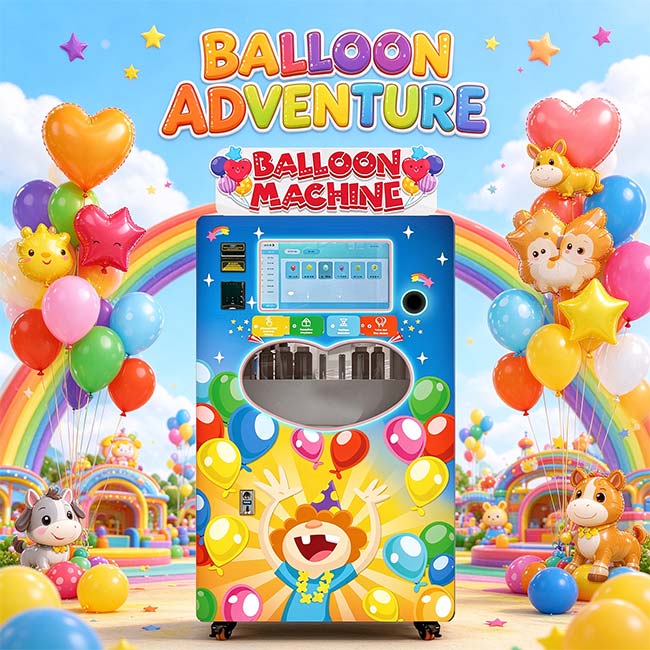
We manufacture a machine built for exactly this setting, the WM688. It is a six slot unit with room for 360 balloons, a 21.5 inch HD touchscreen, and a transparent production chamber that turns inflation into a small show. The single unit reference price is US$3,200, and the machine is available through the WM688 for sale page.
| Specification | Detail |
|---|---|
| Model | WM688 |
| Balloon capacity | 360 balloons, 6 slots of 60 |
| Screen | 21.5 inch HD touchscreen |
| Power | 250W max, 110V to 220V |
| Dimensions | 100 x 82 x 210 cm |
| Weight | 110 kg |
| Payments | Coin, cash, credit card, QR |
| Remote management | PC and mobile app with sales, inventory, and alarm alerts |
| Warranty | 1 year |
Balloon designs drive repeat sales. The catalog includes cartoon characters, animals, and seasonal shapes, and Wider Matrix keeps updating it. A machine with current designs will outsell one with stale stock. Custom graphics, packaging, and logo options let the unit blend into the mall or act as a branded attraction.
Wider Matrix has built vending equipment since 2016 and has shipped more than 3,000 machines to over 130 countries. For an operator, that experience matters most for spare parts, software updates, and after sales support. The manufacturer and supplier page has the full factory spec and contact details.
Flat rent or revenue share: negotiate the deal first
Malls usually offer one of two deal structures. Flat rent keeps the monthly cost predictable but hurts in slow months. A percentage of sales protects the operator early on but can be expensive once the machine takes off. Some malls ask for a base minimum plus a percentage above a threshold.
- Ask for pedestrian counts for the exact spot, not the whole mall.
- Get the placement, power access, and cleaning duties in writing.
- Push for a short initial term, such as six months, with an option to move or expand.
- Clarify who pays payment terminal fees and whether the lease covers insurance.
- Confirm noise restrictions, if any, and how the machine should look.
Families are the core audience, and some operators target a younger crowd with specific designs. A kids balloon vending machine guide covers what both operators and parents should think about.
Day to day operations: refills, jams, and remote checks
The machine runs 24/7, but it still needs a small amount of attention. With 360 balloons and 20 daily sales, a full load lasts about 18 days. Popular designs sell out sooner, so remote inventory alerts matter more than the total capacity.
Balloon jams happen from time to time, usually caused by a damaged balloon or a misloaded slot. A short visit clears it. Payment readers need occasional cleaning, and the glass should stay clear so the chamber stays visible. The WM688 remote app shows sales, inventory, and alarms, so most problems surface before they become a lost sale.
Balloon vending vs the alternatives in a mall
It helps to compare the machine against what the mall might already be considering.
| Option | Upfront cost | Labor | Open hours | Main risks |
|---|---|---|---|---|
| Balloon vending machine | About $3,200 | Restock and cleaning only | 24/7 | Balloon jams, design popularity |
| Staffed balloon cart | Cart, inventory, wages | High | Staff shifts | Labor cost, slow periods |
| Helium balloon stand | Helium tank, canopy, permits | Medium to high | Staff shifts | Helium cost, floating balloons, fire rules |
| Cotton candy or snack vending | Machine plus ingredients | Restock and cleaning | 24/7 | Perishable stock, prep time |
Balloon vending carries the lowest consumable cost per sale of these options, but its ceiling is tied to how many families pass the machine. The other options can justify a higher price per item, but they bring more daily work.
What to check before you buy
- Capacity and slots. Six slots with 360 balloons gives enough variety without constant refills.
- Screen size. A 21.5 inch screen is easier to read and leaves room for ad space.
- Power draw. Lower wattage keeps the electricity bill small and fits more outlets.
- Payment options. Card and QR are essential in malls; coin and cash help in some markets.
- Transparent chamber. Seeing the inflation process is what draws kids in.
- Remote management. Check inventory and alarms from your phone.
- Certifications. Look for CE, ISO 9001, and RoHS.
- Spare parts and support. Ask how quickly replacement parts ship and what the warranty covers.
Ask the supplier for a list of operators in comparable venues. A manufacturer with years in the market should be able to answer questions about restocking, balloon quality, and software updates without hesitation.
Local rules and permits
A stick balloon machine is simpler than helium because there is no gas cylinder, but local rules still apply. Check whether the mall requires a business license, liability insurance, or a vending permit. Fire and electrical codes may require a certified machine, a grounded outlet, or clearance from exits. For markets with specific guidance, the UK rules and cost summary is a useful starting point.
The bottom line
A mall balloon vending machine is a simple business with one unforgiving variable: location. When the machine sits where families linger, the numbers work. When it sits in a quiet corridor, no feature or spec saves it. Buy from a manufacturer with certifications, spare parts, and honest operating cost answers. Negotiate the lease like every percentage point matters. The machine will do the rest quietly.
Frequently asked questions
How much does a mall balloon vending machine cost?
A six slot machine with 360 balloon capacity like the WM688 lists around US$3,200 for a single unit. Shipping, taxes, a venue deposit, and setup add to that total. Multiple units come with volume pricing, so contact the manufacturer for a quote.
Do balloon vending machines use helium?
No. They use latex or foil balloons attached to sticks. The machine inflates and closes the balloon automatically, which removes helium costs and most ceiling related fire hazards.
How many balloons can a mall machine hold?
A typical six slot machine holds 360 balloons, with 60 in each slot. That is enough for roughly two to three weeks of average sales before a full restock.
How much can a mall operator realistically earn?
At 15 sales a day with a $5 price, monthly gross revenue is about $2,250. After balloons, venue costs, and fees, the operator might keep around $1,400 to $1,700. At 30 sales, gross revenue is about $4,500, and operator take might reach $2,800 to $3,500. These are planning ranges, not guarantees.
What happens when a balloon jams?
A jam usually comes from a damaged balloon or a poorly loaded slot. The machine stops and sends an alarm through the remote app, and the operator clears the damaged balloon before restarting. Prevent most jams by loading balloons carefully and using balloons from a reliable supplier.
Are balloon vending machines better than a staffed balloon stand?
They are different businesses. A machine removes labor, works longer hours, and keeps costs predictable, but it cannot customize a balloon on request or talk to a customer. A staffed stand can sell higher prices and handle special requests, but wages and scheduling eat into profit quickly.