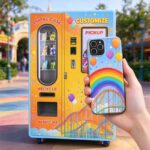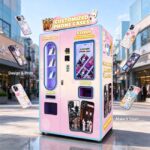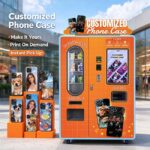


If you have seen a self-service kiosk print a personal photo onto a phone case while the customer watches, you already know why photo phone case vending machines are gaining space in malls and tourist spots. They turn a routine accessory purchase into a quick, personal keepsake with no staff on the payroll. A photo phone case vending machine is a self-service kiosk that prints a customer’s uploaded photo directly onto a phone case in 1 to 3 minutes, and with a solid location it can pay for itself within the first year. This guide covers how the machine works, what it costs to buy and run, how much profit to expect, and what to check before you commit.
What Is a Photo Phone Case Vending Machine?
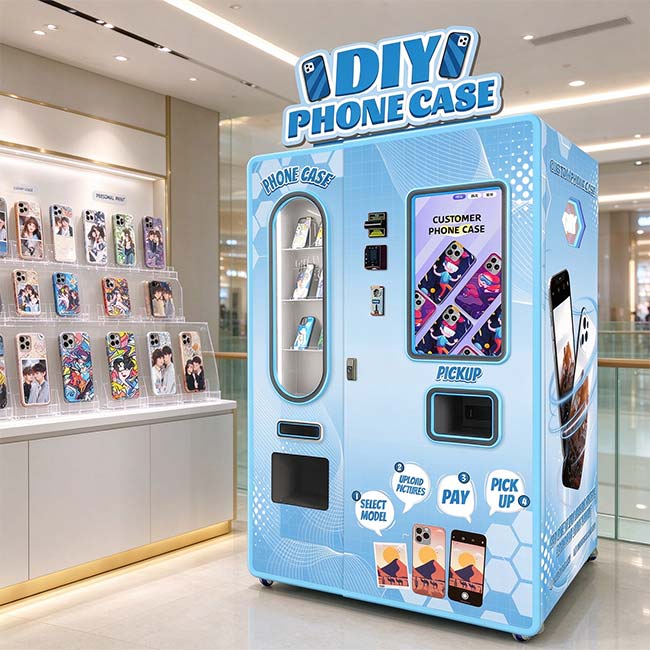
A photo phone case vending machine combines a touchscreen kiosk, an industrial UV printer, and a storage system filled with blank cases. The customer picks their phone model, uploads a photo or chooses a template, pays, and waits a couple of minutes while the machine prints the image directly onto a TPU+PC case. In most machines the case is cured under UV light and then dispensed through a slot.
If you want to see the full customer journey, read what a custom photo phone case vending machine actually does. The short version is that the system removes the need for a staffed kiosk and lets one operator run machines in several locations at once.
How Does the Process Work, Step by Step?
Most photo phone case machines follow the same four-step flow, although the interface changes from brand to brand.
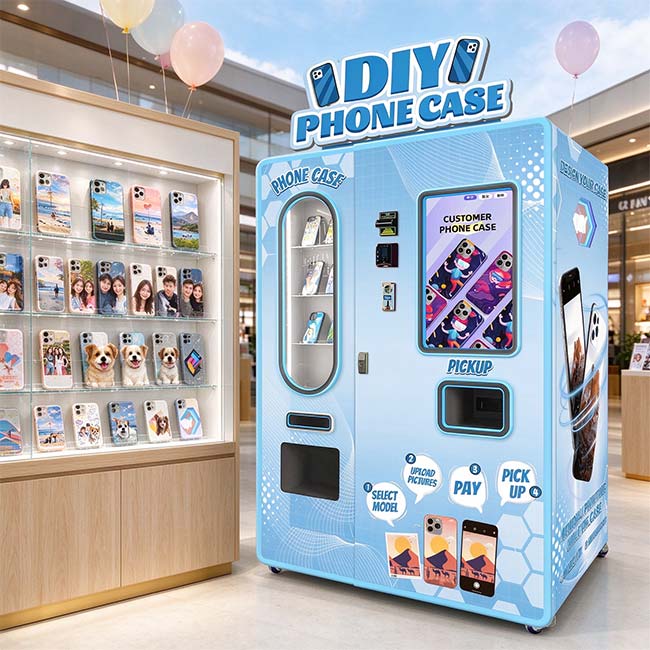
- The customer scans a QR code on the machine screen or waits for the touchscreen to prompt them.
- The machine asks for the phone model. Popular models like iPhone, Samsung, Google Pixel, Xiaomi, Huawei, and OPPO are usually listed on the screen.
- The customer uploads a photo. Some machines offer templates, filters, and AI-based background removal.
- After payment, the machine starts printing. The photo is printed, cured, and the case drops into the dispensing tray.
The full print cycle usually takes 1 to 3 minutes. The Wider Matrix WM880 uses visual recognition to position the image on the case, which avoids white borders and keeps the print aligned on the lens cutout.
How Much Does a Photo Phone Case Vending Machine Cost?
Machine prices range from about $4,000 to $25,000 depending on print technology, capacity, and brand. The Wider Matrix WM880 sits on the budget end of that range: the base F1080 version is US$4,999 per unit, and the faster i1600 version is US$5,999 per unit. Both prices apply to single-unit orders. For orders of multiple units, contact our team for a personalized quote with volume discounts.
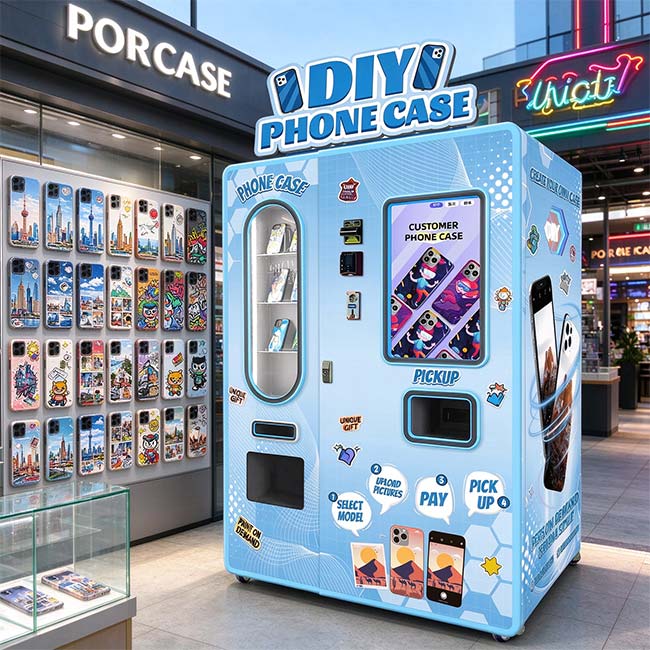
Shipping and installation are separate, and you should budget for site preparation like a power point and internet access. The WM880 runs on 110V to 220V, consumes 410W, and measures 1340 x 990 x 2170 mm. It weighs 380 kg, so delivery needs a ground-floor entrance or a freight elevator.
To see how this price fits into a full startup budget, read our guide to personalized photo phone case vending machines.
What Do You Spend Per Case?
Ongoing costs are just as important as the machine price. The table below uses standard WM880 consumables from the manufacturer.
| Consumable | Price |
|---|---|
| Blank case, 1,000 pcs | US$1.30 / pc |
| Blank case, 5,000 pcs | US$1.20 / pc |
| Blank case, 8,000 pcs | US$1.10 / pc |
| Magnetic case, 1,000 pcs | US$2.30 / pc |
| Magnetic case, 8,000 pcs | US$2.10 / pc |
| Epson UV hard ink, standard 4 colors | US$100 / set |
| Epson UV hard ink, F1080 6 colors | US$160 / set |
With a standard case at $1.10 and ink at around $0.20 to $0.40 per print, your consumable cost lands between $1.30 and $1.50 per case. Add a little for electricity, payment processor fees, and location rent, and you can still keep total cost under $3.00 per case even at moderate volumes.
How Much Profit Can a Photo Phone Case Vending Machine Make?
Retail prices in malls and tourist locations usually sit between $12 and $25 per case. A quick scenario shows why the business model works.
Assume you sell 10 cases a day at $14 and your loaded cost is $2 per case. You clear $120 a day, or about $3,600 a month, before location costs. At that rate a $5,999 machine pays for itself in about two months. Add rent and other overhead, and a realistic payback period is usually 6 to 12 months in a decent location.
| Daily sales | Average price | Monthly revenue | Gross profit before location costs |
|---|---|---|---|
| 5 cases | $14 | $2,100 | $1,800 |
| 10 cases | $14 | $4,200 | $3,600 |
| 15 cases | $16 | $7,200 | $6,300 |
| 20 cases | $16 | $9,600 | $8,400 |
These numbers are estimates, not promises. Foot traffic, seasonal peaks, and your ability to keep the machine running all change the outcome. For a deeper look at revenue drivers, see our article on the phone case vending machine with photo upload feature.
Where Should You Put the Machine?
Location matters more than anything else. You need a consistent flow of people who are willing to wait a few minutes and spend on impulse.
- Malls and shopping centers: high weekend traffic and a built-in audience of shoppers.
- Tourist attractions: visitors buy souvenirs without checking prices online first.
- Universities: students like personalization, and price points under $20 work well.
- Cinemas, arcades, and game centers: people are already in entertainment mode.
- Airports and transit hubs: high foot traffic, but space and dwell time are tight.
The WM880 needs about 1.3 by 1 meter of floor space and 2.2 meters of clearance. It also needs a grounded power outlet and a Wi-Fi or Ethernet connection if you want remote monitoring. Before you sign a lease, spend a few weekday and weekend hours counting how many people walk past the spot.
Cloud-based machines let you check sales and inventory from your phone, which is covered in this guide to WiFi phone case vending machines.
Photo Phone Case Vending Machine vs Staffed Kiosk vs Desktop Printer
Before you commit, it is worth comparing the full self-service route with a lighter setup.
| Factor | Photo case vending machine | Staffed kiosk | Desktop printer kit |
|---|---|---|---|
| Upfront cost | $5,000 to $10,000 | $2,000 to $5,000 plus wages | $500 to $2,000 |
| Labor | None, restock only | 1 to 2 staff | Your own hours |
| Daily capacity | High, limited only by print cycle | Limited by counter speed | Very low |
| Operating hours | 24/7 | Business hours | Only when you are present |
| Print quality | Industrial UV printer | Consumer printer | Consumer printer |
| Scalability | Add another machine | Hire more staff | Not realistic |
If your goal is a side income in a public location, a vending machine wins on labor and hours. A desktop printer only makes sense if you are testing demand without committing to a machine.
What to Check Before You Buy
Not all photo phone case machines are equal. The cheapest unit can become the most expensive if the print head fails or the software stops receiving phone model updates. Use this checklist when you compare suppliers.
- Phone model database. Does the machine cover current iPhone, Samsung, and Pixel models? Does the supplier push updates? The WM880 supports new releases and a broad range of brands.
- Print head quality. An industrial Epson print head is a good baseline. The WM880 offers F1080, i1600, and i3200 options with a lossless upgrade path.
- Internal capacity. More blank cases in the machine means fewer restocking trips. The WM880 stores around 1,020 cases, or 1,025 on the i1600 version.
- Remote management. You want to see sales, inventory, and printer alerts from your phone. The WM880 includes cloud management, and an optional inventory camera costs US$200.
- Warranty and support. One year warranty and 24/7 online support is standard for Wider Matrix. Ask about spare parts availability and response time before you order.
A Closer Look at One Popular Machine: Wider Matrix WM880
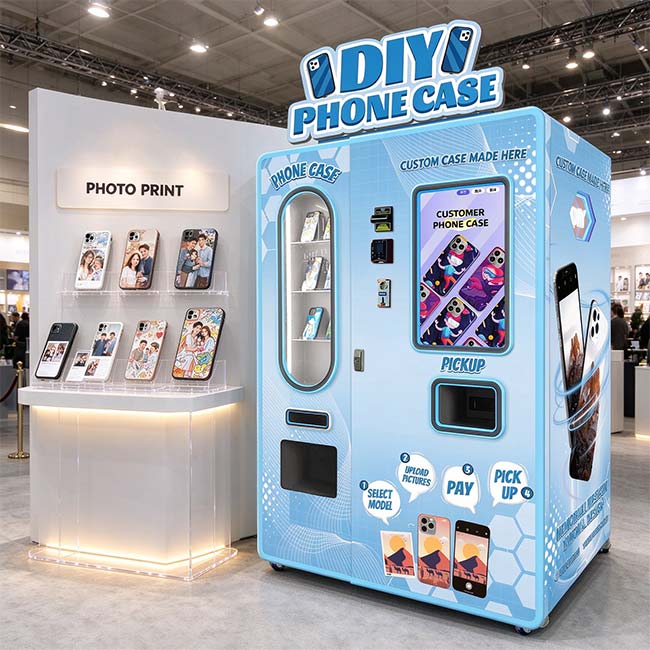
If you are comparing specific products, the Wider Matrix WM880 is worth putting on your shortlist. It is a photo phone case machine with a 1340 x 990 x 2170 mm cabinet, a 2,000 ml ink capacity, and support for coin, cash, credit card, NFC, and QR payment. The standard i1600 version prints faster than the base F1080 and can be upgraded later to the i3200 print head if your volume grows.
Wider Matrix is not a newcomer. The company was founded in 2016, focuses on vending machine R&D, and has shipped more than 3,000 machines to over 130 countries by September 2024. Their machines carry CE, UKCA, RoHS, KC, BRC, Kosher, and HALAL certifications, which helps if you are buying from overseas.
For more background, see the custom phone case vending machine guide for a broader view of the market.
Common Mistakes to Avoid
- Choosing a machine by price alone. A slow printer or poor software support will cost you more in the long run.
- Ignoring foot traffic data. A weekend visit by the site owner is not enough. Count people on weekday mornings and weekend evenings.
- Pricing too low or too high. $10 feels cheap for a product that costs $1.50 in materials, while $30 may scare off impulse buyers.
- Forgetting about payment processor fees. They can eat 3 to 5 percent of every transaction.
- Buying without checking phone model compatibility for the next two years. Older machines may not have a database for new releases.
Frequently Asked Questions
How long does it take to print a phone case?
Most photo phone case machines take 1 to 3 minutes for the full print and cure cycle. The Wider Matrix WM880 in the i1600 version is about three times faster than the base F1080, so high-traffic venues should choose the faster print head.
Is a photo phone case vending machine profitable?
It can be, in the right spot. At 10 sales a day with a $14 average ticket and $2 per case cost, you are looking at about $3,600 a month before location costs. After rent, electricity, and maintenance, a realistic payback period is 6 to 12 months.
What phone models are supported?
Most machines support the latest iPhone, Samsung, Google Pixel, Xiaomi, Huawei, and OPPO models. Ask the supplier how often the model list is updated and whether older models stay available.
How durable are the printed cases?
The cases are made from TPU and PC, and the image is cured with UV light. That makes the print resistant to scratches and daily wear, though how long it lasts depends on the case quality and how the owner treats the phone.
Can customers upload any photo?
Yes, that is the main selling point. You should still set a policy for copyrighted characters and logos so you are not surprised by a takedown request.
Does the machine need daily maintenance?
No. The routine work is refilling blank cases, topping up ink, and cleaning the print head. The WM880 has an optional inventory identification camera that alerts you when a slot is low, which cuts down the number of restocking visits.
Final Thoughts
A photo phone case vending machine can be a strong source of passive income, but it is not a guaranteed win. The machines that perform well are in high-traffic locations, priced fairly, and backed by a supplier that updates phone models and supports you when something breaks.
Start with a simple spreadsheet. Put in the machine price, expected daily sales, average ticket, blank case cost, rent, and payment fees. If the numbers still work at a cautious sales estimate, you have a real opportunity. Then contact a supplier, ask for references, and test the machine before you sign.