


Amusement park operators lose money every time a snack stand closes during peak hours. A popcorn vending machine for amusement parks fixes that. It runs through the lunch rush, the evening surge, and the shoulder season when staffing is thin. The WM680 from Wider Matrix pops fresh kernels in 120 seconds, takes five payment types, and costs $1,800 per unit. If you are planning a park installation and want real numbers on placement, throughput, and payback period, this article walks through all of it. Send Wider Matrix your park specs and they will quote you directly.
I spent three seasons consulting for a mid-sized theme park in the Midwest. One of the things that drove the operations director crazy was the popcorn stand near the roller coaster. It was staffed by two people during peak hours, closed when the park was slow, and had a line of thirty people every time a ride let out. The popcorn was good. The business model around it was not.
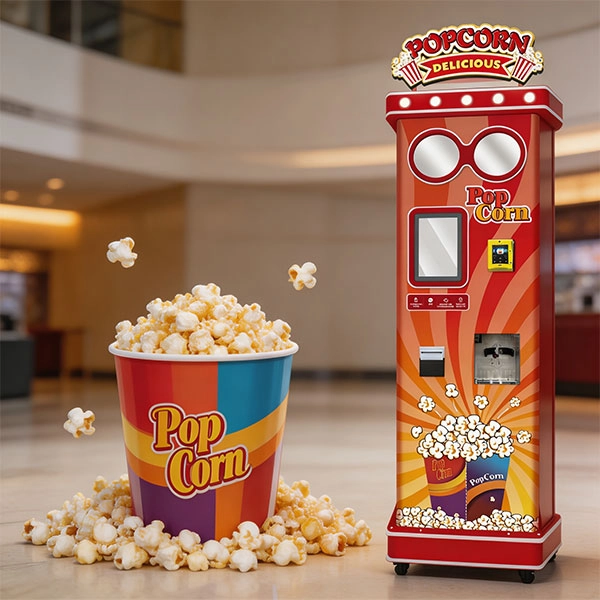
One afternoon he asked me if a popcorn vending machine for amusement parks was a real thing or just a novelty. I told him it was real, but that most of the machines on the market were built for shopping malls and train stations, not for environments where 400 people empty out of a ride area at the same time. That distinction matters. A lot.
This article is for park operators, concession managers, and vendors who are evaluating whether a popcorn vending machine belongs in their amusement park. I will cover what the machine needs to handle, what the WM680 from Wider Matrix does well and where it has limits, how to think about placement inside a park, and what the revenue math looks like when you plug in real attendance numbers.
Why popcorn specifically works in an amusement park
Popcorn has three things going for it in a park setting. The smell travels. The margin is high. And the production process is visual, which means people stop to watch the kernels pop and then buy a cup because they are already standing there.
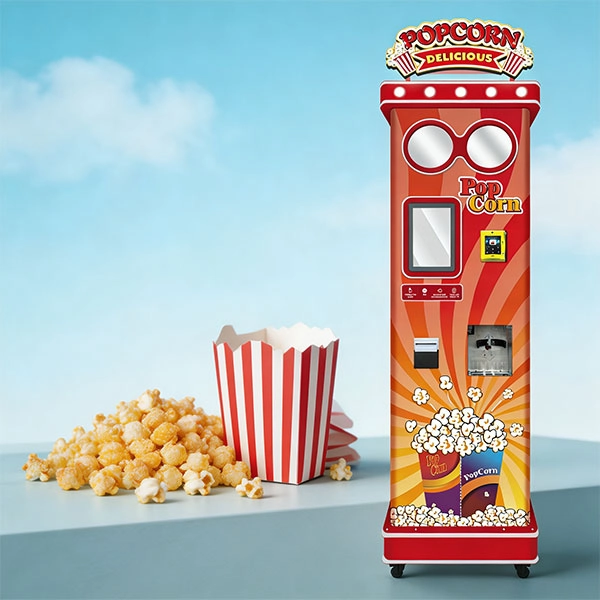
The smell factor is bigger than most people think. I have watched foot traffic patterns shift when a popcorn machine turns on. People who were walking toward a different attraction would literally change direction. That does not happen with pre-packaged snacks sitting behind glass. A fresh popcorn vending machine produces that smell on demand, every 120 seconds, without anyone scooping kernels into a kettle.
The margin comes from the ingredient cost. Dry corn kernels are cheap. A 5.6 kg load, which is what the WM680 holds, produces roughly 140 servings at 40 grams per cup. The cup costs $0.12 at the 1,000-unit tier. The corn and flavoring add a few cents. You sell the cup for $4 to $6 depending on the park. The math works even if attendance is mediocre.
What an amusement park demands that other venues do not
A popcorn vending machine in a shopping mall gets a steady trickle of customers throughout the day. A machine in an amusement park gets hammered in bursts. A ride lets out. A parade ends. A water ride closes because of weather and 200 people suddenly walk past your machine looking for something to do. The machine has to handle that spike without jamming, running out of cups, or producing a half-popped batch because the heating system could not keep up.
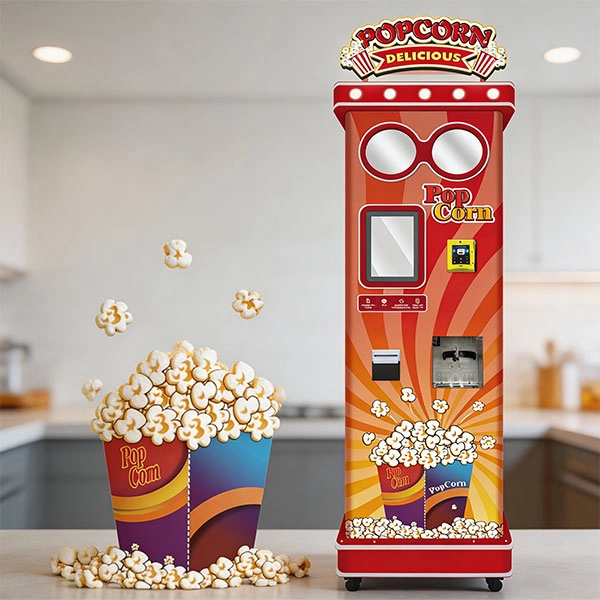
There are four things I tell park operators to check before they buy any machine for this environment.
Throughput speed. If the machine takes three minutes per cup and you have a line of fifty people, the last person in line is waiting two and a half hours. That person will leave. The WM680 from Wider Matrix produces a batch in about 120 seconds. That is still two minutes per cup, which means a fifty-person line takes roughly an hour and forty minutes. That is too long. But if you place the machine in a high-traffic corridor where people walk by in steady streams rather than in single bursts, the throughput works. You are not replacing a high-volume concession stand. You are adding a point-of-sale that catches the people who would not have stood in the concession line anyway.
Cup capacity. The WM680 holds 140 cups. On a busy Saturday in July at a park with 8,000 visitors, 140 cups can sell out in two hours. Someone has to refill. If your park has maintenance staff walking the grounds, that is a five-minute job. If you are running the machine remotely and nobody is nearby, you lose sales for the rest of the day. Plan your refill schedule around peak windows.
Payment flexibility. Amusement parks get a mix of locals, tourists, and international visitors. Some carry cash. Some use Apple Pay. Some have a QR payment app from a country you have never heard of. The Wider Matrix WM680 accepts coins, cash, credit cards, NFC, and QR codes. That covers almost everyone. If your machine only takes coins, you are turning away 70 percent of your customers.
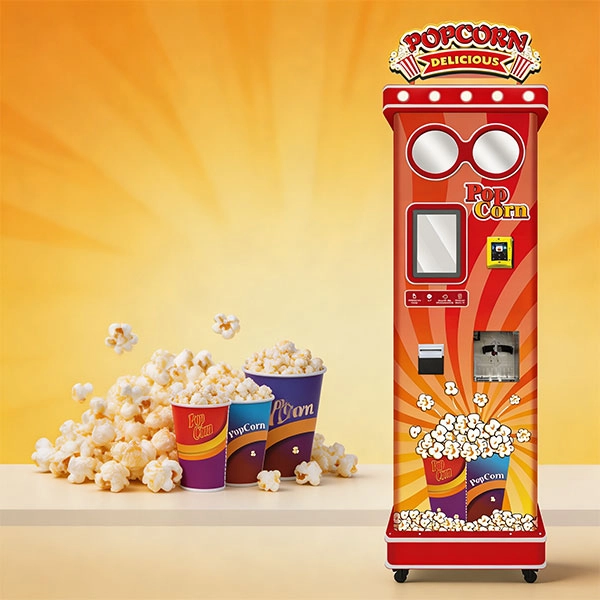
Build quality. Park environments are rougher than indoor malls. Humidity, temperature swings, vibration from nearby rides, and the occasional teenager who thinks the machine is a climbing wall. The WM680 has a thickened metal construction with a reinforced plate. It weighs 70 kg, which is heavy enough that it stays put but light enough that two people can move it for repositioning. It is rated for 220V power, which is standard in most international parks. If your park runs on 110V, you need a step-up transformer or a different model.
Where to put the machine inside the park
Placement is the single biggest factor in whether the machine makes money or sits idle. I have seen operators drop a machine in what looked like a perfect spot, near the park entrance, and watch it underperform. Then they move it 200 meters closer to the exit of a water ride and the revenue triples.
Here is what I have learned about placement in parks.
Near ride exits, not ride entrances. People do not buy snacks before they get on a ride. They buy them after, when the adrenaline fades and they are looking for something to do while they wait for the rest of their group. The exit of a major attraction is prime territory.
Along the path between attractions, not at rest areas. Rest areas already have food stands. Your machine competes with those. The corridor between two attractions, where people are walking and the smell of fresh popcorn catches them mid-stride, is where a popcorn vending machine for sale earns its keep.
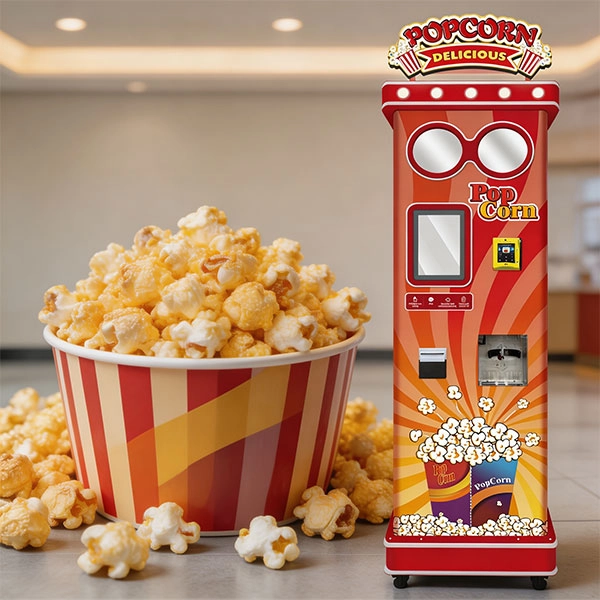
Near the exit gate, but not at it. People leaving the park want one last snack. But if the machine is right at the gate, they are already mentally checked out and heading to the parking lot. Place it about 50 to 100 meters inside the exit corridor, where they are still in “park mode” but close enough to the exit that it feels like a final treat.
Away from full-service concession stands. Do not put your machine next to a stand that sells popcorn by the bucket. You will lose. Put it in a zone where the nearest food option is a 10-minute walk. That is where automated vending wins, because the alternative is no food at all.
If you want a broader framework for this, the principles in finding profitable vending machine locations apply to parks too, but with the added variable of ride-cycle traffic patterns that you do not get in static retail environments.
The WM680 in a park context: what it does well and where it falls short
Wider Matrix designed the WM680 as a general-purpose commercial machine, not specifically for amusement parks. But the feature set translates well to that environment, with a couple of caveats.
What works well:
The hot air popping system is the biggest advantage. Traditional park popcorn stands use oil kettles, which require cleaning, produce smoke, and create a fire risk in enclosed areas. The WM680 uses 360-degree thermal cycle heating with hot air circulation. No oil. The machine stays clean longer, maintenance is simpler, and there is no grease to deal with. For a park operator who already has enough equipment to maintain, that is a real benefit.
The smart backend system lets you monitor the machine from a phone or PC. You can see sales data, cup inventory, and machine status in real time. On a busy Saturday, the operations team can check whether the machine near the log flume needs a refill without walking over there. Wider Matrix includes this system with every unit. Some competitors charge extra for it.
The custom branding options matter in a park setting. Wider Matrix offers free customization on machine appearance, including skins, layouts, luminous displays, and color schemes. You can match the machine to a themed zone. If you have a western section, the machine gets a wood-grain skin. If you have a sci-fi section, it gets metallic blue. That integration makes the machine feel like part of the park rather than a vending machine someone dropped in a hallway.
Where it falls short:
The cup capacity is 140 cups. For a high-traffic park on a peak day, that is not enough. You either need multiple machines or a disciplined refill schedule. Wider Matrix offers tier pricing for 6 to 10 units, so if you are outfitting a park with several machines, the per-unit cost drops. But if you were hoping to install one machine and forget about it for the day, that will not work in a busy park.
The machine is 1930 mm tall and 570 mm wide. It fits in most corridors, but it is not designed for outdoor exposure. If your park has open-air walkways, you need some form of overhead cover. The machine is not weatherproofed for rain. Wider Matrix can discuss enclosure options if your park requires outdoor placement.
The 220V power requirement means North American parks need a transformer or a dedicated 220V circuit. Most modern parks have 220V available in food service areas, but older parks may need an electrician to run a line. Factor that into your installation cost.
Revenue math for a park installation
Let me walk through real numbers. These are based on what I have seen at mid-sized parks. Your numbers will vary depending on attendance, ticket price, and how food-inclined your visitors are.
Say your park gets 5,000 visitors on an average operating day. You place a WM680 along a corridor between two popular rides. About 8 percent of visitors buy a cup of popcorn. That is 400 cups per day.
The machine holds 140 cups. So you need to refill it twice during the day. If you sell each cup at $4.50, your daily revenue is $1,800.
Your cost per cup: the cup itself is $0.12 at the 1,000-unit tier. The corn and flavoring add roughly $0.08. Electricity for the 3000W heating system adds a fraction of a cent per cup. Your total cost per cup is about $0.21.
Daily cost for 400 cups: $84. Daily revenue: $1,800. Daily gross profit: $1,716.
The machine costs $1,800 per unit for orders of 1 to 5. At $1,716 gross profit per day, the machine pays for itself in just over one operating day. That sounds too good to be true, and it is, because I am not accounting for location fees, labor for refills, maintenance, or the fact that not every day is a peak day.
Let me be more conservative. Say your park operates 150 days per year. Of those, 40 days are peak (weekends and holidays), 70 are average, and 40 are slow. On peak days you sell 400 cups. On average days you sell 150. On slow days you sell 50.
Annual revenue: 40 x $1,800 + 70 x $675 + 40 x $225 = $72,000 + $47,250 + $9,000 = $128,250.
Annual cost per cup at $0.21: (40 x 400 + 70 x 150 + 40 x 50) x $0.21 = (16,000 + 10,500 + 2,000) x $0.21 = 28,500 x $0.21 = $5,985.
Annual gross profit: $128,250 minus $5,985 = $122,265. Minus the machine cost of $1,800. Minus a rough estimate of $10,000 for location fees, labor, and incidentals. Net profit in year one: roughly $110,000.
Those numbers are real for a well-placed machine in a park with decent attendance. They are not real for a machine in a poorly chosen spot in a park with low traffic. Placement and attendance are the two variables that make or break the whole model. If you want to compare popcorn against other vending options, this breakdown of what type of vending machine is most profitable gives you a benchmark across categories.
And if you want to see how this compares to a cinema popcorn vending machine or a commercial popcorn vending machine in other high-traffic venues, the fundamentals are the same. The difference is traffic volume and pattern. Parks have burst traffic. Cinemas have pre-show rushes. Malls have steady flow. The machine needs to match the pattern.
How amusement park operators are combining machines
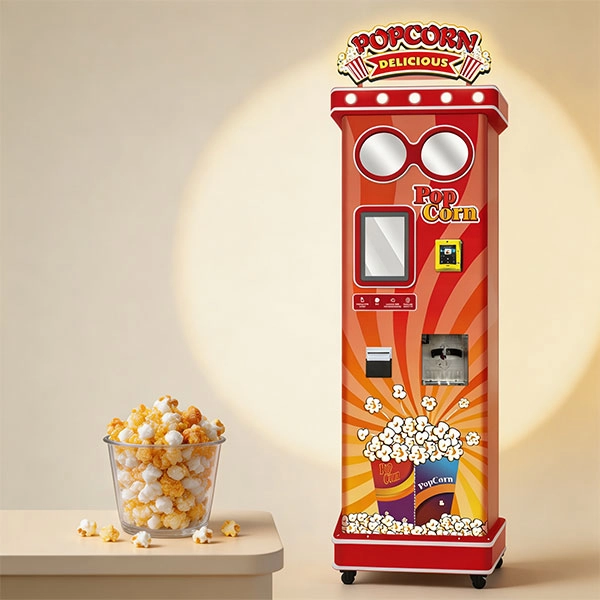
One trend I am seeing is parks installing multiple vending machine types in the same zone. A popcorn machine next to a cotton candy vending machine for amusement parks creates a snack cluster that draws families. The popcorn smell pulls them in. The cotton candy keeps the kids interested. The park gets two revenue streams from one footprint without adding staff.
Wider Matrix builds both. The company offers cotton candy machines, popcorn machines, ice cream machines, and other vending products, all with the same backend management system. If you are running multiple Wider Matrix machines across a park, you can monitor all of them from a single dashboard. That matters when you have six machines spread across 40 acres and a maintenance team of two people.
Some parks are also looking at automated cotton candy for theme parks and cinemas as a companion product. The logic is simple: different snacks attract different demographics. Popcorn skews toward adults and older kids. Cotton candy skews toward younger children. Together they cover the family.
What to ask before you commit
If you are a park operator evaluating a popcorn vending machine, here are the questions that actually matter.
What is my peak-hour traffic at the proposed location? If the answer is fewer than 50 people per hour, the machine will sit idle too often. If it is more than 200 per hour, one machine will not keep up. You need two or you need to accept that some people will walk away.
Who refills the machine and how often? If your park has roaming maintenance staff, this is easy. If it does not, you need to build a refill route into your operations plan. The WM680 holds 140 cups and 5.6 kg of corn. A full load lasts about two hours at peak traffic.
What is my power situation? The machine needs 220V and 3000W. Make sure your location has the right circuit. If it does not, budget for an electrician.
Do I need weather protection? If the machine is outdoors or in a semi-covered area, you need a canopy or enclosure. The machine itself is not rated for direct rain.
How many machines do I need? One machine covers one zone. If your park has three high-traffic corridors, you need three machines. Wider Matrix offers tier pricing for bulk orders, so the per-unit cost drops as you scale.
Can I customize the appearance? Yes. Wider Matrix offers free customization on skins, layouts, luminous characters, and color schemes. This is worth doing in a park setting because the machine needs to look like it belongs there, not like a piece of office equipment someone rolled in.
FAQ
Can a popcorn vending machine survive outdoors in an amusement park?
The WM680 is built with thickened metal construction, but it is not designed for direct rain exposure. If you want to place it in an open-air area, you need a canopy, a gazebo-style enclosure, or a semi-covered corridor. Indoor ride exits, covered walkways, and food court areas are the safest placements. Talk to Wider Matrix about your specific location and they can advise on whether an enclosure is needed.
How many cups does the machine hold before it needs a refill?
The WM680 holds 140 cups at 40 grams per cup. It also holds 5.6 kg of corn kernels. In a busy park, that capacity lasts roughly two hours during peak traffic. For a full operating day, plan on two to three refills depending on attendance.
Does the machine work with park wristband or RFID payment systems?
The WM680 accepts coins, cash, credit cards, NFC, and QR code payments. NFC covers most contactless wristbands and smart cards. If your park uses a proprietary RFID system, you would need to check compatibility with Wider Matrix’s engineering team. The payment module is modular, so integration is possible but may require custom work.
How long does it take to pop one batch?
About 120 seconds from the moment the customer pays to the moment the cup is ready. The machine uses hot air circulation heating, which is faster than oil-based popping and produces a cleaner product. The customer watches the process through a transparent window, which is part of the appeal in a park setting.
Is a popcorn vending machine profitable in a small park?
It depends on what “small” means. A park with 1,000 daily visitors can still generate meaningful revenue if the machine is placed well. At 5 percent conversion, that is 50 cups per day. At $4.50 per cup, you gross $225 per day. Over a 100-day season, that is $22,500 in revenue against roughly $1,050 in ingredient costs. The machine pays for itself in the first season. But the margin is thin enough that placement has to be right. A bad location in a small park means the machine never pays back.
Can I brand the machine with my park’s logo and colors?
Yes. Wider Matrix offers free customization on machine appearance including skins, layouts, luminous character displays, and color schemes. This is included in the base price of $1,800 per unit. You can see more detail on the commercial popcorn machine buying guide page.
What happens if the machine breaks down during operating hours?
The smart management system sends an alert to your phone or PC when the machine has a fault. Wider Matrix provides 24-hour technical support. For parks in North America or Europe, the most common issues are payment module jams and cup dispenser misalignment, both of which can be fixed on-site by maintenance staff with basic tools. Wider Matrix ships spare parts internationally and provides remote troubleshooting through the backend system.
How does popcorn vending compare to other vending machines in a park?
Popcorn has one of the highest margin profiles among vending products because the raw ingredient cost is so low. Cotton candy is comparable. Ice cream has higher ingredient cost and requires frozen storage. Pizza has the highest ingredient cost and the most complex machine. If you want a detailed comparison, this analysis of popcorn machine profitability breaks down the numbers across machine types.
How do I get a quote for my park?
Wider Matrix sells direct. The base price for the WM680 is $1,800 per unit for orders of 1 to 5 machines, with tier pricing for larger orders. You can contact Wider Matrix directly with your park specs, including the number of machines you need, your power setup, and any customization requirements. They typically respond within one business day and can provide a formal quotation that includes shipping to your location.
Bottom line
A popcorn vending machine for amusement parks is not a gimmick. It is a revenue tool that works when the placement is right and the operator understands the traffic pattern. The WM680 from Wider Matrix hits the key requirements: fast production, multiple payment options, remote monitoring, free branding, and a price point that makes the ROI math work even at modest attendance levels.
The machine is not perfect for every park. If your park has low attendance, no 220V power, or no staff available for refills, the model breaks down. But if you have 2,000 or more daily visitors, a corridor with steady foot traffic, and a maintenance team that can handle a two-minute refill twice a day, the machine will pay for itself in the first season. Possibly the first month.
If you want to talk through the specifics of your park, Wider Matrix is the company that builds the machine and they are the ones who can give you a real quote based on your actual requirements. Reach out to them with your park size, visitor count, and the number of machines you are considering. They will give you straight numbers, not a sales pitch.