


How profitable are flower vending machines? The honest answer is that it depends on three numbers you control and one you don’t. The three you control: where you place the machine, what you charge per bouquet, and how well you manage spoilage. The one you don’t: how many people walk past every day. This article gives you the math to turn those four numbers into a real profit forecast, so you can decide before you buy. In a well-chosen location, that forecast usually points to something most people don’t expect from a vending business: payback in 1-2 months.
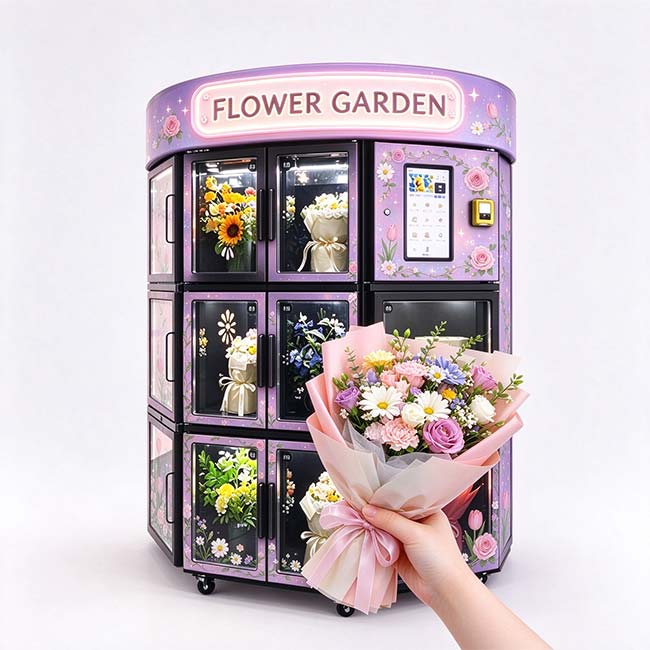
Flower vending machines are refrigerated kiosks that sell bouquets 24/7 without a staff member. They work because flowers are an impulse purchase, and a well-placed machine captures sales that a florist shop misses. But they also carry a risk that most vending machines don’t: the product dies. Manage the cold chain and spoilage stays under 10%. Get that right, and the numbers below are what’s left.
How profitable are flower vending machines? The short answer
In a good location, a flower vending machine can earn 50-65% net margin after all costs and pay for itself in 1-2 months. In a bad location, it loses money every month. The difference is not luck. It’s placement, pricing, and spoilage control — the math below.
Let’s start with the unit economics, because everything else follows from that.
Build a profit and loss statement for one machine
Before you buy, model a full month. Here’s the template we use when we help operators plan. Fill in your own numbers as you go, then compare them with the worked example below.
| Line item | How to calculate it |
|---|---|
| Revenue | Average bouquets sold per day x average price x 30 days |
| Wholesale flower cost | Cost per bouquet x bouquets sold |
| Spoilage | Percentage of bouquets that don’t sell and must be discarded (typically 8-15% with good rotation) |
| Venue fee or commission | Fixed rent per month OR percentage of revenue (often 10-20%) |
| Electricity | Refrigeration and lighting, typically $30-80 per month |
| Card processing fees | 2-3% of card revenue |
| Software / connectivity | Cloud monitoring and payment terminal, often $20-50 per month |
| Restocking labor | Hours per week x your hourly cost |
| Insurance | Liability and machine coverage, often $20-60 per month |
| Maintenance reserve | Set aside 5-10% of revenue for repairs |
| Depreciation | Machine cost divided by expected life (3-5 years) |
Subtract all costs from revenue to get net profit. Divide net profit by revenue to get net margin. Divide machine cost by monthly net profit to get payback in months. For a broader look at vending machine economics, see how profitable vending machines are in general.
Break-even and sensitivity: the math that tells you yes or no
Here’s a worked example, using the numbers we see from operators in good locations. You buy a refrigerated machine for $10,000. Your all-in fixed costs are $600 per month — venue rent, electricity, software, insurance, and restocking labor. Your variable cost per bouquet is $8, which covers wholesale flowers, packaging, card fees, a 10% spoilage allowance, and a small maintenance reserve. You sell each bouquet for $25. That leaves a $17 contribution margin per bouquet.
Break-even is $600 / $17 = 36 bouquets per month, or a little over one a day. That’s it. Anything above that is profit, and a busy site clears it before lunch.
Now the part that matters: payback. A hospital entrance, a shopping mall, or a transit concourse in a good Western market commonly moves 12-20 bouquets a day. At 15 a day you sell 450 bouquets a month: $11,250 revenue, $3,600 variable cost, $7,650 contribution, and $7,050 net profit after the $600 fixed costs. A $10,000 machine pays for itself in about six weeks. In month two you are already earning on a paid-off asset.
Push it to 20 a day and net profit is $9,600 a month — payback in roughly one month. Pull it back to 12 a day and it’s $5,520 a month, still under two months.
Now stress-test it. What if sales drop 40%? From 20 a day down to 12 a day: 360 bouquets, $9,000 revenue, $2,880 variable cost, $6,120 contribution, $5,520 net. The machine still pays for itself in 1.8 months. That’s the point of a high-margin, low-overhead product: there is a lot of room between a great month and a slow one before payback stops being fast.
This is the sensitivity analysis that tells you a location is worth buying for. In a well-chosen spot, the answer is 1-2 months. Even a soft month doesn’t change that.
| Daily bouquets | Monthly revenue | Monthly net profit | Payback (months) |
|---|---|---|---|
| 12 | $9,000 | $5,520 | 1.8 |
| 15 | $11,250 | $7,050 | 1.4 |
| 20 | $15,000 | $9,600 | 1.0 |
Seasonality: the calendar that makes or breaks flower vending
Flowers are not a steady product. Demand spikes around Valentine’s Day, Mother’s Day, and graduation season. It drops in January and September. A good operator plans for this. In peak months, you can raise prices and stock more high-margin bouquets. In trough months, you might reduce stock, run promotions, or move the machine to a different venue.
Here’s a rough demand index for a typical flower vending machine in a Western market. 100 is average month.
| Month | Demand index | What’s happening |
|---|---|---|
| January | 70 | Post-holiday slump, cold weather |
| February | 180 | Valentine’s Day |
| March | 90 | Spring, but no major gifting holiday |
| April | 100 | Easter, spring events |
| May | 160 | Mother’s Day, graduations |
| June | 110 | Weddings, end of school |
| July | 85 | Summer travel, lower foot traffic |
| August | 80 | Summer slump |
| September | 75 | Back to school, no gifting |
| October | 90 | Fall, Halloween events |
| November | 95 | Thanksgiving, early holiday prep |
| December | 120 | Holiday parties, Christmas |
Use this to forecast the year. If a normal month nets $7,050, February can more than double that and January might come in near $4,900. Even the quiet months stay firmly profitable, and the annual average is what drives payback — which is why a machine bought in January can be paid off before spring is over.
Location: how to pick a site and win the contract
Location is the single biggest driver of flower vending profitability. Here’s a simple way to estimate daily sales before you sign anything.
Count the people who walk past the site during peak hours. Multiply that by a conversion rate. For a gift-oriented venue like a hospital or mall, a 1-2% conversion is realistic. For a transit hub, 0.5-1%. For a low-traffic office, 0.2-0.5%. That gives you expected daily bouquets.
Example: A hospital entrance sees 1,000 people pass per day. At 1.5% conversion, that’s 15 bouquets per day. At $25 average price, that’s $375 per day, or $11,250 per month. After costs, roughly $7,000 net — enough to pay off a $10,000 machine in about six weeks.
When you negotiate with a venue, focus on these terms:
- Commission vs fixed rent. A 10-20% revenue share is common. Fixed rent is better if you expect high sales, but riskier if sales are low.
- Exclusivity. Can the venue put another flower machine nearby? Get written exclusivity.
- Power access. Who pays for electricity? If the venue charges you a flat fee, make sure it’s reasonable.
- Termination. Can they kick you out with 30 days’ notice? That kills your payback. Aim for a 12-month minimum.
- Maintenance access. You need to restock and clean. Make sure you can access the machine without a staff escort every time.
Spoilage and sourcing: the two costs that eat your margin
Flowers are perishable. The average bouquet has a vase life of 5-7 days, but that drops fast if the cold chain breaks. Here’s what to do.
- Source from a wholesaler with a reliable cold chain. Ask for flowers that are at least 3 days from peak bloom.
- Keep the machine at 36-42°F. Check the temperature daily. A failure of even a few hours can wipe out a whole restock.
- Rotate stock. Put the oldest bouquets in front, newest behind.
- Mark down. If a bouquet is 3 days old, price it 30% lower. If it’s 4 days old, 50% lower. Better to sell at a discount than throw it away.
- Track spoilage rate. If you’re discarding more than 20% of your stock, you’re either buying too much or the machine is too warm.
Wholesale flowers typically run 25-35% of retail price, so gross margin sits around 65-70%. Spoilage, card fees, and venue costs take a bite out of that, but with tight rotation and a reliable cold chain, net margin still lands at 50-65%. That gap between gross and net is exactly why payback here is measured in weeks, not years.
Hidden costs and risks: fees, insurance, permits, and failures
Many first-time buyers only think about the machine and flowers. Here are the costs they forget:
- Card processing fees: 2-3% of card sales.
- Software subscription: cloud monitoring and remote management, often $20-50 per month.
- Insurance: liability and equipment coverage, often $20-60 per month.
- Permits: some cities require a vending permit, which can cost $100-500 per year.
- Depreciation: a $10,000 machine over 5 years is $167 per month in cost you’ll never get back.
Risks to plan for:
- Theft and vandalism. Use a machine with a solid lock and a camera. Place it in a well-lit, visible spot.
- Power outage. A long outage can ruin your stock. Ask the venue about backup power, or get a machine with a battery backup for the refrigeration.
- Temperature failure. If the compressor dies, you have hours, not days. Have a maintenance contact who can respond within 24 hours.
- Dead location. If sales are below break-even for 3 months, move the machine. Budget for relocation costs.
Machine selection: what to look for before you buy
Not all flower vending machines are the same. Look for these features:
- Refrigeration: a sealed, insulated cabinet that holds 36-42°F. Some machines use a compressor, others use thermoelectric cooling. Compressor is better for high-heat locations.
- Capacity: how many bouquets can it hold? A single-door machine might hold 20-30 bouquets. A multi-door machine might hold 60-80. Match capacity to your expected daily sales plus a buffer for weekends.
- Payment: cash, card, and mobile. Card is essential. Make sure the terminal supports the payment methods common in your market.
- Monitoring: cloud-based software that alerts you to low stock, temperature issues, and sales. This is not optional if you want to manage multiple machines.
- Security: a reinforced door and lock. Flower vending machines are targets for theft because the product is valuable and perishable.
- Power draw: a refrigerated machine can use 300-800W. Check the venue’s electrical capacity before you sign.
Also consider the supplier. A factory with a warranty and technical support is worth paying extra for. Ask about spare parts availability and response time. If you’re comparing machine types, read which vending machine types are most profitable.
When is a flower vending machine not profitable?
Here are the situations where a flower vending machine loses money:
- Low foot traffic. If fewer than 200 people pass per day, you won’t sell enough to cover costs.
- High spoilage. If you can’t restock every 2-3 days, or if the machine temperature is unreliable, spoilage will eat your margin.
- High venue commission. A 30% revenue share plus high electricity can leave you with nothing.
- Wrong product mix. Selling only expensive bouquets in a budget area, or only cheap bouquets in a premium area, both fail.
- Seasonal troughs. If you buy a machine and only look at February and May, you’ll be shocked by the rest of the year.
None of these are fixed facts about the business. They’re the three numbers you control plus foot traffic, and you can check all four before you buy. Get the site, the price, and the cold chain right, and the 1-2 month payback above is what the math gives you.
FAQ: flower vending machine profitability questions
How much does a flower vending machine make per day?
In a good location, expect 12-25 bouquets per day. At an average price of $20-35, that’s $240-875 per day in revenue. Net profit after all costs is typically 50-65% of that.
What is the profit margin on a flower vending machine?
Gross margin is high, often 65-70%, because flowers are cheap at wholesale. Net margin after spoilage, venue fees, electricity, and labor is typically 50-65% in a good location. That is what makes a one-to-two-month payback possible.
How long does it take to pay off a flower vending machine?
This is the number that surprises most first-time buyers: 1-2 months in a good location. With a $10,000 machine netting $7,050 a month, payback is about six weeks. At a slower site netting $5,520, it’s 1.8 months. Compare that with most vending categories, where operators plan for a year or more, and the difference comes down to high margin and low overhead.
Is a flower vending machine worth it in 2026?
Yes, if you have a high-traffic location and a reliable cold chain. It’s one of the fastest paybacks in vending: a well-placed machine can be earning on a paid-off asset by its second month. How profitable are flower vending machines depends on the math above, and it tells you which kind of location you have.
What is the biggest risk with a flower vending machine?
Spoilage. A single refrigeration failure can destroy your entire inventory. That’s why temperature monitoring and a maintenance plan are non-negotiable. Keep spoilage under 10% and the 1-2 month payback holds.
Talk to Wider Matrix about your flower vending machine
Wider Matrix is a vending machine factory in Guangzhou, China. We’ve built machines for operators in 130+ countries, and we can help you plan a flower vending business — including the numbers for your own location. A machine that pays for itself in 1-2 months is a very different decision from one that takes a year. Whether you need advice on machine specs, capacity, or payment systems, our team will answer within 24 hours. Contact us for a quote.
If you’re still working through the math, start with our detailed guides: