

You are walking through a shopping mall and see a machine that lets you upload a photo and get a fully personalized phone case in minutes. You think: “This is so cool, but how much does it cost to start such a business?” Or perhaps you are a store manager looking for a new way to attract customers and reduce inventory pressure. Either way, you are looking for the answer to the same question: How much does a custom phone case vending machine actually cost?
The straightforward answer is: The cost of a custom phone case vending machine ranges widely, typically from $5,000 to $10,000. This huge price difference depends mainly on the machine’s features, level of customization, printing technology, brand, and whether you buy new or used equipment. This article will break down these costs in detail to help you make an informed investment decision.
Why Such a Big Price Difference? Key Factors Affecting the Cost of a Custom Phone Case Vending Machine
A price range from $5,000 to $10,000 sounds like a huge gap. Let’s break down what causes these differences. It is not just about the machine itself, but the entire solution you get.
1. Printing Technology & Quality: The Core Cost Driver
This is the most important factor determining the machine’s price. Different printing technologies directly affect print speed, color quality, and the durability of the final product.
- UV Printing: This is the most mainstream and highest‑quality technology on the market today. UV printing costs more, but delivers vibrant colors, strong adhesion, and excellent wear resistance. Machines with high‑quality UV printheads (such as Epson or Konica Minolta) will cost significantly more than those using entry‑level heads.
- Heat Transfer / Dye‑Sublimation: This technology is cheaper, but typically requires extra steps (transferring the design onto the case) and may not match the color quality and durability of UV printing. It is mainly used in some low‑cost entry‑level equipment.
- 3D Printing: Some high‑end concept machines may integrate 3D printing to create phone cases with embossed effects. This technology is currently very expensive and slow, mainly used for high‑end customization or prototyping.
2. Degree of Automation & Features
The price difference between a “fully automatic” machine and a “semi‑automatic” one is huge.
- Fully automatic all‑in‑one machine: The user goes from design upload, payment, printing to final product output without any manual intervention. These machines integrate high‑precision robotic arms, automatic feeding systems, and advanced software. The price typically ranges from $5,000 to $10,000+. For example, a Fully Automatic Customize Phone Case Vending Machine falls into this category, providing a complete end‑to‑end experience.
- Semi‑automatic / desktop device: These usually require manual intervention, such as placing the phone case, starting the print, or doing final quality checks and packaging. Such devices are cheaper, potentially between $2,000 and $8,000. They are suitable for startups or low‑traffic locations.
3. Brand, Quality & After‑Sales Service
Choosing a reliable manufacturer is critical. A well‑known brand or a company like Wider Matrix vending machines that focuses on R&D and user experience may charge more than a no‑name factory, but in return you get more stable performance, longer life, and more reliable after‑sales support.
- International certifications: Does the machine hold international safety certifications such as CE, UKCA, RoHS, FCC, etc.? These certifications increase manufacturing costs but ensure the machine can be safely sold worldwide.
- Software and system: Does the machine come with a user‑friendly interface, remote monitoring system, inventory management software, and payment system integration? The cost of developing and integrating this software is also included in the final price.
Comparison of investment across different tiers of custom phone case vending machines
| Factor | Low‑end / Entry | Mid‑range / Commercial | High‑end / Fully Automatic |
|---|---|---|---|
| Price range | $1,000 – $3,000 | $3,000 – $5,000 | $5,000 – $10,000 |
| Printing technology | Low‑end UV / Heat transfer | Mainstream UV printing | High‑end UV / 3D printing |
| Automation level | Semi‑automatic / manual | Partially automatic | Fully automatic, unattended |
| Suitable scenarios | Small events, startup testing | Shopping malls, convenience stores, small shops | Large malls, airports, theme parks |
| Payback period | 6‑12 months | 3‑6 months | 1‑3 months (high traffic) |
Return on Investment in 1‑3 Months? The Profit Logic of Custom Phone Case Vending Machines
You may ask: “If I spend this much money on a machine, how long until I get my money back?” The answer is: Under ideal high‑traffic scenarios, a payback period of 1‑3 months is entirely possible. Let’s look at a concrete calculation.
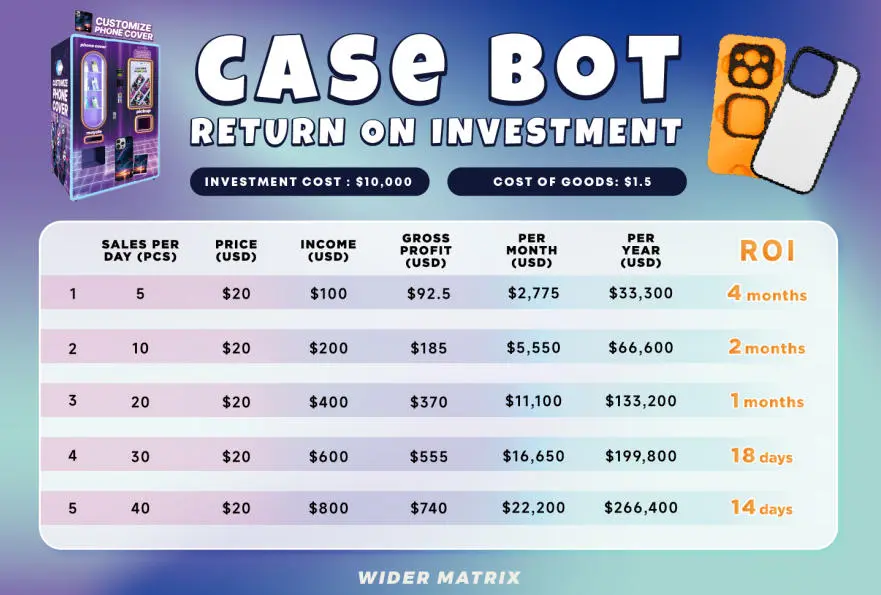
Profit Scenario: A Mid‑to‑High‑End Fully Automatic Machine
Assume you buy a mid‑to‑high‑end fully automatic custom phone case vending machine for $40,000 and place it in a high‑traffic shopping mall or tourist attraction.
- Price per custom case: $20 – $30.
- Average daily orders: Assume 40 orders per day (easily achievable in a popular location).
- Consumables cost per case: Blank case, ink, packaging etc.: about $5 – $8.
- Gross profit per case: $25 (selling price) – $7 (cost) = $18.
- Daily gross profit: 40 orders × $18 = $720.
- Monthly gross profit (30 days): $720 × 30 = $21,600.
Payback calculation:
Even after deducting rent, electricity, and occasional maintenance (say $6,000/month), your monthly net profit would still be $15,600. That means you would recover your machine cost in just 2.5 months ($40,000 / $15,600). After that, the machine generates passive income for you.
The keys to this logic are: high traffic, high average transaction value, low consumables cost. This also explains why companies like Wider Matrix (gz) Technology Co., Ltd. focus on developing highly stable and high‑throughput equipment – every minute of downtime means lost profit.
Real‑World Case Studies: From Zero to $10,000+ Monthly Profit
Theoretical numbers sound nice, but real cases are more convincing. Let’s see how two customers succeeded with custom phone case vending machines.
Case Study 1: The “Case Crafts” Miracle at Suntec City, Singapore
Background: An entrepreneur placed a custom phone case vending machine in Suntec City shopping mall, Singapore. His main challenge: how to quickly attract customers to a new concept and validate the business model.
Solution: He chose a mid‑range, stable custom machine and promoted it via social media (Instagram). He encouraged customers to film and share their case‑making experience.
Result: As we saw in competitor analysis, this case went viral on social media. His machine became not just a point of sale but an “Instagram hotspot”. Reports show that during peak months, it served over 100 customers per day, with prices starting from $15 SGD for a basic case. That means monthly revenue easily exceeded $30,000 SGD. His success proves the huge potential of “experiential consumption” and the importance of placing the machine in high‑traffic, social‑media‑friendly locations.
Case Study 2: A Shopping Mall’s “Brand Customization Station”
Background: A large shopping mall operator wanted to offer unique value‑added services and increase customer dwell time.
Solution: They purchased a Phone Case Printing Vending Machine and placed it in the mall atrium. They offered not only personal customization but also collaborated with mall brands to launch limited‑edition co‑branded cases as brand promotions and member perks.
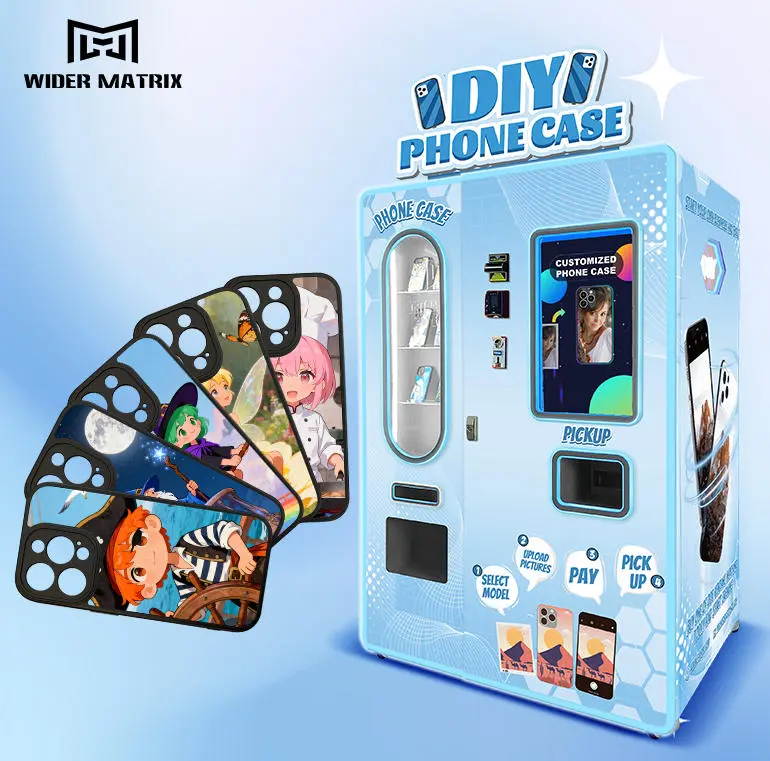
Result: The machine generated $25,000 in sales in its first month. More importantly, it became a powerful customer data collector. Through the machine’s payment and interaction system, the mall gathered consumer preferences and contact information from thousands of shoppers, providing valuable data for future targeted marketing. The mall manager said: “This machine didn’t consume our budget – it became an independent profit center.” They recovered their entire investment within 3 months.
Beyond the Machine Cost: What Hidden Fees Should You Consider?
When calculating total cost, don’t just look at the machine price. Here are other important expenses:
- Location rent: This is one of the biggest ongoing costs. Rent in a prime location can be thousands or even tens of thousands of dollars per month.
- Consumables cost: Besides blank phone cases, you need high‑quality UV ink, cleaning fluid, packaging, etc. The quality of consumables directly affects the final product’s quality and customer satisfaction.
- Shipping & installation: Transport, customs clearance, and on‑site setup from the manufacturer to your location can add thousands.
- Maintenance & repair: Any machine can fail. Setting aside a budget for regular maintenance and emergency repairs is wise. Choosing a supplier with good after‑sales service, like Wider Matrix, greatly reduces this risk.
- Software & payment system fees: You may have to pay transaction fees for payment gateways (credit cards, mobile payments) and subscription fees for remote management software.
Frequently Asked Questions (FAQ)
1. What is the cheapest custom phone case vending machine?
The cheapest entry‑level semi‑automatic or desktop device can cost as low as $5,000 – $8,000. However, such devices typically require manual operation, have limited printing speed and stability, and are better suited for testing or small events.
2. How much does a high‑quality, reliable commercial machine cost?
For merchants who want to operate long‑term and pursue stable profit, a high‑quality fully automatic commercial machine typically costs between $5,000 and $10,000. Machines in this price range usually use mainstream UV printing technology, have high automation and stability – such as the Fully Automatic Customize Phone Case Vending Machine.
3. Is it worth buying a used custom phone case vending machine?
Buying used equipment can significantly lower costs (maybe 50‑70% of new), but the risks are higher. You need to carefully inspect printhead wear, mechanical stability, and whether the software is outdated. If you lack expertise, it’s safer to choose a new machine with warranty.
4. How do I choose the right machine model?
First, define your target location and foot traffic. Second, consider your budget and expected payback period. Finally, choose a supplier with good reputation and after‑sales service. You can consult a professional company like Wider Matrix (gz) Technology Co., Ltd. for customised advice based on your needs.
5. Besides phone cases, can these machines make other products?
Yes. Many advanced custom machines are modular. Besides phone cases, they can also customise tablet cases, AirPods cases, mouse pads, and even small decorations. This can greatly expand your product line and revenue sources.
6. Can the payback period really be as short as 1‑3 months?
Yes – but only if you have an excellent location (e.g., a very high‑traffic tourist spot or shopping mall) and run the operation well. In ordinary locations, the typical payback period is 6‑12 months. Refer to our profit scenario above to evaluate your specific situation.
7. Is it hard to maintain such a machine? Do I need a dedicated technician?
Most modern machines are designed to be easy to maintain. The main daily tasks are changing ink cartridges, cleaning printheads, and refilling blank cases. More complex hardware issues usually require the manufacturer’s technical support. Choosing a supplier that offers remote diagnostics and global technical support is crucial.
Related Topics
- Phone Case Machine Maker: The Ultimate Guide to Manufacturing & Customization Equipment
- vending machines
- How Much Can You Make with a Cotton Candy Machine? A 2025 Profit Guide
- Is a Cotton Candy Machine a Good Investment? A 2025 Profitability Guide
- Commercial Cotton Candy Vending Machines: The Ultimate Guide for Profitable Sweet Treats
Conclusion: Your Path to Investing in a Custom Phone Case Vending Machine
Investing in a custom phone case vending machine is not just buying a hardware device – it is investing in a complete business solution that integrates hardware, software, consumables, and operating models. Costs range from a few thousand to hundreds of thousands of dollars, but higher investment often corresponds to higher returns and a faster payback period. The keys are precise location selection, a reliable equipment supplier, and a deep understanding of your target market.
Technology‑driven companies like Wider Matrix, with their experience in the automation industry since 2016 and a track record of exporting over 3,000 machines to more than 130 countries, can provide you with market‑proven, high‑quality, and internationally standard solutions. We offer not only machines but also full‑process support – from model selection and site evaluation to after‑sales service – helping you succeed in this era of personalised consumption.