


Vending machine profitability is decided by cost per sale, throughput, location costs, uptime, refill frequency and payment mix far more than by the machine itself. This page puts published consumable prices, machine prices, capacity and service data for popcorn, cotton candy, ice cream, phone case, nail printer, puzzle, balloon, protein shake and smoothie machines side by side, then lists the numbers to watch during the first month of operation.
The machine is rarely the reason
Two operators order the same popcorn machine in the same month. One restocks it twice a week and buys a second unit before the year ends. The other lists it for sale after four months and tells people that vending does not work. Nothing was wrong with either machine, and neither operator was lying.
Most of what drives vending machine profitability is measurable before you pay for anything and adjustable after the machine is on site: what one sale costs you, how many sales the machine can complete in an hour, what the location takes from the revenue, how often the machine sits idle, how far you drive to refill it, and how much of the money arrives through a card reader instead of a coin slot. The size of the cabinet on the floor barely enters the calculation.
Cost per sale sets the ceiling
The machine is a single payment, and vending machine cost is the number every buyer checks first. Consumables are a payment you make on every transaction for as long as the machine runs, which is why a difference of a few cents decides whether a route is worth operating. The figures below come from the manufacturer’s published consumable price list.
| Machine | Cost per sale | Detail |
|---|---|---|
| Popcorn WM680 | US$0.12 per cup at 1,000 pcs, US$0.10 per cup at 10,000 pcs | 40g serving, 140 cups loaded at a time, 5.6 kg of corn |
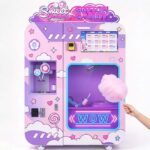
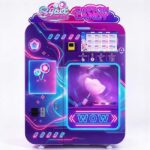
| Cotton candy WM980 | US$3.25 per sugar bag at 96 bags, US$2.75 at 2,004 bags, plus US$0.050 per stick, down to US$0.038 above 100,000 sticks | 28 to 30g of sugar per candy, six sugar flavors, 36 candy designs |
| Ice cream WM550 | US$0.12 per cup at 10,000 pcs, US$0.10 at 40,000 pcs, plus US$0.03 per spoon | Small machine cups cost US$0.10 at 1,000 pcs and US$0.08 above 5,000 pcs |
| Protein shake WM186 | US$0.80 to US$1.50 per cup, average about US$1.20 | Powder from 7 hoppers, 4L each, three temperature zones |
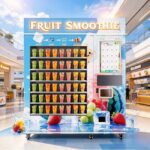
| Smoothie WM666 | US$0.22 per cup at 1,000 pcs, US$0.185 at 10,000 pcs, plus US$0.06 per straw, down to US$0.05 | 14 oz cup, 400 ml actual capacity |
| Phone case WM880 | US$1.30 per TPU and PC blank at 1,000 pcs, US$1.10 at 8,000 pcs; magnetic blanks US$2.30 down to US$2.10 | Ink costs US$100 per 4-color set or US$160 per 6-color set, 2,000 ml ink capacity |
| Nail printer WM860 | US$1.00 per pair of plain press-on nails at 1,000 pairs, US$0.80 at 8,000; cat eye and gem styles US$1.50 down to US$1.30; toolkit US$0.30 per set | Ink is US$85 per set and each bottle prints about 5,000 pairs |
| Puzzle WM520 and WM520+ | A5 paper puzzles US$1.20 at 1,000 to US$0.80 at 8,000, frames US$1.80 down to US$1.20 | Ink US$160 per set for the generation 2 machine, US$100 for generation 1 |
| Balloon WM688 | US$0.30 per balloon and stick at 1,000 pcs, US$0.10 at 10,000 pcs | 360 balloons stored across 6 slots of 60 |
Two things stand out when those figures sit next to each other. The first is that the gap between a small order and a bulk order is wide enough to change a business. A phone case blank costs US$1.30 in a pack of 1,000 and US$1.10 in a pack of 8,000. An ice cream cup falls from US$0.12 to US$0.10 when the order grows from 10,000 to 40,000. Cotton candy sticks drop from US$0.050 to US$0.038 above 100,000 pieces. An operator who buys to the minimum and reorders every month pays more per unit all year, and that surcharge shows up as a permanently thinner margin.
The second is that the cost sits in a very different place depending on the product. A smoothie carries about US$1.30 of ingredients and packaging per 14 oz cup, so at US$4.50 a sale keeps roughly US$3.20. A nail printer customer pays US$8 to US$15 for a set that uses about US$1.50 of press-on nails, toolkit and ink, which is where the 80% gross margin figure in the manufacturer’s material comes from. Popcorn has the cheapest consumable on this list at about US$0.12 per serving, but a cheap item also needs volume to produce the same money, and the machine still has to be refilled and cleaned.
Cost per sale is the first input in vending machine profitability and the one most often estimated from memory rather than from the price list. Write it down per product before you compare any two machines.
Throughput caps what a busy hour is worth
A machine can only sell as many units as it can make while people are standing in front of it. That limit differs by an order of magnitude across product types.
| Machine | Time per sale | Stated capacity |
|---|---|---|
| Popcorn WM680 | About 120 seconds from order to collection | 140 cups and 5.6 kg of corn preloaded |
| Ice cream WM550 | 15 seconds of cup dispensing | 28L output, up to 300 cups per batch |
| Protein shake WM186 | Under 60 seconds per shake, under 30 seconds for the customer to order and pay | 60+ cups per hour at peak |
| Smoothie WM666 | 90 seconds per cup | 1,000+ cups per day, against about 100 cups in an eight hour shift for a traditional setup |
| Puzzle WM520+ | 3 minutes per printed sheet | 208 puzzles and 140 frames in stock |
| Nail printer WM860 | About 5 minutes per customer, against 60 to 120 minutes in a nail salon | 200+ orders per day |
| Phone case WM880 | Printing starts as soon as the photo is uploaded and paid for | 1,020 to 1,025 cases stored, 2,000 ml of ink on board |
Put a five minute machine in a commuter station where customers pass through in under a minute and it will look broken even though it works perfectly. Put the 15 second machine in the same spot and it can clear a queue between trains. A venue with short dwell time rewards speed, and a venue where people wait, such as a cinema lobby or a family entertainment centre, can carry a slower machine that sells a bigger ticket.
This is the variable owners tend to notice last, because the machine is not failing. It is simply finishing the sale after the customer has walked away. Throughput is also the part of vending machine profitability that a purchase decision can change most, since print head versions, cup size and batch capacity are fixed at the factory.
Location moves more money than any hardware choice
Site selection sets the sales and the rent at the same time, in opposite directions. The manufacturer’s own installation data shows how wide the spread is. In a commercial gym with more than 500 members, a protein shake machine averages more than 40 cups a day, and a university sports centre peaks above 80. Sports complexes sell 60+ cups on event days at US$6 to US$8 per cup. Mall kiosks running nail printers average about 45 orders a day in a Dubai installation, and one unit in Bangkok reached 200 orders a day during a holiday promotion. Two identical machines in those two sites would post entirely different vending machine profitability, for reasons that have nothing to do with the hardware.
Those are good sites, not typical ones, and the same product in a quiet corridor produces a fraction of that volume. The useful question is not whether a place is busy, but whether the people in it are the kind who buy what the machine sells, and whether they are there often enough to build a habit. Comparing how much a vending machine makes a month across venue types is a faster way to learn that than guessing, and the reasoning behind where to put vending machines inside a building follows the same logic.
Whether vending machine owners pay for a location as a flat fee or as a share of revenue changes who carries the risk. A percentage deal is easier to sign and more expensive on a strong site. A flat fee is cheap on a strong site and dangerous on a weak one. Vending machine location profitability is settled by that structure, so read the terms before falling in love with the foot traffic. Lease length, delivery access and repeat visits matter as much as headcount, and the location strategies that hold up over years of operation are usually the dull ones about access and habit.
Floor space and weight belong in the same conversation, because both affect what the site will accept and what it charges.
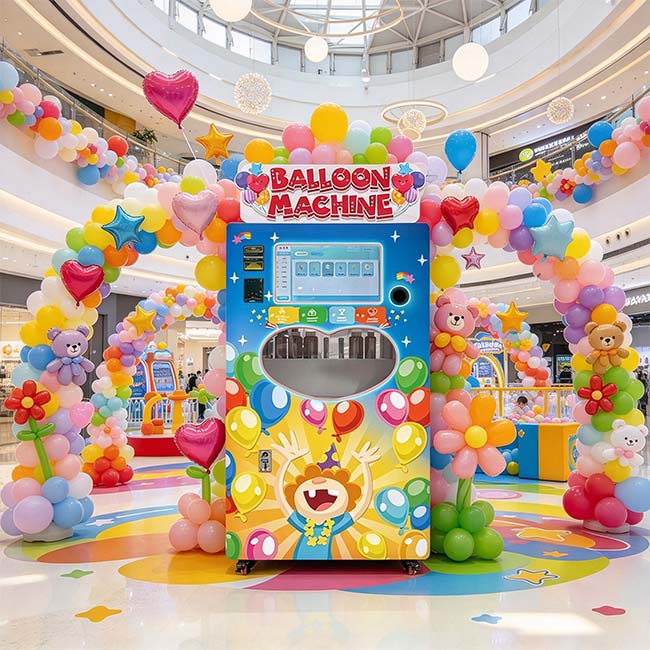
The balloon machine measures 100 x 82 x 210 cm and takes about 1 square metre of floor. A nail printer installation is quoted at 1.5 square metres.
The puzzle machine is 970 x 1,100 mm at 370 kg, the ice cream vending machine WM550 runs from 640 kg down to about 240 kg for the small model at 81 x 126 x 180 cm, the cotton candy WM980 is 132 x 195 x 67 cm at 300 kg, and the phone case WM880 is 380 kg. A load limit or a staircase can eliminate an otherwise perfect spot, and a compact model can open up locations that a full size unit will never fit.
Downtime costs more than the repair
A machine out of service for three days does not lose three days of sales. It also loses the customers who tried it once, saw an error message and never came back. On a busy route the second loss is the bigger one, and it is invisible in the sales report because a failed vending attempt leaves no record to reconcile.
What keeps a machine running is mostly software and service rather than hardware. That layer is also the cheapest part of vending machine profitability to protect, because the tools ship with the machine. Remote dashboards show live equipment status, stock levels, alarms and connectivity for every model in this range. The protein shake machine and the smoothie machine send fault self-diagnosis alerts to the operator and the service team. The generation 2 puzzle machine adds predictive maintenance alerts, and the cotton candy machine pushes software updates over the air, which avoids a site visit for a settings change. Cleaning cycles matter as much: the smoothie machine steam cleans at 120 degrees Celsius after each cup, the cotton candy burner cleans itself, and the indoor cotton candy cabinet locks magnetically during production so nobody opens the window mid cycle.
Then there is the repair itself. Wider Matrix ships from its own factory in Panyu, Guangzhou, works with a team of 50+ engineers, and covers each machine with a one year warranty plus lifetime technical support and 24 hour online assistance, along with installation and maintenance videos for the operator. Ask how long a replacement print head, a cup dispenser or a payment module takes to reach your city before you order, because that number, not the failure rate, decides how much a fault costs you.
Refill trips and spoilage
Every refill is unpaid work plus travel, and how often you make that trip shapes vending machine profitability in a way no brochure mentions. The machines that cut trips are simply the ones with more capacity between visits. The phone case machine holds 1,020 to 1,025 blanks and 2,000 ml of ink. The nail printer holds 720 pairs of press-on nails and reminds the operator when stock runs low.
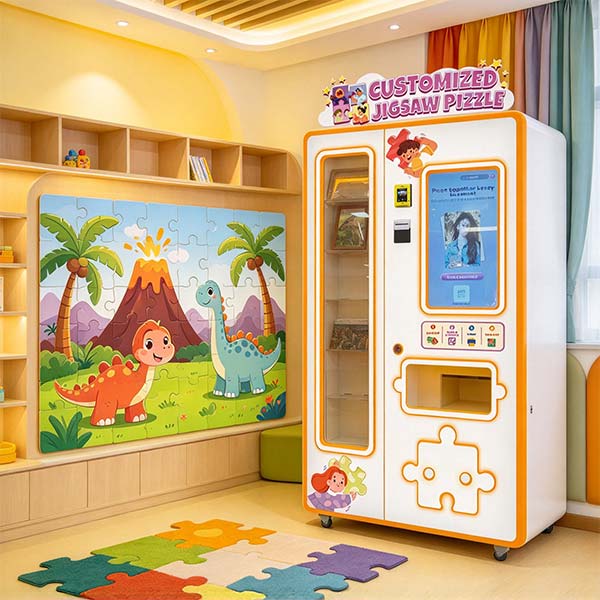
The puzzle vending machine WM520 stores 208 puzzles, 140 frames and a 600 piece inkwell. The balloon machine carries 360 balloons in six slots of 60, so a slow design can be swapped without touching the rest. The popcorn machine holds 5.6 kg of corn and 140 cups. The ice cream machine outputs from a 28L batch of up to 300 cups. The smoothie machine runs 63 channels and 315 cups. The protein shake machine holds 7 hoppers of 4L each.
Perishable stock adds a second cost that capacity alone does not solve. Spoiled mix, unsold fruit and expired powder are money that left the building without a sale behind it. This is where storage temperature earns its place: the smoothie machine keeps ingredients at minus 18 degrees Celsius, which the manufacturer states holds them for six months or more with under 5% vitamin loss and no juice loss, so unsold stock stays sellable instead of being dumped at the end of the week. Frozen and sealed ingredients remove the daily waste that a fresh fruit counter has to absorb.
Refill cadence feeds into vending machine profitability twice, once as your own labor and once as the risk of running dry during the busiest hours. A machine that empties on a Saturday afternoon has paid for the trip that did not happen.
Payments decide how much of the money reaches you
Cash is expensive in ways that do not appear on the invoice. It needs collection trips, it can be stolen on the way, and it disappears from the record if the operator is careless. Coins and banknotes also cap the ticket price at whatever people carry in their pockets, which is a problem for a US$12 nail set or a US$5 shake.
Payment mix sits inside vending machine profitability twice as well: it sets the hours in which the machine can sell at all, and it decides how much the money costs to collect. The machines in this range accept coin, cash, credit card, NFC and QR payment, with the protein shake and nail printer units also supporting Nayax and Pax readers and the universal MDB protocol. The management dashboards handle multi-currency pricing, promotion rules, discount periods and quantity limits, and they report revenue daily, weekly and monthly from a phone or a desktop. Card and QR acceptance is what lets a machine keep selling at 2 a.m. in an unattended location, and unattended hours are exactly where the margin on a self-service site is built.
Set aside a line for failed vends and refunds as well. A machine that takes payment and fails to deliver generates a complaint, a refund and sometimes a chargeback, and payment mix belongs in any honest model of vending machine profitability.
Machine price and what an upgrade actually buys
The purchase price is the easiest number to compare and the least useful on its own. It says very little about vending machine profitability until you know what the machine costs to run for five years. Factory direct prices from Wider Matrix for single units in this range look like this.
| Machine | Price | Quantity tier |
|---|---|---|
| Popcorn WM680 | US$1,800 | 1 to 5 units |
| Balloon WM688 | US$3,200 | 1 unit |
| Protein shake WM186 | US$4,150 | Factory direct |
| Ice cream small model | US$4,400 | 1 to 4 units |
| Ice cream WM550, WM550+ | US$5,799 and US$6,799 | 1 unit, 9 and 27 flavor combinations |
| Cotton candy WM980, WM980+, WM668 outdoor | US$4,800, US$4,999 and US$5,299 | 1 unit |
| Phone case WM880 | US$4,999 with the F1080 head, US$5,999 with the i1600 head | 1 to 3 units |
| Puzzle WM520 and WM520+ | US$5,550 and US$5,500 | 1 to 5 units |
| Nail printer WM860 | US$5,800, US$5,500 at 5 to 9 units, US$5,200 at 10+ | Tier pricing |
| Smoothie WM666 | US$9,400 list, quoted per market | 1 unit minimum |
Two upgrades are worth pricing before you decide, because they change output rather than appearance.
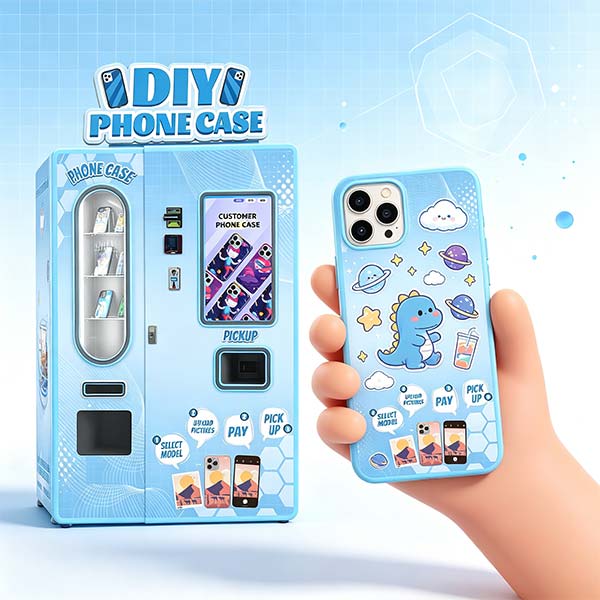
On the phone case vending machine WM880, moving from the F1080 head to the i1600 head triples printing speed, extends lifespan by a factor of four and doubles clarity, and the step up to the i3200 head costs another US$680. On the cotton candy machine, larger sugar tanks cost US$200 and reduce refill frequency. An optional inventory camera on the phone case machine adds US$200 and removes manual stock counting. These are the line items that quietly shift a machine from a chore into a route you can scale.
Then comes payback, which is where any straight answer to how profitable a vending machine really is runs into volume assumptions instead of sticker prices. The manufacturer’s own material lists a 1 to 3 month payback for the protein shake machine at 30 to 50 cups a day and for the puzzle machine in high traffic locations, and documents nail printer payback as short as 5 to 15 days in mall installations. Every one of those figures carries an assumption about volume: 30 to 50 cups a day, about 10 puzzles a day, 45 to 200 nail orders a day. A site selling 8 cups a day will take far longer no matter how good the machine is, and the same cabinet that pays back in a month in a mall may take two years in a lobby. Run the arithmetic with your own traffic estimate and your own prices before you order, and treat any stated payback period as a scenario you are testing rather than a result you are buying.
What the first 30 days of data tell you
Set up the dashboard before the machine opens and the first month becomes a measurement instead of a guess. A handful of numbers is enough: transactions per day, average ticket, cost per sale, hours of downtime, refill trips and rent as a share of revenue. Compare all six against the assumptions you used to justify the purchase, then act on the gap.
- Low transactions on a busy site usually means price or product selection, and it can be fixed from the management screen.
- Low transactions on an empty site means the location is wrong, and no price cut will repair it.
- A healthy ticket with a weak margin points at consumable purchasing, especially where bulk tier pricing was not used.
- Repeated downtime points at maintenance and spare part supply, which is a supplier question rather than an operator question.
- Heavy refill trips on a high traffic site mean the machine is too small for the volume it is doing.
That last point is a good problem, and it is the one that justifies a second unit. The first month is also when vending machine profitability stops being a projection and becomes a number you can act on, which is why the data matters more than the brochure. Operators who already run a route tend to give the same advice about this stage, and the vending machine business tips that survive are the ones about response time and refill discipline rather than product choice.
Frequently asked questions
What is the biggest factor in vending machine profitability?
Transactions per day at the site comes first, followed by the margin on each sale. A machine completing 30 sales a day with US$3 of margin each beats one completing 100 sales with US$0.30 of margin. Within a chosen site, cost per sale and throughput are the two inputs an operator controls directly.
How much does a vending machine make in a month?
It depends on volume and price. The manufacturer’s planning examples put a protein shake machine at 30 cups a day and US$5 per cup at about US$3,600 of monthly revenue, and a smoothie machine at 40 cups a day and US$4.50 per cup with US$1.30 of consumable cost at roughly US$3,840 of monthly gross profit. Both figures assume steady traffic, and a quiet site will produce less.
How long does a vending machine take to pay for itself?
Published payback periods in this range run from 5 to 15 days for a mall nail printer to 1 to 3 months for a protein shake or puzzle machine in a high traffic location. Each of those figures assumes a specific daily volume, so the honest way to use them is to rebuild the calculation with your own foot traffic, your prices and your rent. A fuller year one model, including running costs and location fees, sits in this guide to how profitable owning a vending machine is.
Can a vending machine run without staff?
Yes. The cotton candy machine is built for 24 hour unattended operation, the protein shake and smoothie machines run without a counter or a cashier, and the puzzle and balloon machines vend around the clock. Restocking, cleaning and cash collection still need a person, and remote monitoring is what keeps those visits to a minimum.
Do I have to pay the location owner?
Usually, either as a flat monthly fee or as a percentage of revenue. Space also sets the limit on which machine fits: about 1 square metre for the balloon machine and 1.5 square metres for a nail printer installation, against larger footprints for ice cream and cotton candy units. Sites that charge nothing often have the lowest traffic, which is not a saving.
Which costs do owners underestimate most?
Consumables bought in small quantities, because the bulk tier price is often 10 to 20 percent lower. Delivery, payment processing, spoiled perishable stock, technician visits and the sales lost while a machine is offline are the other recurring items that never appear in a purchase quote. A model of vending machine profitability that leaves them out will look better than the business actually is.
Is a cheaper machine more profitable?
Not by itself. A lower price helps the payback calculation, but a machine that cannot keep up with demand, runs out of stock or fails without an alert costs more over a year than a better equipped unit. Compare cost per sale, time per sale, capacity between refills, payment options, monitoring, warranty and spare part availability before comparing price alone.
How do I compare two suppliers fairly?
Ask for the consumable price list and the machine price in the same document, then ask what happens after the warranty ends. Wider Matrix, for example, ships from its own factory in Guangzhou with tier pricing from 1 unit, and the company reports more than 3,000 machines shipped to 130+ countries with a one year warranty and lifetime technical support. Requests for a written consumable quote and a spare part lead time will sort serious suppliers from resellers quickly.
Get numbers for your site
A quote is only useful when it is built on your location rather than on a generic model. Send the venue type, an estimate of daily foot traffic, the floor space available and the price you plan to charge, and Wider Matrix will come back with the consumable price list, the machine configuration that fits the site and a payback model using your inputs rather than theirs.
If you would rather see the catalogue first, start with the popcorn vending machine at US$1,800 or the phone case vending machine at US$4,999, then ask for the numbers behind vending machine profitability at your own address. Machine prices, shipping terms, taxes and bulk discounts change with destination, so a written quote beats a marketplace listing every time.
Send the details through the contact form and a reply usually comes back within 24 hours, in your time zone, with the figures attached.