



Client name: UrbanPoint Retail Group
Project location: Los Angeles, California, USA
Project type: unattended retail project at a shopping mall
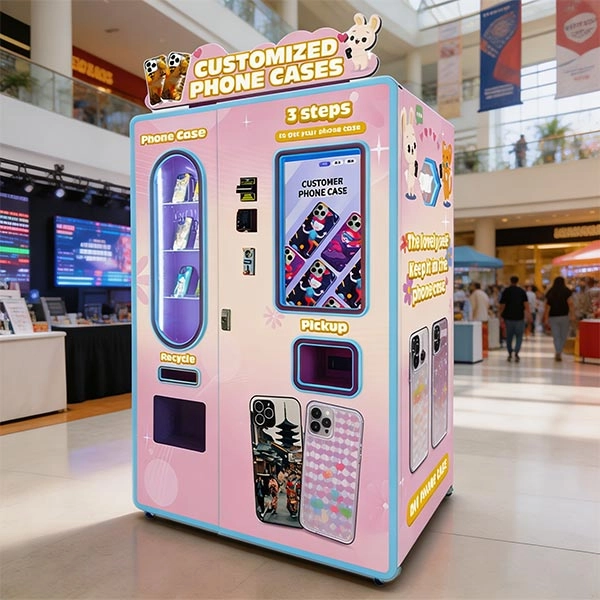
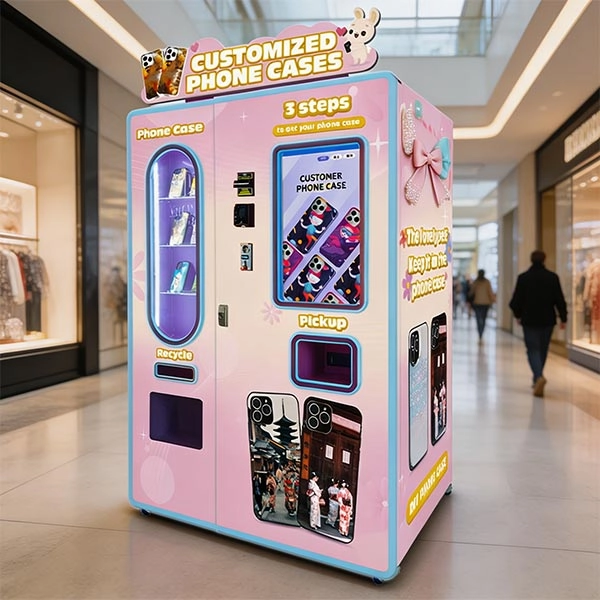
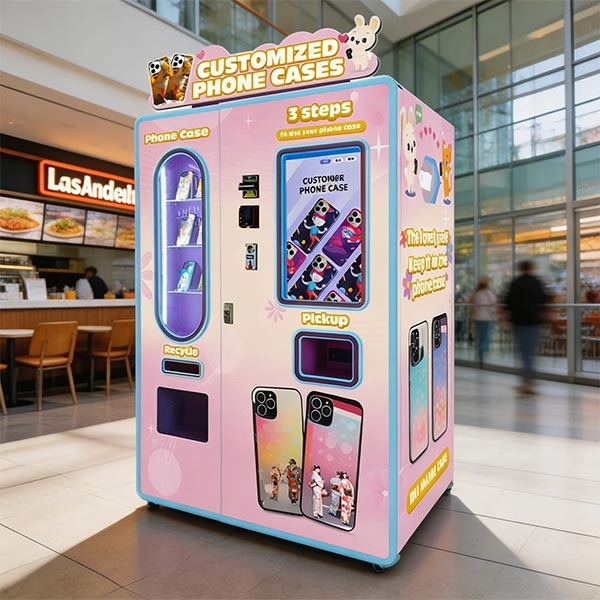
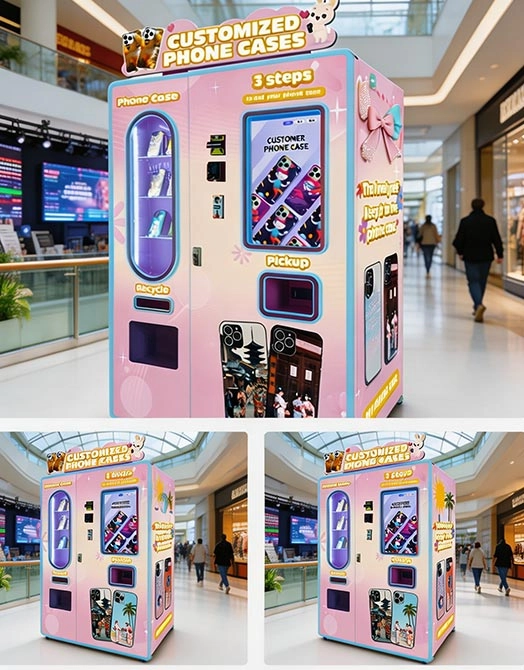
Machine model: WM880 phone case vending machine
First order: 2 units
1. Project background
UrbanPoint Retail Group is a commercial operating group based in California. Its main work is managing shopping centres and commercial complexes.
Younger shoppers have become a core group in shopping centres, so UrbanPoint wanted to go beyond the traditional retail formats and bring in something with more interaction, personalisation, and hands-on experience.
During planning, UrbanPoint looked at drinks and snacks machines first. Market research showed that these products are heavily homogenised inside shopping centres, and the interaction between a customer and the machine stays quite limited.
So UrbanPoint set out to find a product that worked differently from a normal vending machine:
A machine that could sell on its own, let the customer take part, and carry some personalisation and social sharing value.
After several rounds of discussion, UrbanPoint settled on our WM880 phone case vending machine.
The first order was two units, placed at the shopping centre’s cinema entrance and in the dining and leisure area.
2. UrbanPoint Retail Group’s project requirements
Before settling on the machine, UrbanPoint set out a few core requirements for how the project would run.
Unattended operation
A shopping centre cannot keep a dedicated staff member on one machine, so the machine needed to run with as little manual involvement as possible.
Customers should be able to browse, pay, and customise on their own. Operators only need to restock and maintain the equipment on a set schedule.
Coverage of multiple phone models
Shoppers in Los Angeles use a wide range of phone brands and models.
A machine that only held a few models would cap the number of orders, so UrbanPoint wanted Apple, Samsung, and Google Pixel covered at minimum.
Large inventory capacity
A phone case is not the same as a normal vending product. Each model is its own SKU.
So the machine had to hold enough cases and let operators adjust the stock ratio between models based on sales data.
Multiple payment methods
As a US commercial project, UrbanPoint wanted customers to pay with credit card and NFC, while keeping QR as an option that could be switched on later.
Remote management
UrbanPoint plans to copy this project to other shopping centres later.
So the client cared a lot about whether the back end could show sales data, order information, machine status, and inventory from a distance.
3. The solution configured for the client’s needs
Based on UrbanPoint’s actual requirements, we configured the project with the WM880 i1600-U1 phone case vending machine.
The WM880 measures 1340 x 990 x 2170 mm, draws 410W, and supports 110V to 220V input, which covers overseas commercial deployment.
On the print system, the client chose the Epson i1600-U1 print head.
The WM880 offers F1080, i1600-U1, and i3200-U1HD print head options, so the choice depends on the printing needs and operating scale of each project.
Compared with the base F1080 version, the i1600-U1 improves print speed, lifespan, and clarity, which is why UrbanPoint found it the better fit for a shopping centre’s day-to-day workload.
On capacity, the i1600-U1 version holds up to 1,025 phone cases, covering a wide range of models while cutting down restocking frequency.
4. Adjusting the phone case SKUs to the local market
Once the machine was confirmed, we worked with UrbanPoint on the SKU configuration.
Since the project was aimed at US consumers, the first stock leaned on the iPhone line, with some popular Samsung and Google Pixel models alongside.
The first fill focused on:
- iPhone 16 series
- iPhone 15 series
- iPhone 14 series
- iPhone 13 series
- selected popular Samsung models
- selected popular Google Pixel models
The WM880 supports Apple, Samsung, Google Pixel, Xiaomi, Huawei, and OPPO, so the SKU mix can be adjusted later for different countries and regions.
After launch, UrbanPoint found through the back-end sales data that some popular iPhone models sold noticeably better than others.
The client gradually cut the slow models and pushed more stock into the popular ones.
That way, the machine’s limited slot space went to the models that actually moved.
5. Customers can customise a phone case on site
A key reason UrbanPoint picked the phone case vending machine was to offer a retail experience that differs from a normal store.
A traditional phone case sale goes:
Pick a finished product, pay, leave.
The WM880 changes the process to:
Pick a phone model, upload a picture, pay, get a custom case.
A customer can upload their own photo, a pet photo, a travel photo, a couple’s photo, or a design they like, and turn it into their own case.
The whole flow is four steps:
Step 1: Scan. Scan the QR code on the machine screen.
Step 2: Select model. Choose the phone model.
Step 3: Upload a picture. Upload the photo or image to print.
Step 4: Payment. Complete the payment.
After payment, the machine moves into the case production stage.
A first-time user does not need any know-how, and no staff member needs to stand there guiding them.
6. Personalised printing became a key selling point
In actual operation, UrbanPoint found that customers were clearly more interested in designing their own case than in buying a finished one.
At the cinema entrance especially, customers waiting for a film had some idle time and were more willing to stop, upload a picture, and try the case DIY.
The WM880 has print visual recognition that helps position the image accurately, reducing the white-border problem.
The cases use TPU and PC composite material, with different lens protection designs.
That gives the case a personalised look while still holding up in daily use.
For UrbanPoint, this product-plus-DIY model also turned the machine into a small interactive consumption scene inside the shopping centre.
7. Multiple payment methods for the US market
For the US market, the project was configured mainly around credit card and NFC.
At the same time, the WM880 supports cash, coin, credit card, NFC, and QR, so the payment setup can be changed for different markets.
For UrbanPoint, that flexibility means the machines can keep working in Los Angeles malls now and be adjusted to other regions’ payment habits later.
It also makes a wider rollout easier down the line.
8. Remote back end for managing the machines
For a commercial operating group, installing the machine is only the start of the project.
What really affects later operating efficiency is whether the machine can be managed conveniently.
So we configured the WM880 with a PC and mobile app remote management system for UrbanPoint.
Operators can check the following from the back end:
- daily, weekly, and monthly sales data;
- order records and order status;
- machine running status;
- printer running status;
- machine alarm information;
- network connection status;
- promotional activities;
- multi-currency and language settings.
Using a phone or computer, UrbanPoint’s operators can check how the machines are doing without standing next to them.
UrbanPoint also added the optional inventory identification feature.
The camera module helps recognise and monitor the phone case stock inside the machine, cutting down manual stocktaking.
9. Project rollout and operating results
In March 2026, the two WM880 phone case vending machines were installed and put into formal operation.
The first machine went near the shopping centre’s cinema entrance, and the second went in the dining and leisure area.
In the first two weeks, UrbanPoint mainly watched how customers used the machines, including:
- which phone models were in highest demand;
- which area saw higher machine usage;
- what kinds of pictures customers preferred to upload;
- which payment method was used most;
- how orders shifted across different time periods.
After the test period, the cinema entrance machine clearly outperformed the dining area machine.
Orders picked up noticeably on Friday nights and weekends in particular.
In the first full month, the two machines handled about 860 orders combined.
Of those:
Cinema entrance machine: 18 to 20 orders a day on average.
Dining area machine: 8 to 10 orders a day on average.
The average sale price of a custom case was about $29.9 per case.
Based on the early operating data, the two machines’ first-month sales came to about $25,000.
As UrbanPoint kept adjusting the SKUs based on sales data, improved the on-screen content, and ran promotions alongside mall events, second-month orders rose about 17% over the first month.
10. Client feedback
After some time in operation, UrbanPoint Retail Group is satisfied with the project’s overall performance.
The client believes the biggest difference between a phone case machine and a normal vending machine is not the automated selling, but that customers genuinely want to take part in the whole process.
In front of a drinks or snacks machine, a customer buys and leaves right away.
In front of a phone case machine, the customer picks a model, chooses or uploads a picture, and waits for the personalised product to finish.
The whole process adds interaction between the customer and the machine.
At the same time, some customers photograph the finished case and post it to Instagram, TikTok, and other social platforms, which brings the shopping centre extra word of mouth.
So in UrbanPoint’s view, the WM880 is not only an automated vending machine, but can also serve as an interactive retail experience point inside the shopping centre.
11. Why UrbanPoint chose the WM880
In the early stages of the project, UrbanPoint Retail Group also compared other phone case printing machines on the market.
In the end, the client chose the WM880 based mainly on these points.
Large inventory capacity
It holds over 1,000 phone cases, covering more models and reducing the daily restocking burden.
Flexible print configuration
The WM880 offers F1080, i1600-U1, and i3200-U1HD print head options with upgrade support, so the right configuration can be picked for each stage of a project.
Smart back-end management
The PC and mobile app setup lets operators check sales, orders, and machine status remotely, which makes running multiple machines easier later.
Multiple payment methods
Cash, coin, credit card, NFC, and QR are all supported, adapting to the payment habits of different markets.
Configuration for overseas markets
The WM880 supports multiple languages and currencies, so it can be tuned to the needs of different countries and regions.
12. Main project configuration
| Item | Configuration |
|---|---|
| Client name | UrbanPoint Retail Group |
| Project location | Los Angeles, California, USA |
| Application scenario | Shopping mall |
| Units deployed | 2 |
| Machine model | WM880 |
| Print head | Epson i1600-U1 |
| Case capacity | 1,025 |
| Case material | TPU + PC |
| Input voltage | 110V to 220V |
| Power | 410W |
| Dimensions | 1340 x 990 x 2170 mm |
| Payment methods | Credit card / NFC / QR |
| Back end | PC + mobile app |
| Inventory identification | Optional |
| Core customer | Younger shoppers, tourists, couples, families |
13. Project summary
For UrbanPoint Retail Group, this phone case vending machine project was not simply about adding two vending machines.
What the client really wanted to solve was:
How to use limited commercial space to create a new retail project that draws younger shoppers, cuts manual involvement, and offers a personalised experience.
By combining phone case storage, personalised printing, self-serve payment, automated operation, and remote management, the WM880 gives shopping centres a new kind of consumption scene.
Customers can spend a few minutes designing their own case while shopping, dining, or waiting for a film.
Operators can check machine data from the remote back end and adjust phone models and stock based on actual sales.
Moving from selling a product to letting the customer take part in making it, the phone case vending machine offers shopping centres a more interactive form of unattended retail.
UrbanPoint Retail Group is now assessing a rollout to its other shopping centres, and it plans to test the machines in tourist areas, entertainment centres, and other commercial scenarios.
For operators who want to bring unattended retail with a personalisation angle into a commercial space, the WM880 phone case vending machine is a business model worth considering.