



Walk through the ground floor of any large shopping mall and you will see the same pattern. A nail salon with a two hour wait list, a row of teenagers scrolling on their phones, and a kiosk selling something nobody planned to buy. A nail vending machine for shopping mall placement sits in that gap. It takes a customer who has twenty minutes, prints a custom set of press on nails in about five, and sends them on their way with a product they did not know they wanted. No appointment, no nail tech, no chair. That is the whole pitch for a nail vending machine in a mall, and it is why the format keeps spreading.
This article is written for someone weighing whether to put a nail vending machine in a shopping mall, either as a mall operator, a vending business owner, or an investor. I will go through what the machine actually does, what it costs to buy and run, how the numbers work out, and the placement decisions that separate a machine that pays for itself in two weeks from one that sits idle. I have spent years around automated retail equipment, and I have watched these units do well in malls and also watched them fail in the wrong spot. The machine is proven. The placement is what you have to get right.
What a nail vending machine actually does
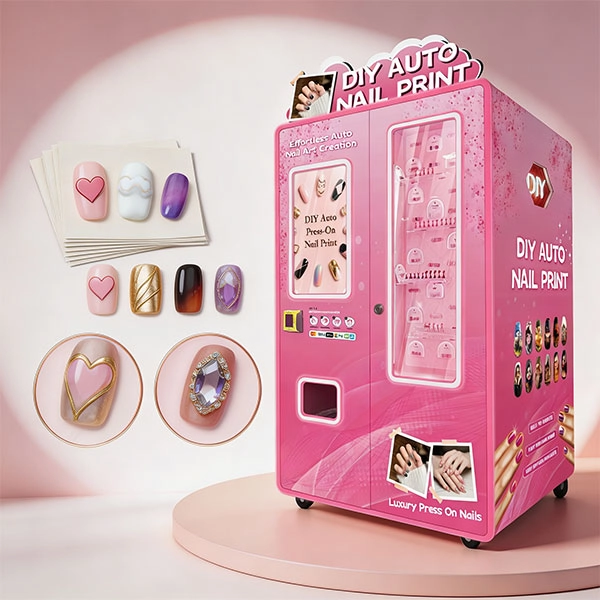
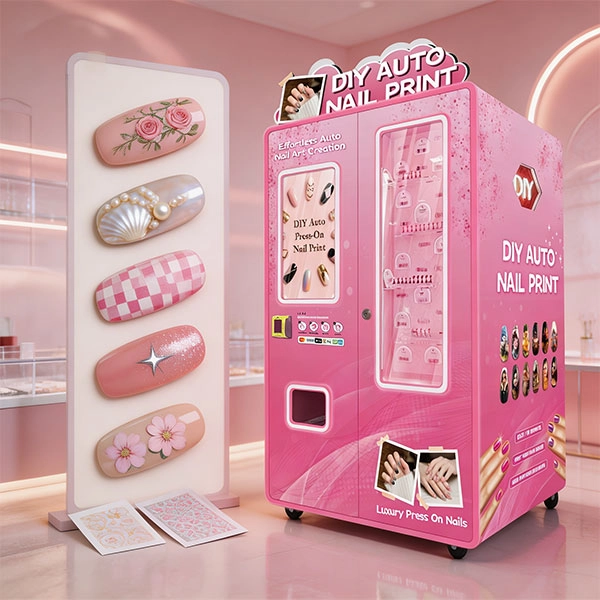
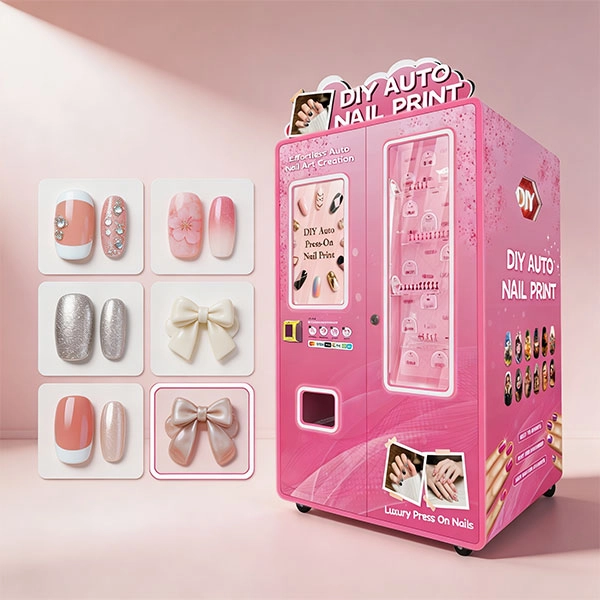
People picture a robot arm painting a customer’s fingernails. The machines that work in malls do not work that way. They print onto press on nails, not onto the hand. The customer picks a design on a touchscreen, the machine prints the pattern onto a set of press on nails with UV ink, cures it in about thirty seconds, and drops the finished set into a tray. The customer takes the nails home and applies them. The whole service runs about five minutes from start to finish, which is what makes a nail vending machine a fit for a busy mall floor.
Take the Wider Matrix WM860 as the concrete example, because it is the model most mall buyers ask about. It uses IMT printing, which means it prints directly onto the surface of the press on nail. The print head is an industrial grade F1080 UV head running at 600 dpi, and the ink system is six colors, which is four colors plus two sealants at 250 milliliters per bottle. The UV LED curing takes about thirty seconds, so the print is dry before the customer picks it up. There is no smudging and no waiting.
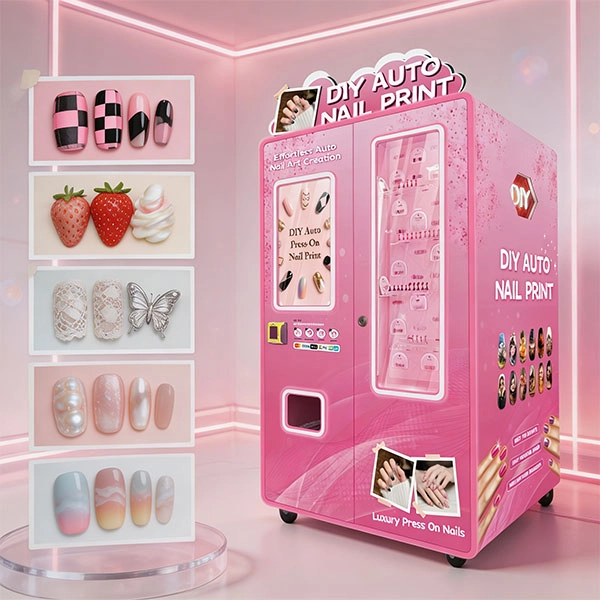
The machine holds 720 pairs of press on nails, split between plain sets and pre designed sets. It comes with 48 built in nail patterns, including French and 3D cat eye. Customers can also upload their own photo over Wi Fi, with no app to install, and the machine uses AI to position the design automatically. The screen is a 27 inch HD capacitive touch display at 1920 by 1080. The whole unit runs on a cloud dashboard that lets you watch sales, ink, and inventory remotely, push new designs over the air, and manage more than a hundred machines from one screen.
Why a shopping mall is the right home for it
A nail vending machine for shopping mall placement works because malls give it three things at once: foot traffic, dwell time, and a buying mood. The traffic is obvious. The dwell time matters more. People in a mall are not rushing. They are waiting for a movie, waiting for a table, or killing time between stores. A five minute nail print fits that window perfectly. And the buying mood is already there, because a mall is a place where people spend money on things they did not plan to buy.
The comparison to a traditional nail salon is where the placement logic gets clear. A salon needs ten square meters or more, a licensed nail tech, fixed hours, and a manager. The WM860 needs about 1.5 square meters, runs 24 hours a day with nobody on site, and serves a customer in five minutes instead of sixty to one hundred twenty. A mall can put one of these in a corner that would otherwise be dead space and turn it into a revenue line.
If you are deciding between malls or between spots inside one mall, the where to put vending machines guide walks through the traffic patterns and lease terms that matter. The short rule I give every operator is this: put the machine where people already stop and wait, not where you hope to create a destination.
What it costs to buy and run
Let me give you the numbers straight, because pricing is where buyers get confused. The Wider Matrix WM860 is US$5,800 for one to four units, US$5,500 for five to nine, and US$5,200 for ten or more. The startup cost used in the ROI analysis is US$5,500. Wider Matrix also runs limited time promo pricing and consumable bundle deals, so the number can move depending on when you buy. For a mall operator, the price of a nail vending machine is only part of the picture, because the lease, the power, and the supply chain all add to the total.
The running costs are where the margin lives. Plain press on nails in four styles run US$1.00 a pair at 1,000 pairs, US$0.90 at 5,000, and US$0.80 at 8,000. Cat eye and gem press on nails in sixteen styles run US$1.50 a pair at 1,000, US$1.40 at 5,000, and US$1.30 at 8,000. Tool kits are US$0.30 a set. The UV hard ink, which is four colors plus two sealants at 250 milliliters a bottle, is US$85 a set, and each bottle prints roughly 5,000 pairs.
So the material cost per pair lands around US$1.50. If you sell a set for US$10, the gross margin is over 80 percent. That is the number that makes the whole business work, and it is why the payback is so short compared to a traditional salon.
How fast it pays back
I am careful with profit claims, because a lot of what you read online is inflated. Here is the realistic range from the WM860 numbers. At 30 orders a day at US$8 each, daily revenue is US$240, material cost is US$1.50 a pair, daily profit is about US$195, and monthly profit is around US$5,850. That pays back the US$5,500 machine in about thirty days. At 70 orders a day at US$10, daily profit is about US$595, monthly profit is US$17,850, and payback drops to about fifteen days. At 120 orders a day, payback is about eight days. At 200 orders a day, which is a strong holiday or weekend number, payback is about five days.
Those are not fantasy numbers. They come from real mall installations. A Wider Matrix customer in a Dubai shopping mall runs a kiosk, sells at US$8 to US$15 a pair with material at US$1.50, averages 45 orders a day, clears US$5,400 a month in profit, and recovered the US$5,800 investment in fifteen days before ordering three more units. A Bangkok mall location hit 200 orders a day during a holiday promotion and paid back in five days, which is the fastest the manufacturer has recorded.
For a broader look at what vending machines can earn, the how much can a vending machine make guide gives you a baseline for the whole category, and the are vending machines profitable analysis runs the scenarios in more detail.
Where inside the mall to place it
Placement inside the mall matters as much as the mall itself. The best spots are near the food court, the cinema entrance, and the main walkway between anchor stores. Those are the places with the highest dwell time and the most people in a buying mood. A spot near the nail salon is a double edged sword. It can catch overflow from a busy salon, but it can also look like competition to the salon that pays rent in the same mall. Talk to the mall management about that before you commit.
Foot traffic is not the only thing to check. You need to confirm the machine can get into the building and into the spot, and that there is power where you want it. The WM860 is a self contained unit, but it still needs a clean power source and enough clearance to move it in. Check the loading dock and the elevator before you sign, not after.
If you are comparing multiple malls or multiple spots, the best place to put a vending machine guide and the 171 best vending machine locations list cover the traffic patterns and the lease terms in more depth.
How it compares to a traditional nail salon
The comparison is worth spelling out, because it changes how you think about the machine. A traditional salon serves one customer in sixty to one hundred twenty minutes. The WM860 serves one in five. A salon needs ten square meters and a licensed tech. The machine needs 1.5 square meters and nobody. A salon is limited by the nail tech’s skill. The machine offers AI custom designs plus 48 built in patterns. A salon runs fixed hours. The machine runs 24 hours a day unattended. A salon takes eighteen to twenty four months to pay back. The machine does it in five to fifteen days.
There is also a difference in how the customer’s nails are treated. A traditional salon files the nail and uses a UV lamp on the hand. The WM860 prints onto a press on nail, so there is no filing and no UV exposure to the skin. That is a real selling point for customers who are nervous about salon treatments.
The machine also opens revenue streams a salon does not have. It can run a mini program commission, offer remote printing, and license IP designs. A salon mostly sells upgrades. The machine sells a product with a margin over 80 percent and no labor attached.
What to check before you buy
Buying a nail vending machine for shopping mall placement is a capital purchase, and you should treat it like one. Here is the checklist I give every buyer. It applies whether you are placing one nail vending machine in a single mall or a small fleet across a few locations.
First, confirm the mall will accept the machine and where it can go. Some malls restrict kiosk placement or charge a premium for high traffic corners. Get the placement and the lease terms in writing before you buy the machine.
Second, check the power and the access. The machine needs a clean power source and enough clearance to move in. Confirm the loading dock, the elevator, and the doorway before you commit.
Third, check the inventory and ink supply chain. The machine holds 720 pairs and alerts you when stock runs low through the IoT dashboard. Make sure you have a reliable source for press on nails and ink, because a machine that runs out of stock in the middle of a weekend is a machine that loses money.
Fourth, check the service and parts situation. Ask the manufacturer about the warranty, spare parts, and how fast a replacement part ships. This is where buying from a real manufacturer matters, and the choosing the right vending machine manufacturer guide is worth reading before you commit.
Why Wider Matrix for a mall operator
Wider Matrix builds the WM860 and ships it to operators around the world, including a steady flow of units into shopping malls. The company has shipped more than 3,000 units to over 130 countries since 2016, and the engineering team is more than 50 people. When you buy from Wider Matrix, you buy from the factory in Guangzhou, not from a reseller, which matters for two reasons. The first is price, because there is no middleman markup. The second is support, because the people who built the machine are the people you talk to when something needs attention. The warranty is one year with lifetime support, and global shipping is included.
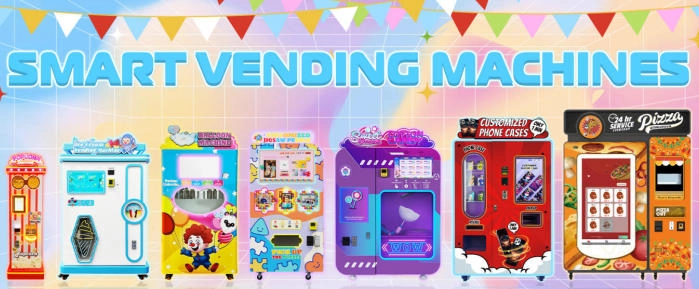
The company also makes the broader vending line, so if you are building a mall footprint, you can standardize on one supplier across nail, phone case, cotton candy, popcorn, and ice cream machines. That is a real advantage when you manage multiple locations and want one support contact and one set of spare parts.
If you want to see how the same placement logic applies to another mall product, the mall phone case vending machines guide covers a similar machine in the same kind of location. For the sourcing side, the China vending machine manufacturers and suppliers guide explains how factory direct buying works and what to watch for.
Common questions about nail vending machines in shopping malls
How much does a nail vending machine cost?
The Wider Matrix WM860 is US$5,800 for one to four units, US$5,500 for five to nine, and US$5,200 for ten or more. The startup cost used in the ROI analysis is US$5,500. Shipping, installation, and any electrical work at the mall are separate costs.
How long does it take to make one set of nails?
About five minutes from start to finish. The machine prints the design onto a set of press on nails, cures it in about thirty seconds with UV LED, and drops the finished set into a tray.
How many pairs of nails can it hold?
The WM860 holds 720 pairs of press on nails, split between plain and pre designed sets. The IoT dashboard alerts you when stock runs low.
Can customers upload their own design?
Yes. Customers upload a photo over Wi Fi with no app to install, and the machine uses AI to position the design automatically. It also comes with 48 built in patterns including French and 3D cat eye.
What payment methods does it accept?
The machine accepts bank card, Apple Pay, Google Pay, WeChat Pay, Alipay, QR code, and NFC, and it supports the universal MDB protocol.
How profitable is a nail vending machine in a mall?
At 30 orders a day at US$8, monthly profit is about US$5,850 and payback is about thirty days. At 70 orders a day, monthly profit is about US$17,850 and payback is about fifteen days. The material cost per pair is about US$1.50, so the gross margin is over 80 percent.
What is the best spot inside a mall?
Near the food court, the cinema entrance, and the main walkway between anchor stores. Those areas have the highest dwell time and the most people in a buying mood.
Does it need a nail tech to operate?
No. The machine runs 24 hours a day unattended. It prints onto press on nails, so there is no filing and no UV exposure to the skin.
How does it compare to a traditional nail salon?
A salon serves one customer in sixty to one hundred twenty minutes and needs ten square meters. The machine serves one in five minutes and needs 1.5 square meters. A salon takes eighteen to twenty four months to pay back. The machine does it in five to fifteen days.
Can I buy directly from the manufacturer?
Yes. Wider Matrix is the factory, so you buy direct without a reseller markup, and you deal with the people who built the machine for support and spare parts. The warranty is one year with lifetime support.
Final word
A nail vending machine for shopping mall placement is a proven business when the numbers line up. The machine is reliable, the margin on a set of press on nails is over 80 percent, and the payback is measured in weeks, not years. The operators who make money with these units do the homework on the mall, the spot, the power, and the supply chain before they buy. The ones who lose money skip that homework and blame the machine.
If you are serious about putting one of these in a shopping mall, the next step is to talk to Wider Matrix directly about your mall, your spot, and the model that fits. They can walk you through the WM860, the pricing tiers, and the consumable bundle deals, and give you a shipping and support plan. Send them your mall details and your expected foot traffic, and they will tell you straight whether the numbers work.