


A practical operator’s guide for salon owners weighing a self-service nail printer. It explains why a salon searches for this machine, how the WM860 prints a custom set in about five minutes, the real purchase and consumable costs, the profit and payback numbers, where the unit earns its floor space, the three checks that separate a durable machine from a clogging one, and why operators buy from Wider Matrix. Written to match the search intent behind “nail art vending machine for beauty salon” and to end with a soft request for a quote.
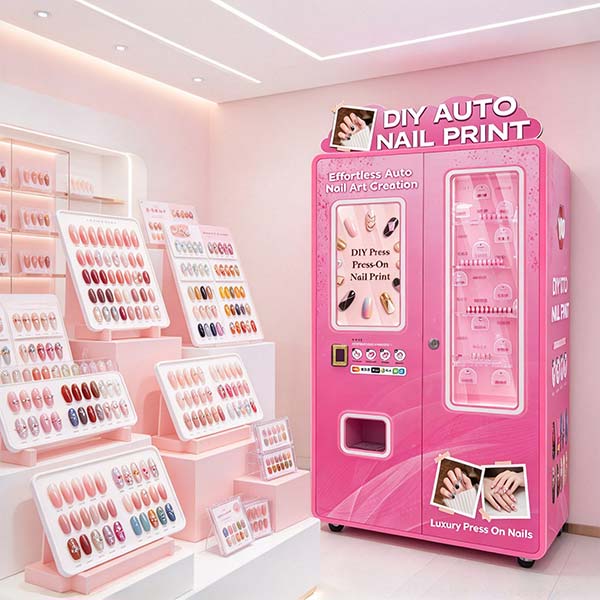
A nail art vending machine is a self-service kiosk that prints a custom design onto a set of press-on nails and hands it to the customer in about five minutes. In a salon it usually sits by the door or near the waiting chairs. Clients pick a design, pay at the screen, and leave with a fresh set while your techs stay booked on the chairs. This guide follows the WM860 from Wider Matrix, the model most salons run, through the purchase price, the running costs, and the money it actually brings back in.
If you manage a beauty salon, you have lived through the same afternoon more than once. Three customers arrive at once. Two have appointments, one does not. Your techs are fully booked, so the walk-in leaves, and you watch that sale walk out behind them. A nail printer does not replace a nail tech. It catches the customers a full schedule would otherwise turn away, and it does it without adding to your wage bill.
Why a salon owner looks for a nail art vending machine
The search almost always starts with scheduling. Beauty salons lose money on three points: a tech who calls in sick, a Saturday rush that outruns the chairs, and clients who want the kind of nail art the team does not offer. A nail art vending machine answers all three at once.
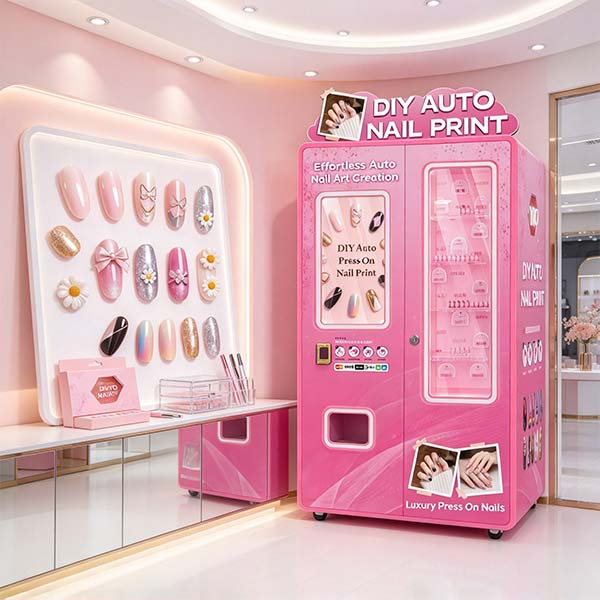
Hand-painted nail art is the bottleneck in most salons. A single set can take 60 to 120 minutes, and it only works if the tech already knows that exact design. A cat-eye finish, a photo of a pet, a gradient across ten nails: all of that takes skill and time. The WM860 ships with 48 built-in designs and lets a client upload a photo over Wi-Fi, with no app to install. The machine finds the nail bed on each finger by itself, prints at 600 dpi through an industrial F1080 print head, and cures the ink under a UV printing lamp in 30 seconds. The client walks out in five minutes instead of sitting for an hour and a half.
There is a second reason salons search for this, and it sits outside the salon itself. A nail printer needs only 1.5 square meters and can run 24 hours, so the same machine also works as a mall kiosk, a beauty supply store counter, or a second front-of-house spot where you would never post a licensed tech. That is where the busier owners start thinking one step ahead: one unit in the salon, one at the store.
How a nail art vending machine works, step by step
The whole flow is five minutes. The customer opens the 27-inch touchscreen and picks one of 48 ready designs, or uploads a photo from the phone. The machine locates each nail bed by itself, so the customer does not line anything up. The 600-dpi printer lays the design straight onto the press-on nail surface, and a UV-LED cures the ink in 30 seconds so it sets instantly. The client pays by card, Apple Pay or Google Pay, or WeChat Pay or Alipay, and the set drops into the tray.
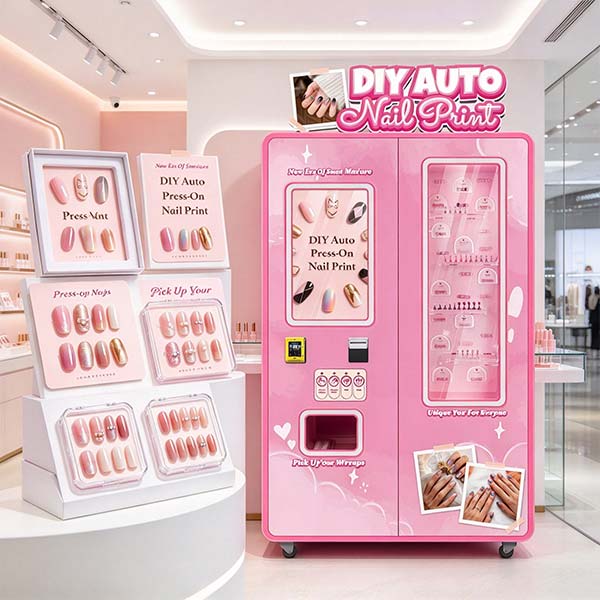
Because it prints onto press-on nails rather than onto a live hand, there is no filing and no UV lamp held against the skin. That detail matters to the customers who already worry about nail damage. The hopper holds 720 pairs of blanks, a mix of plain and pre-designed nails, and the built-in IoT board sends a stock warning before anything runs out.
What a nail art vending machine costs
The WM860 sells for US$5,800 for one to four units, US$5,500 for five to nine, and US$5,200 for ten or more. Most single-location operators budget around US$5,500 all in. The consumables stay cheap because these are press-on nails, not full acrylic work. Plain blanks run US$0.80 to US$1.00 a pair depending on volume, and the cat-eye and gem styles run US$1.30 to US$1.50. A set of six ink bottles costs US$85 and prints roughly 5,000 pairs before you replace it.
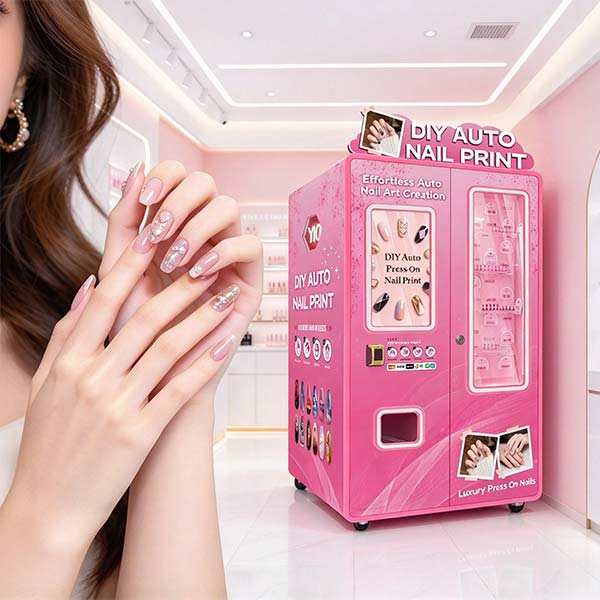
If you want the hardware cost set against other machine classes, the guide on what vending machines cost to run is worth a read. The short version for a salon: the hardware is a one-time outlay, the recurring spend is nails and ink, and neither needs a technician on call.
What the numbers look like in a real salon
Here is the arithmetic at the machine’s margins, which run above 80% because the material cost stays near US$1.50 a set while retail sits between US$8 and US$15.
| Daily sets | Retail price | Daily revenue | Material per set | Daily profit | Monthly profit | Payback |
|---|---|---|---|---|---|---|
| 30 | $8 | $240 | $1.50 | $195 | $5,850 | ~30 days |
| 70 | $10 | $700 | $1.50 | $595 | $17,850 | ~15 days |
| 120 | $10 | $1,200 | $1.50 | $1,020 | $30,600 | ~8 days |
| 200 | $12 | $2,400 | $1.50 | $2,100 | $63,000 | ~5 days |
Those are projections, not promises. Two recorded examples are more useful. A mall kiosk in Dubai averages about 45 sets a day, clearing US$5,400 a month after costs; the owner recovered the US$5,800 machine in 15 days and then ordered three more. A Bangkok shop hit 200 sets a day during a holiday push and paid the unit off in five days, which Wider Matrix records as its fastest payback.
If you want to check the logic against the wider trade, the guide on how much a vending machine can make runs the same math for several machine classes.
Where it fits in a salon, and where it does not
Inside a beauty salon the machine earns its floor space by catching walk-ins and giving sit-down clients a quick add-on while their polish dries. Outside the salon, the same 1.5 square meters works in a shopping mall, an airport, a cinema, a beauty supply store, or a university campus. Wider Matrix keeps a longer list in its guide on where to place vending machines.
It helps to be plain about the limit here. A nail printer sells nail art. It does not cut cuticles, shape nails, or build acrylic overlays, so it will not replace a full manicure. The salons that get the best returns use it as an extra chair that never takes a lunch break, not as a substitute for the techs they already have.
What to check before you buy a nail art vending machine
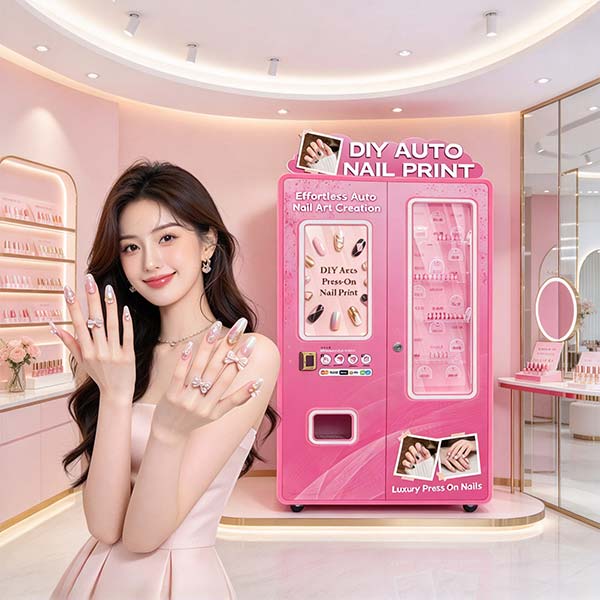
Most of the machines shown online look identical in a photo. Under the hood they are not. Three things separate a unit that runs for years from one that turns into a paperweight.
First, the print head and ink. The WM860 runs an industrial F1080 UV head with a six-color system, and that gap is the difference between a 600-dpi print that survives washing and a cheap head that clogs in a month. Second, the software. A nail printer is a smart vending machine, so the screen matters as much as the nozzle. Check whether it uploads photos without an app, positions fingers on its own, and pushes new designs out over the air. Third, support. Confirm the warranty, the training, and whether you can reach a real engineer when the unit sits 8,000 kilometers from the factory. That last point matters more in a salon than in a warehouse, because a down machine in the waiting area is a down machine sitting right in front of your clients.
For a fuller list covering certification, lead time, and warranty, Wider Matrix has a separate guide on choosing a vending machine manufacturer.
Why salons buy the WM860 from Wider Matrix
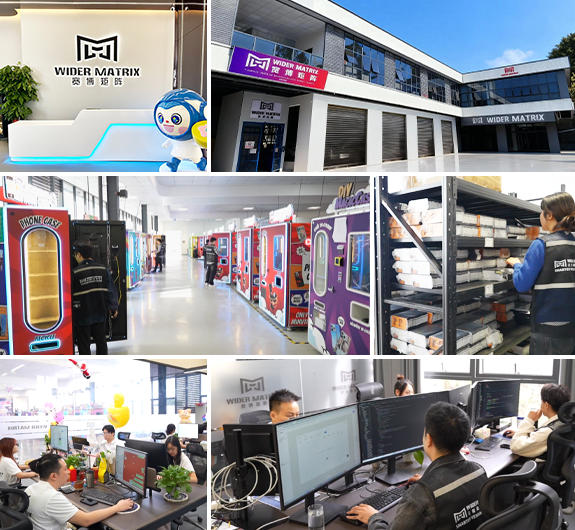
Wider Matrix builds the WM860 in its Guangzhou factory and sells it direct rather than through a trading company, which is one reason the price holds where it does. The company has shipped more than 3,000 machines to over 130 countries since 2016 and keeps about 50 engineers on staff. The machine is CE certified and carries a one-year warranty with lifetime support.
A few specifics stand out for a salon operator. The same cloud dashboard that watches sales and ink levels can run 100+ machines, so an owner with several locations checks the whole fleet from a phone. New nail designs arrive over the air instead of waiting for a technician visit. And because the machine prints on-demand art, you can have the cabinet, the screen, and the color scheme matched to your salon without re-engineering the internals.
For the factory and company background, see Wider Matrix.
Frequently asked questions
How much does a nail art vending machine for beauty salon cost?
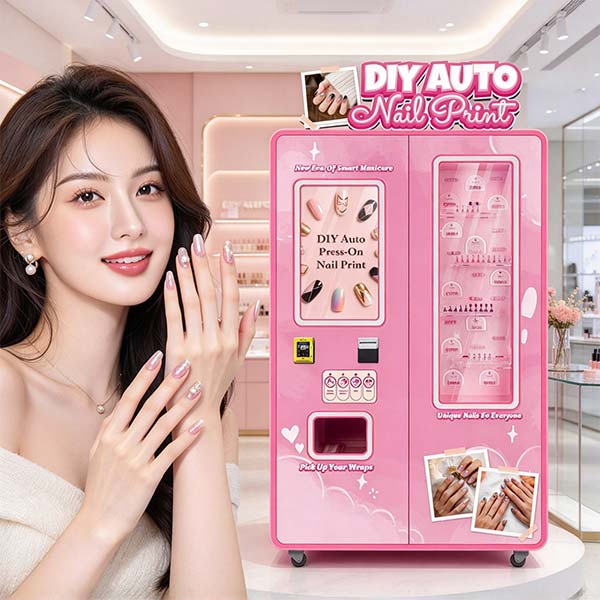
The WM860 costs US$5,800 for one to four units, US$5,500 for five to nine, and US$5,200 for ten or more. Consumables add about US$1.50 per set in materials at retail prices of US$8 to US$15 a set.
How does a nail art vending machine work?
The customer chooses one of 48 designs or uploads a photo over Wi-Fi, the machine finds the nail bed automatically, a 600-dpi UV head prints the design onto a press-on set, and a UV-LED cures it in 30 seconds. The whole transaction runs about five minutes and is fully self-service.
Is a nail art vending machine profitable?
At 70 sets a day the unit clears roughly US$595 daily and about US$17,850 a month, for a payback around 15 days. The gross margin stays above 80% because material cost runs about US$1.50 a set against a US$8 to US$15 retail price.
Can I put a nail art vending machine in my salon without extra staff?
Yes. It is unattended, runs 24 hours, and needs no licensed tech. It occupies 1.5 square meters, so it fits by the door or in the waiting area without removing a chair.
Do I need special training to run one?
No. The customer side is a touchscreen, and the owner side is a cloud dashboard that tracks sales, ink, and inventory. Wider Matrix includes setup guidance with the machine.
The cheapest way to test whether a nail art vending machine makes sense is to run the figures against your own chair count and walk-in rate, then ask for a quote with your location and expected volume. If you want to see the WM860 numbers for your market, contact Wider Matrix and a sales engineer will walk you through them.