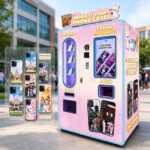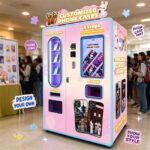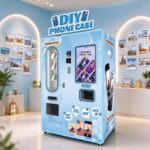


Buying a touchscreen phone case vending machine is a capital purchase, and most buyers ask about price before they know which features drive it. The sticker price can move by thousands of dollars depending on the print head, case capacity, payment hardware, and whether the unit is new or used. A new touchscreen phone case vending machine usually costs US$5,000 to US$12,000 before freight and import fees, and used units often sell for US$6,500 to US$9,000. For a factory-direct machine like the Wider Matrix WM880, single-unit pricing is US$4,999 for the F1080 version and US$5,999 for the i1600 version.

What a touchscreen phone case vending machine costs in 2026
The market splits into four price bands. These are typical ranges buyers see before freight, duties, and site work. Ask every seller what is included in the number they quote.
| Configuration | Typical new price | What you usually get | What to check |
|---|---|---|---|
| Entry single cabinet with a 4-color print head and 500 to 800 case capacity | US$5,000 to US$7,000 | Basic touchscreen, card reader, starter templates | Print speed, phone model list, cost of a spare print head |
| Standard single cabinet with a 6-color or high-speed head and about 1,000 case capacity | US$7,000 to US$10,000 | Faster printing, card and QR payment, remote monitoring | Nozzle check, software fees, warranty on the print head |
| Premium high-capacity or dual cabinet | US$10,000 to US$15,000 | 1,500 or more cases, dual payment, larger screen | Power draw, footprint, whether both cabinets print independently |
| Used unit, 1 to 3 years old | US$6,500 to US$9,000 | Machine as-is, sometimes with starter stock | Print head hours, software license transfer, freight damage |
The touchscreen alone does not set the price. Two machines can both have a large screen and still differ by US$4,000 because one uses a slower print head, has half the case capacity, or lacks remote diagnostics. Compare the print system and the support terms before you compare screen size.
The line items that change your final invoice
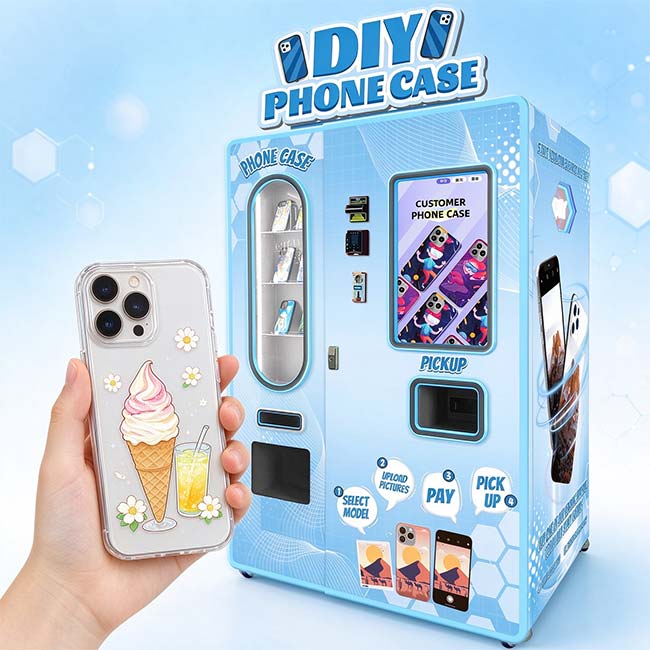
A machine quote is rarely the full cost. The invoice that matters includes everything needed to open the machine and keep it running. Here is a budget table you can use for planning.
| Line item | Budget range | Why it moves |
|---|---|---|
| Machine base | US$5,000 to US$15,000 | Print head, case capacity, cabinet size, software |
| Payment hardware | US$300 to US$800 | Card reader, bill acceptor, NFC. Sometimes bundled |
| Freight | US$500 to US$3,000 | Weight, distance, liftgate, residential delivery |
| Duties and taxes | 0% to 15% | Country and HS code |
| Installation and training | US$0 to US$1,000 | Often remote. On-site visits cost more |
| Starter inventory | US$200 to US$500 | 100 to 300 cases plus ink |
| Site prep | US$500 to US$2,000 | Power outlet, network, floor protection, access |
| Spare parts | US$200 to US$500 | Print head, capping station, feeders |
| Software or connectivity | US$0 to US$50 per month | Some vendors bundle it. Some charge separately |
Ask for a line-item quote so you can compare offers like for like. A single machine price with freight listed as contact seller is not a budget number. Our guide to the full cost breakdown for phone case vending machines goes deeper into these categories.
Why the touchscreen is more than a screen
The screen is where the sale happens. A customer walks up with a photo on their phone. If the interface takes more than a minute to explain, they leave. A good touchscreen does several jobs at once: it shows case designs, lets the customer pick a phone model, accepts an upload, takes payment, and confirms print status.
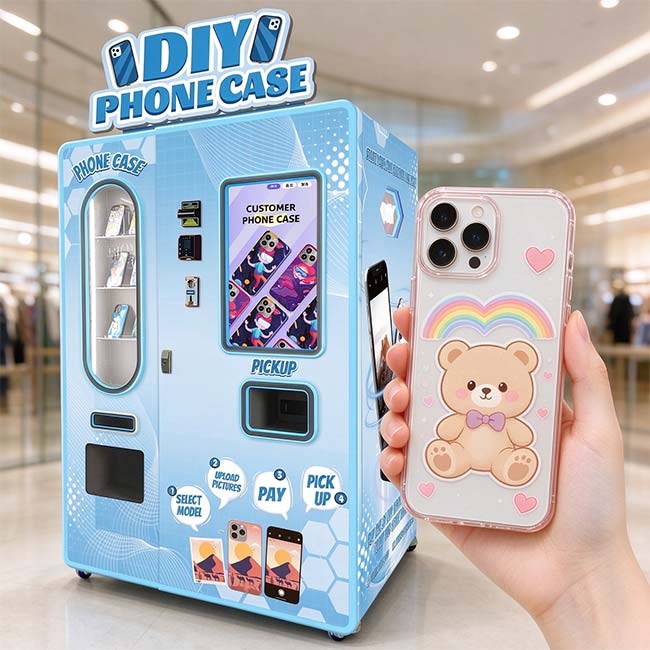
The best flows use a QR code so the customer uploads from their own phone instead of poking at a kiosk screen with dirty fingers. Test the upload path with an older iPhone and a newer Android model. Check how the software crops a tall photo, whether it warns about low resolution, and what happens when the network drops.
Some machines store a template library on the machine. Others rely on cloud templates. Cloud templates can be updated remotely, but they need stable internet. Local templates work offline, but you have to update them by USB or during a service visit. Ask which model you are buying before you sign.
The WM880 flow is scan, choose model, upload photo, pay. The machine prints the case and the customer takes it in about 1 to 3 minutes. That flow matters more than screen size for most buyers. For a closer look at interface and operator issues, read our touch screen phone case vending machine buyer’s guide and this 2026 touchscreen UV printer analysis.
What it costs to run: per-case math
The machine price is only the entry ticket. The number that decides whether you make money is the variable cost per case. Case blanks and ink are the two biggest inputs.
| Cost item | Typical cost | Notes |
|---|---|---|
| Standard TPU+PC case | US$1.10 to US$1.30 | 1,000-piece price. Larger orders cost less |
| Magnetic case | US$2.10 to US$2.30 | 1,000-piece price |
| Ink set, 4-color | US$100 | Sold by set, not per case |
| Ink set, 6-color | US$160 | F1080 version uses 6 colors |
| Payment processing | About 3% of sale | Depends on processor and card mix |
| Power | 410W for WM880 | Low compared with food machines |
| Packaging | US$0.05 to US$0.15 | Sleeve or bag if you use one |
| Maintenance reserve | 3% to 5% of revenue | Print head, capping station, filters |
A simple example: a US$10 case with a US$1.30 blank, US$0.60 of ink and consumables, US$0.30 payment fee, and US$0.10 packaging leaves about US$7.70 in gross profit before rent, power, and support. Ink cost per case depends on image coverage, so treat this as an illustration and check your own print settings.
That gross profit number is why location matters more than the machine sticker price. A US$5,000 machine in a dead mall loses money. A US$9,000 machine near a busy transit stop can pay back faster.
Payback math at 10, 20 and 40 cases a day
Use your own numbers, but this table shows the shape of the math. It assumes a US$10 average sale, US$2.30 variable cost per case, US$900 per month in fixed site costs, and a US$9,000 total startup budget.
| Cases per day | Daily gross profit | Monthly gross profit | Monthly net after fixed costs | Simple payback |
|---|---|---|---|---|
| 10 | US$77 | US$2,310 | US$1,410 | About 6.4 months |
| 20 | US$154 | US$4,620 | US$3,720 | About 2.4 months |
| 40 | US$308 | US$9,240 | US$8,340 | About 1.1 months |
Payback ignores taxes, financing, and your own labor. If you pay someone to restock and clean, add that cost. For a fuller model, see our pricing and ROI guide from a manufacturer.
New vs used: what the lower sticker price hides
A used touchscreen machine can save US$2,000 to US$4,000, but the risk sits in parts you cannot see in a photo. Print heads wear out. Touchscreens drift. Case feeders jam. Payment modules lose certification for newer card networks. Use this inspection list before you wire money.
| Check | Why it matters | How to test |
|---|---|---|
| Nozzle check and print sample | A worn head can cost US$500 or more to replace | Print a full-color photo at 100% coverage |
| Print head hours or counter | Tells you how much life is left | Ask for the service menu reading |
| Touchscreen calibration | A bad screen makes every sale harder | Tap all four corners and the payment button |
| Case feeder test | Jams kill uptime | Run 10 cases of different phone models |
| Ink system and capping station | Clogs are common on used units | Look for dried ink, cracks, and missing caps |
| Payment module | Card readers need current firmware | Run a live test transaction and a refund |
| Software license and remote access | Some licenses do not transfer | Get the transfer in writing before payment |
| Service history and spare parts | Used machines often ship without support | Ask for the last 12 months of service records |
| Freight and rigging | A 380 kg machine needs equipment | Get a door-to-door quote with liftgate |
If the seller will not run a live demo on video, walk away. A used machine that cannot print a clean sample is a parts machine. You can also compare new and used options in our phone case vending machine for sale guide.
What to compare in warranty and support
Support is where cheap machines get expensive. A one-year warranty that excludes the print head is not worth much on a machine that prints every day. Put these questions in your quote request.
| Support item | Good sign | Question to ask |
|---|---|---|
| Warranty length | 12 months or more | Does it cover the print head, touchscreen, and payment module? |
| Remote diagnostics | Included | Can you log in and see error codes? |
| Spare parts | Stocked in your region | What is the lead time for a print head? |
| Software updates | Included | Are new phone models added for free? |
| Training | Video plus live call | Who teaches your staff to load cases and fix jams? |
| Response time | Written service level | What happens on a weekend? |
Get the response time and parts lead time in the quote. A machine that is down for two weeks costs more than the warranty saves.
Factory-direct example: what the WM880 includes
Wider Matrix builds the WM880, a touchscreen phone case vending machine for custom photo cases. Single-unit pricing is US$4,999 for the F1080 version and US$5,999 for the i1600 version. For orders of multiple units, contact our team for a personalized quote with volume discounts.
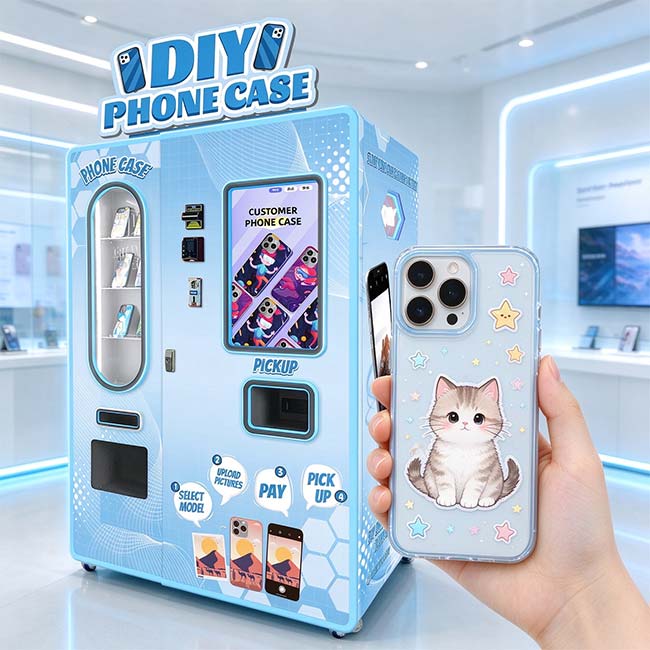
The WM880 uses a 410W power draw and runs on 110V to 220V. It measures 1340 x 990 x 2170 mm and weighs 380 kg. Case storage is about 1,020 to 1,025 cases, depending on the version. The standard i1600 print head prints faster and lasts longer than the F1080, and you can upgrade to the i3200 head later. An optional inventory identification camera adds US$200.
The customer flow is scan the QR code, pick the phone model, upload a photo, and pay. The machine prints the case and the customer takes it in about 1 to 3 minutes. Standard TPU+PC cases cost US$1.10 to US$1.30 each at 1,000 pieces. Magnetic cases cost US$2.10 to US$2.30. Ink sets are US$100 for 4-color and US$160 for 6-color.
We have shipped 3,000+ machines to 130+ countries since 2016. The WM880 carries CE, RoHS, CCC, ISO, and PSE certifications, and our team provides 7×24 after-sales support. If you want the full investment picture, read our custom smartphone case vending machine cost guide. The WM880 is one option in a crowded field. Compare its print head, case capacity, and support terms with any other quote you receive.
Site prep and hidden costs most buyers miss
A phone case machine is smaller than a food vending machine, but it still needs planning. The WM880 weighs 380 kg. Check the door width, lift capacity, and floor loading before delivery.
Power is usually a standard outlet. The WM880 draws 410W, so it will not need a dedicated circuit in most locations. Network access matters for card payments and remote monitoring. If the site has weak Wi-Fi, use a wired connection or a cellular router.
Other costs include signage, a mat or floor protection, a small table for customer bags, and a cleaning schedule. None of these are huge, but they add up. Budget for them before you sign a location lease.
How to get an accurate quote
Send every vendor the same brief so you can compare line by line. Include your country and city, the phone models you want to stock, expected daily sales, payment methods, voltage, and whether you need starter inventory.
Ask for a quote that separates machine, freight, duties, installation, training, and spare parts. Ask what is not included. A quote that only shows the machine price is not a quote you can budget from.
If you are still choosing a business model, read our guide to how the phone case printing vending machine business model works. It covers location deals, pricing, and restock cycles.
What to do next
The price of a touchscreen phone case vending machine starts around US$5,000 and climbs with print speed, case capacity, payment hardware, and support. Add 15% to 25% for freight, duties, installation, and starter stock. Then test the payback math with your own rent and traffic.
Before you buy, run a live demo, get a line-item quote, and check the warranty on the print head. Those steps will save you more money than haggling over the sticker price.
FAQ
How much is a phone case vending machine with a touch screen?
New machines typically cost US$5,000 to US$12,000 before freight and duties. Used units often sell for US$6,500 to US$9,000. Factory-direct single-unit prices for the WM880 are US$4,999 for the F1080 version and US$5,999 for the i1600 version.
What is the cheapest way to start?
Start with a single-cabinet model, a small case inventory, and a location with steady foot traffic. A used unit can cost less, but only if you can test the print head, touchscreen, feeder, and payment module before you pay.
How much does each printed case cost?
A standard TPU+PC case blank costs US$1.10 to US$1.30 at 1,000 pieces. Magnetic cases cost US$2.10 to US$2.30. Ink is sold by the set at US$100 for 4-color and US$160 for 6-color. Add payment processing and packaging, and most cases land around US$2 to US$3 in variable cost depending on the case type and print coverage.
How many cases do I need to sell to break even?
It depends on rent and site fees. In the example above, 10 cases a day at US$10 each covers US$900 in monthly fixed costs and pays back a US$9,000 startup in about 6.4 months. At 20 cases a day, payback drops to about 2.4 months.
Do I need special power or network?
The WM880 runs on 110V to 220V and draws 410W. That is a standard outlet in most markets. You do need reliable network access for card payments and remote monitoring. A wired connection or cellular router is safer than weak public Wi-Fi.
Can customers upload their own photos?
Yes. On the WM880, the customer scans a QR code, chooses a phone model, uploads a photo, and pays. The machine prints the case and the customer takes it in about 1 to 3 minutes.
What warranty should I ask for?
Ask for at least 12 months and get the coverage in writing. Confirm whether the print head, touchscreen, and payment module are included. Also ask for spare parts lead time and weekend support response.
Is a touchscreen machine worth more than a non-touch model?
It is worth more when you need custom photo uploads and self-service sales. The screen handles design selection, payment, and order status, so you do not need staff on site. If you only sell pre-made cases, a simpler machine may be enough.