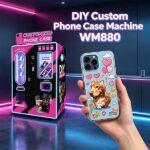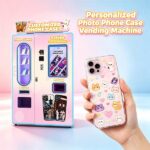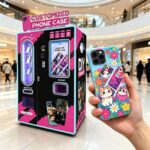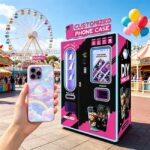



The WM880 is a fully automatic phone case printing vending machine from Wider Matrix that prints a customer’s own photo onto a fresh case in about one to three minutes, holds more than 1,000 blank cases at a time, and sells for US$4,999 with the Epson F1080 print head or US$5,999 with the faster Epson i1600-U1. Every number on this page comes from the factory specification sheet, including the exact cost of cases and ink, so you can work out your payback before you talk to anyone. If you want the tier pricing for 4, 7 or 11 units, send us your target quantity and country through the inquiry form below and you will have a quotation the same day.
How much is a phone case printing machine, exactly?
A real, factory-direct phone case printing machine costs between US$4,999 and US$5,999 depending on the print head you choose. Those are the two starting prices for the Wider Matrix WM880: US$4,999 for the Epson F1080 version and US$5,999 for the Epson i1600-U1 version, both quoted for orders of 1 to 3 units. Anything you see advertised far below that range is usually a desktop UV printer without the vending cabinet, the payment system, or the case dispensing mechanism, and it will not run unattended in a mall.
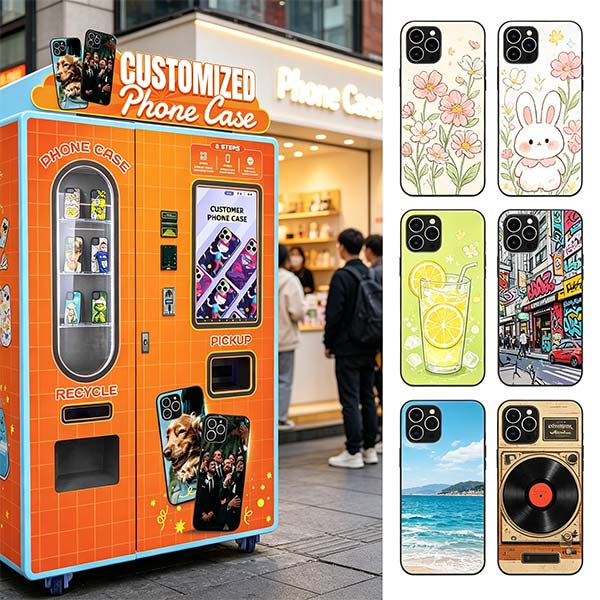
Price is only the entry point, though. When operators ask me “how much is a phone case printing machine,” what they actually need to know is the full number: machine, consumables, upgrades, and what it costs to print each case. This page lays all of it out from the WM880 specification sheet, so you can do your own math before you commit. If you want the longer version of the cost story, the full cost breakdown for a phone case vending machine covers the expenses that show up after delivery.
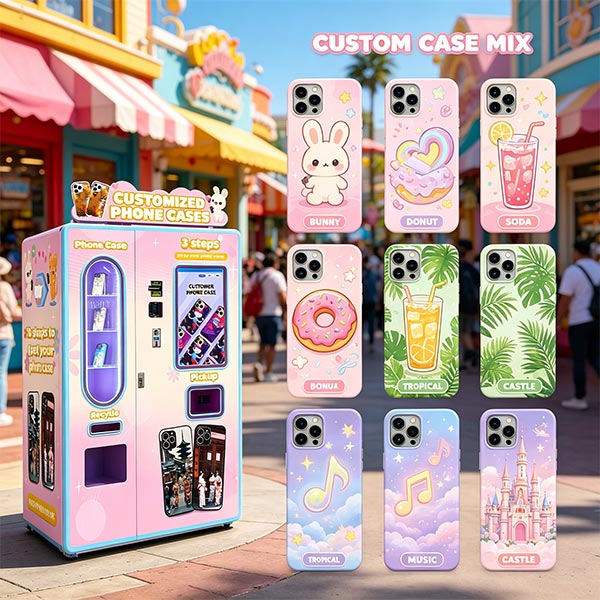
The WM880 itself is simple to describe. It is a floor-standing cabinet, 1,340 mm wide, 990 mm deep and 2,170 mm tall, weighing 380 kg. Inside sits an industrial Epson UV print head, a storage rack that holds 1,020 to 1,025 blank phone cases depending on version, 2,000 ml of ink capacity, and a payment module that accepts coins, cash, credit cards, NFC and QR codes. A customer walks up, picks their phone model, uploads a photo, pays, and walks away about one to three minutes later with a case that nobody else in the building has. You never touch the machine except to restock cases.
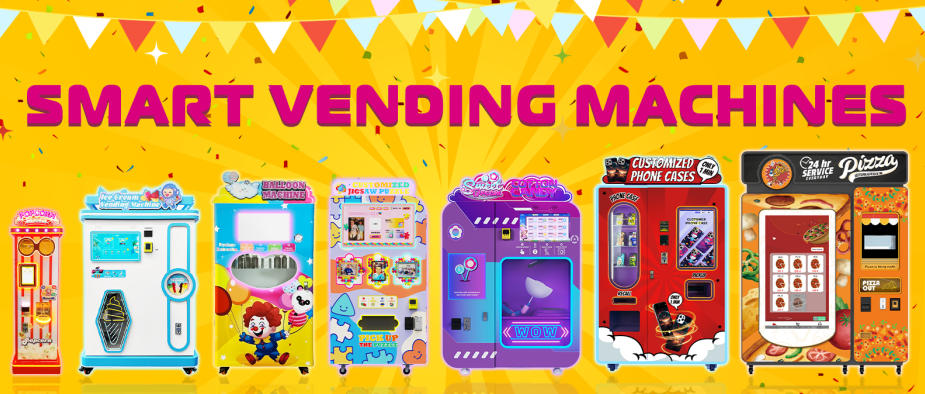
Wider Matrix (GZ) Technology Co., Ltd. builds this machine in Guangzhou and has been shipping vending machines like it to operators in the Middle East, Southeast Asia, Europe and North America for the past five years. The same factory also makes cotton candy, ice cream, pizza, balloon and popcorn vending machines, so the payment, telemetry and cabinet engineering behind the WM880 is not a first attempt. If you are comparing machines from several suppliers right now, our WM880 phone case printing machine overview walks through the same hardware in a bit more narrative detail.
WM880 technical specifications
Here is the complete sheet. Check these numbers against any competitor quotation you have on your desk, because this is where cheap machines hide their corners: light cabinets, small case capacity, low-grade print heads.
| Parameter | Specification |
|---|---|
| Model | WM880 |
| Input voltage | 110V – 220V |
| Power consumption | 410W |
| Dimensions (W × D × H) | 1340 × 990 × 2170 mm |
| Weight | 380 kg |
| Ink capacity | 2000 ml |
| Case storage | 1020 – 1025 pcs |
| Case material | TPU + PC composite |
| Payment methods | Coin / cash / credit card / NFC / QR |
| Remote management | PC + mobile APP |
A few of these deserve comment because buyers consistently get them wrong.
The 410W power draw is low enough to run from a standard mall socket. Some operators assume a UV printer means kilowatts of consumption and complicated electrical work. It does not. Your landlord will not ask questions when you hand over the site plan.
The 110V to 220V input range matters if you operate across markets. A unit destined for the Philippines and one destined for Toronto run on the same electrical design, and voltage conversion is not something you need to budget for separately.
The 380 kg weight is a feature, not a logistics problem. Machines this size do not tip, do not walk, and survive the treatment a shopping mall Friday night delivers. It ships in a reinforced crate and two people with a pallet truck can position it.
And the case storage figure is the one I would underline twice. Over a thousand blank cases inside the cabinet means you can leave a machine in a secondary location for a week or more without a restock run. If you plan to place machines in several cities and visit each site monthly, capacity like this decides whether the route is profitable.
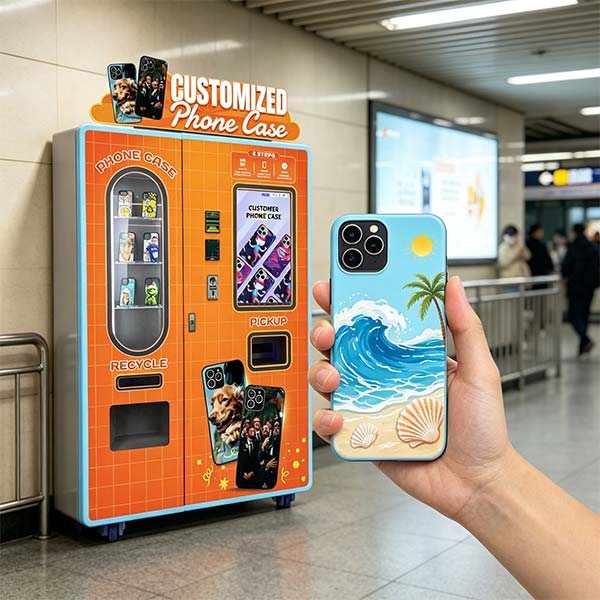
How a customer uses the WM880
The whole flow is four steps and needs no staff on your side at any point.
- Scan. The customer scans the QR code shown on the machine’s screen. The interface is touch-driven and available in English, Russian, French, Arabic, Korean and other languages, which matters more than people expect in tourist locations.
- Select the phone model. The menu covers current devices like the iPhone 16, iPhone 15 and iPhone 11, and extends across Samsung, Google Pixel, Xiaomi, Huawei and OPPO lines. If the customer’s phone is in stock, the machine knows it.
- Upload a picture. This is the moment that sells the machine to bystanders. Someone’s dog, a couple’s anniversary photo, a kid’s drawing. The print positioning is AI-assisted visual recognition, so the image lands correctly on the case back with no white borders, even when the customer uploads something slightly off-center.
- Pay. Coins, banknotes, credit card, NFC tap, or QR payment. The banknote counter validates cash automatically, so you are not fielding complaints about rejected bills.
Printing finishes in roughly one to three minutes depending on the design, and the finished case drops into the collection point. Total time from scan to case is shorter than the queue at the bubble tea shop next to it, which is exactly why these machines do well in high-traffic spots.
Restocking is equally undramatic. You place blank cases flat with the back facing up, keep the stack below the red line indicator, and push them into the rack. An experienced operator does a full 1,000-case reload in well under half an hour. If you add the optional inventory identification function, described below, the machine itself tells you which slots are running low before you even open the door.
WM880 versions and pricing: which one should you buy?
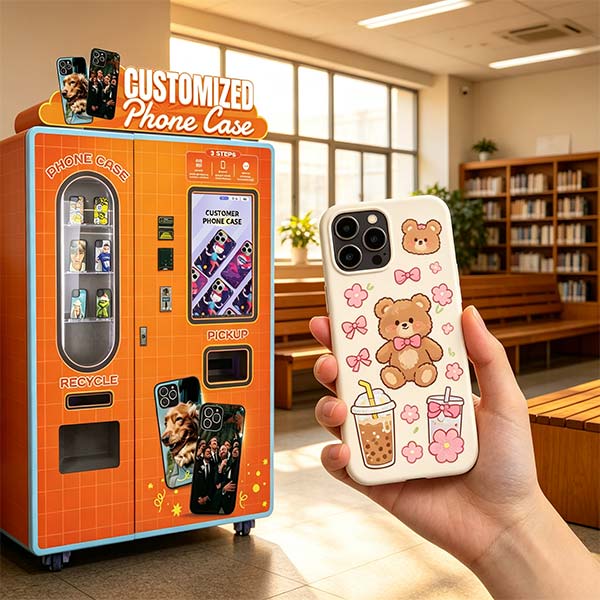
The WM880 comes in two factory configurations, plus a field upgrade path. The difference between versions is the Epson print head, and the difference matters, so let me be concrete about it.
WM880 F1080 version (base configuration)
The F1080 version uses the Epson F1080-A1 print head and holds 1,020 phone cases. Photo resolution is good, details come through clearly, and colors are vivid. For a first machine in a single location, this is a completely legitimate choice, and plenty of our operators started here.
Price: US$4,999.00 per unit for orders of 1 to 3 units. Quantity tiers exist for 4–6 units, 7–10 units and 11+ units, and those numbers move enough with freight and destination that we quote them individually. Send your quantity and port and you will get the tier sheet the same day.
WM880 i1600-U1 version (standard configuration)
The i1600-U1 version uses the Epson i1600-U1 print head and holds 1,025 cases. Compared to the F1080, printing speed is roughly three times higher, print head lifespan is roughly four times longer, and clarity is about twice as good. If your location does serious daily volume, the speed difference alone pays for the price gap within the first busy season, because throughput is revenue in vending.
Price: US$5,999.00 per unit for orders of 1 to 3 units. Same tier structure: 4–6, 7–10, and 11+ units all have their own price points, available on request.
The i3200 upgrade path
Here is the part that separates the WM880 from machines that are obsolete the day you buy them. The i1600-U1 version supports a lossless upgrade to the Epson i3200-U1HD print head for an additional US$680 (¥5,000). “Lossless” means exactly what it should mean: you keep everything, your cases, your settings, your revenue history, and you only swap the head. The upgrade path runs F1080 → i1600-U1 → i3200-U1HD, so a machine bought today does not need to be replaced when your volume outgrows it.
If you have ever run print equipment before, you know how unusual that is. Most vending machines with integrated printers are sealed boxes. This one grows with your business.
Optional inventory identification function
Both versions can take an optional camera module mounted on top of the machine that provides automatic stock recognition, for an additional US$200 (¥1,350). Once installed, the backend shows real-time stock levels per slot, and you stop sending staff to count cases manually across a fleet. On a two-machine operation this is a convenience. On a ten-machine operation it is the difference between a restocking plan and restocking guesses. I recommend it to anyone placing more than three machines.
Price summary
| Configuration | Price (1–3 units) | Case storage | Notable options |
|---|---|---|---|
| WM880 F1080 (Epson F1080-A1) | US$4,999.00 | 1,020 pcs | Inventory identification +US$200 |
| WM880 i1600-U1 (Epson i1600-U1) | US$5,999.00 | 1,025 pcs | Inventory identification +US$200; i3200-U1HD upgrade +US$680 |
For a deeper comparison of what each configuration gets you in daily operation, the phone case printing machine price guide breaks down what a business-ready system includes beyond the sticker number, and why machines quoted suspiciously lower tend to cost more by the end of the first year.
What each printed case actually costs you
The machine price is a one-time event. Consumables are the number that follows you for years, so here they are, complete, straight from the factory price list.
Blank phone cases
Cases are a TPU + PC composite, the standard durable combination for custom printing. Prices per piece drop with order volume:
| Order quantity | Standard case | Magnetic case |
|---|---|---|
| 1,000 pcs | US$1.30 / pc | US$2.30 / pc |
| 5,000 pcs | US$1.20 / pc | US$2.20 / pc |
| 8,000 pcs | US$1.10 / pc | US$2.10 / pc |
So your baseline consumable cost per standard case runs from US$1.10 to US$1.30, and magnetic cases run US$2.10 to US$2.30. What you charge the customer is your decision and your market’s, but the input cost never moves much once you are ordering in thousands. The cases feature two optional lens cover protection designs, and the structure is optimized so cases install easily on the customer’s phone and stack efficiently during replenishment.
If you want to sanity-check these figures against the total economics of a single sale, this breakdown of what it costs to make a phone case puts the consumable number next to everything else that touches a transaction.
Ink
Ink is Epson UV hard ink, sold in sets:
- Standard version: 4-color set, US$100.00 per set
- F1080 version: 6-color set, US$160.00 per set
The machine carries 2,000 ml of ink capacity, so you are not swapping cartridges weekly. Ink cost per printed case is small relative to the case itself, which is the correct way around; you want your variable cost dominated by the physical product the customer keeps, not by consumables that produce nothing.
The honest cost picture
Add it up and a single custom case sale costs you roughly a dollar-something in blank case plus a sliver of ink. Everything above that line, minus location fees and payment processing, is your margin. That is the whole appeal of this category, and also the whole risk: margin depends on footfall, and footfall depends on where you put the machine. The phone case printing vending machine business model article walks through how the revenue math works in practice, including the expenses operators forget to model, and I would read it before you sign any location lease.
Managing the machine from your phone or PC
The WM880 connects to a cloud management system accessible from both a PC and a mobile app. This is standard equipment, not a paid add-on. Here is what the backend covers:
| Module | What it does |
|---|---|
| Revenue statement | Daily, weekly and monthly sales analytics with charts |
| Order status | Complete order history and status tracking |
| Basic settings | Machine configuration and preferences |
| Promotion activity settings | Discount rules, time periods, quantity limits |
| Machine status details | Live monitoring of printer operation, alarms and connectivity |
| Inventory identification (optional) | Real-time per-slot stock monitoring when the camera module is installed |
| Currency setting | Multi-currency support for different markets |
| Language settings | English, Russian, French, Arabic, Korean and more |
Two of these earn their place. The promotion activity module lets you run, say, a weekend discount or a second-case offer directly from the backend, which is how you move slow stock without driving to the site. And the machine status monitoring means you find out about a printer alarm the hour it happens, not the following weekend when a customer’s Instagram post has already done the damage.
The practical effect for a fleet operator is that one person can supervise machines in several locations from a laptop. Whether that person needs to physically visit a site on any given day becomes a data question rather than a hope.
Case quality and phone compatibility
A printing machine is only as good as the cases it sells, because the customer carries your product on their phone every day. The WM880’s cases use a TPU + PC composite: a polycarbonate back plate for rigidity and print surface, wrapped in a thermoplastic polyurethane bumper for drop absorption. That is the same construction philosophy as the premium aftermarket cases people buy in electronics stores.
Compatibility covers the phone models that actually generate volume in retail locations:
- Apple: iPhone 16, iPhone 15, iPhone 11 and other current lines
- Samsung
- Google Pixel
- Xiaomi
- Huawei
- OPPO
When you order, you tell us your market and we set the case mix accordingly. A mall in Dubai needs different model coverage than a university district in Kuala Lumpur, and the storage rack is configured at the factory before shipment. The two optional lens cover protection designs also matter for iPhone buyers specifically, since the camera bump is the first thing people check on a new case.
Installation is deliberately foolproof: the case structure guides itself onto the phone, so even a customer who has never removed a case in their life completes the swap without help. Fewer support moments at the machine means higher throughput during peak hours.
Where operators place the WM880
I have watched these machines earn in enough different settings to generalize a little, carefully.
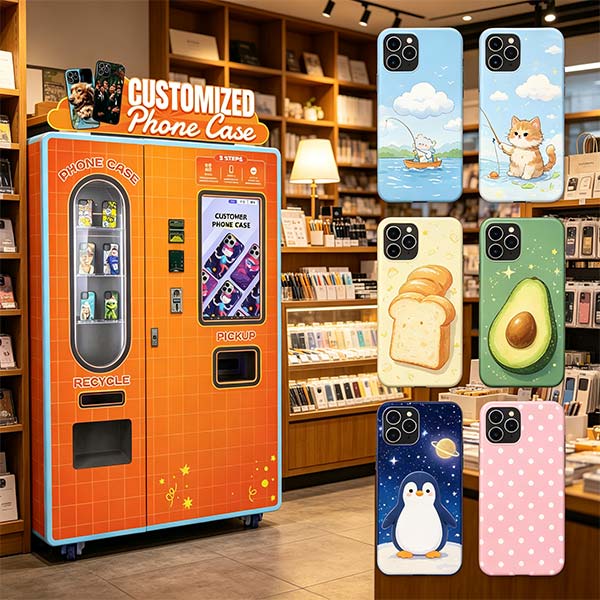
Shopping malls are the anchor location. Custom phone cases are an impulse purchase with high perceived value, and mall traffic supplies exactly the right kind of impulse: people already in a spending mood with fifteen minutes to fill. The machine’s footprint, just under one and a half square meters, fits against a wall or beside an escalator landing without renegotiating your lease layout.
Tourist zones and attractions do consistently well because the product doubles as a souvenir. A visitor uploads a photo they took an hour ago and walks away wearing it. That loop closes itself, and the multi-language interface including Arabic, French and Korean handles the customer base without extra effort from you.
Cinemas, arcades and entertainment venues benefit from the same dynamic: dwell time plus groups. One person orders, three people watch the printer work, and at least one of them queues up next. The machine is its own best advertisement, which is also why the cabinet takes LED lighting and full custom skins.
Airports and transit hubs work for a different reason: forgotten or broken cases, long waits, and a captive audience with a phone in hand. Volume per customer is lower, but the price tolerance is higher.
The placement principle underneath all of these is simple: the WM880 needs eyes on it. It prints photos of people’s own lives, and the visible print process is what converts passersby. Dark corners kill that. When you are evaluating a site, stand where the machine would stand and check whether the printer is visible from the main walking line. If it is not, negotiate a better spot or walk away.
Certifications and factory credentials
The WM880 carries the certifications needed for the markets we ship to most often:
| Certification | Scope |
|---|---|
| CCC | China Compulsory Certification |
| CE | European Union compliance |
| ISO | International Organization for Standardization |
| RoHS | Restriction of Hazardous Substances |
| PSE | Japan electrical product safety |
Behind the certificates, the product side holds 5+ independent R&D patents, including KC, CE and PSE related R&D patents, and the company has collected 30+ industry awards. I mention these because importers get burned by machines that arrive without paperwork for customs or without certification when a mall asks for compliance documents. If your market needs a specific certificate not listed above, ask us before ordering; we will tell you straight whether we have it.
Why operators buy the WM880 from Wider Matrix
Wider Matrix (GZ) Technology Co., Ltd. is based in Guangzhou and has spent five years focused on AI vending machines and smart robots, with more than 3,000 units deployed worldwide and a team of 50+ people. The product line includes phone case vending machines, phone screen protector machines, cotton candy, ice cream, pizza, balloon and popcorn machines. The WM880 shares its payment, telemetry and cabinet platform with machines that have already survived years in the field.
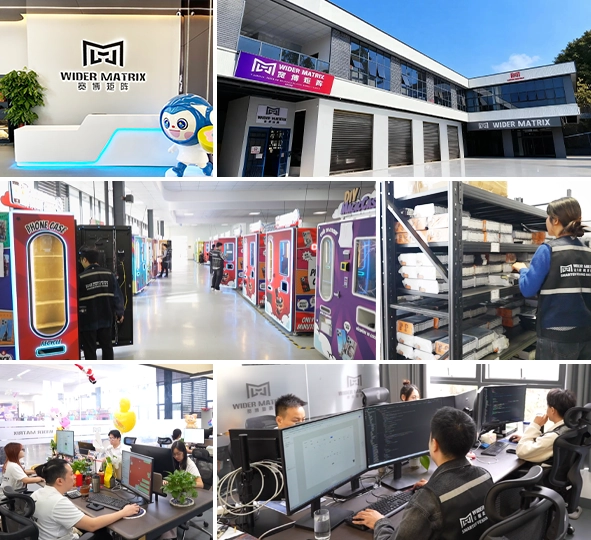
What that means for you as a buyer, practically:
You buy from the factory, not from a trading company adding a margin and disappearing at the first technical question. OEM and ODM orders are supported, so your machines can carry your brand, your cabinet skins and your luminous signage rather than ours.
After-sales support runs 7×24 with human staff, not a bot that forwards your message to a mailbox. When a printer alarm goes off at 9 pm local time, you reach someone who can look at the machine’s live status data with you.
Export experience covers the Middle East, Southeast Asia, Europe and North America, and the machines have been shown at trade exhibitions across those regions, including Saudi Arabia, Indonesia, the Netherlands, the UK, Italy, Spain, the USA and Mexico. Freight documentation, voltage configuration and multi-currency payment setup are routine parts of the process here, not special requests.
And the machines themselves hold up: thickened metal construction, a reinforced metal plate chassis, and the lossless print head upgrade path described above. We would rather sell you a US$200 camera module and a US$680 head upgrade over three years than have you replace the whole cabinet because it could not keep up.
If you are still comparing suppliers, the sensible next step is reading where to buy a phone case vending machine and how to go straight to the source, which explains the questions worth asking any factory, including this one, before you wire a deposit.
WM880 FAQ
How much is a phone case printing machine?
The WM880 starts at US$4,999.00 for the F1080 version and US$5,999.00 for the i1600-U1 version, both for orders of 1 to 3 units. Orders of 4–6, 7–10 and 11+ units qualify for tier pricing, which we quote based on quantity and destination port. Contact us with your target quantity and country and you will have the full tier sheet the same day.
What will I spend on consumables per case?
Blank standard cases cost US$1.30 per piece at 1,000 units, US$1.20 at 5,000 units, and US$1.10 at 8,000 units. Magnetic cases cost US$2.30, US$2.20 and US$2.10 at those same volume steps. Ink runs US$100.00 per 4-color set on the standard version or US$160.00 per 6-color set on the F1080 version. Your selling price is set by your market, so the margin structure ends up being yours to define.
How long does one custom case take to print?
Most designs finish in roughly one to three minutes from upload to finished case. The i1600-U1 print head prints about three times faster than the F1080, so if your location sustains queues at peak hours, the faster head is worth the price difference.
Which phone models does the machine support?
The case menu covers Apple lines including the iPhone 16, iPhone 15 and iPhone 11, plus Samsung, Google Pixel, Xiaomi, Huawei and OPPO models. You confirm your market when ordering and the factory configures the case mix to match local phone share.
Can I upgrade the print head later instead of buying a new machine?
Yes. The i1600-U1 version supports a lossless upgrade to the Epson i3200-U1HD print head for US$680 (¥5,000). Your cases, settings and sales history all carry over. The full path runs F1080 to i1600-U1 to i3200-U1HD, so the machine you buy now does not become the machine you replace in two years.
Is the stock monitoring function included?
The inventory identification function is optional and costs an additional US$200 (¥1,350). It adds a camera module on top of the machine that recognizes stock levels per slot in real time. Without it, you check levels visually during restock visits; with it, the backend tells you before a slot runs dry. For fleets above three machines, we consider it standard equipment.
What payment methods does the machine accept?
Coin, cash with automatic banknote validation, credit card, NFC contactless and QR payment. The backend supports multi-currency settings for different markets, so the machine adapts to wherever you deploy it rather than the reverse.
What certifications does the WM880 have?
CCC, CE, ISO, RoHS and PSE, plus 5+ independent R&D patents and 30+ industry awards. If your country or your landlord requires a specific certificate, ask before ordering and we will confirm availability in writing.
What about warranty, spare parts and shipping time?
Warranty terms, spare part kits and delivery schedules depend on your destination and order size, so we do not publish a one-size-fits-all number here. Contact us with your port and quantity and you will get the specific terms in the quotation. Support itself is 7×24 with live staff on both ends.
Can I order just one machine to start?
Yes. Tier pricing begins at a single unit, and the US$4,999 / US$5,999 figures are for orders of 1 to 3 units. Many operators start with one machine, learn their location’s demand curve for a quarter, and then use the 4–6 unit tier to expand.
Get your quotation
You now have every number that matters: machine prices by version, the upgrade costs, the consumable price list at three volume levels, and the exact specifications of the cabinet. The remaining variables are your quantity, your market and your timeline, and those live in a short conversation.
Send us your target quantity, your country or destination port, and any deadline you are working against. A sales engineer will reply with the tier price sheet, freight options and current production schedule, usually the same day. Whether you are placing a first test unit or outfitting a ten-location rollout, the quote costs nothing and commits you to nothing.
Leave your inquiry below, or reach Wider Matrix directly, and find out what the WM880 costs to put in your location, not just on a webpage.