



One number is not a quote. This page breaks down what an automatic cotton candy vending machine from Wider Matrix really costs: $4,800 for the WM980, $4,999 for the WM980 Plus, and $5,299 for the outdoor WM668, plus freight, the first order of sugar and paper sticks, and the warranty. If you are comparing machines and tired of vague pricing, this is the honest version. For a line-itemed cotton candy vending machine quote with shipping and tier discounts, tell Wider Matrix your city, your quantity, and whether the location is indoors or outdoors.
Most people search for a cotton candy vending machine quote expecting a single number. What they actually need is a breakdown, because the sticker price on the machine is rarely what you pay by the time it is bolted to the floor of your mall, arcade, or boardwalk.
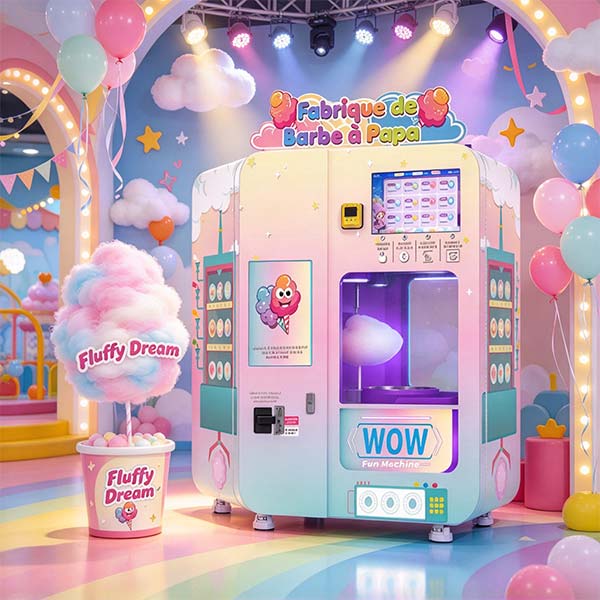
Wider Matrix sells three automatic machines aimed at commercial operators. The WM980 starts at $4,800. The WM980 Plus runs $4,999. The outdoor WM668 is $5,299. Those are factory prices for one unit, and they drop once you order three, six, or ten machines at the same time. A real cotton candy vending machine quote will show you those tiers instead of hiding them.
I have spent a good part of my working life around these machines, first running them and later helping Wider Matrix move them to buyers in the US, Canada, Australia, and a few other countries. What I have learned is that the price of the machine is the easy part. It is the freight, the sugar, the sticks, the warranty, and the small print that decide whether you actually made money on the deal. So here is what a real quote contains, what pushes the number up or down, and what to ask so a vendor cannot bury a fee in the fine print later.
What a cotton candy vending machine quote should include
When you ask for a cotton candy vending machine quote, make the seller break the number into at least four lines. Most of the trouble starts when everything is lumped into one figure.
The machine itself comes first. That means the model and its configuration, down to the tank size and the payment module. A WM980 in its standard form holds four 2 kilogram sugar tanks. Pay $200 more and those become four 3 kilogram tanks. If a quote just says “cotton candy machine” with no model number, ask again. A WM168, a CT580, and a WM980 are very different machines, and a sloppy quote is usually a sign of a sloppy seller all the way down the line.
Freight and delivery come second. These machines weigh about 300 kilograms, so they do not ship in a padded envelope. The cost depends on where you are, whether it is a full container or a shared load, and who clears customs. A factory price of $4,800 does not include getting a 300 kilogram machine to a mall in Texas or a street in Sydney. Wider Matrix ships to the US on a regular schedule, but you still want the freight number on the quote in writing, not in a follow up email two weeks later.
Startup consumables come next. A cotton candy machine is useless without the right sugar and paper sticks. The sugar is granulated to 1.2 to 1.7 millimeters, and ordinary table sugar from the grocery store will clog the machine, so do not try to save money there. Wider Matrix sugar costs $3.25 a kilogram when you buy in bulk, and each cotton candy only uses 28 to 30 grams. Paper sticks run about 5 cents each and drop to roughly 3.8 cents on very large orders. Your first order should include enough of both to survive a few weeks.
Warranty and support come last, and people skip this one far too often. Find out how long the parts are covered, what is excluded, and whether remote support and over the air software updates are included. If the seller cannot tell you what happens when a board fails in month eight, that is your answer.
What these machines really cost
Here are the numbers without the pitch. Wider Matrix runs three cotton candy models for commercial buyers.

The WM980 is the workhorse at $4,800 for a single unit, with the price stepping down at three, six, and ten machines. It takes coin, cash, credit card, and NFC payments, and it makes 36 candy shapes. Inside there is a 4-DOF robotic arm, an auto cleaning burner, and a magnetic door lock that stops people from opening the window while the machine is running. It pulls 500 watts on standby and 3,000 watts while making candy. At 300 kilograms it is not light, and that weight is a feature rather than a bug, because a machine left in a public space all day needs to be hard to tip over or walk off with.
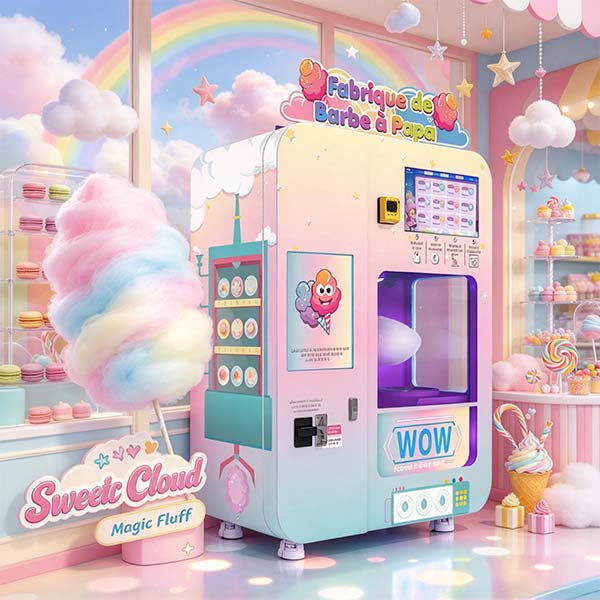
The WM980 Plus is $4,999. For the extra $199 you get an ambient ring light strip, a sturdier metal cabinet, and the 3 kilogram tanks as standard rather than an upgrade. If the machine is going somewhere with evening foot traffic, the light strip pays for itself in attention.
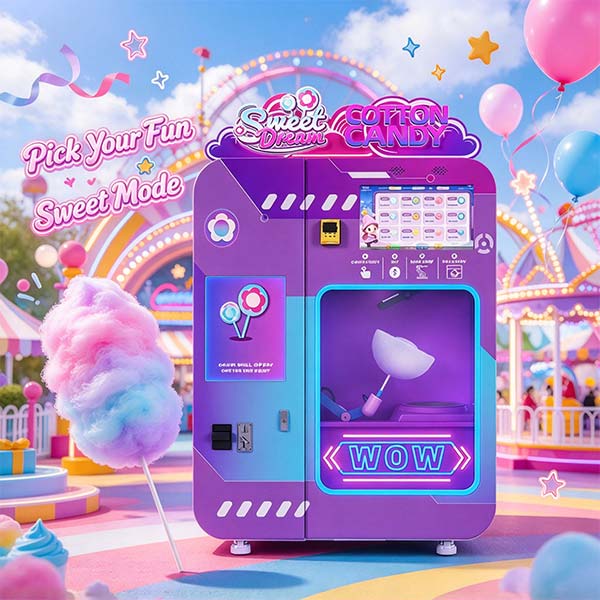
The WM668 is the outdoor model at $5,299. It has a high brightness screen, an elevated roof, and a rainproof design, so it holds up on boardwalks, theme parks, and open air food courts. If the weather can reach your machine, this is the one you want, and the other two are not a substitute.
There is a wider family too, including the smaller WM168 and a multi flavor unit, so a different budget or a smaller footprint does not leave you stuck. For the full line and current specs, the cotton candy vending machine catalog lists every model. If you want a broader look at how prices compare across the market, our piece on automatic cotton candy machine prices walks through what you get at each tier.
On the consumables side, the recurring numbers are small, and that is where the business gets healthy. Each cotton candy uses 28 to 30 grams of sugar, which works out to roughly 9 to 10 cents at bulk pricing. Add 4 to 5 cents for the stick and a couple cents of power, and one cotton candy costs you somewhere around 16 to 18 cents to make. Selling it for $3 or $4 leaves a margin most retail products can only dream about, and the math holds up in practice, not just on a spreadsheet.
The things that move the price around
A cotton candy vending machine quote is rarely one number. These are the levers that shift it.

Order size is the biggest one, because the tiered pricing cuts in at three machines and improves from there. If you plan to build a route rather than place a single unit, ask for the ten machine price even if you start with three.
Configuration is next. Bigger tanks, extra payment modules, and a custom paint job all add cost. Wider Matrix sells OEM and customized versions, so a branded machine with your colors and logo is possible, but it is not free.
Delivery location swings the number more than most buyers expect. Two identical machines going to Los Angeles and to Johannesburg will not carry the same freight line, so get the delivery figure on the same quote instead of a separate message.
Import duty and tax come into play depending on the country you buy into. A good seller will tell you which shipping terms the quote assumes, such as FOB or CIF.
Spare parts and setup round out the list. Ask whether the quote includes the first round of spare parts and remote setup guidance, because some sellers quietly leave that out and then charge you later for the manual that should have come with the machine.
The pattern is the same every time: if the quote is one number and a handshake, something is missing. If it is a table of lines, you can compare it against the next vendor without guessing.
How to ask for a quote without getting burned
When you write to a supplier, give them what they need to give you a real number. Tell them the country and city, whether you want one machine or ten, whether the spot is indoors or outdoors, and whether you need the tanks or payment setup changed. A serious vendor will come back with a line itemed quote and a few questions about your situation. A vendor who is not serious will come back with one price and a discount that expires Friday.

Then read the quote the way you would read a contract, because it becomes one the moment you pay. Look for what is left out. Freight, duty, training, the first sugar order, and the warranty period are the usual gaps. If any of them is missing, ask before you transfer money. I have watched buyers sign on a cheap machine and then discover the sugar alone was marked up high enough to erase the upfront saving inside a year.
The same reasoning applies to who you buy from. A genuine manufacturer will have a factory you can video call, a history of shipping to your region, and a catalog with actual model numbers instead of stock photos. Wider Matrix fits that description. The company makes the machines, ships to North America and other regions on a regular schedule, and keeps its consumables standardized so you are never hunting for compatible sugar or sticks. If you are still choosing between suppliers, we have written up how to find the most reliable cotton candy machine and a separate list of what to look for before you buy.
Frequently asked questions
How much does a cotton candy vending machine cost?
Wider Matrix automatic machines start at $4,800 for the WM980, $4,999 for the WM980 Plus, and $5,299 for the outdoor WM668. Those are single unit factory prices, with tier discounts at three, six, and ten units. Freight, duty, and your first order of consumables sit on top.
How do I get a cotton candy vending machine quote?
Send the country and city, the number of machines, whether the location is indoors or outdoors, and any changes you want to tanks or payment methods. A proper quote comes back as a line itemed breakdown rather than one round number.
Is there a minimum order quantity?
You can order a single machine. The volume pricing is an incentive, not a requirement. Custom OEM machines may carry a small minimum depending on what you want branded.
How much does shipping add to the price?
It depends on the destination and the quantity. Each machine weighs about 300 kilograms, so freight is a meaningful line item. Ask for it on the quote itself. Wider Matrix ships to the US, Canada, Australia, and other regions regularly.
What does it cost to make each cotton candy?
Around 16 to 18 cents. That covers 28 to 30 grams of sugar at bulk pricing, a paper stick, and a small amount of power. Most operators sell each one for $3 to $5, which is where the profit sits. If you want the full earning picture, see what these machines actually earn and whether the margins hold up.
Do I need special sugar?
Yes. Cotton candy needs sugar granulated to roughly 1.2 to 1.7 millimeters. Normal table sugar jams the machine. Wider Matrix supplies the correct sugar in six flavors, and the per kilogram price drops as your order grows.
Do I need a license to sell cotton candy?
Usually, yes. Most places want a seller’s permit at minimum, and some add a food or vending permit. The rules change by state and city, so confirm locally. We have a full write up on the licensing requirements if you want the detail.
What does the warranty cover?
That is exactly the question to put on your quote. Confirm the parts coverage, what is excluded, and whether remote support and over the air updates are included before you order.
The next step
If you are close to buying, get a cotton candy vending machine quote and lay the two or three offers side by side. Compare them line by line on freight, tanks, warranty, and the first sugar order, and the better deal usually shows itself. If you are still in the research phase, read a little on what the machines earn and where they perform best, because a price only matters next to the revenue the location can support.
For a quote from Wider Matrix, reach out through the contact page with your city, your quantity, and whether the machine is for indoor or outdoor use. A real number usually comes back inside a day or two, and it will arrive as a breakdown you can actually act on.