



Most people who decide to buy a popcorn vending machine do it backwards. They find a supplier online, look at a few photos, compare two or three prices, and pick the one that seems reasonable. Then six months later they are on the phone with the manufacturer trying to figure out why the heating element died, or why the payment system will not connect to their local network, or why the cups keep jamming in the dispenser.
I have watched this happen enough times that I stopped being surprised by it. The popcorn vending business is a good one. The margins are real, the machines are relatively simple compared to something like a pizza vending machine, and the product itself is cheap to produce. But the buying part is where people lose money they never get back.
This article walks through what actually matters when you buy a popcorn vending machine. Not the marketing version. The version that comes from operators who have installed these machines, dealt with the problems, and figured out what was worth paying for and what was not.
What you are actually paying for
When you buy a popcorn vending machine, the price tag covers several different things. The hardware itself is the obvious one. But you are also paying for the payment system, the software backend, the heating technology, the dispensing mechanism, and the structural build quality. A machine that looks identical on the outside can have completely different components on the inside.
The WM680 from Wider Matrix sells for $1,800 per unit when you order 1 to 5 machines. That price includes the full machine with a 5.6 kg corn storage capacity, 140 pre-loaded cups, and a payment system that handles coins, cash, credit cards, NFC, and QR codes. Some suppliers will quote you $2,500 or $3,000 for a machine with fewer payment options and half the cup capacity. The difference is not always quality. Sometimes it is just markup.
Before you compare prices, you need to know what each quotation includes. Does it cover shipping? Does it include the payment gateway setup? Are the cups part of the package, or do you buy those separately? These questions sound boring, but they can shift your real cost by 20 to 30 percent.
Where to buy, and why it matters more than the price
You have a few options when it comes to sourcing. You can buy from a domestic distributor who imports machines and resells them with a markup. You can buy direct from a manufacturer. Or you can buy from a trading company that acts as a middleman between you and the factory.
Each route has trade-offs. A domestic distributor gives you faster shipping and someone local to call when something breaks. But you pay more, and the distributor may not understand the machine deeply enough to troubleshoot. Buying direct from a manufacturer like Wider Matrix gives you better pricing and direct technical support, but shipping takes longer. A trading company is usually the worst option. They add a markup without adding any technical value, and when something goes wrong, they have to ask the factory anyway.
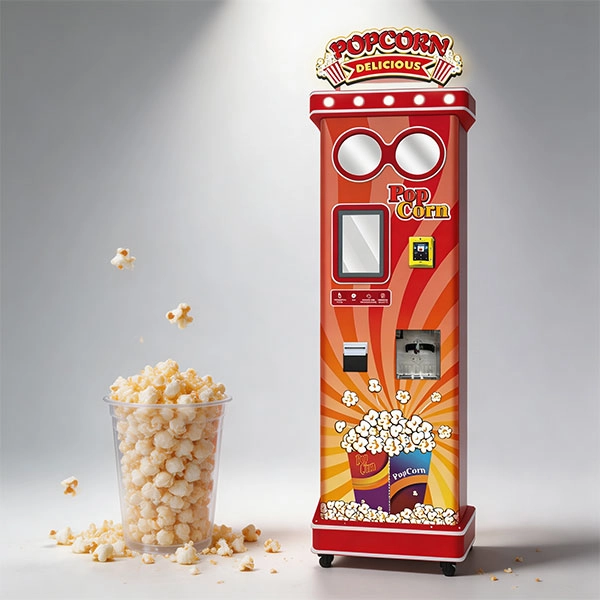
If you want to find a popcorn vending machine supplier in China, or you are looking for a popcorn vending machine supplier in the USA, the same rule applies. Find the company that actually builds the machine. Ask them how long they have been manufacturing. Ask for references from operators who have had their machines running for over a year. If they cannot provide that, move on.
The heating system is the part that breaks first
This is something nobody tells you until you own the machine. The heating system is the single most important component, and it is also the one most likely to fail.
There are two approaches to popping corn in a vending machine. The first uses oil, which produces a flavor some people prefer but creates a mess. Oil machines require more cleaning, the oil goes rancid if the machine sits idle, and the heating elements degrade faster because grease gets into everything.
The second approach uses hot air. The WM680 from Wider Matrix uses what they call 360-degree thermal cycle heating with hot air circulation. No oil. The kernels pop using heated air, which means the machine stays clean, maintenance is simpler, and there are fewer parts that can fail. Each batch takes about 120 seconds. For an operator, that means the machine can serve a queue of people without making them wait forever.
If you are going to buy a fresh popcorn vending machine, ask the supplier what heating method it uses. If they say oil, ask how often it needs cleaning and how long the heating element lasts. If they cannot answer with specific numbers, that is a problem.
Payment systems: the difference between making money and losing it
A popcorn vending machine that only takes coins is a machine that loses customers. In most markets, people under 35 do not carry coins. They pay with their phones. If your machine cannot accept NFC payments or QR code payments, you are turning away a large portion of your potential customers.
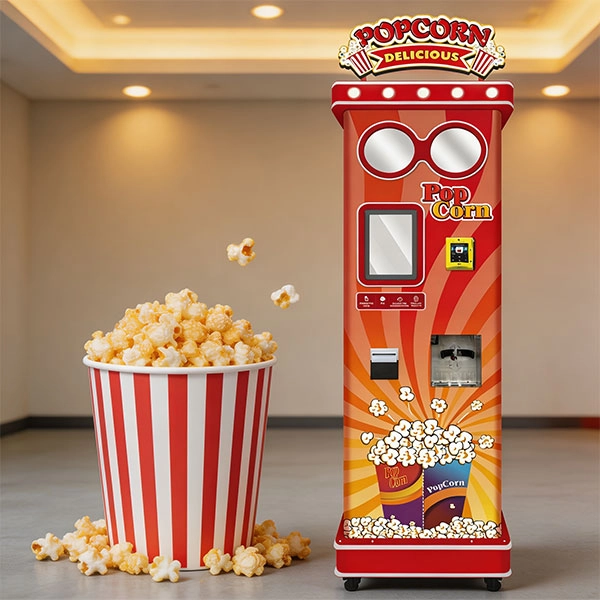
Wider Matrix built the WM680 with five payment methods: coins, cash, credit card, NFC, and QR payment. That covers basically every customer who walks up to the machine. A tourist with Apple Pay. A college student with a QR code app. A parent who only has a debit card. The machine handles all of them.
When you compare machines from different suppliers, check the payment system carefully. Some suppliers advertise “cashless payment” but only support one or two methods. Others require you to use their proprietary payment gateway, which may not work in your country. Wider Matrix lets you use standard payment processors, which means you are not locked into a specific vendor.
The cup situation
This sounds trivial until you run the numbers. Popcorn cups are a consumable. You will buy them over and over for the entire life of the machine. The price per cup matters more than you think.
Wider Matrix sells 32-ounce popcorn cups at $0.12 each for orders of 1,000, and $0.10 each for orders of 10,000. Each cup holds about 40 grams of popcorn. If you buy cups from a third-party supplier, you might pay $0.20 or $0.25 per cup, and the dimensions might not match the dispensing mechanism. Cups that are slightly too wide or too narrow will jam. Jams mean downtime. Downtime means lost revenue.
Buy your cups from the same company that makes the machine, at least for the first year. Once you understand the exact specifications, you can shop around. But do not start with random cups from a discount supplier. You will regret it the first time a cup gets stuck in the dispenser during a Saturday rush.
Profit expectations: real numbers, not wishful thinking
People who wonder whether popcorn machines are profitable usually see a YouTube video claiming $500 per week from a single machine and get excited. The real numbers are more complicated.
A cup of popcorn costs you about $0.15 in raw materials. The kernels cost pennies. The cup costs $0.12. Electricity for the heating cycle is negligible. So your cost per serving is roughly $0.15 to $0.18. If you sell each cup for $3.00 to $5.00, your gross margin per cup is $2.80 to $4.80. That is genuinely good.
But revenue depends entirely on foot traffic. A machine in a busy cinema lobby might sell 80 to 120 cups on a weekend. A machine in a quiet office building might sell 10 cups a day. Location is everything. If you want to understand the range of what different locations produce, read about how much a vending machine makes per month from someone who has tracked this across many installations.
A reasonable expectation for a well-placed popcorn vending machine is $200 to $600 per week in gross revenue. At the midpoint of $400 per week, you would recover the $1,800 cost of a WM680 in about 4 to 5 weeks of operation, assuming your location does not charge rent. If you pay a location 15 to 20 percent of revenue, the payback stretches to about 6 to 8 weeks. Those are good numbers for a vending business. But they assume you picked the right location and the machine works reliably.
What to check before you pay
Before you send money to any supplier, get answers to these questions:
What is the warranty period, and what does it cover? Wider Matrix covers manufacturing defects, but you should ask specifically about the heating element and the payment system, since those are the two most common failure points.
How long does shipping take, and who handles customs? If you are importing from China, shipping can take 25 to 40 days by sea. Air freight is faster but costs a lot more. Make sure the supplier has experience exporting to your country.
Can they provide remote technical support in your time zone? If your machine goes down on a Friday evening and the supplier’s support team does not work weekends, you lose an entire weekend of revenue.
What is the expected lifespan of the machine? A well-built commercial popcorn machine should last 5 to 8 years with proper maintenance. If the supplier cannot give you a straight answer, that tells you something.
Do they offer customization? Wider Matrix includes free customization on machine appearance. You can change the skins, layouts, luminous displays, and color scheme. If you are placing the machine in a cinema or a branded retail space, this matters. Read about custom branding options for popcorn vending machines if that is relevant to your situation.
Buying more than one machine
If you plan to scale, the math changes. Wider Matrix offers tier pricing for orders of 6 to 10 units. The per-unit cost drops, and you spread your shipping and customs costs across more machines.
Before you order multiple machines, though, test one first. Get it installed. Run it for 60 days. See what breaks. See how fast the supplier responds. See whether the location actually produces the revenue you projected. If the first machine works and the numbers hold, order more. If the first machine has problems, you want to find out with $1,800 at stake, not $18,000.
For operators who want to understand the bulk import process in detail, there is a wholesale guide for bulk ordering popcorn vending machines from China that covers MOQ, shipping, and customs paperwork.
Common mistakes I see buyers make
The most common mistake is buying the cheapest machine. A machine that costs $1,200 instead of $1,800 sounds like a deal until the payment system stops working after three months and the supplier stops answering emails. You save $600 upfront and lose thousands in downtime and lost revenue.
The second mistake is buying a machine without verifying the power specifications. The WM680 runs on 220V at 3000W. If you are in the United States, your standard outlet is 110V. You will need a step-up transformer or a dedicated 220V line. This is not a deal-breaker, but you need to know about it before the machine arrives, not after.
The third mistake is underestimating maintenance. Even an oil-free machine needs regular cleaning. The dispensing mechanism needs to be checked. The cup stack needs to be refilled. The corn storage needs to be topped up. If you think you can install the machine and forget about it for a month, you will have a machine full of stale popcorn and frustrated customers. If you want to know what can go wrong, read about common problems with popcorn machines before you buy.
Why the WM680 is worth your consideration
I am not going to pretend every buyer should choose Wider Matrix. Different operators have different needs. But if you are trying to decide whether the WM680 is the right machine to buy, here is what I can tell you based on the specifications and what operators report.
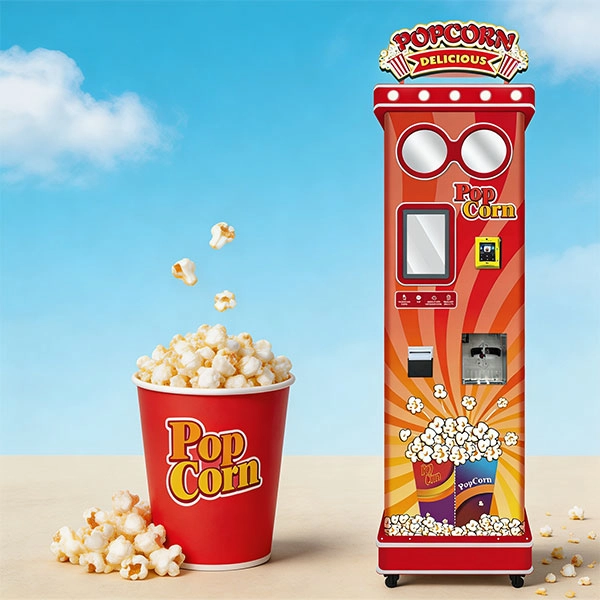
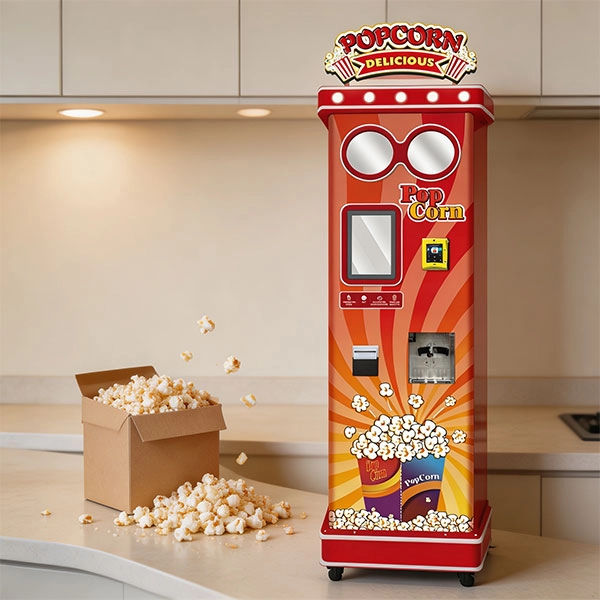
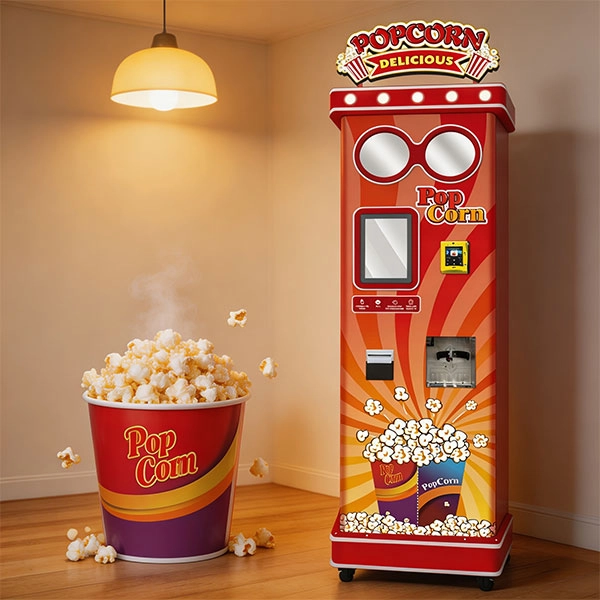
The machine is 570 mm wide, 540 mm deep, and 1930 mm tall. It weighs 70 kg. That means it fits through a standard door and one person can move it with a dolly. It does not require special installation. You plug it in, load the corn and cups, connect it to your payment processor, and it is ready to go.
The hot air heating system means no oil, no grease, and no rancid smells if the machine sits idle for a day. The 120-second pop time means customers do not stand around waiting. The 5.6 kg corn storage holds enough for roughly 140 servings before you need to refill. For a location with moderate traffic, that is a week between refills.
Wider Matrix has been shipping machines to operators in the US, UK, Germany, France, Canada, Australia, and dozens of other countries. They offer direct factory pricing without distributor markups, and they provide remote technical support. For a first-time buyer, having the manufacturer on the other end of the line is worth more than any spec sheet.
If you want to go deeper on the purchasing process, the guide to buying a commercial popcorn vending machine covers the full timeline from first inquiry to delivery.
FAQ
How much does it cost to buy a popcorn vending machine?
The WM680 from Wider Matrix costs $1,800 per unit for orders of 1 to 5 machines. Tier pricing is available for 6 to 10 units. You also need to budget for cups ($0.10 to $0.12 each), corn kernels, shipping, and possibly a 220V power setup depending on your country.
Can I make money with a popcorn vending machine?
Yes, but it depends on location. A well-placed machine can generate $200 to $600 per week in gross revenue. Your cost per cup is roughly $0.15 to $0.18, so the margin is strong. A bad location will produce almost nothing regardless of how good the machine is.
Do I need a 220V power supply?
The WM680 runs on 220V at 3000W. In countries with 110V standard outlets (like the US), you will need a step-up transformer or a dedicated 220V line. This is a one-time setup cost and does not affect ongoing operation.
How often do I need to refill the machine?
The WM680 holds 5.6 kg of corn kernels and 140 cups. At moderate traffic, that lasts about a week. At high traffic in a cinema or amusement park, you might refill every 2 to 3 days. The cloud management system shows you inventory levels remotely, so you do not need to visit the machine to check.
What payment methods does the machine accept?
The WM680 accepts coins, cash, credit cards, NFC (including Apple Pay and Google Pay), and QR code payments. You can enable or disable specific methods through the backend.
How long does shipping take?
If you order from Wider Matrix directly, sea freight typically takes 25 to 40 days depending on your country. Air freight is available for faster delivery but costs more. The supplier handles export documentation and can assist with customs clearance.
What if the machine breaks?
Wider Matrix provides remote technical support. Most issues can be diagnosed and resolved through the cloud management system. For hardware failures, replacement parts can be shipped. Before buying, ask any supplier about their support hours and response times.
Can I brand the machine with my own logo?
Yes. Wider Matrix offers free customization on machine appearance, including skins, layouts, luminous displays, and color schemes. This is included in the base price.
The bottom line
Buying a popcorn vending machine is a $1,800 to $3,000 decision that can pay for itself in a few weeks if you get it right, or become an expensive paperweight if you do not. The machine matters. The supplier matters. The location matters. But the buying process matters most of all, because that is where you either set yourself up for success or create problems you will be dealing with for years.
Wider Matrix builds a machine that hits the right balance of price, functionality, and support. The WM680 is not the cheapest option on the market, and it is not the most expensive. It is the option that gives you hot air popping, five payment methods, cloud management, and free branding customization for $1,800. If you want to buy a popcorn vending machine and you want to talk to the people who actually build it, reach out to Wider Matrix and ask for a quotation based on your specific location and volume.