



Most search results for “robotic vending machine for sale” are ordinary coil machines with a touchscreen bolted on. The machines that actually build the product while the customer watches, a gripper arm that inflates balloons, an ice cream robot that pours a cup in 15 seconds, an oven that bakes a 12-inch pizza in two minutes, are a different class of machine, and they price differently. In this guide Wider Matrix lists all nine robotic models we manufacture, from the $1,800 popcorn machine to the $9,600 pizza robot, with real factory prices, per-unit consumable costs, cycle times, and the supplier checklist we tell every buyer to run before wiring a deposit. Tell us your venue, country, and budget, and we will send a machine recommendation plus a landed-cost quote within 24 hours. Minimum order is one unit.
Search “robotic vending machine for sale” and you will get two very different kinds of results mixed together. The first is an ordinary coil machine with a touchscreen glued to the front. The second is a machine that physically makes something while the customer watches: an arm that grabs a balloon and inflates it, a spinner that pulls sugar into a flower-shaped candy, an oven that bakes a 12-inch pizza in two minutes. Buyers who use the word robotic almost always mean the second kind. That second kind is what we build.
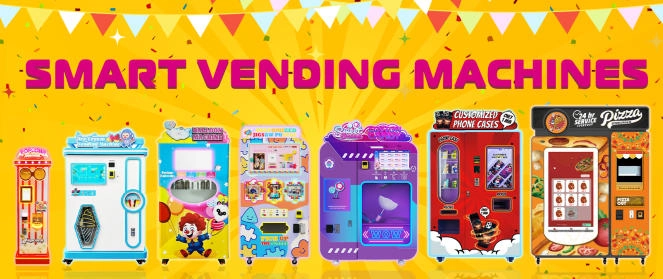
I work at Wider Matrix. We manufacture nine types of vending machines and ship to operators in more than 130 countries, and this is our fourth generation in the business. Most people find us after watching a video of one of our machines working in a mall, and the first question is always the same: what does it cost. This page answers that with real factory prices, model by model, plus the running costs and supplier checks that separate a good purchase from an expensive lesson.
The quick answer, before anything else. A robotic vending machine from our factory runs from $1,800 for the popcorn model to $9,600 for the frozen pizza machine. Most buyers land somewhere between $4,000 and $6,000. Minimum order is one unit, and every machine ships fully assembled and tested. Volume orders and current promotions move the final number, so treat the figures below as list pricing and request a quote for what you will actually pay.
What makes a vending machine “robotic”?
A robotic vending machine is a self-service machine that builds, prints, heats, mixes, or otherwise transforms the product at the moment of purchase, using mechanical systems like gripper arms, print heads, ovens, or spinning mechanisms. A standard automatic vending machine does none of that. It stores pre-packaged goods behind glass and drops one into a chute when you pay.
The commercial difference shows up fast. A bag of chips from a coil machine sells for around $2. A fresh ice cream cup that the machine pours in 15 seconds sells for $3 to $6, and a phone case printed while the customer waits goes for $15 to $35. Then there is the attention factor. People stop for machines that move. Our balloon robot is the clearest example: the gripper arm works behind a fully transparent production bay, kids press their faces to the glass, and adults film it for social media. That is free advertising every single day.
Freshness and personalization are the parts a coil machine cannot copy at any price. You cannot pre-package a cotton candy rose or a custom-printed puzzle. A robot makes them on demand, and on-demand is why these machines command higher prices per sale.
Every robotic machine we sell, with list prices
| Machine | Model | What the robotic part does | Single-unit price |
|---|---|---|---|
| Popcorn | WM680 | 360-degree hot air pops kernels and fills a 32oz cup in about 120 seconds | $1,800 |
| Balloon | WM688 | Gripper arm picks a balloon from 6 slots, inflates it, and delivers it through the port | $3,200 |
| Protein shake | WM186 | Mixes powder from 7 hoppers with cold, room-temperature, or hot water; 60 seconds per shake | $4,150 |
| Small ice cream | Compact model | Dispenses 100g cups, 6 combinations, 90-cup capacity, about 240 kg | $4,400 |
| Cotton candy | WM980 | Spins sugar into 36 shapes at 28 to 30g per candy | $4,800 (WM980+ $4,999, outdoor WM668 $5,299) |
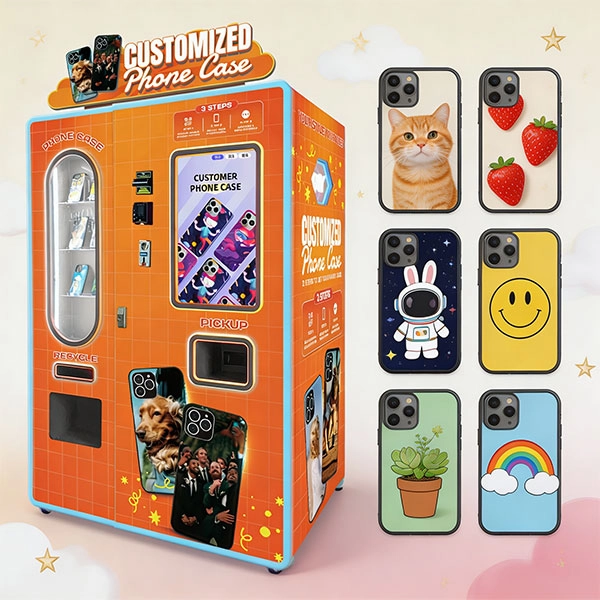
| Phone case printer | WM880 | Prints a customer photo onto a case with an Epson UV head; holds 1020+ cases | $4,999 (i1600 head version $5,999) |
| Ice cream | WM550 | Pours a cup in 15 seconds, up to 300 cups per 28L batch | $5,799 (WM550+ three-flavor $6,799) |
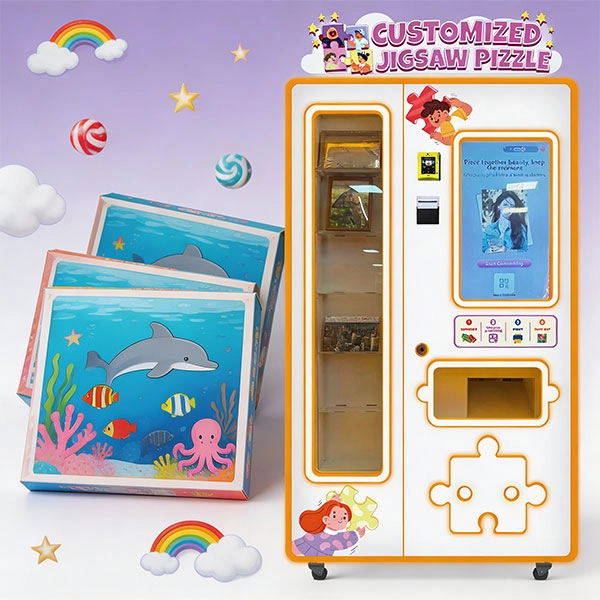
| Puzzle printer | WM520+ | 6-color UV print on German card stock with AI image optimization; 3 minutes per sheet | $5,500 |
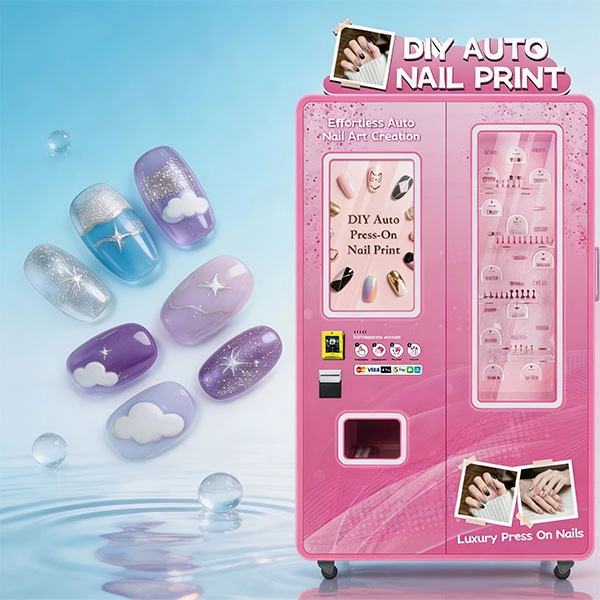
| Nail printer | WM860 | Camera and AI position the fingers, 600 dpi UV print, 30-second cure; 5 minutes per customer | $5,800 |
| Pizza | WM660 | Bakes a 12-inch pizza in as fast as 120 seconds from 72 refrigerated boxes | $8,250 (frozen WM660+ $9,600) |
Quantity discounts are real and worth planning around.
The nail printer drops from $5,800 to $5,500 at five to nine units and $5,200 at ten or more.
The puzzle machine lists at $6,000 and currently sells at $5,500.
On the phone case machine, $680 upgrades the Epson i1600 head to the i3200, which is a lossless swap, and $200 adds a camera module that identifies inventory levels automatically.
Two configuration notes buyers often miss. The cotton candy line has an outdoor version, the WM668, which adds a high-brightness screen and a rainproof raised roof for $5,299.
And the pizza line splits into refrigerated (WM660, 0 to 10 degrees Celsius) and frozen (WM660+, adjustable down to minus 21 degrees).
The frozen version uses microwave plus hot-air composite baking and extends ingredient shelf life past 180 days, which matters if your location has uneven demand.
The four machines buyers ask about most
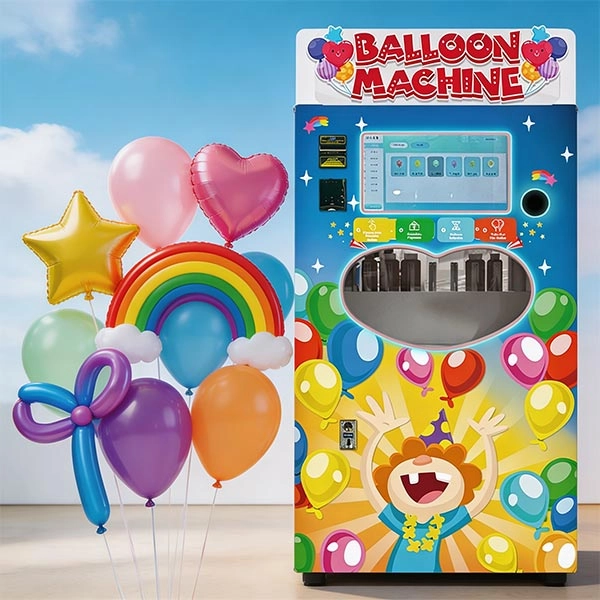
The balloon robot (WM688)
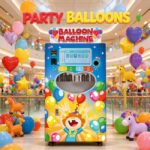
This is the machine I show people first, and the margin explains why. The spec sheet calls it an automatic clamping manipulator. In plain language, it is a gripper arm that pulls a balloon from one of six slots, inflates it, and hands it out through the port, all behind glass so the customer watches the whole show. Capacity is 360 balloons, 60 per slot, and the footprint is roughly one square meter (100 x 82 x 210 cm). Max power draw is 250W, so it runs on an ordinary outlet anywhere.
Balloons with sticks cost $0.30 each at 1,000 pieces and $0.10 each at 10,000. Retail runs $2 to $5 per balloon depending on your market. The shape catalog keeps updating, and DIY custom shapes are available. Graphics, packaging, and logo can all carry your brand. For a deeper look, we have a full guide to the smart balloon vending machine and an operator-focused breakdown of the self-service balloon machine.
The ice cream robot (WM550 series)
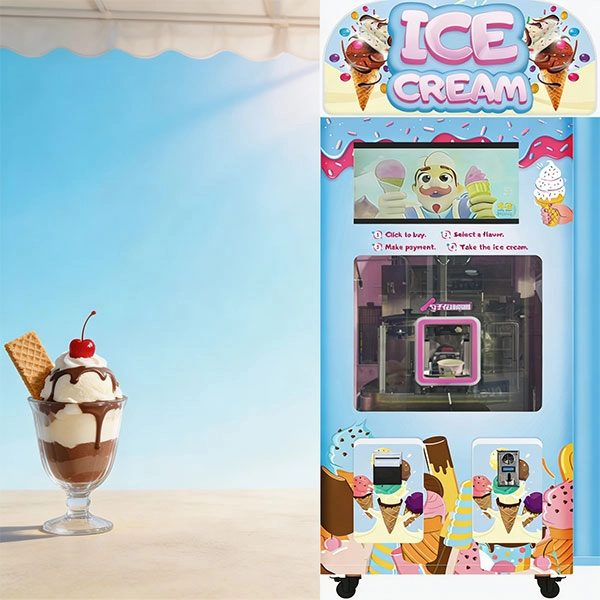
Fifteen seconds from payment to cup. The WM550 pours a fresh ice cream cup with fruit sauces and toppings, and one 28-liter batch covers up to 300 cups. The single-flavor version makes 9 combinations for $5,799. The WM550+ adds two flavors plus a mix option for 27 combinations at $6,799, and it is the only three-flavor model in the line. If space or budget is tight, the compact machine at $4,400 handles 90 cups with 6 combinations and weighs around 240 kg.
Two practical warnings from the field. The full-size WM550 weighs 640 kg, so check your floor and your doorway before it arrives. And at 3000W processing power, it wants a dedicated circuit. Cups cost $0.10 to $0.12 at volume. If you are evaluating this category, our guides on the robotic ice cream vending machine in the USA and what a robot ice cream machine actually costs break down the regional numbers, and the small automatic WM550 page covers the compact option.
The cotton candy robot (WM980 series)
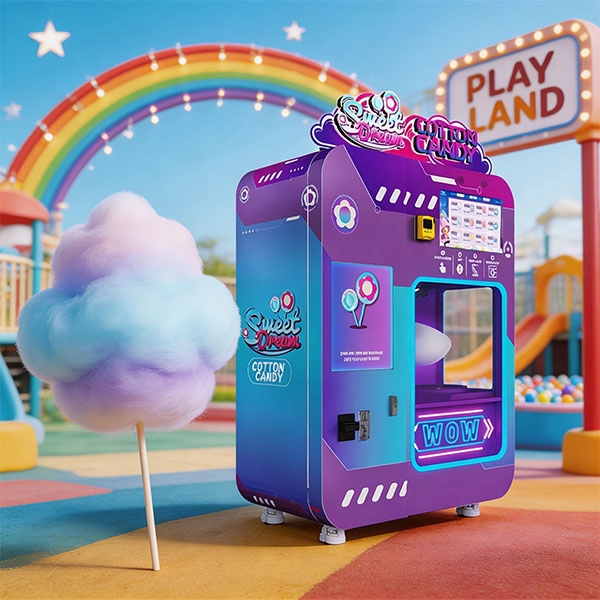
Sugar goes in, a shaped candy comes out. The machine spins 36 different designs and keeps adding more, using 28 to 30 grams of sugar per candy. The base WM980 with four 2kg sugar tanks is $4,800. The WM980+ at $4,999 adds an ambient ring light strip and an improved metal cabinet, plus bigger 3kg tanks. Sugar costs $3.25 per bag at 96 bags and drops to $2.75 per bag above 2,000, with six flavors available: milk, banana, strawberry, blueberry, apple, and grape. A candy that costs you roughly 30 cents in sugar sells for $2 to $5.
The full cost and profit math lives in our guide to the fully automatic cotton candy vending machine, and the cotton candy robot vending machine guide covers placement for theme parks and cinemas.
The nail printing robot (WM860)
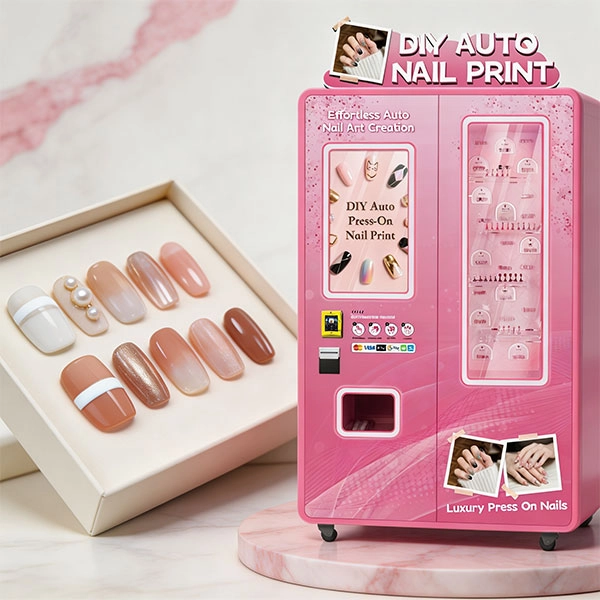
A nail salon appointment takes 60 to 120 minutes. This machine finishes a customer in 5. The WM860 uses a camera with AI finger positioning, prints at 600 dpi with a 6-color UV ink system (four colors plus two sealants), and cures each set in 30 seconds under UV-LED, so nothing smudges. It holds 720 pairs of press-on nails, has 48 built-in designs including French and 3D cat eye, and accepts customer photos over Wi-Fi with no app install. Rated output is 200+ orders per day.
Pricing tiers: $5,800 for one to four units, $5,500 for five to nine, $5,200 for ten or more. The IoT dashboard monitors sales, ink levels, and inventory remotely, pushes new designs over the air, and scales to 100+ machines under one login. CE certified. Our complete guide to automated nail art vending and the WM860 product page have the full detail.
The rest of the line, briefly
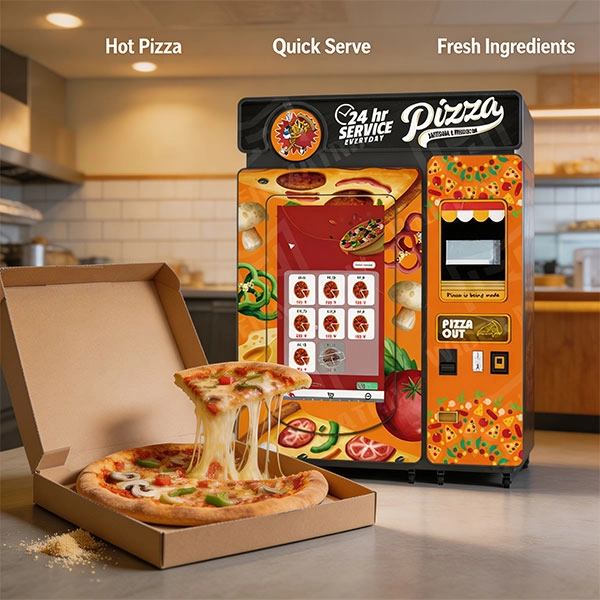
The pizza machine bakes outside-in with hot air and serves a 12-inch pie in as fast as two minutes; see the fully automatic pizza vending machine guide for profitability and risk notes. The protein shake machine runs 7 hoppers (whey, plant-based, mass gainer, BCAA, creatine, pre-workout, plus one custom slot), serves 60+ cups per hour, and integrates Nayax and Pax; details are in the self-service protein shake guide. The popcorn machine air-pops without oil, and the automatic popcorn vending machine quotation page walks through pricing and ROI honestly. The phone case printer has a lossless head upgrade path (F1080 to i1600 to i3200, with the i1600 tripling print speed and quadrupling head life over the base), explained in our smart phone case vending machine article. And yes, there is a machine that prints, cuts, and frames custom jigsaws; the puzzle machine guide covers the AI image optimization and predictive maintenance in the WM520+.
What it costs to keep a robotic machine running
The purchase price is maybe 70 percent of your first-year cost. The rest is consumables, power, and payment processing. Here is what consumables actually cost at our volume pricing:
| Consumable | Small quantity | Bulk quantity |
|---|---|---|
| Balloons with sticks | $0.30 per pc (1,000 pcs) | $0.10 per pc (10,000 pcs) |
| Popcorn cups (32oz) | $0.12 per cup (1,000 pcs) | $0.10 per cup (10,000 pcs) |
| Cotton candy sugar | $3.25 per bag (96 bags) | $2.75 per bag (2,004 bags) |
| Ice cream cups | $0.12 per cup (10,000 pcs) | $0.10 per cup (40,000 pcs) |
| Protein shake per cup (powder + cup) | $0.80 to $1.50, average around $1.20 | |
Power draw varies more than people expect. The balloon machine sips at 250W max and the phone case printer runs at 410W. The popcorn, ice cream, and cotton candy machines pull 3000W while processing, and pizza peaks between 7500W and 8500W depending on version. Processing spikes are short, and standby draw is much lower, but high-wattage models still need a proper dedicated circuit. Ask your venue about this before you sign anything.
On margins, take the protein shake machine as a worked example. Retail is $3 to $8 per cup against roughly $1.20 in consumables, which puts gross margin at 60 to 75 percent. At 15 or more cups a day, our projection has the $4,150 machine paying back in one to three months. If you want to compare categories side by side, our analysis of what type of vending machine is most profitable uses real numbers from eight machine types, and the top 5 smart vending machines for 2026 ranks ROI across the line.
Before you wire a deposit: how to vet a robotic vending machine supplier
When you shop for a robotic vending machine anywhere, from us or from anyone else, run this checklist. Buyers who skip it are the ones who end up with a machine that failed certification at customs or a seller who vanishes after payment.
- Certifications. Ask which standards the machine carries. Ours are built to CE, ISO 9001, and RoHS, with documentation for customs in your market.
- Pre-delivery testing. Ask for a live video of your exact unit running before it ships. Every Wider Matrix machine is fully assembled and tested before it leaves the factory.
- Warranty and support. Ours is one year, with 24-hour online support, video installation guides, and operator training included.
- Spare parts. Ask how fast parts ship to your country. We ship globally and diagnose most issues remotely through the IoT dashboard before any part moves.
- Remote management. Sales analytics, inventory levels, motor status, and alarms should reach your phone. The balloon machine reports through a PC and mobile app; the nail system manages 100+ machines from one dashboard; the puzzle line uses SRRS cloud monitoring. New designs push over the air.
- Landed cost, not factory cost. Freight, customs, and local taxes change the final number. Our quotes state what is included, and we flag what is not.
- Voltage. Most of our models accept 110V to 220V for global deployment, but confirm the configuration for your market on every quote. Some models run 220V standard with 110V optional.
Experience is harder to verify than specs, so ask pointed questions. How many generations has the factory been building these? Where has the model run before? We are in our fourth generation and have machines operating in more than 130 countries. Our guide on finding the right vending machine supplier expands on the full evaluation process.
Where robotic machines earn their keep
Machine-to-venue fit decides most of your revenue. Balloons and cotton candy belong where families pass: amusement parks, cinemas, mall atriums. Phone case and puzzle vending machines want shoppers with idle time, so malls and transport hubs work. The protein shake machine wants gyms, obviously, and the pizza machine wants late-night foot traffic: campuses, stations, entertainment districts. Dwell time beats raw foot count every time, because a customer has to stand still long enough to watch a robot work.
The broader shift is toward machines that think. Inventory alerts, OTA design updates, cashless payment through cards, NFC wallets (Apple Pay, Google Pay, WeChat Pay, Alipay on supported models), QR codes, and MDB-protocol integration with Nayax and Pax are now standard expectations. Our piece on AI smart vending machines covers where unattended retail is heading in 2026, and if you are evaluating a specific market, the smart automatic vending machine guide for Canada is a good worked example.
Frequently asked questions
What is a robotic vending machine?
It is a self-service vending machine that makes or transforms the product at the moment of purchase instead of dropping a pre-packaged item from a coil. Gripper arms, print heads, ovens, spinners, and mixers are the usual mechanisms. A balloon robot that inflates and delivers a balloon, or an ice cream robot that pours a cup in 15 seconds, both qualify. A soda machine does not. These machines run 24/7 without staff, which is where the profit model comes from.
How much does a robotic vending machine cost?
From our factory, $1,800 to $9,600 per unit at list pricing, with most buyers spending $4,000 to $6,000. Volume tiers lower the unit price (the nail machine falls to $5,200 at ten or more), and freight, customs, and taxes add to the landed cost. Request a quote with your destination for an exact figure.
Is “robotic” the same thing as “automatic”?
No, though the terms get mixed in listings. Automatic means the machine runs without staff. Robotic means it physically manipulates or creates the product. Every robotic vending machine is automatic, but most automatic machines, including every coil machine ever sold, are not robotic.
What is the cheapest robotic machine to start with?
The WM680 popcorn machine at $1,800. It air-pops kernels and fills a cup in 120 seconds with no oil, and cups cost 10 to 12 cents at volume. If you specifically want a visible moving arm, the balloon machine at $3,200 is the lowest-priced option with a gripper arm and a transparent production bay.
Do I need a technician on site to run one?
No. Machines arrive assembled and tested, and setup is positioning, power, and a walkthrough of the video guides. Day-to-day issues are diagnosed remotely through the IoT dashboard, and replacement parts ship globally. Under warranty, support is 24 hours online.
Can I put my own brand on the machine?
Yes. Graphics, packaging, and logo customization are available, with a minimum order of one unit on models like the balloon machine. Language packs, currency settings, and payment method configuration adapt to your market. For a full walkthrough of the custom vending options, we have a dedicated guide.
Which payment methods do these machines accept?
Card, QR code, and NFC wallets on most models, with coin and cash accepted on many. The nail and protein machines also support Apple Pay, Google Pay, WeChat Pay, and Alipay, and both connect through MDB protocol to processors like Nayax and Pax.
Are there robotic machines that prepare fresh food?
Four in our line: ice cream (poured fresh in 15 seconds), cotton candy (spun to order in 36 shapes), popcorn (air-popped in 120 seconds), and pizza (baked from refrigerated or frozen stock in as fast as two minutes).
What is the minimum order quantity?
One unit. Most operators start with a single machine to validate their location, then reorder with volume pricing once the numbers prove out.
Where can I find a robotic vending machine for sale directly from the manufacturer?
You are on the manufacturer’s site. Wider Matrix builds all nine machine types described in this article in our own factory and sells direct, which makes us a vending machine manufacturer you deal with face to face rather than through a trader adding a markup. It is also why we can publish list prices, consumable costs, and upgrade pricing openly instead of hiding everything behind “contact for pricing”.
Get a factory quote from Wider Matrix
Send us four things: your country, your venue type, your budget range, and which machines caught your eye. We will come back within 24 hours with a recommendation, list pricing for your quantity, an estimated landed cost including freight, and any active promotions or consumable bundles. If you are still deciding between models, ask us for the profit projection for your specific foot traffic. We would rather talk you into the right machine than sell you the wrong one, because the operators who succeed are the ones who reorder.