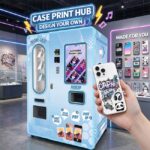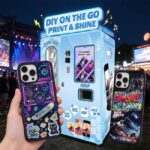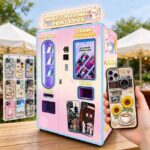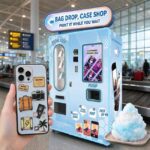



What Is Credit Card Phone Case Vending? Credit card phone case vending is a self-service machine that lets shoppers pay with a credit or debit card and print a custom phone case on the spot. Instead of stocking only fixed designs, the machine holds blank TPU+PC cases for popular phone models and prints the buyer’s photo or artwork in minutes. The card reader makes the purchase feel familiar, so customers can buy without waiting for staff or hunting for cash.
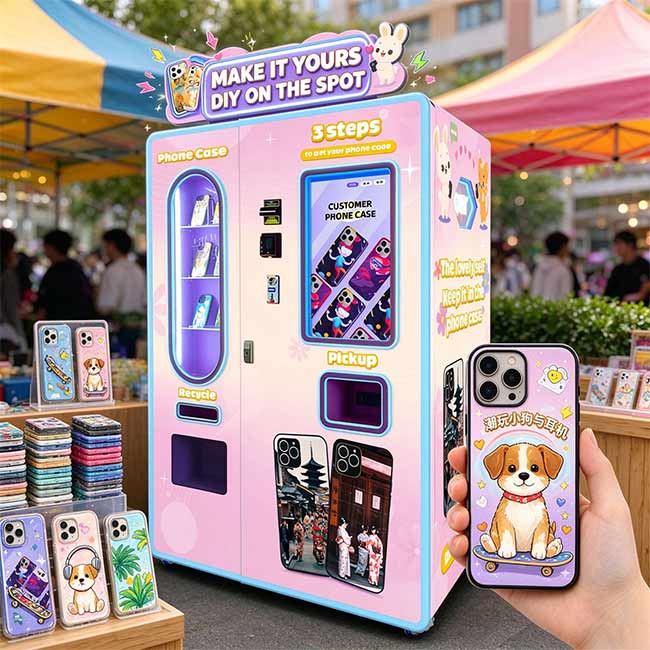
For operators, it is a retail format built around impulse demand and low staffing. You stock cases and ink, set prices, monitor sales remotely, and let the machine handle payment and printing. If you are new to the model, this card payment phone case vending machine guide walks through the business basics.
Why Card Payments Matter for Phone Case Vending
Card acceptance changes the buying experience. A shopper who left cash at home can still say yes, and tourists avoid currency confusion. Card and NFC payments also reduce cash handling, shrink queues, and create a clean digital record for reconciliation.
That does not mean cash is useless. The strongest setups usually accept card, NFC, QR, coin, and cash. A cashless phone case vending machine guide can help you compare the trade-offs, especially if you plan to run in several countries.
Three practical benefits of card-first payments
- Higher conversion: Customers can buy when the idea strikes, even with no cash in their wallet.
- Cleaner operations: Fewer cash pickups and less risk at unattended sites.
- Better reporting: Card and QR sales flow into the management dashboard for daily, weekly, and monthly views.
How a Credit Card Phone Case Vending Machine Works
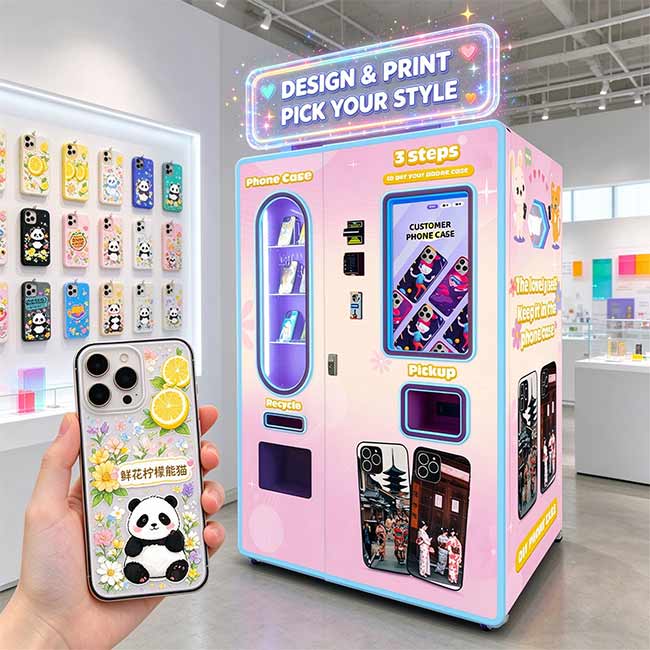
The customer journey is short by design. A shopper scans the QR code on the screen, chooses a phone model, uploads a picture, and pays by card or another accepted method. The machine then prints the case and dispenses it. For a step-by-step walkthrough, see this guide on how a phone case vending machine works.
The four-step customer flow
- Scan: The user scans the QR code shown on the machine screen.
- Select model: They choose a phone model such as iPhone 16, iPhone 15, or iPhone 11.
- Upload a picture: They upload the photo or design they want printed.
- Pay: They complete payment by credit card, NFC, QR, coin, or cash.
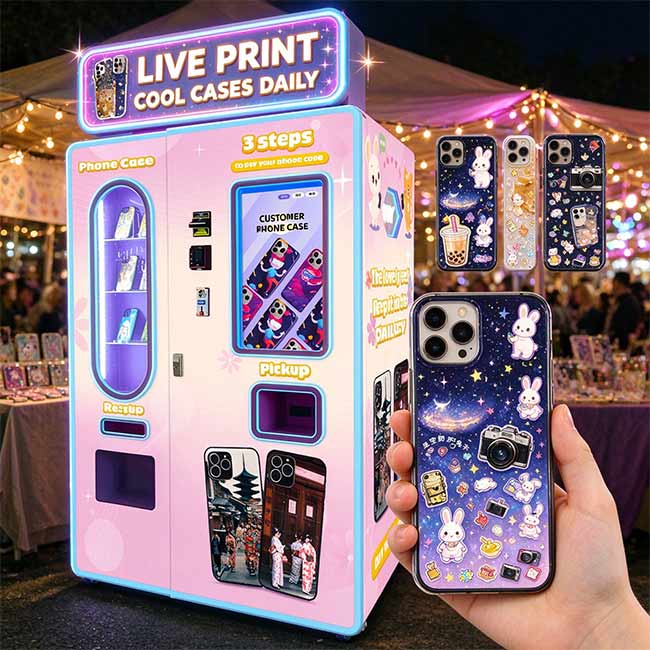
Inside the machine, print visual recognition helps position the design without white borders. The print head lays down UV ink on a TPU+PC case, and the finished product drops into the collection area. The WM880 stores 1,020 to 1,025 cases depending on the version, so one reload can cover a lot of orders.
WM880 Specs That Matter for Card-Paying Buyers
The WM880 is a floor-standing model built for unattended retail. It runs on 110V–220V power, draws 410W, and measures 1340 × 990 × 2170 mm at 380 KG. The payment list includes coin, cash, credit card, NFC, and QR, which covers the main ways customers expect to pay. For a deeper buyer checklist, see the WM880 buyer’s guide.
| Parameter | WM880 Specification |
|---|---|
| Model | WM880 |
| Payment methods | Coin, cash, credit card, NFC, QR |
| Case storage | 1,020 cases (F1080) or 1,025 cases (i1600) |
| Print heads | Epson F1080, i1600-U1, or i3200-U1HD |
| Ink capacity | 2,000 ml |
| Power | 410W, 110V–220V |
| Dimensions | 1340 × 990 × 2170 mm |
| Weight | 380 KG |
| Case material | TPU + PC composite |
Pricing starts at US$4,999 for the F1080 version and US$5,999 for the i1600-U1 version at 1–3 units. The optional inventory identification camera adds US$200. If you want more speed later, the i1600 version can be upgraded to the i3200 print head for an additional US$680.
Credit Card vs. Other Payment Methods
Card payments are the headline feature, but the best payment mix depends on your location. A mall in a card-heavy market may run mostly on card and NFC. A tourist spot may see more QR and cash. The table below gives a practical view.
| Payment method | Best for | What to watch |
|---|---|---|
| Credit/debit card | Everyday shoppers, high-ticket custom cases | Payment processing fees and chargeback rules |
| NFC | Fast mobile wallet checkout | Customer familiarity with tap-to-pay |
| QR payment | Mobile-first markets and tourists | Currency and app compatibility |
| Coin/cash | Backup payments and some local markets | Cash collection, change, and security |
A multiple-payment setup reduces friction and protects sales when one method fails. This guide to multiple payment phone case vending explains how to balance the options without overcomplicating the screen.
Costs, Inventory, and Realistic ROI
The main costs are the machine, phone cases, ink, site rent, payment fees, and service. Standard TPU+PC cases cost US$1.30 each at 1,000 pieces, falling to US$1.20 at 5,000 and US$1.10 at 8,000. Magnetic cases run higher: US$2.30, US$2.20, and US$2.10 at the same tiers. A standard 4-color Epson UV hard ink set costs US$100, while the F1080 6-color set costs US$160.
Run a simple payback model before you sign a lease. If you sell 10 custom cases a day at US$19, gross sales are US$190 a day. Case cost is about US$13 a day at US$1.30 per case, leaving room for ink, rent, payment fees, and maintenance. At that pace, a US$4,999 machine generates about US$5,700 in monthly gross sales before costs.
The realistic ROI and startup guide helps you stress-test those numbers.
Keep the inventory mix simple
- Lead with popular models: iPhone 16, iPhone 15, and iPhone 11 should be easy to select.
- Add Android coverage: Samsung, Google Pixel, Xiaomi, Huawei, and OPPO broaden the buyer pool.
- Use the optional camera: Inventory identification helps monitor stock per slot when installed.
Where Card-Paying Customers Expect Phone Case Vending
Card-first vending works best where people already expect self-service and have a reason to buy on impulse. Good sites include shopping malls, airports, transit hubs, universities, tourist districts, hotels, and event venues. The common thread is foot traffic plus dwell time.
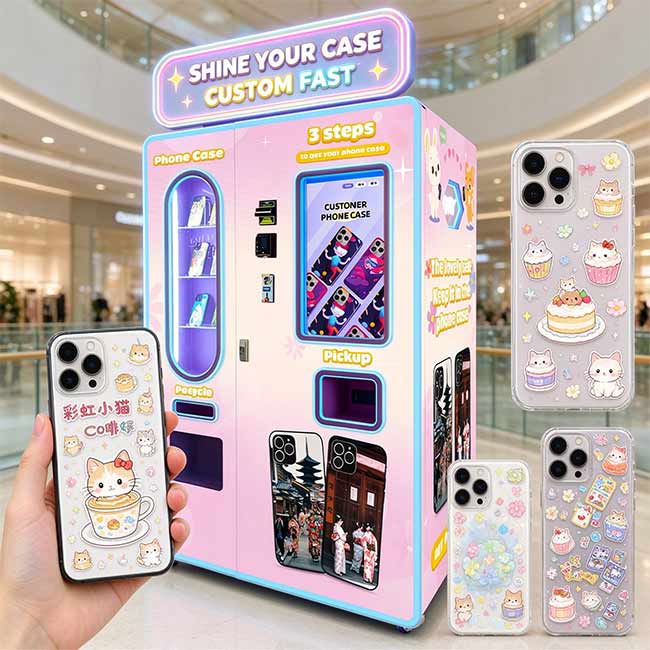
Unattended retail also needs reliable power, a clean installation spot, and a strong data connection for card processing. A cloud-based phone case vending machine lets you watch machine status, sales, and print records from a phone or PC, which is useful when you run more than one location.
Setup Checklist for a Credit Card Phone Case Vending Business
- Confirm the site: Check foot traffic, nearby competitors, lease terms, and security.
- Check power: The WM880 needs 110V–220V and draws 410W.
- Test connectivity: Card payments and remote management need stable internet.
- Plan inventory: Stock cases for the phone models your local customers actually use.
- Set pricing: Cover case cost, ink, rent, payment fees, and service before you chase volume.
- Train reloads: Place cases flat with the back facing up, stay below the red line, and push each case inside.
- Use the dashboard: Track revenue, order status, machine alarms, promotions, currency, and language settings.
The WM880 carries CCC, CE, ISO, RoHS, and PSE certifications, plus 5+ independent R&D patents and 30+ industry awards. That matters when you need to satisfy landlords, insurers, or local compliance reviews.
Choosing the Right Print Head and Version
The F1080 version is the base option with excellent photo resolution and vivid colors. The i1600-U1 version is the standard step up, with roughly 3× printing speed, 4× lifespan, and 2× clarity versus F1080. The i3200-U1HD is the upgrade path for even faster output, and both upgrades are lossless.
If you expect steady volume, the i1600 version usually makes more sense because it reduces customer wait time. If you are testing a new site, the F1080 version lowers entry cost. Either way, confirm the phone case fit and lens protection design before you order in bulk.
FAQ
Do credit card phone case vending machines accept debit cards?
Yes. The card reader handles credit and debit cards, and the WM880 also accepts NFC, QR, coin, and cash. Check with your payment provider on accepted card networks and processing fees.
How much does a credit card phone case vending machine cost?
The WM880 starts at US$4,999 for the F1080 version and US$5,999 for the i1600-U1 version at 1–3 units. Optional inventory identification adds US$200, and the i3200 print head upgrade adds US$680.
How many phone cases does the machine hold?
The WM880 holds 1,020 cases in the F1080 version and 1,025 cases in the i1600 version. That capacity supports high-traffic sites with fewer manual reload trips.
Can customers still pay with cash or QR codes?
Yes. The machine supports coin, cash, credit card, NFC, and QR payment. A mixed payment setup helps you serve locals and tourists without forcing one checkout method.
What does the machine need for card payments to work?
It needs a stable internet connection for card authorization and remote management. Confirm site connectivity before installation, and test a live card payment after setup.