



If you are comparing commercial cotton candy vending machines for the US market, the number on the quote is only half the picture. The difference between a machine that pays for itself and one that gathers dust comes down to the supplier behind it: who builds it, what parts and sugar they stock, and how fast they respond when something breaks at 9 pm on a Saturday. Wider Matrix builds the WM980, WM980+, and WM668 factory direct, stocks the sugar and paper sticks you will reorder for years, and walks US buyers through import and setup. Send us a message with your location and expected volume, and we will get back with a landed estimate and a breakdown of the numbers for your specific site.
If you are looking for a commercial cotton candy vending machine supplier for the USA, you have probably already collected two or three prices and are trying to work out which one is real. The numbers on a quote look close. What actually separates a good purchase from a bad one is what happens six months after the machine lands, when you need a burner part, a restock of sugar, or someone who picks up the phone.
We build these machines at the Wider Matrix factory. We also keep the consumables in stock and answer US buyers directly rather than routing you through a reseller. This page is the straight version of what we tell people before they send an inquiry, covering pricing, the three models, import, and the support questions that decide whether a location earns or sits empty.
What a commercial cotton candy vending machine actually does
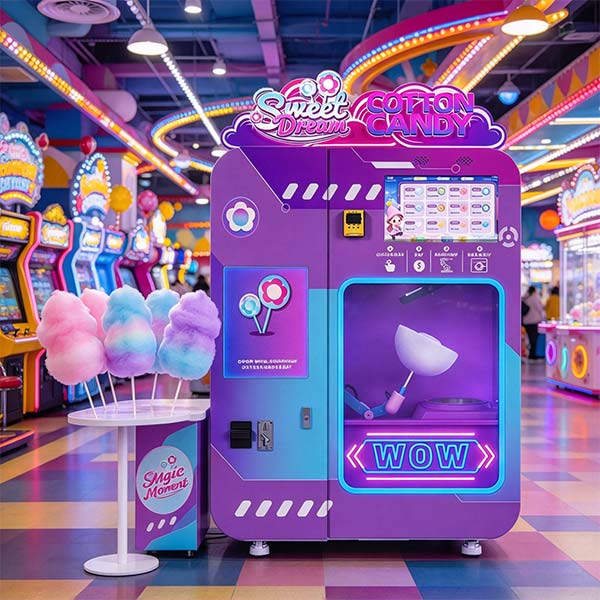
The machine takes over the job a person used to do behind a counter. A customer walks up, picks a shape on the touchscreen, pays by coin, cash, card, or NFC, and the machine spins, shapes, and hands over a cotton candy in a closed cabinet. The newer models run unattended around the clock, which is the whole point: you are not hiring someone to stand there.
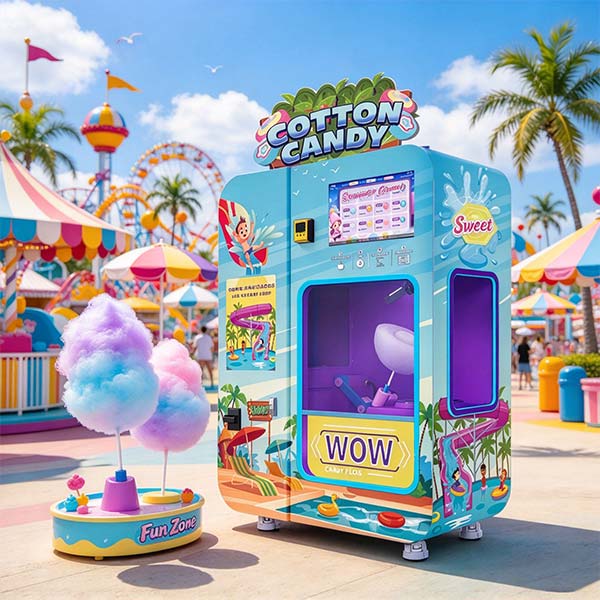
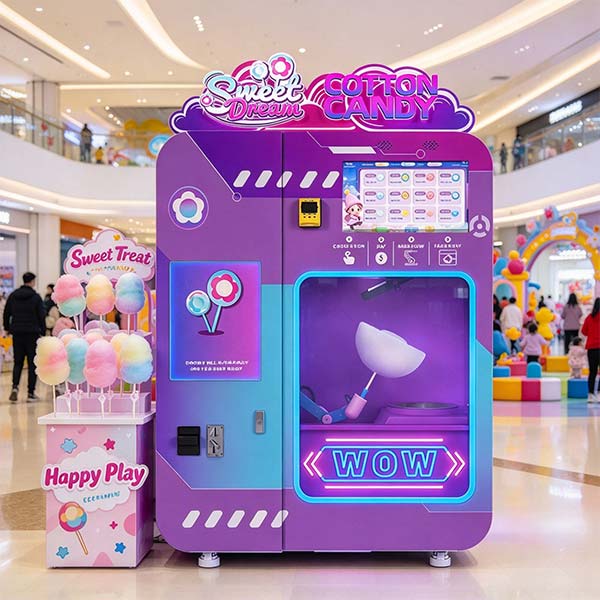
The WM980, which is the model most US buyers start with, measures 132 x 195 x 67 cm and weighs 300 kg. It draws 500 W on standby and about 3,000 W while it is actually making candy, so the idle power bill is small even when the machine sits overnight. Each serve uses 28 to 30 g of sugar, and the machine can produce 36 different shapes, with more added through software as time goes on.
Inside, the parts that take wear are built for it. The burner runs an auto-cleaning and humidifying cycle that stretches its life. The shaping knife has a non-stick finish so sugar does not glue itself to the moving parts. A four-axis robotic arm does the shaping, an electromagnetic lock keeps the front door shut during production, and the whole unit sits on wheels with an easy-lock mechanism so two people can move it in and out of a space. There is also a screen on the front that plays advertising, which some operators sell as extra local ad space.
Manufacturer or trading company: why it matters for US orders
Plenty of people selling cotton candy machines do not make them. They list a product, take your deposit, and forward the order to a factory they have never visited. That is fine until you need a spare part, a wiring diagram, or a software update, and suddenly your “supplier” is forwarding questions to someone else over email.
We run the factory that builds the WM980, WM980+, and WM668. That means the drawings, the parts list, and the test line are all in one place, and when you ask for something (a different payment setup, a language pack, your logo on the cabinet), it does not have to travel through a middleman. If you are still deciding between a few sources, we wrote down what to look for when choosing a cotton candy machine supplier, and a separate look at finding a current supplier when the first quote falls through.
For US buyers the factory-direct route also changes the math on price and on support. There is no import markup from a distributor layered on top of the unit price, and when something breaks you talk to the people who assembled the machine, not a sales rep reading a script.
The three models and their real prices
Wider Matrix sells three versions of the machine. They share the same core (robotic arm, auto-cleaning burner, 36 shapes, unattended operation), and differ on capacity, cabinet, and where they are meant to sit.
| Model | What it is | Single-unit price |
|---|---|---|
| WM980 | Standard model, four 2 kg sugar tanks. Upgrade to four 3 kg tanks adds $200. | $4,800 |
| WM980+ | Upgraded cabinet with an ambient LED ring and metal body, four 3 kg tanks as standard. | $4,999 |
| WM668 | Outdoor model with a high-brightness screen, raised rainproof roof, six 2 kg tanks. | $5,299 |
Those are single-unit factory prices. At three to five units, six to nine units, and ten or more, the price steps down, so if you are placing a location or buying for a small fleet, ask for volume pricing rather than ordering one at a time. The sugar tanks matter more than most buyers expect: the base WM980 holds around 8 kg of sugar, enough for roughly 280 serves between refills, while the WM980+ and its 12 kg load push a refill out past 400 serves. If you will not be on site every day, the bigger tanks mean fewer trips. If you want the automated version with more on the profit side, we also keep a guide on the AI cotton candy vending machine USA supplier angle.
What to check before you buy
If you are comparing this machine against another supplier, look past the glossy photos and check four things that decide whether a unit survives the first year.
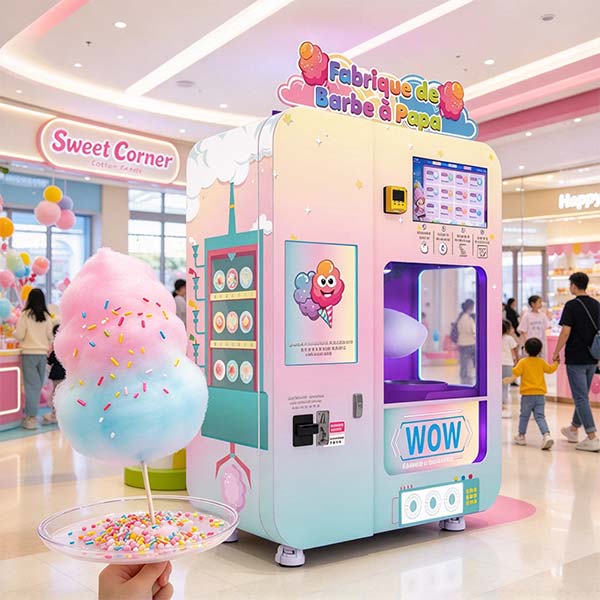
First, the software layer. This machine has a cloud control system, remote diagnosis, and over-the-air updates, which means a stuck menu or a payment glitch is often fixed without a service call. Ask any seller whether their machine can be updated remotely or whether every fix means a technician. The answer tells you a lot about how the machine is engineered.
Second, payment. The WM980 accepts coin, cash, credit card, and NFC in one unit, and the modules are configurable. In the US, card acceptance is the difference between a full week of sales and a week of people walking past because they have no quarters.
Third, the cabinet and the consumables. Sugar granule size sits at 1.2 to 1.7 mm, and we stock bags in six colors (milk, banana, strawberry, blueberry, apple, grape) with no powder residue, plus paper sticks 10 mm wide and 300 mm long. If you plan to rebrand the machine, we also do OEM cotton candy vending machines, with custom logos and patterns.
Fourth, what happens on delivery day. A machine that arrives without a clear install path can sit in a warehouse for weeks. We cover setup questions directly, and the machine ships with a four-step customer flow you can test yourself: pick a style, choose payment, watch it make the candy, collect it. If that flow is not simple enough for a distracted customer at a mall, it does not matter how many features are on the spec sheet.
What you spend after the machine
The machine is not the whole cost. The number that trips up first-time operators is the ongoing spend on sugar and sticks, because that is where your margin lives.
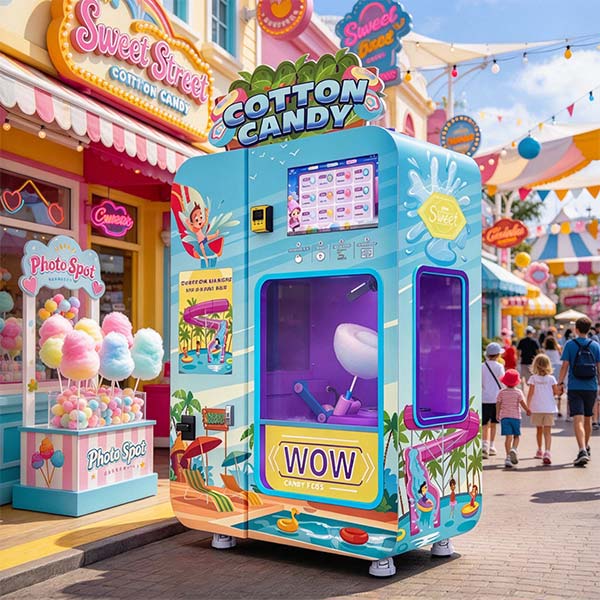
Our sugar runs $2.75 to $3.25 a bag depending on volume. A small order of 96 bags is $3.25 each, 480 bags drops to $3.00, 1,008 bags to $2.85, and a 2,004-bag order comes to $2.75. Paper sticks run from $0.050 each for 2,000 pieces down to $0.038 each at 100,000 or more, and custom printing on the sticks has a minimum order of 10,000. Because each serve uses under 30 g of sugar, the raw ingredient cost per candy stays low even at retail pricing, which is why the model holds up next to a person working a manual cart.
We keep the sugar and sticks in stock rather than making you hunt for a compatible consumable later, and we ship them with machines or separately. If you are putting a machine somewhere with limited floor space, we also cover smaller-footprint options in separate notes.
Shipping, import, and installation in the USA
Shipping a 300 kg machine across an ocean is not the hard part. The hard part is making sure it clears customs, arrives with the right documentation, and gets placed in your location without surprises. We walk US buyers through this as part of the order rather than handing you a container number and going quiet.
What you should ask any supplier, us included, is what the landed cost actually is: unit price, freight, customs clearance, and any duties, in one number. Duties and inland freight move around by port and by state, so we quote that for your location instead of giving you a generic number that will be wrong. We lay out the whole sequence in how to order a cotton candy vending machine, from inquiry through delivery.
Installation itself is designed to be light. The unit rolls on wheels, plugs into a standard supply, and is operated by the touchscreen and cloud app, so you do not need a specialist on site. We provide the setup guidance and a run-through of the four-step customer flow, and most operators have it taking orders the same week it arrives.
Parts, warranty, and support
This is where most US buyers get burned, because a lot of the machines offered online are sold once and then the seller disappears. A cotton candy machine is a device with a burner, motors, and a robotic arm, and those parts will eventually need service no matter how well they are made.
Because we build it, we hold the spare parts: burners, shaping knives, screens, payment modules, and the consumables. Remote diagnosis works over the cloud, so we can often pinpoint a fault before any part is shipped, and send only the piece you need instead of a whole service visit. Over-the-air updates mean software fixes land without a trip. We are happy to spell out warranty terms and response times for your market before you pay, because a supplier that will not answer that question in writing is telling you something important.
Why buy factory direct from Wider Matrix
The honest reason to buy from us is not that our machine is magic. It is that we control the whole chain: we build the cabinet and the arm, we stock the sugar and sticks, and we answer US operators directly. That removes the three points where imports usually go wrong, which are a shrugging middleman, a missing spare part, and a consumable you cannot source locally.
If you want to go factory direct, we would rather you compare us against a real quote than take our word for it. Send us your location, your expected volume or foot traffic, and whether you want indoor or outdoor, and we will return a landed price plus a per-serve breakdown so you can see where the machine pays for itself. We respond in writing, and we stand behind the numbers.
Common questions from US buyers
How much does a commercial cotton candy vending machine cost in the USA?
The machine itself is $4,800 for the WM980, $4,999 for the WM980+, and $5,299 for the outdoor WM668, before volume discounts. On top of that you add freight, customs clearance, and any duties, which we quote for your specific location so the landed number is real.
Do you manufacture in-house or are you a trading company?
We manufacture. The WM980, WM980+, and WM668 are built at the Wider Matrix factory, and the robots, burners, and software are our own, so spare parts, custom orders, and support all come from one place.
How long does shipping to the USA take, and who handles customs?
Transit and clearance time depends on your port and the season, so we give you a window for your location rather than a generic number. We coordinate the documentation and clearance as part of the order. Contact us with your city and we will return an estimate.
What payment methods does the machine accept?
Coin, cash, credit card, and NFC, all in one unit, and the modules are configurable. In the US market most operators run card plus NFC as the default.
How many serves does one fill of sugar make?
A standard WM980 holds four 2 kg tanks, roughly 8 kg, which is around 280 serves at 28 to 30 g each. The WM980+ holds four 3 kg tanks, pushing a refill past 400 serves.
What flavors and sugar options are available?
We stock sugar in six colors and flavors: milk, banana, strawberry, blueberry, apple, and grape. Granule size is 1.2 to 1.7 mm with no powder residue, and the machine can produce 36 shapes, with more added through software updates.
Is installation included, or do I set it up myself?
Setup is designed to be simple: the unit rolls on wheels, plugs in, and runs from the touchscreen and cloud app, so you do not need a specialist. We provide guidance and a walkthrough of the customer flow before you open.
What warranty and after-sales support do you offer?
We hold spare parts in stock, diagnose faults remotely over the cloud, and ship only the part you need. Software fixes come over the air. Ask for the specific warranty terms and response times for your market and we will put them in writing.
If your question is not here, send it through. We would rather you had the answer before you buy than discover it after the machine is on a pallet.