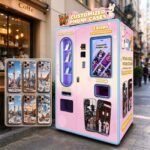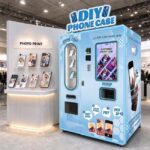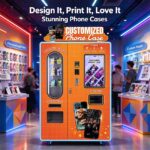



A shopping center is the best home a phone case vending machine has. The footfall is there, the card payment habits are there, and the bored shopper killing a wait is exactly the customer who pays to turn a photo into a case. The machine that does it is the Wider Matrix WM880, from US$4,999, holding up to 1,025 blank cases and running unattended all day. Send us your location and order size, and we will return factory pricing with a lead time to your door.
A shopping center is the best home a phone case vending machine has, and not only because of the footfall. A mall already brings the card payment habits, the staffed security, and the bored shoppers killing a wait, which is the exact moment someone else pays to turn a photo into a phone case. If you are researching a shopping center phone case vending machine, the unit you will almost certainly end up comparing against is the Wider Matrix WM880, priced from US$4,999.
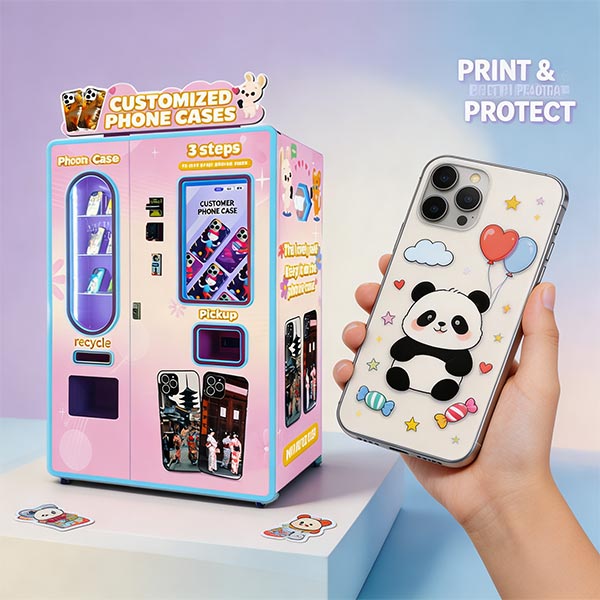
The WM880 prints a customer’s own photo onto a TPU and PC case in a few minutes while they wait, and it stocks 1,020 to 1,025 blank cases depending on the print head, so a busy mall unit does not need daily restocking. It runs unattended for the whole trading day and takes card, cash, coin, NFC, and QR payment, which covers every way a mall crowd pays.
It comes in two versions. The F1080 starts at US$4,999 and the i1600 at US$5,999, and the difference is the print head, which sets both speed and how long the head lasts. The rest of this covers the specs, the running costs, and why placement inside the center matters more to your return than any figure on the sheet.
Why a shopping center works better than the street
The reason this machine leans toward malls is that the mall does half the selling for you. Shoppers already expect to pay by card or phone, they are walking past with time on their hands, and a kiosk that prints their own photo onto a case reads as entertainment rather than a purchase. A street unit has to fight for all of that on its own.
There is also the practical edge: malls have loading access, power, and usually a security staff that means your machine is not the first thing a vandal touches overnight. That combination is why operators who place a unit in a busy mall routinely report it outperforming an identical unit in a quieter street spot. For a walkthrough of finding and vetting one for a mall, our page on finding a phone case vending machine in a New York mall is the closest published walk-through.
The machine: WM880
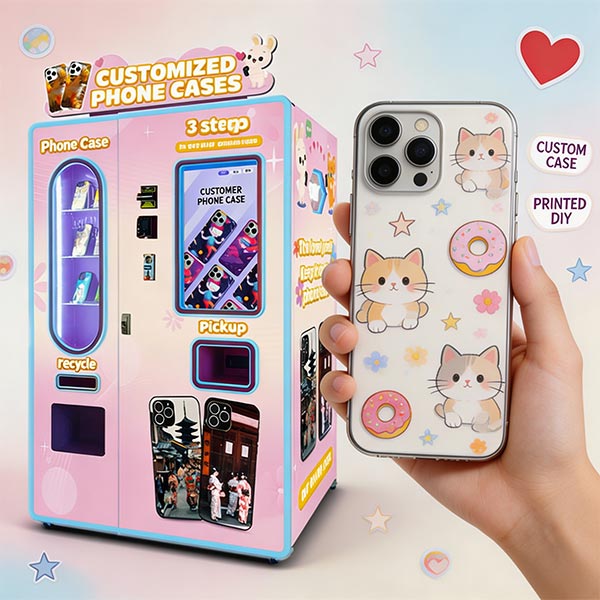
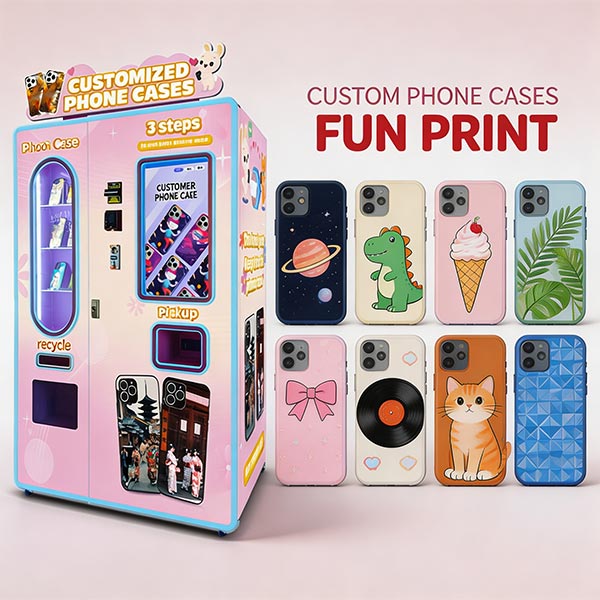
The WM880 is a photo-to-case printer in a vending cabinet. A customer scans the QR code on screen, picks their phone model, uploads a photo, and pays. The machine prints the image onto the case with AI-assisted positioning so it lands without white borders, then drops the finished case into the collection tray. The whole loop happens with no employee involved.
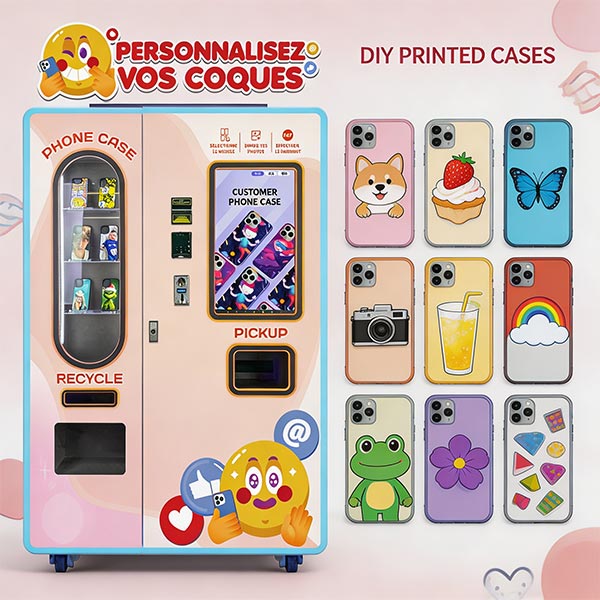
| Model | WM880 |
| Dimensions (W x D x H) | 1340 x 990 x 2170 mm |
| Weight | 380 kg |
| Power | 410W, 110V to 220V |
| Ink capacity | 2,000 ml |
| Case capacity | 1,020 (F1080) / 1,025 (i1600) |
| Case material | TPU + PC |
| Print heads | Epson F1080-A1 / i1600-U1 / i3200-U1HD |
| Payment methods | Coin, cash, card, NFC, QR |
The machine prints onto cases fit for the phones shoppers actually carry: Apple models including the iPhone 16, 15, and 11, plus Samsung, Google Pixel, Xiaomi, Huawei, and OPPO. For the broader view of how these machines work before you commit, our guide to mobile phone case vending machines covers the category.
What to check before you put one in a mall
Three things decide whether a machine survives a shopping center, and none of them is the cabinet colour. The print head decides speed and head life. The case capacity decides how often someone has to restock. And the payment stack decides whether you catch every sale or watch shoppers walk off because they only carry a phone.
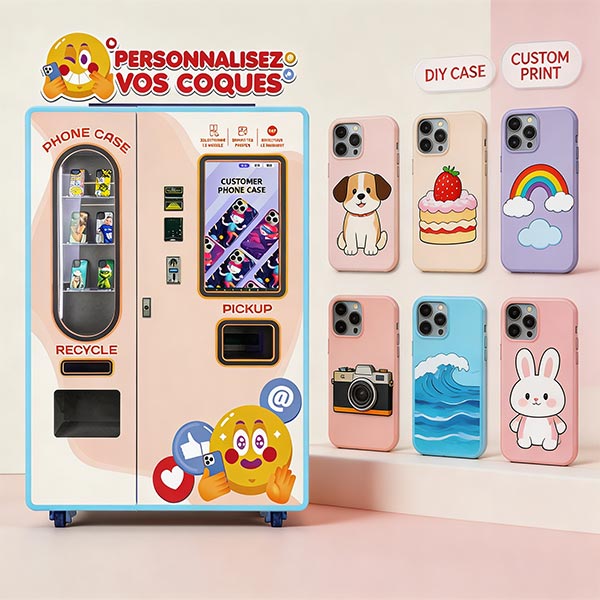
The WM880 lands well on all three. The i1600 head prints about three times faster than the base F1080 and lasts around four times longer. The cabinet holds over a thousand cases. The payment stack includes NFC and QR, which is the gap that used to cost operators the contactless crowd. If your priority is head speed and print life, the i1600 version is the one to spec, and the extra US$1,000 over the F1080 is the jump most mall operators make.
Price and running costs
The F1080 version is US$4,999 and the i1600 is US$5,999 at 1 to 3 units, with tiered pricing above that. The i1600 can be upgraded to the i3200 head later for an extra US$680, and the optional inventory recognition camera, which counts stock automatically, adds US$200. Orders of 4 to 6, 7 to 10, and 11 or more get better per-unit rates, so send us your quantity for the tiered figure. The full buyer’s breakdown, including the fine print, is in our phone case vending machine for sale buyers guide.
The ongoing costs are the blank cases and the ink. Standard TPU and PC cases run US$1.30 each at 1,000 pieces, down to US$1.10 at 8,000, while the magnetic version runs US$2.30 down to US$2.10. Ink is US$100 per set for the four-colour standard, or US$160 for the six-colour F1080, and the 2,000 ml tank means refills are rare.
Placement inside the center: where it earns
Inside a shopping center, the difference between a machine that prints all day and one that gathers dust is about forty metres. Good spots are the food court, the cinema lobby, and anywhere near the phone accessory and gadget stores, where shoppers already have phones on their mind. The weakest spot is a quiet back corridor, no matter how cheap the rent, because a phone case machine feeds on people who can see it while they wait.
Negotiate for visibility, not just square metres. A landlord will often move on rent when you can show them the machine also draws people and fills dead space, and that is the conversation worth having before you sign. We dig into placement strategy in our guide to where to place a custom phone case vending machine for profit.
Running it unattended in a mall
A mall machine runs the same long shift as the centre itself, and the WM880 is built for that. It takes every common payment method, reports sales and stock to a phone over the cloud, and supports multiple currencies and languages, which matters in the international airports and flagship malls where a mix of shoppers passes through. The optional inventory camera reads stock per slot in real time, so you know what to bring on your restock visit instead of counting by hand.
Why Wider Matrix
Wider Matrix builds the WM880 in its own factory, so the machine, the spares, the cases, the ink, and the after-sales support come from one origin. The unit carries CCC, CE, ISO, RoHS, and PSE certification, and Wider Matrix holds more than five independent R&D patents with over 30 industry awards, which matters when a mall’s management asks for paperwork before they approve the kiosk. If your plan is a branded line of machines rather than running under ours, we do custom builds too, which is what our custom phone case vending machine page covers.
Buying questions, answered
What is a mobile phone case printing vending machine, and is it the best way to sell cases?
It is a cabinet with an inkjet print head inside that prints a customer’s uploaded photo directly onto a blank case while they wait. Compared to selling pre-printed cases, it carries no dead stock, because every case is made to order. Compared to a counter staffed by a person, it runs without payroll. For a mall location that combination is usually the stronger model, which is why operators search it out.
How much does a mobile case printing vending machine cost?
The WM880 starts at US$4,999 for the F1080 version and US$5,999 for the i1600 at 1 to 3 units, with tiered pricing above that. Add blanks, ink, and a lease for the full picture. Send us your quantity and we will return the exact tiered figure.
How much does it cost to make your own phone case?
On this machine, the marginal cost is a blank TPU and PC case at US$1.10 to US$1.30 each in volume, plus a small share of ink. That is the number under the retail price, and it is what gives the machine its margin. A magnetic case runs US$2.10 to US$2.30.
Is 3D printing a phone case worth it compared to this?
For vending, generally not. A 3D printer is slow per unit, the finish is rougher in the ranges buyers expect, and the material cost is higher, which is why a mall machine prints on a pre-made TPU and PC blank with a UV or pigment head instead. For a one-off case at home, a print might make sense, but as a self-service business the WM880’s print-to-order blank is built for throughput.
Can I build my own phone case machine, or make cases at home?
You can assemble a printer, a screen, and a payment terminal, but the hard parts are the head firmware, the case feeder, and the software that ties a payment to a job. A factory machine already has those engineered and certified. Making a case at home works for personal use, but it is not the same as a cabinet that runs alone in a mall, which is the thing that actually earns.
What do I need to start making phone cases?
For a vending business, you need the machine, blank cases, ink, a location, and the patience to test the buyer flow in your first weeks. Wider Matrix supplies the machine and the consumables from the same factory, and the blanks and ink reorder together, so your supply chain is one contact instead of three. Licence requirements depend on the country and the venue, so check those locally before you sign anything.
What is the most profitable vending machine to own?
Custom phone cases tend to sit near the top because the blank is cheap and the printed result feels personal, so the markup is real. The honest ranking depends on your traffic and location more than the machine category, which is why a mall placement shifts the numbers in the phone case machine’s favour in the first place.
Where can I create my own phone case, and what is trending?
Today you can make one in a mall kiosk like the WM880, at a print-on-demand counter, or with a tabletop printer at home. The demand that keeps the category moving is personalisation: pet photos, memes, couple photos, and text, printed on demand rather than stocked. The people who skip cases entirely are a different market, usually chasing the bare device, and they do not change the fact that most shoppers still buy one, which is the crowd a mall kiosk captures.
Get a quote
Tell us your country, whether you are targeting an indoor mall or a mixed foot-traffic spot, and how many units you need. We will come back with factory pricing, the lead time to your door, and the case and ink costs so you can see the margin before you decide.
Send the inquiry through the form below and we will reply with a quote. If you already know your quantity and location, include them and we will skip the back and forth.