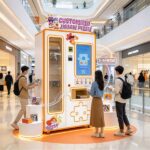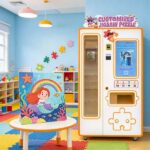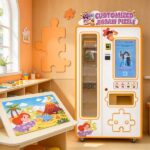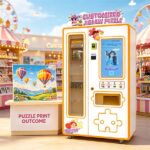


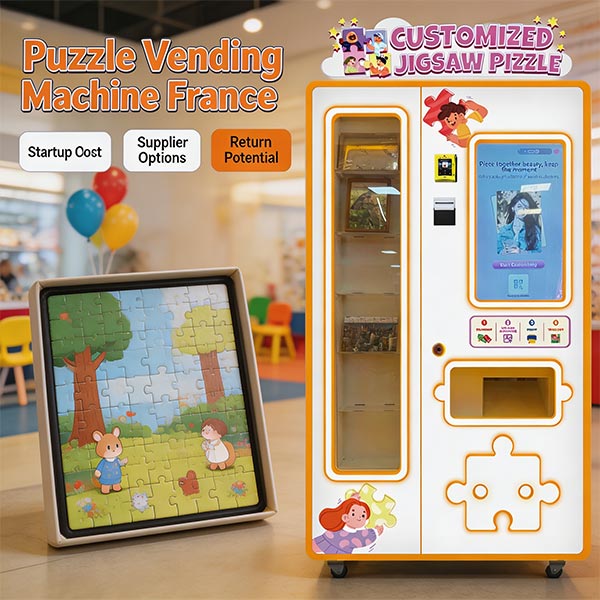
Puzzle vending machines in France almost never come from France. They are imported, and Wider Matrix builds two of the ones that end up in French malls and tourist spots: the WM520 for wooden puzzles and the WM520+ for paper puzzles. The WM520+ runs US$5,500, prints a custom photo puzzle in about three minutes, and usually clears its cost in one to three months in a busy location. Tell us your city and order size, and we will return factory pricing with a lead time for delivery into France.
Puzzle vending machines in France almost never come from France. The photo-to-puzzle kiosk you walk past in a French mall or tourist town was almost certainly built in a factory overseas and shipped in, and Wider Matrix is one of the factories that builds them. If you are looking for a puzzle vending machine for the French market, the realistic shortlist is two models: the WM520 and the WM520+, with the WM520+ priced at US$5,500.
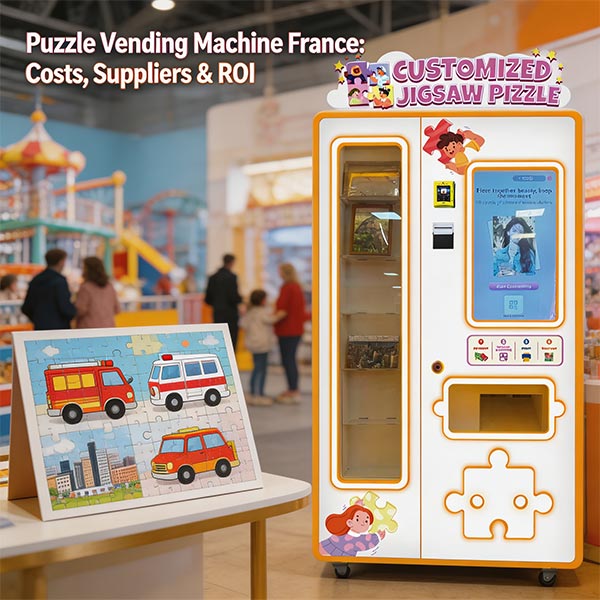
France is one of the easier European markets to equip, for reasons worth stating before you spend a euro. The machines run on standard 220V, which is the French mains supply, so there is no transformer to buy. The interface can be localized into French, and the paper puzzle blanks are German blue card stock, a premium card that arrives from a neighbouring market and holds colour well. None of that fixes the one thing that actually decides whether you earn, which is placement, and that is the part you should think through hardest.
The WM520 prints onto wooden puzzles and costs US$5,550. The WM520+ prints onto paper puzzles with a six-colour head and AI image optimization for US$5,500. In a busy French location both typically clear their cost in one to three months. The rest of this covers the specs, the real costs, and how to bring a machine in without getting burned by a supplier.
The French market in a nutshell
France is one of the most visited countries in Europe, and that visitor traffic is what funds this machine. Tourists move through railway stations, airports, seasonal markets, and the shopping streets around the landmarks all year, and in those spots a souvenir that began as the customer’s own photo sells itself. The other half of the demand is local: families with children, grandparents after a keepsake, and the school holiday footfall that fills shopping centres on a rainy afternoon.
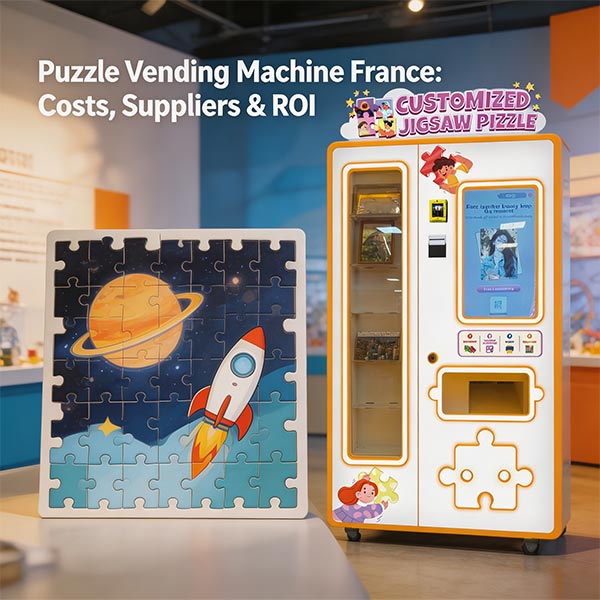
The market is also used to unattended retail. Cards and contactless payments are the norm at French checkouts, which is exactly the payment stack these machines carry through Nayax, banknotes, and coins. Puzzles themselves are a familiar family pastime in France, so turning a personal photo into a puzzle reads as a gift and a game in one, not a machine people have to be talked through.
None of that means every street corner earns. France rewards placement the way every market does, and harder than most, because rent in the best spots is not cheap. The decision a French operator really makes is not which print head to buy but which doorway to put the machine in front of. Get the spot right and the traffic does the rest.
Where puzzle vending machines in France actually come from
There is not much of a local manufacturing base for this category in France. The machines, and most of the puzzle blanks that go inside them, come from China, which is why the supplier decision matters more than the machine spec in an imported market. Your two buyers in this arrangement are the factory that builds the unit and the forwarder who lands it, and the factory is the one that will still exist when the arm jams in year two. For a candid read on how the machines perform elsewhere in Europe, see what we wrote about the puzzle vending machine market in Germany, which runs on the same import model and the same 220V supply.
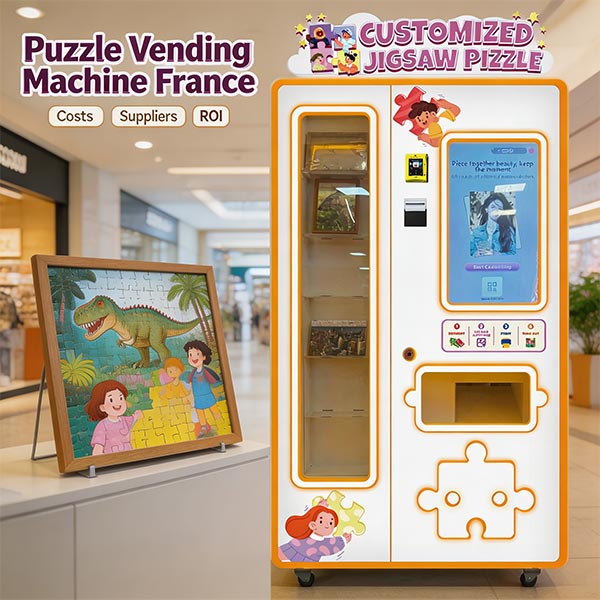
The two machines: WM520 and WM520+
Both machines turn a customer’s uploaded photo into a finished puzzle in about three minutes, with no employee involved. The WM520 is the first generation, a four-colour CMYK head printing pigment ink onto wooden puzzles. The WM520+ is the second, a six-colour F1080 head printing UV hard ink onto German blue card paper puzzles, with AI image optimization and a 27-inch touchscreen.
| WM520 (Gen 1) | WM520+ (Gen 2) | |
|---|---|---|
| Print head | XP600, 4-color CMYK | F1080, 6-color CMYK+LC+LM |
| Print medium | Wooden puzzles | Paper puzzles (German blue card) |
| Ink | Pigment ink | UV hard ink, anti-clogging |
| Print speed | 3 minutes per sheet | 3 minutes per sheet |
| Screen | Touchscreen | 27-inch touchscreen |
| Smart features | Basic PLC control | AI optimization + predictive maintenance |
| Price (1 to 5 units) | US$5,550 | US$5,500 |
The WM520+ holds 208 puzzle blanks, 140 photo frames across two styles, and 600 pieces of A5 stock, and it runs on 220V as standard. For fifty dollars less than the older model, it adds the six-colour head and the AI layer, which is why it is the unit most buyers outside a strictly wooden-puzzle market should choose. The core of what matters when buying one of these is the print head, and we go deeper on that in our jigsaw puzzle printer write-up.
What to check before you buy
Bring the same eye to this purchase you would bring to any imported capital equipment. Ask whose name is on the firmware, not just whose name is on the invoice, because a trader cannot fix the cloud system or send you a patch. Ask whether the head is anti-clogging, because an unattended machine sitting idle overnight is exactly where nozzles dry shut. And ask where blanks and ink come from, since your margin depends on a steady supply of consumables at a price you can plan around.
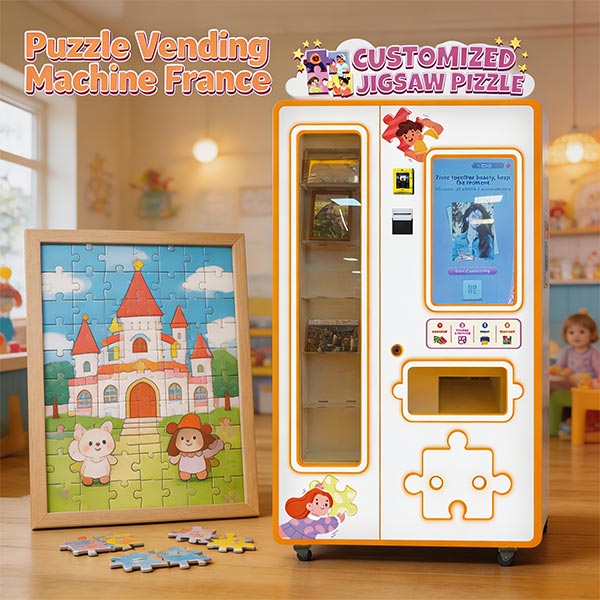
The WM520+ answers all three from the factory side: F1080 head, anti-clogging UV ink, and blanks, frames, and ink that all ship from the same origin. That consistency is what turns a novelty into something you can actually operate.
Price, consumables, and what the numbers look like in France
The machine is one line item; the rest is consumables, shipping, a lease, and taxes. Paper puzzle blanks run US$1.20 each at 1,000 pieces, dropping to US$1.00 at volume and as low as US$0.80 in bulk. Frames run US$1.80 down to US$1.50, the six-colour UV ink set is US$160, and the WM520’s pigment ink is US$100 a set.
| Item | Unit cost by volume |
|---|---|
| Paper puzzle blank (A5) | US$1.20 down to US$0.80 |
| Photo frame | US$1.80 down to US$1.20 |
| UV ink set (WM520+) | US$160 |
| Pigment ink set (WM520) | US$100 |
Wider Matrix models a sample location selling ten puzzles a day at US$9.90 to US$20 each, which clears roughly US$31,200 in sales against about US$19,100 in all-in first-year cost, and faster sites pay the machine off in one to three months. The import side, customs, and what to expect from shipping into Europe is laid out in our guide to exporting a puzzle vending machine from China.
Shipping to France and running it day to day
The machines ship factory-direct into France, and because they run on 220V as standard, there is no voltage step-down to sort out at installation. The interface localizes to French, and the payment stack covers card through Nayax, banknotes, and coins, which is what the French vending market expects at unattended points.
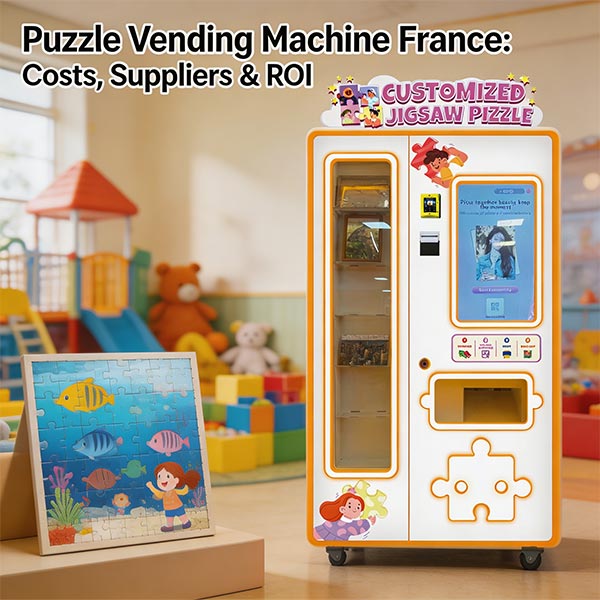
Once it is live, you run it from a phone over the cloud: live status, stock levels, sales, and over-the-air software updates. If you are mapping the launch rather than the machine itself, our guide to starting a custom jigsaw puzzle vending machine business walks the first weeks.
Why Wider Matrix
Wider Matrix builds the WM520 series in its own factory and ships to European operators, which means the machine, the spares, the blanks, and the support come from a single origin instead of a chain of middlemen. That matters across borders the way it matters nowhere else: when a unit in Lyon throws an error, you want the fix from the factory that wrote the firmware, not a forwarder forwarding your email. We can point you to shipped European reference cases, and if you are building your own brand we do OEM and ODM down to the UI language for the French market.
Buying questions, answered
Do any French companies make these machines?
Not at any real scale. The machines and most of their puzzle blanks are imported, so when you buy you are really choosing between a direct factory and a local reseller who added a margin on the same hardware. Buying factory-direct removes that layer, as long as the factory also handles support, which is the thing to verify before you send money.
Are puzzles good for the brain, and does that help me sell?
Puzzles are widely treated as a low-effort brain exercise, and that gives the machine a second selling angle beyond a photo souvenir: a parent and child making a puzzle of their own photo feels like a memory and a plaything at once. You do not have to push the cognitive angle to sell, but in gift shops and family locations it quietly works in your favour.
How much does a puzzle vending machine cost?
The WM520 is US$5,550 and the WM520+ is US$5,500 at 1 to 5 units, with tiered pricing at 6 to 10 and 11 or more. Add blanks, ink, shipping, and a lease to get the real number. We break the whole cost down in our look at how much a puzzle machine costs.
What is the difference between the WM520 and the WM520+?
The WM520 prints four-colour pigment ink onto wooden puzzles. The WM520+ prints six-colour UV hard ink onto German blue card paper puzzles, with a 27-inch screen, AI image optimization, and predictive maintenance. At fifty dollars less, the WM520+ is the better machine for almost every French location.
Where do I get blanks and ink for the French market?
From the same factory that built the machine. You reorder one consumable set, pre-speced to the unit, rather than finding a separate supplier for blanks, frames, and ink. That keeps your cost per puzzle stable and removes the hunt for a reliable source, which is the reason importing operators usually buy the machine and the consumables together.
Do you ship to France, and what about voltage and language?
Yes, factory-direct into France. The machine runs on standard 220V, matching the French grid, and the interface localizes to French. Delivery time depends on your city and order size, so tell us your location and we will give a lead time before any payment changes hands.
What about support and spare parts in France?
Support runs through the same factory, including over-the-air updates and predictive maintenance that catch wear early. Spares and blanks ship from the same origin, and warranty terms are confirmed at order, so ask for the current coverage with your quote.
Can I put my own brand on the machine?
Yes. Wider Matrix does OEM and ODM, covering exterior wraps, luminous characters, UI language including French, packaging, and the vending software. Send us your brand requirements and we will confirm what is possible and quote it.
Get a quote
Tell us the French city you are targeting, whether you are leaning toward the WM520 or the WM520+, and how many units you need. We will come back with factory pricing, a lead time for delivery into France, and a full consumables table so you see the entire picture before you decide.
Send the inquiry through the form below and we will reply with a quote. If you already know your quantity and location, include them and we will skip the back and forth.