

If you are searching for a professional cotton candy machine for sale, the biggest mistake is treating it like a kitchen gadget. A commercial unit is an industrial machine with a 3000W heating load and a robotic precision system that runs for hours. At Wider Matrix, we build these units in Guangzhou, and we ship them fully assembled and tested to operators in over 130 countries. This guide breaks down exactly how the machine works, what it costs to run, and how to calculate your profit margins before you spend a dollar on hardware.
What defines a professional machine vs. a home unit
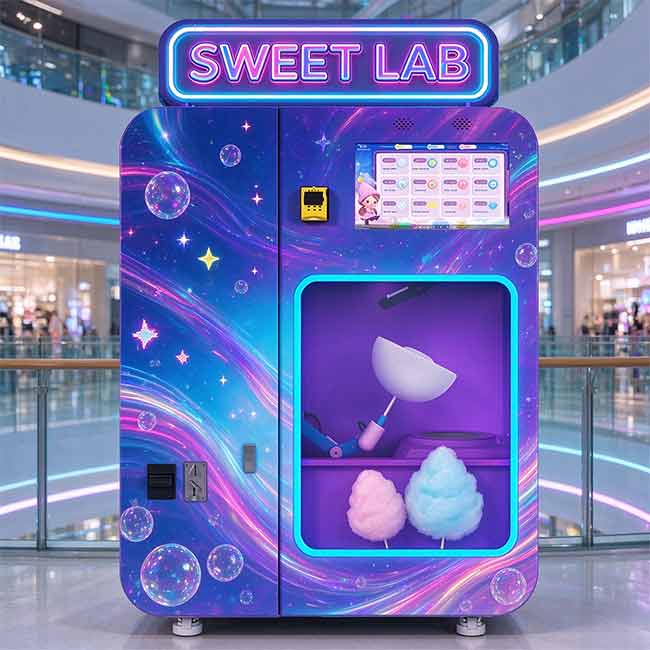
The line between hobbyist and commercial is drawn by the motor, the heating recovery speed, and the payload. A home machine usually has a 500W to 1000W heating element and holds 1 to 2 kilograms of sugar. It shuts down if you sell too many in a row. It requires a human to operate the stick and spray the sugar. A professional unit, like our WM980, runs on a 3000W processing load with a 4-degree-of-freedom robotic arm. It holds up to 8 kilograms of sugar in four separate tanks. The machine runs unattended for 24 hours. The customer touches the screen, pays, and walks away. The machine makes the candy and ejects it through a magnetic door lock that prevents access during production. If you are weighing your options on the broader market, check out our detailed breakdown of Professional Cotton Candy Machine Price: The Ultimate 2025 Buyer’s Guide to see how factory-direct pricing compares to retail markups.
Core specs of the Wider Matrix WM980 platform
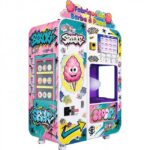
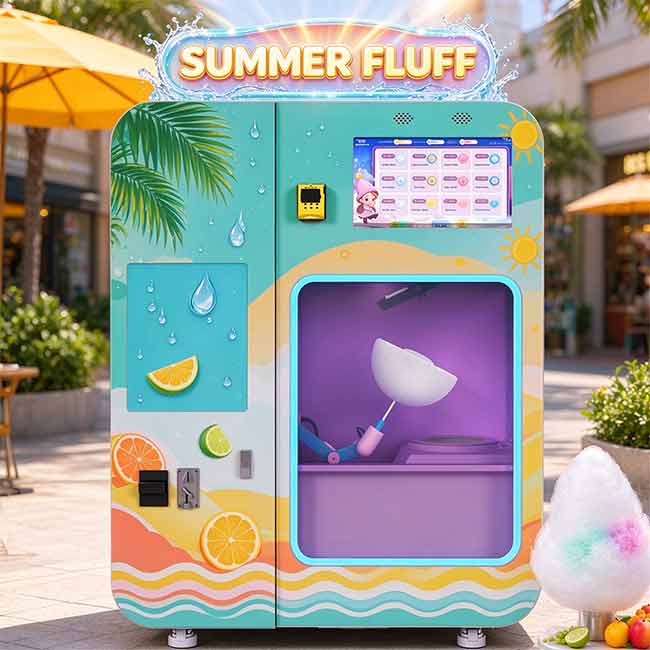
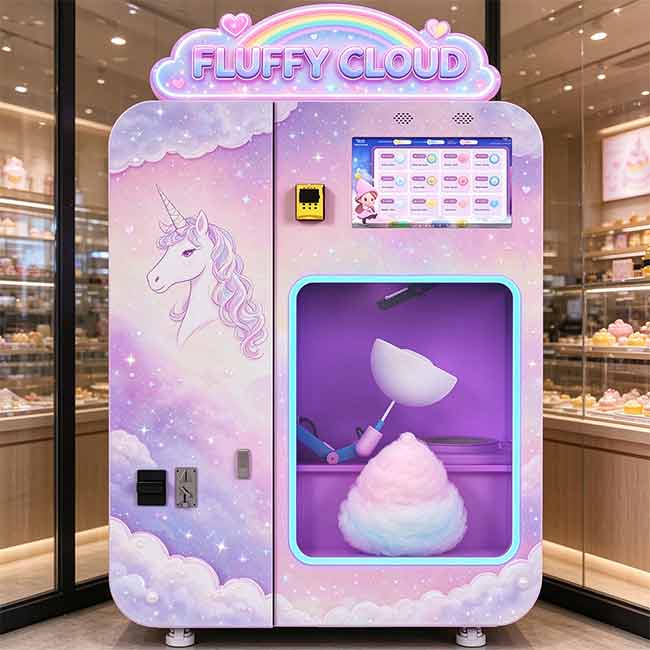
When we say we manufacture professional cotton candy machines for sale, here are the exact physical numbers you need to plan your space. The base WM980 model measures 132 x 195 x 67 cm and weighs 300 KG. It stands roughly knee-high if placed on the floor, but most operators put it on a sturdy stand to reach eye level. The standby power draw is 500W, but it spikes to 3000W during the heating and spinning cycles. You need a dedicated 220V or 110V circuit depending on your regional voltage setting.
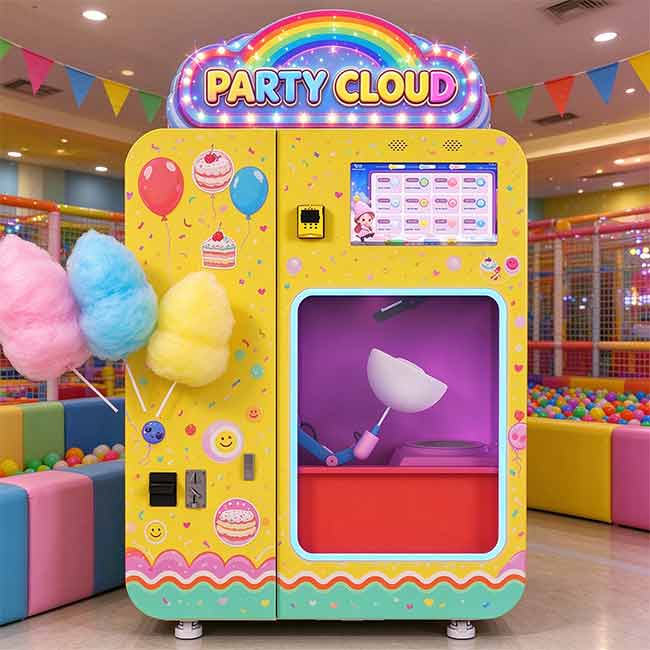
We configure the plug and internal wiring for your destination market before it leaves the factory. The control system is a multilingual touch screen with a built-in USB video advertising slot. You can run your own local brand video on that screen while the machine is waiting for the next customer. This ad space generates extra passive revenue on top of the candy sales.
The robotic arm and sugar delivery
The machine uses 1.2 to 1.7mm granulated sugar. This is not the fine powder you buy in a grocery store bag, because powder clumps and clogs the burner. The granules fall through the auto-cleaning burner, which self-cleans and humidifies after cycles to extend the lifespan of the heating element. The robotic arm moves the shaping knife through the spinning cloud. This creates 36 different patterns that update via cloud control. We currently include shapes like flowers, mushrooms, hearts, and clouds. Because the patterns are controlled via OTA (over-the-air) updates, you can change the available designs without opening the machine. The sugar consumption is locked at 28 to 30 grams per piece of candy. This is a hard metric for calculating your cost of goods.
Three models to choose from
We offer three main configurations for commercial venues. The pricing below is for a single unit. If you are buying for a chain or a multi-city rollout, How to Choose the Best Cotton Candy Machine Supplier China: A Complete Guide for 2026 explains how to negotiate and structure multi-unit contracts.
| Model | Best For | Key Difference | Reference Price (1 Unit) |
|---|---|---|---|
| WM980 | Standard indoor malls, theme parks | Base hot model, 4 x 2kg sugar tanks | US$4,800 |
| WM980+ | Premium venues needing ambient light | Upgraded metal cabinet, ring light, 4 x 3kg tanks | US$4,999 |
| WM668 | Outdoor plazas, street corners | High-brightness display, rainproof roof, 6 x 2kg tanks | US$5,299 |
You can upgrade the WM980 to use 4 x 3kg tanks for an extra US$200. The WM668 is the only one with an elevated roof to protect the screen from direct rain. Note that the WM668 has a larger footprint of 6 x 2kg tanks, so it produces more total candy before a restock. Choose the WM668 if you are placing the machine on a windy or exposed outdoor location. Choose the WM980 or WM980+ for indoor environments with climate control.
The math: cost per candy and gross margin
This is the section that makes the business case. The machine costs between US$4,800 and US$5,299. You must also buy the consumables: the sugar and the paper sticks. The sugar comes in six colors (milk, banana, strawberry, blueberry, apple, grape). At a 96-bag bulk order, each bag costs US$3.25. At a massive 2,004-bag order, the cost drops to US$2.75 per bag. The paper sticks cost US$0.050 each at 2,000 units, and US$0.038 each if you order 100,000. Custom printed sticks are available with a minimum order of 10,000. Let’s use realistic average numbers for a mall location: US$2.90 per bag of sugar and US$0.04 per stick. Since the machine uses roughly 30g of sugar per candy, a single bag of sugar (assuming a standard retail weight, typically around 1.5kg to 2kg, which yields about 50 to 65 candies per bag) gives you a very low variable cost.
Your direct material cost per candy is well under US$0.15. If you sell a candy for US$3.00 to US$5.00, your gross margin sits above 90% before you even calculate rent and electricity. If you want to see how this compares to renting, read our analysis on Is Renting a Cotton Candy Machine Cheaper Than Buying? A 2025 Cost Analysis. Buying from a factory almost always beats renting once you cross the 3-month mark, because you own the asset and the hardware lasts for years.
Where to place a cotton candy vending machine
Foot traffic is the only variable that matters here. The machine sells to people who stop. High-traffic, low-decision venues are the best fit. Shopping mall food courts get steady streams of kids and parents. Theme parks and amusement parks fit perfectly because the machine looks like a natural part of the park’s ecosystem. Movie theaters capture the audience during the 20-minute intermission or pre-show waiting time. Airports and transit hubs are busy, but you must check local regulations on open heating elements in restricted zones. University campuses are great for late-night traffic, and students will happily spend US$2.00 on a treat. If you are targeting the North American market specifically, our guide on Commercial Cotton Candy Machine for Sale in the USA: 2026 Price and Buyer Guide covers local electrical codes and popular placement strategies.
For a quick look at what else is trending in our lineup, check out Where to Buy the Most Reliable Cotton Candy Machine: The Ultimate 2025 Guide to see how our reliability standards compare to other brands.
Warranty, shipping, and what happens when it breaks
We are a factory, not a middleman. Every unit gets a 1-year warranty and lifetime technical support. When you send us a problem, we respond within 24 hours. Every machine is assembled and tested on our production line in Guangzhou before it ships. We handle global shipping via sea or air freight. We will send you the full shipping cost and lead time when you request a quote. If a part fails under warranty, we ship a replacement. You do not pay for expedited shipping on warranty claims. The cloud control system means that if we find a software bug or want to update a candy pattern, we push it to your machine remotely. You do not have to call a technician for a software update. The hardware is robust, but the software is always evolving. Read our deep dive into What to Look for When Buying a Cotton Candy Machine: The Ultimate 2025 Buyer’s Guide to understand the specific burners and motors you should demand from a supplier.
Frequently asked questions about professional cotton candy machines
How many candies can the machine make between restocks?
It depends on the model. The standard WM980 holds 4 tanks of 2kg sugar each, totaling 8kg. At 30g per candy, that is roughly 260 to 280 candies before you must refill. The WM668 outdoor model holds 6 tanks of 2kg each, giving you 12kg and about 400 candies per restock. Restocking takes less than 5 minutes if you pre-weigh the bags.
What power supply does the machine need?
The WM980 and WM980+ have a 500W standby load and a 3000W processing load. You need a standard 220V (or 110V if configured) outlet with a dedicated 16A circuit. Do not plug it into a shared strip with other high-draw equipment. The machine will trip the breaker or shut down the robotic arm if the voltage dips.
Does the machine require daily cleaning?
Yes, but it is quick. The burner has an auto-clean and humidify function that runs continuously to stop the sugar from sticking. You still need to wipe the glass viewing windows and the robotic arm every morning. A deep clean of the sugar tanks should happen every 1 to 2 weeks depending on how fast you sell. The auto-clean function saves you from having to manually disassemble the burner every shift.
Can I put my own brand logo on the machine?
Absolutely. Wider Matrix supports OEM and ODM. We can print your logo on the main cabinet, customize the multilingual user interface, and even brand the physical packaging. If you want custom printed paper sticks to match your machine, our minimum order is 10,000 sticks, which keeps the cost at US$0.038 each.
Get your exact quote and shipping timeline
If you want to see the exact pricing for your specific location and order quantity, you need to get our live numbers. Send your destination port, your target venue type (indoor or outdoor), and your preferred tank configuration (2kg or 3kg) to our sales team. We will send back a breakdown within 24 hours that includes the factory direct price, the exact shipping cost, the expected delivery window, and the available payment methods for your country. You will also get a recommendation on which of the 36 candy patterns performs best for your demographic. No commitment required, just the real data you need to make the investment decision.