



yes, an ice cream vending machine can be profitable, and it usually is when it sits where people already are. This piece runs through what the machines cost, what each cup costs you, and how the payback math actually works for the Wider Matrix WM550, WM550+, and small models. If you already have a location in mind, send us the address and the foot traffic and we’ll put together a realistic daily sales and payback estimate before you spend a dollar.
If you’re asking this, you’re probably looking at a robotic ice cream dispenser and wondering whether the numbers hold up without a staff member standing in front of it. The answer is yes. An ice cream vending machine is profitable in most cases where it’s placed in real foot traffic, and the gross margin on each cup is far better than what you’ll get from a snack or drink machine.
That said, profitable is not automatic. A machine parked in an empty corridor loses money no matter how good the hardware is. The machine has to match the location, the price per cup has to match your market, and you need a supplier who won’t leave you stranded when a compressor or touch screen goes down. Get those three things right and the numbers are genuinely good. Get them wrong and the machine ends up on a resale listing.
Below I’ll walk through what these machines cost, what each cup costs you, how the daily math works, and the things nobody tells you until after you’ve already bought. We build and service these machines at Wider Matrix, so I’ll be straight about the weak spots too, not just the selling points.
The short answer: margins are high, the risk is in placement
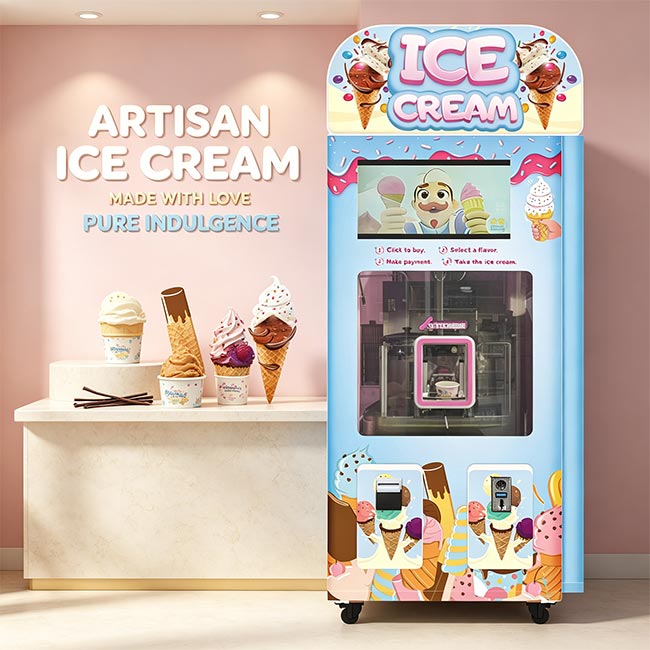
An automatic ice cream machine has a gross margin that a snack vending machine can’t touch. The packaging on a Wider Matrix machine runs $0.11 to $0.15 per cup once you add the cup and the spoon. Ice cream in a cup usually sells for $3 to $5 in most Western markets, sometimes more at a theme park or airport. A can of soda, by comparison, might earn you 30 cents after you restock it. Frozen confections give you more room between what you pay and what the customer pays.
That’s the reason so many operators are asking whether ice cream vending machines actually make money right now. The interest isn’t coming from hobbyists. It’s coming from people who already run snack or drink machines and are tired of thin margins.
The risk sits almost entirely in placement. A frozen dessert machine only works where people pass by, linger, and have time to watch a cup being made. The 15-second dispensing is part of the attraction. Put the machine where nobody walks and you get a very expensive freezer. Put it in a trampoline park, a mall food court, a cinema lobby, or a transit hub and the same hardware earns several hundred dollars a day.
So before we get into machine specs and cost per cup, keep this frame in mind: the machine will not rescue a bad location, and a mediocre location will not ruin a good machine. Decide the location first, then size the machine to it.
If you want the same conclusion in more depth, we wrote a longer breakdown of how profitable an ice cream machine is that walks through the category numbers in full.
What these machines actually do
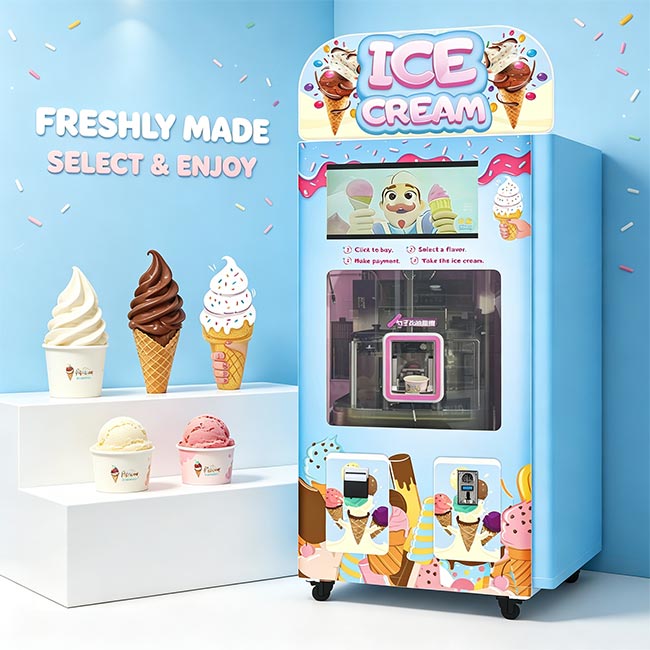
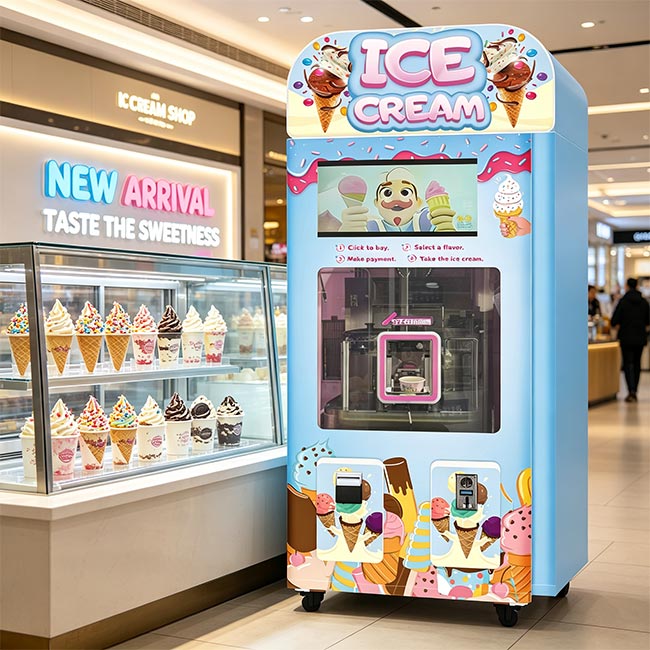
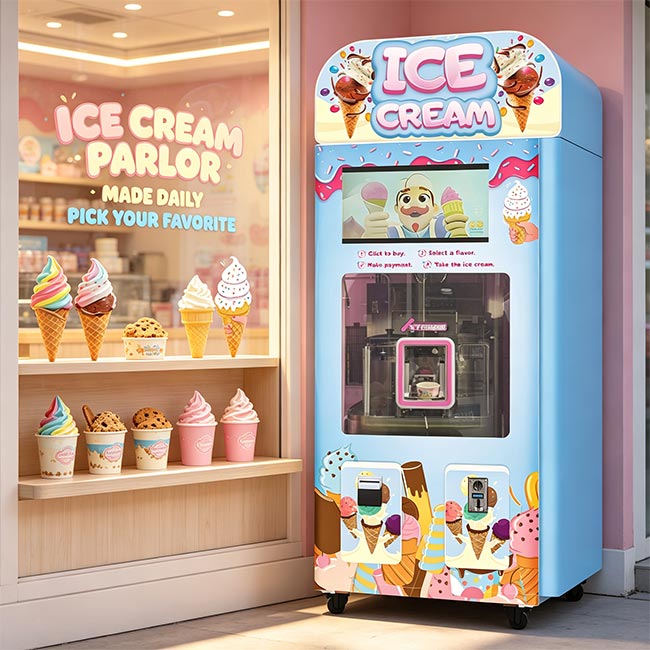
An ice cream vending machine is not a vending machine in the classic sense of a glass box with coils and rows of products. It’s a small frozen dessert plant in a cabinet. The customer chooses a flavor and topping on a 21.5-inch portrait touch screen, pays by coin, cash, credit card, or NFC, and watches the machine build the cup in about 15 seconds.
The Wider Matrix machines run unattended. They don’t need an operator on site, they don’t close for lunch, and they keep selling at night as long as the venue is open. That 24/7, no-labor model is the whole reason the unit economics work. Payroll is the single largest cost in a traditional ice cream shop, and this machine removes it almost entirely.
The tradeoff is that you are now responsible for the machine the way a shop owner is responsible for a staffed counter. You refill the milk base, keep the sauces and toppings stocked, clean the dispensing parts, and deal with the occasional service call. It’s far less work than running a shop, but it is not zero work. People who think they can place the machine and forget it for a month usually have a bad first six weeks.
What you’re really buying is the removal of labor from the sale of a high-margin, perishable product. That one change is what makes the payback math work, and it’s worth keeping in mind every time someone quotes you a machine price without mentioning labor savings.
The three models, and which one you should buy
Wider Matrix makes the machine line in three versions, and the right one depends on how much variety your location wants and how much floor space you have.
The flagship is the WM550 automatic ice cream vending machine. It measures 227 × 93 × 95 cm, weighs 640 kg, and runs on 220V at 3000W. The hopper holds 28 liters and dispenses up to 300 cups per batch, which is more than enough for a busy weekend at a family entertainment center. The single-flavor WM550 carries one base flavor plus three fruit sauces and three small toppings, which gives you 9 combinations. That model lists at US$5,799 for a single unit.
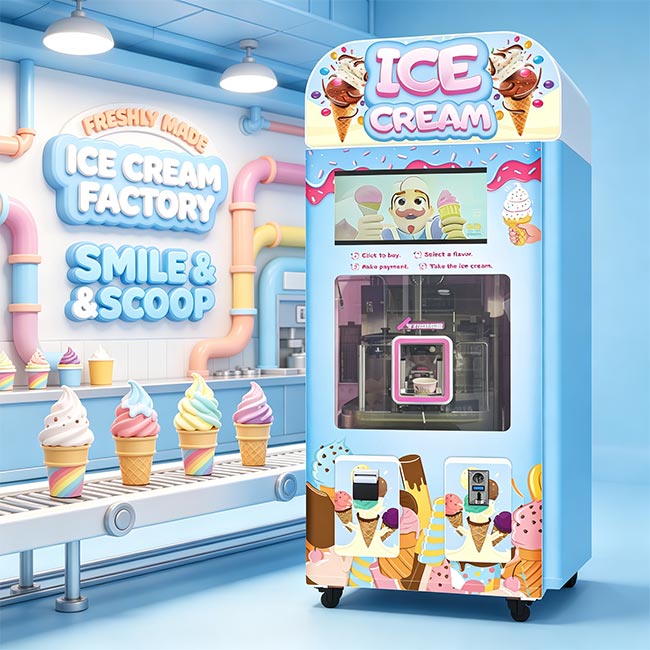
If your location wants more variety, there’s the WM550+, which adds two base flavors plus a mixed flavor, still with three sauces and three toppings, for 27 total combinations. The WM550+ is US$6,799 for a single unit. Both machines share the same cabinet, screen, payment setup, and 15-second cup time, so the only real decision is whether your customers will pay more for flavor choice.
Then there’s the compact unit, which is the one most operators start with. The small automatic ice cream vending machine measures 81 × 126 × 180 cm, weighs about 240 kg, and still carries the same 21.5-inch screen. It uses one milk base, three fruit sauces, and two toppings for 6 combinations, fills a 100g cup, and holds up to 90 cups. It lists at US$4,400 for 1 to 4 units, with lower tiers at larger quantities. You can also read the mini ice cream machine product page for the full spec.
Honestly, for a first location or a test, the small model is the better choice. It fits through a standard doorway, it’s easier to position, and the lower price shortens your payback. You can always move up to the WM550 once you’ve proven the location. Buying the big three-flavor machine for an unproven site is a common and avoidable mistake; you’re paying for variety you can’t yet confirm anyone wants.
The way I tell buyers to choose is simple. If the site is small, seasonal, or uncertain, start small and scale. If you’ve already got a confirmed high-traffic venue and you know the operator will restock regularly, the WM550 or WM550+ earns back its higher price through capacity and variety.
What each cup costs you
This is the number most first-time buyers never calculate before they order, and it’s the one that decides whether a location actually profits. Here’s the breakdown from our own price list, so you can see exactly what’s fixed and what varies.
The cup is your biggest packaging line item. Standard cups run US$0.12 each at a 10,000-piece order and US$0.10 at 40,000 pieces. The small machine’s cups, which have a spoon molded into the base, run US$0.10 each for 1,000 to 4,999 pieces and US$0.08 at 5,000 or more. Spoons add US$0.03 each at 10,000 pieces. Cups ship 1,026 per box in a seven-layer packing, and spoons ship 3,000 per box.
So at volume, a standard cup plus spoon costs you about US$0.13, and a small-machine cup with its built-in spoon costs you about US$0.11. Call it roughly a dime and change per serving before you add any ice cream. That’s the part of the cost you can predict down to the penny.
The variable part is the mix itself: the milk base, the fruit sauce, and the sprinkle topping. That cost depends on the base and sauce supplier you choose, and it’s the number you should nail down with your supplier before you commit to a selling price. If you want a precise per-cup ingredient figure for your market, ask us for a quote rather than guessing. What you should not do is assume the ingredient cost is negligible and price a cup at $2 expecting a fat margin.
Worth saying plainly: a prepared base and sauce is the cheaper and more consistent route for a retail machine, because you skip pasteurization, recipe control, and the waste that comes with making mix in-house. The machine is built around bought base and sauce, not around you becoming an ice cream manufacturer. That answers a question a lot of buyers ask at this stage, which is whether they should make their own product. For vending, you shouldn’t.
A simple way to run the profit numbers
The profitability question only makes sense when you plug in your own location. Here are three plain worked examples you can copy, all using the small machine because it’s the cheapest and most common way to start. The machine cost, packaging figures, and capacities are from our price list; the selling price and daily volume are assumptions you should swap for your own site.
Start with a conservative case. Assume the machine costs US$4,400. Assume you sell 40 cups a day at US$3.50 each. That’s US$140 a day in revenue, or about US$4,200 a month. Packaging at US$0.11 per cup is US$4.40 a day. If you put the ingredient cost around US$0.60 per cup, that’s US$24 a day. You’re left with roughly US$111 a day before the venue’s cut, electricity, card fees, and any financing. That’s still enough to pay the machine off in a couple of months even after modest site costs.
Now a realistic mid case. Sell 60 cups a day at US$4.00 each and you’re at US$240 a day. Packaging runs US$6.60, ingredients about US$36, leaving roughly US$197 a day before site and payment costs. At that pace the machine pays for itself in weeks, not quarters.
Then a strong case for a busy venue. Sell 90 cups a day at US$4.50 each and you’re at US$405 a day. Packaging is US$9.90 and ingredients about US$54, leaving roughly US$341 a day before site and payment costs. That’s the kind of number operators chase at airports, water parks, and large family entertainment centers, and it’s why the full-size WM550 with its 300-cup batch exists.
None of this is a promise of a specific outcome, because the venue share and card fees vary so much by country. But it shows the shape of the math: the product margin is solid, and the deciding variable is almost always daily volume, not the machine price. That’s exactly the territory covered in how much an ice cream vending machine profits per day, and it’s worth reading alongside this page.
The takeaway is not a single number. It’s that the payback on this equipment is short enough that the real question shifts from “will it make money” to “how do I find enough good locations to keep adding machines.”
A full first-year picture, not just the first month
Most people run the math on a good day and stop there. A first-year view often changes the decision, so it’s worth walking through the whole timeline.
Your first month is the slowest. You’re still dialing in the price, learning the cleaning routine, and figuring out which flavors and toppings actually sell in that venue. Expect to adjust. The fruit sauce and topping combination a buyer keeps stocked should be based on what customers pick, not what sounded good in a catalog, and the first month gives you that data.
Months two to six are where momentum builds. Regulars learn the machine is there, the site staff start pointing customers to it, and you settle into a refill schedule. This is also when most of the one-time costs, like freight and any site deposit, are behind you, so the daily number looks better than it did in month one.
Through the back half of the year you’ll likely see seasonality. In a warm climate or an indoor venue it’s mild; in a seasonal outdoor location the summer can be several times the winter. That’s normal and it’s the reason you shouldn’t judge profitability on a single week. An ice cream machine is a high-margin business run over a year, not a box that prints the same number every day.
If you’re comparing this against starting an ice cream shop, the first-year difference is stark. A shop needs a fit-out, staff, training, and months of rent before your first sale. A vending machine starts at US$4,400 plus shipping and a space rental. That makes it the lower-cost way to test the market without hiring anyone, and it’s a big part of why the category keeps growing.
Seasonality, weather, and planning for the slow months
Ice cream rides on weather and school holidays more than most vending categories, so a smart operator plans the year rather than reacting to it. The pattern looks different depending on where your machine lives.
An indoor machine in a shopping mall or cinema sees a modest dip in the cold months and a strong summer in warm regions, but it never fully stops. An outdoor machine at a water park or beach lives and dies by the season, which means a large chunk of your year’s profit lands in eight to twelve busy weeks. Both models work; they just need different expectations and different cash planning.
During the slow months, dial down your standing stock so base and sauce don’t sit around longer than they should, and use the quiet time for maintenance, deep cleaning, and renewing site agreements. The worst thing you can do in pricing season is cut the price to chase volume and train customers that your cup is cheap, then wonder why the busy months underperform.
If your region has a real winter, a portable or smaller machine gives you an option the big fixed cabinets don’t: you can move it to an indoor venue when the temperature drops. The small model’s 240 kg and 81 × 126 × 180 cm footprint make seasonal relocation feasible in a way the 640 kg WM550 doesn’t invite.
Where these machines make money, and where they don’t
Location is worth repeating because it decides everything. The places where these machines consistently work are the places where people stand still and have discretionary money to burn: family entertainment centers, trampoline parks, cinemas, bowling alleys, water parks, shopping malls, airports and rail stations, universities, tourist attractions, and hospital or corporate food courts.
What these all share is foot traffic plus a short wait. A customer who has 90 seconds will watch a cup being made and buy on impulse. A customer who is walking fast past a machine in a supermarket aisle will not stop, partly because they’re already surrounded by cheaper packaged desserts.
The places that usually fail are quiet office lobbies after hours, box stores with no seating, and any spot where the machine only sees real traffic on weekends. A machine that is busy Friday night and dead for four days still has to pay its site costs every day. Before you sign a site agreement, spend an afternoon counting actual foot traffic, not the number the landlord gives you.
Heat and access matter too. The machine needs a level floor, a 220V supply, and enough room around it to open the cabinet for refilling and cleaning. The small model’s 81 × 126 × 180 cm footprint helps here, which is why it gets placed in corners and tight kiosk spaces where the full-size WM550 won’t fit.
One more thing on placement that buyers often forget: the machine needs to be somewhere you can actually service it. A picture-perfect spot that requires a freight elevator and a two-hour drive to refill means you either eat that time or abandon the machine. Pick a site you can reach, not just a site with numbers.
How to price your cups in your market
Pricing is where a lot of otherwise decent operations leave money on the table. The instinct is to underprice to drive volume, but that’s usually a mistake with a product this visual.
What I’ve seen work is to anchor the price to the entertainment value, not the ingredient cost. A customer at a trampoline park doesn’t compare your cup to a grocery tub of ice cream. They compare it to the $5 soda and the $8 caramel corn they just bought. In that context a $4 or $5 cup looks reasonable, and the extra dollar goes almost entirely to margin because your per-cup cost barely moves.
The toppings and sauces also give you a natural upsell. The WM550+ with its 27 combinations lets you charge more for a mixed flavor or an extra sauce, and the machine handles the added complexity without added labor. That’s pricing power a plain soft-serve machine doesn’t have.
Test the ceiling early. Start slightly above where you think you should be, watch a weekend, then step the price down if volume disappoints. It’s easier to lower a price than to raise it after locals have decided what your cone is worth.
Signage, sampling, and getting the first hundred cups moving
A new machine doesn’t sell itself on day one. Most of the machines that underperform in the first month don’t have a hardware problem. They have a visibility problem. Nobody notices a silent cabinet sitting off to the side of a busy lobby.
The fix is cheap and it’s mostly work you’d do anyway. Put strong signage above and beside the machine so someone across the room sees what it’s for. Run a launch promotion for the first week, a dollar off or a buy-one-give-one coupon handed out by the front desk. Have the site staff order a cup in front of customers once or twice a day so people watch it happen and realize what the machine does.
Sampling is the highest-return move early on. A few hundred free mini cups handed out over a launch weekend converts far more reliably than a discount sign alone, because the product quality is the best sales argument you have. Once people have tasted it, they’ll walk past the machine and buy.
The 21.5-inch screen is also a quiet asset here. It’s an advertising display when it’s not taking an order, so you can loop your own menu, a nearby business’s ad, or a promotion without buying separate signage. Operators routinely lease that screen space out to a third business and cover part of their site rent with it.
Social media helps too, but only when the location cooperates. A short video of the machine making a cup, tagged to the venue, does well because the process is genuinely fun to watch. Ask the venue’s page to repost it and you get a free bump in foot traffic you didn’t pay for.
Site agreements, revenue share, and what the landlord won’t volunteer
Where you put the machine is half the business, and the terms you sign for that spot are the other half. Site costs are usually the biggest single line item after the machine itself, and they’re the least standardized.
Landlords and venue operators generally structure it one of two ways: a flat monthly rent for the footprint, or a revenue share, often 10 to 20 percent of takings. Sometimes it’s a combination of both. The revenue share is friendlier at the start but eats into the good months, so run your numbers on the good month, not the average, before you agree to it.
Push to have these details written down: who pays for the power, what happens on a slow season, whether you can move the machine to a better spot inside the same venue, and how disputes over the revenue count get resolved. A handshake with a venue manager who later leaves is a classic way operators lose a good site.
Also ask whether the venue wants a branded machine or a generic cabinet. If you’re building toward a name, a machine with your own livery and screen content matters, and it’s something you want to know before the unit ships, not after it’s bolted in place.
What makes this different from a snack machine
If you already run one of the more profitable types of vending machines, you know the drill: buy product, restock, collect cash, repeat. An ice cream machine changes the risk profile in a few useful ways.
Your only real inventory is mix, sauce, and topping, which stores longer and spoils slower than sandwiches or fresh food. There’s also no coil jam, no product that expires before it sells, and no shake-to-steal problem to worry about.
And the machine itself is part of the experience, so customers pay for the spectacle as much as the dessert, which props up the price per cup.
The downside is that the hardware is more expensive than a snack machine and the service is more involved. A snack machine failing means a few lost sales. A frozen dessert machine failing means a mess, a complaint, and usually a service visit. You have to clean the dispensing path on a schedule or you’ll fight texture and hygiene problems. That’s the honest tradeoff, and it’s the main thing to weigh before you commit.
It also means your choice of supplier matters more than with a snack machine. You can swap a snack machine’s brand with little consequence. Swapping this machine’s spare parts, firmware, and service knowledge is a much bigger deal, which is why the manufacturer question below is worth your time.
What to check before you order
When you start talking to suppliers, here are the specifications and features that actually affect your daily operation, pulled from the Wider Matrix spec sheets so you know what to compare against.
Dispensing speed matters more than most buyers expect. At 15 seconds per cup, a queue moves quickly at a busy school or cinema. If a competing machine takes 40 seconds, your throughput at peak is roughly a third of theirs, which directly caps daily revenue.
Capacity decides how often you refill. The WM550’s 28-liter hopper and 300-cup batch means you’re not babysitting the machine during a weekend rush. The small machine’s 90-cup capacity fits a lower-volume site and a part-time operator.
Payments are non-negotiable for unattended sales. The machines accept coin, cash, credit card, and NFC, so a customer with a phone or a card is always covered. In markets where cashless is the norm, card and NFC support is the difference between a sale and a walkaway.
The screen also does double duty. The 21.5-inch portrait touch screen runs the ordering flow and doubles as an advertising display you can sell or use to push your own menu. That’s a small revenue line most first-time buyers ignore.
Check voltage and clearances early too. These machines run on 220V at 50Hz or 60Hz, and the full-size WM550 needs its 227 × 93 × 95 cm footprint plus service clearance. Confirming the power and the doorway before you order saves you from a machine stuck in the loading dock.
Finally, ask about the consumable parts: seals, dispensing nozzles, and anything that wears. Their price and lead time matter more than the headline machine price, because you’ll be buying them for years while the machine price is paid once.
For a fuller checklist of what to verify, see ice cream vending machine price and investment and the page on current ice cream vending machine prices and suppliers.
How to spot a real manufacturer instead of a trading company
This is where a lot of buyers get burned, and it feeds directly into whether your machine stays profitable over three years instead of three months. Plenty of companies selling ice cream vending machines online don’t make them. They buy from a factory, mark the price up, and disappear when the machine needs parts.
The first question to ask any supplier is whether they manufacture the machine in their own facility or just resell it. Wider Matrix manufactures in Guangdong, China, which is also the answer to why most of the serious factories in this category are concentrated there. You can read the full run-down in what buyers need to know about a China ice cream vending factory and our Guangdong buyer verification guide.
Ask for the things a trading company can’t easily produce: photos and video of the actual production line, a spec sheet with the exact model and weight, a sample invoice structure for your market, and a clear answer on spare parts. A manufacturer can send you a replacement compressor, keypad, or board from stock. A middleman has to forward your request and hope.
Also ask how long support lasts. A real factory has service manuals, a parts list, and a person who knows the firmware. If a supplier can’t tell you who replaces a failed touch screen in Month 14, that’s your answer.
And ask about customization as a litmus test. If you ask for your country’s voltage standard or a branded cabinet and the supplier says no, they’re probably not making the machine. A manufacturer can adjust the flavor and topping arrangement, run the machine in your voltage standard, and brand the screen content. A reseller reads from a fixed catalog.
Why two quotes for the same machine can be hundreds of dollars apart
It’s common for a buyer to request three quotes and get back prices that differ by several hundred dollars for what looks like the same geometry. Usually the machines aren’t the same at all, and knowing where the differences hide stops you from comparing apples to rocking chairs.
The first variable is the quote’s scope. An FOB price leaves freight, duty, and the final mile out entirely, while a door-to-door price includes them. Two quotes that look far apart on paper are sometimes the same once you add the shipping back in. Always ask each supplier to state whether the price is FOB or landed at your address.
The second variable is what’s inside the box. A machine quoted without its spare parts, or without the payment terminal licensed for your market, or without the correct voltage, is cheaper for a reason you’ll pay for later. Line-item the quote and ask what’s included before you compare totals.
There’s also the support layer, which doesn’t show up on an invoice but absolutely has a price. Remote startup help, a parts list with lead times, and a warranty in writing are worth a little more up front, because the alternative is a machine you can’t get serviced when it matters. A cheap quote with no support behind it usually costs more by the end of the first year.
When the numbers are close, weigh the manufacturer and the support over the last few dollars. The machine is the one part of this business you’ll still be running three years from now.
Quality control and what you should ask to see before you pay
A machine that looks great in a render but leaks mix in week three is not a bargain, and the only way to lower that risk is to look at how the machine is actually built and tested before your money leaves the country. You don’t need to fly to the factory, but you should ask for the evidence a real manufacturer keeps on hand.
Ask for video of a machine running a full cycle, not just photos of the outside. You want to see the dispenser fill a cup, the toppings drop, and the cup land in the pick-up area without help. Ask how the machines are tested before crating: a power-up and a full-cycle run on the line, versus a visual check, are two very different standards.
Ask how the unit is crated for export. The WM550 at 640 kg needs real shock protection and tiedowns inside a crate, because a rough ocean crossing will find any weak packing. If a supplier can’t tell you how the machine is secured for shipping, that’s a warning about what’s going to arrive.
None of this is about company flair. It’s about the gap between a supplier who builds and tests the machine and one who forwards an order. The build quality, the test cycle, and the crating are the three places most “cheaper machine” stories quietly fall apart, which is why they matter more than the final dollar on the invoice.
Getting the machine to your door: shipping, import, and installation
Most of our buyers are importing the machine into their own country, so a big part of the real cost is freight, duty, and setup. The machine ships in a crate, and the full-size unit’s 640 kg means you need a dock or a tailgate truck and a way to wheel it into place. The small model at roughly 240 kg is handled far more easily by two people and a pallet jack.
You should get a door-to-door quote, not an FOB price, when you compare suppliers. FOB tells you the machine leaves China. It tells you nothing about customs, drayage, or the final mile, which can surprise you by a few hundred dollars.
Installation itself is mostly positioning, leveling, power, and a first run to confirm the compressor, dispenser, and payment terminals work. The machine is designed to be set up without a technician on site, though we walk every buyer through the first start-up over video and provide the manual and a checklist. If you want to understand the whole import path in detail, our guide on importing an ice cream vending machine from China covers freight, customs, and timing step by step.
Timing is the other thing buyers overlook. A machine on a boat is not earning money, and rushing a correction at the last minute costs more than planning the route early. Get the delivery window in writing before you pay, and match it against your site’s opening or a season, whichever is more forgiving.
Running and maintaining the machine
Day to day, the machine mostly runs itself. You or your route operator top up the base and toppings, empty the cash path if you use coins, and run the cleaning program for the dispensing parts. That cleaning cycle is the single most important habit for long-term profit, because a neglected machine develops texture issues and eventually a customer complaint that a local site manager remembers.
Spare parts should be part of the buying decision, not an afterthought. Before you order, have your supplier list the wear parts, their expected life, and the lead time for replacements. Wider Matrix keeps parts in stock and can ship them with your initial order or later, and our after-sales team supports remote diagnosis over video so a small fault doesn’t become a service call with a technician’s hourly rate.
Warranty is the other thing to pin down in writing. Make sure you know exactly what’s covered, for how long, and what counts as user error versus a manufacturing defect. That one piece of paper is what separates a supplier who answers the phone in Month 13 from one who doesn’t.
If you plan to run several machines rather than one, service becomes a route problem, and it changes what you should buy. A single operator can clean and refill a handful of small machines in an afternoon. Ten machines spread across a city need a route plan, spare parts on hand, and probably a second person during peak season. The machine is the easy part; the route is where most multi-unit operators start to feel the work.
Ingredients, food safety, and keeping the machine clean
The machine handles the mechanical side of making a cup, but the food is the operator’s job, and it’s the part that separates a machine that lasts for years from one that gets pulled out of a venue.
Your two consumables are the milk base and the fruit sauces, plus the dry toppings. The base is a dairy product, so it needs cold storage and stock rotation. Order in quantities you’ll actually go through, keep older stock in front, and don’t top a half-used batch with fresh product. A machine lives or dies on the discipline of whoever refills it.
Cleaning is non-negotiable and it’s mostly the dispensing path: wherever the mix, sauce, and topping flow through and meet the cup. Run the cleaning cycle on a schedule, not when you remember, because residue hardens and then affects texture, and a customer who gets a grainy cup once usually doesn’t come back. The machine’s own cleaning program does the heavy lifting, but someone still has to run it.
Local health codes vary by country and sometimes by city, so before you place a machine, confirm with the venue or your local authority what a self-service food machine needs to display or document. Some markets want a visible hygiene process, a hand-cleaning setup nearby, or a food handling certificate for whoever restocks. Sorting that out early is far easier than having a venue manager shut the machine down mid-summer.
None of this is glamorous, but it’s the difference between a vending business and a vending habit that quietly stalls out. The machine removes labor, not responsibility.
How operators actually scale from one machine to several
Almost every serious operator I’ve worked with started with a single small machine to prove the concept, then used the first three months of data to decide the next move. The scaling path is consistent enough that it’s worth knowing ahead of time.
The first machine is a data machine more than a profit machine. It tells you which flavors sell, what the real daily volume is at a given venue type, how long a 90-cup fill actually lasts, and what a cleaning visit really takes out of your day. Once you have those numbers, the second machine is a much safer bet, and the third and fourth get easier still because you’ve already worked out your refill route and your supplier.
Volume pricing makes scale cheaper on the hardware side. The small machine drops from its single-unit price as soon as you order five or more, and the WM550 and WM550+ have tiered pricing at 3 to 5 units and 6 to 10 units. Bulk cup and spoon orders cut your packaging cost the same way, from US$0.12 a cup down toward US$0.08 to US$0.10 at larger quantities.
The thing that trips up scaling operators is not the machine count. It’s that each new site has its own terms, its own foot traffic, and its own manager, and a deal that works at a trampoline park won’t necessarily copy to a cinema. Treat every new location as its own small test, keep using the first-month data instead of assuming, and the compounding is real.
A quick look at the alternatives
Before you spend money, it’s worth knowing what else is out there, because a few buyers come in asking for a soft-serve machine or a robot arm machine and realize those are different products with different economics.
A soft-serve vending machine is a more traditional soft ice cream dispenser with vending controls added. It’s a solid choice for a single flavor at a fair, and we cover the differences in our soft serve ice cream vending machine guide.
A robotic arm machine, where a mechanical arm physically assembles the cup, is the most expensive route and usually only pays in a high-traffic flagship location. If the robot is what you’re after, check robotic ice cream vending machine costs and what an ice cream robot actually costs before you decide.
And if you need a cabinet with a non-standard footprint to fit a specific kiosk, a custom size ice cream vending machine is something we can quote, since we build in-house rather than reselling a fixed catalog.
You’ll also run into the classic unattended machine pitch, and the newer market trend is genuinely moving in that direction. Customers increasingly prefer to order on a screen, tap a card or phone, and skip the queue, which is what the wider unattended ice cream vending machine category is built on. That shift is a tailwind for the whole segment, not a reason to buy any one machine.
The mistakes that sink most new operators
After watching a lot of buyers start out, the failures almost always trace back to a small set of preventable moves, and they’re worth naming directly because each one is cheaper to avoid than to fix.
Trusting the landlord’s foot traffic claim without counting it yourself is probably the most expensive one. Closely behind it is underpricing out of fear, which trains the market that your cup is cheap and kneecaps your margin for as long as the machine sits there. Skipping the cleaning schedule is quieter but just as damaging, because a grainy cup or a sticky machine is how a good unit earns a bad reputation in a venue.
Buying the wrong size shows up often too. A full-size three-flavor WM550+ in an unproven small venue is money tied up in variety nobody has asked for, while a small machine in a busy airport is capacity you’ll outgrow in a month. Match the machine to the site, not to your ambition.
And there’s the classic one: buying from whoever is cheapest and finding out in Month 14, when a part fails, that there’s nobody on the other end. The machine price is paid once. The supplier relationship is something you live with every week after that, so it’s the wrong place to save a few percent.
Why operators buy from Wider Matrix
The reason to bring this up isn’t to hand you a brochure. It’s that your machine’s profitability over its life depends on the company behind it, and that’s the part you can’t see in a photo.
We manufacture the WM550, WM550+, and small models ourselves, so the machine you buy is the machine we built, tested, and can send parts for. Because we make them, we can also do things a reseller can’t, like adjust the flavor or topping arrangement to your market, run the machine in your voltage standard, or brand the cabinet and the screen content for a franchise or chain.
We ship internationally and have exported these machines to operators across North America, Europe, the Middle East, and Asia, so a buyer in one country asking about duty and a buyer in another asking about card terminals are both questions we’ve answered before. On the service side, we provide remote start-up support, a spare parts list with lead times, and a warranty in writing before you order.
Most of the operators who buy from us run more than one unit, and most of them came in asking the same question you’re asking now. If you want to see how a real location pencils out before you spend anything, the fastest way is to send us the site details and let us run the numbers with you.
Frequently asked questions
Is an ice cream vending machine profitable?
Yes, in the right location. The gross margin per cup is high because the packaging costs roughly US$0.11 to US$0.15 and a cup sells for US$3 to US$5 in most markets, while the machine needs no staff. The main risk is placement: a machine in low foot traffic will not earn back its cost no matter how good the hardware is.
What is the most profitable type of vending machine?
Machines with a high markup per item and low labor. Ice cream and frozen dessert machines sit near the top of that list because the product cost is low and the pricing power is high, a step above snack and drink machines. The tradeoff is a steeper upfront price and more involved cleaning.
How much does an ice cream vending machine cost?
At Wider Matrix, the small model lists at US$4,400, the single-flavor WM550 at US$5,799, and the three-flavor WM550+ at US$6,799, with volume pricing at larger quantities. Add freight, duty, and any site costs to get your true landed cost. The full price guide is in the complete ice cream vending machine price breakdown.
How much money do I need to start?
Far less than an ice cream shop. A shop needs a fit-out, staff, and months of rent before your first sale. A vending machine starts at US$4,400 plus shipping, a space rental, and your first stock of mix and toppings. That makes the machine the low-cost way to test the market without hiring anyone. If you’re weighing a full launch, see our note on starting an ice cream vending business.
What are the disadvantages of owning a vending machine?
The honest list: higher upfront cost than a snack machine, a cleaning schedule you can’t skip, a service call when something breaks, and revenue that depends entirely on the site. It’s passive in the sense of “no staff,” not passive in the sense of “forget it.” Most disappointed buyers underestimated the cleaning or picked a weak location.
Are vending machines a good investment in 2026?
Unattended and robotic vending is one of the few retail models still expanding, driven by labor costs and customers who prefer not to queue. Ice cream specifically benefits because it’s an impulse purchase with high margins. As a hardware investment it’s good, provided the site is verified first.
Can I get financing for a vending machine?
Yes, many operators finance through equipment lenders, leasing companies, or their bank. Financing terms depend on your country and credit, and we can point you to the right channel for your market when you inquire. The details vary enough by region that a quote is the reliable way to answer this.
Is it cheaper to buy or make your own ice cream?
For a retail machine, buying a prepared base and sauce is cheaper and far more consistent than making mix in-house, because you skip the pasteurization, recipe control, and waste. That’s what these machines are designed around: you buy the base and sauce, and the machine assembles and dispenses. For a precise ingredient cost per cup in your market, ask us for a quote.
Is it hard to own an ice cream shop versus running a machine?
A shop is a staffing and operations business that happens to sell ice cream. A vending machine is a placement and cleaning job that happens to sell ice cream. The machine is the lower-effort, lower-risk route for someone who wants the revenue without hiring a team, which is why most of our buyers are operators adding units rather than shop owners replacing counters.
What are the best selling items in a vending machine, and the top ice cream flavors?
Snack machines sell chips, candy, and bottled drinks in that order. For ice cream, the flavors that move fastest in most markets are vanilla and chocolate, with a fruit option like strawberry rounding out the top three, which is exactly why the WM550+ runs two base flavors plus a mixed flavor with three sauces and three toppings.
What are the latest trends in vending machines?
The move is toward unattended and robotic machines with touch screens, card and NFC payment, and a screen that doubles as advertising. Ice cream fits the trend because the dispensing is visual and quick, which is what the 15-second cup time and 21.5-inch screen on the Wider Matrix line are built around.
How fast does it dispense, and how many cups does it hold?
Each cup takes about 15 seconds. The WM550 holds 28 liters and dispenses up to 300 cups per batch. The small model holds up to 90 cups of 100g each. All models take coin, cash, credit card, and NFC, and run on 220V at 50Hz or 60Hz.
Do you ship to my country?
Almost certainly. We export to North America, Europe, the Middle East, and Asia, and we’ll confirm duty and freight for your specific port when you send us your details. For buyers in the US and Canada, our guides on the US ice cream business and Canada self-service market spell out what’s different there.
Which is better for a new operator, the small machine or the WM550?
For a first site or a test, the small machine at US$4,400 is usually the right call because the lower price shortens your payback and the footprint fits more spots. The WM550 and WM550+ earn their higher price through capacity and variety once you’ve confirmed the traffic. Start small, prove the location, then scale up.
How long does shipping and delivery take?
It depends on your destination, the production queue, and whether you need customization. A standard model already in production ships faster than a custom-branded unit. We’ll give you a delivery window in writing before you pay, and we time it against your site opening or season. For your specific port, send us the details and we’ll confirm the schedule and transit time.
What warranty and after-sales support do you provide?
We provide remote startup support over video, a spare parts list with lead times, and a warranty that’s put in writing before you order. Remote diagnosis means many small faults get fixed without a technician call. The exact warranty terms vary by model and market, so ask us for the current terms when you request a quote.
Can the machine run 24 hours a day?
Yes. The machine is designed for unattended, around-the-clock operation as long as the venue is open and power is supplied. The 3000W draw at 220V means you should confirm the circuit can carry it before installation, but there’s no duty cycle that forces the machine to rest.
How much electricity does the machine use, and how much space does it need?
The WM550 and WM550+ run on 220V at 50Hz or 60Hz and draw 3000W. The full-size cabinet needs about 227 × 93 × 95 cm plus room to open the doors for cleaning and refilling. The small model needs about 81 × 126 × 180 cm and draws proportionally less, which is why it fits into tight kiosks and corners.
Can I customize the flavors, the toppings, or the branding?
Yes. Because we manufacture the machines ourselves, we can adjust the flavor and topping arrangement, run the unit in your voltage standard, and brand the cabinet and screen content for your chain or franchise. That kind of customization is usually the clearest sign you’re buying from a factory rather than a reseller reading from a fixed catalog.
Get a number for your location
The fastest way to know if an ice cream vending machine will be profitable for you is to stop working in averages and run the math on your actual site. Send us the location type, the rough daily foot traffic, and the price you’d want to sell a cup for. We’ll come back with a recommended model, a landed cost including freight, and a realistic daily sales and payback estimate.
No deposit, no pressure. If the numbers don’t work for your site, we’ll tell you that too, and you’ll at least walk away knowing your real cost per cup. Use the contact form or reach our sales team directly, and mention the WM550 or small model so we can send the right spec sheet and pricing tiers instead of a generic list.
If you’re still gathering information rather than ready to quote, that’s fine too. Bookmark this page, take the three worked examples above, and swap in your own price and daily volume. The moment you’re ready to put a real site against those numbers, we’re the people to call.