




Yes, are cotton candy vending machines profitable? Absolutely, with the right strategy and equipment, they can be a highly lucrative business, offering profit margins often exceeding 90%. The key to unlocking this profitability lies in a clear understanding of costs, strategic placement, and choosing a reliable, efficient machine. This guide provides a comprehensive 2026 profit analysis, complete with real-world data and actionable steps to help you make an informed investment decision.

Before diving deep, here are the core takeaways on cotton candy vending machine profitability:
- High Profit Margins: Material cost per serving can be as low as $0.30-$0.50, while sale prices typically range from $5 to $12, yielding margins of 85%-95%.
- Moderate Initial Investment: A quality, fully automated machine represents the primary cost, with prices ranging from ~$4,500 to over $10,000.
- Fast ROI Potential: In high-traffic locations, operators can see a return on investment (ROI) in as little as 1-3 months.
- Success is Location-Dependent: Foot traffic, dwell time, and customer demographics are the most critical factors determining your earnings.
- Operational Simplicity: Modern machines are largely automated, making this a viable semi-passive income stream with manageable maintenance.
The Market Appeal of Automated Cotton Candy
The global shift towards automated retail and experiential vending is a powerful tailwind. Cotton candy is uniquely positioned within this trend due to its universal appeal, high perceived value, and strong impulse purchase drivers, especially at events, malls, and family entertainment centers. An automated machine transforms this nostalgic treat into a consistent, hygienic, and captivating attraction that prints money with minimal labor.
Revenue Projections and Realistic ROI Calculation
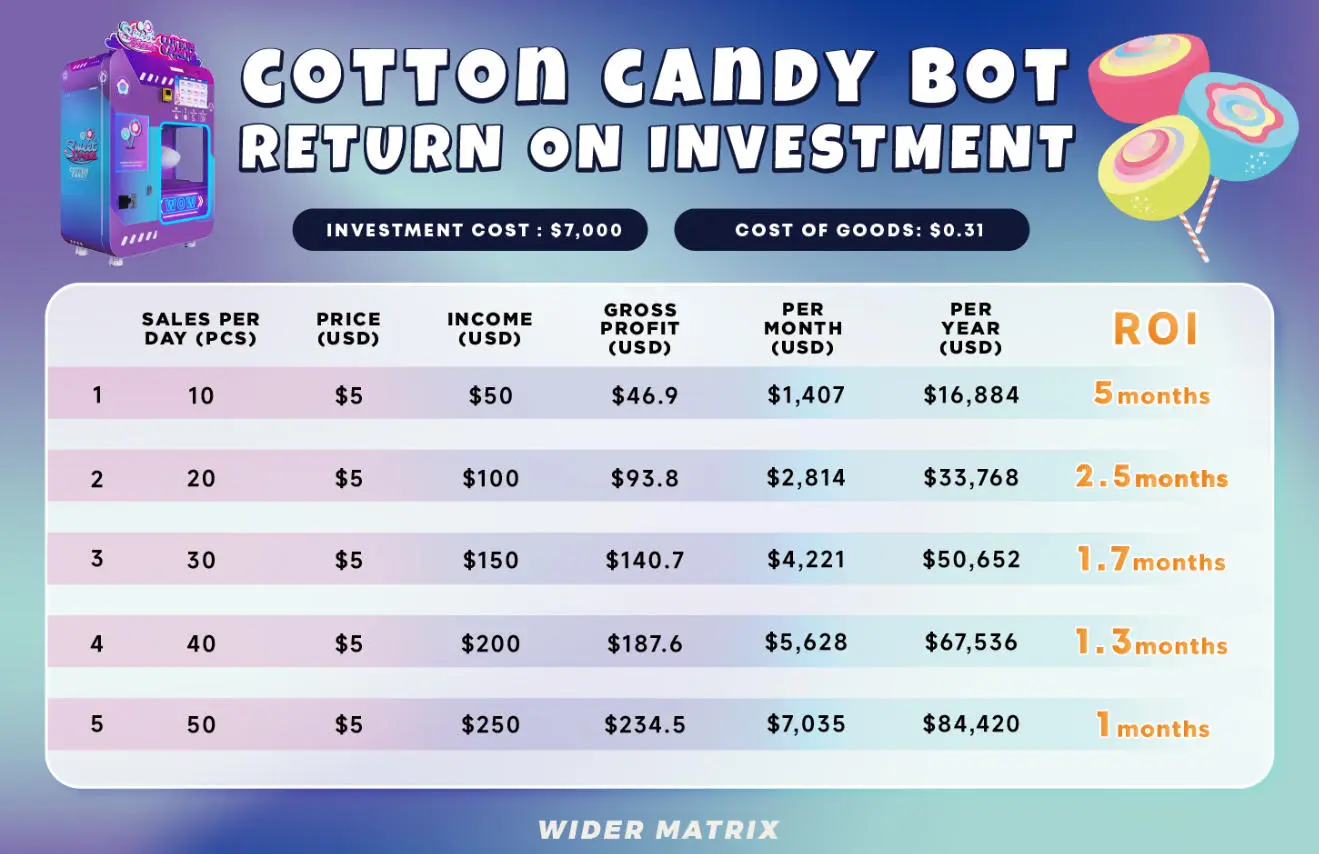
The 5 Pillars of a Profitable Cotton Candy Vending Business
- Location is King: Target places with captive, celebratory audiences: movie theaters, bowling alleys, zoos, festivals, and shopping malls near food courts or children’s play areas.
- Machine Reliability & Support: Downtime is lost revenue. Invest in a machine from a reputable manufacturer. For instance, Wider Matrix, with 8 years in the automation industry and exports to 130+ countries, provides a 1-year warranty, lifetime technical support, and a 24/7 engineering team—critical for business continuity.
- Presentation & Marketing: Use vibrant signage, LED lights, and clear pricing. Let the machine’s spinning action market itself. Consider offering seasonal colors or limited-time flavors to drive repeat sales.
- Operational Efficiency: Choose a machine that simplifies the process. Look for features like quick sugar loading, easy cleaning, and reliable cashless payment systems to maximize uptime and customer satisfaction.
- Master the Logistics: Build relationships with bulk sugar and cone suppliers. Have a consistent restocking and cleaning schedule. Always carry essential spare parts if your supplier’s support isn’t local.
Navigating Challenges and Mitigating Risks
- Machine Maintenance: Regular cleaning is non-negotiable to prevent sugar clogs. Partner with a supplier that offers comprehensive video tutorials and readily available spare parts.
- Seasonal Fluctuations: Sales may dip outside summer and holiday periods. Mitigate this by securing indoor, year-round locations or focusing on event rentals.
- Location Agreements: Carefully negotiate terms. A flat monthly rent is often more predictable than a high percentage of sales.
- Competition: Differentiate with a superior machine, better presentation, or unique product offerings (e.g., organic sugar options).
Your Step-by-Step Launch Checklist
- [ ] Conduct Market Research: Identify 3-5 potential locations and observe foot traffic.
- [ ] Secure Financing: Calculate your budget based on the total initial investment.
- [ ] Choose Your Machine Supplier: Prioritize reliability, after-sales support, and clarity on shipping/warranty terms. Request detailed quotes and ROI projections from potential suppliers to compare.
- [ ] Finalize a Location: Get a signed agreement detailing terms, rent, and duration.
- [ ] Handle Legalities: Register your business and obtain necessary local permits.
- [ ] Order Machine & Supplies: Factor in lead time for delivery and setup.
- [ ] Market Your Launch: Use social media and on-site signage to create buzz.
- [ ] Launch, Monitor & Optimize: Track sales daily, adjust positioning if needed, and engage with customers for feedback.
Key Takeaways and Your Next Step
Are cotton candy vending machines profitable? The evidence strongly points to yes. This business model combines high-margin impulse sales with increasingly automated operations. Success hinges on:
- A meticulous understanding of all costs.
- Securing a high-traffic, relevant location.
- Investing in a dependable machine with strong manufacturer support.
- Implementing consistent, professional operations.
The difference between a struggling side hustle and a thriving business often comes down to the quality of your equipment and the robustness of your supplier’s support network.
Frequently Asked Questions (FAQ)
Q: How much money can I really make with a cotton candy vending machine?
A: Earnings vary drastically by location. In an average good location (e.g., a family entertainment center), selling 15 units per day at $7 each can generate over $35,000 in annual net profit after costs. Prime locations at festivals or major tourist spots can significantly exceed this.
Q: What is the total startup cost I should budget for?
A: You should budget between $5,500 and $16,000 to fully launch. This covers the machine (the largest cost), shipping, initial sugar/cones inventory, any necessary permits, business registration, and basic signage. Always get a detailed quote from your machine supplier.
Q: Do I need a food license or health permit to operate?
A: In most regions, yes. Regulations vary by country, state, and even city. You will typically need a general business license and may require a specific mobile food vendor or vending permit from your local health department. Always check with your local authorities first.
Q: How do I find and secure a good location for my machine?
A: Start by making a list of venues with your target demographic (families, children). Contact the management of places like skating rinks, cinemas, community pools, or mall leasing offices. Be prepared with a professional proposal outlining the benefits (new attraction, revenue share) for them.
Q: Are fully automatic cotton candy machines reliable?
A: Modern machines from reputable manufacturers are designed for commercial reliability. However, like any electromechanical device, they require maintenance. Choosing a supplier with a strong warranty (like Wider Matrix’s 1-year warranty) and accessible technical support is crucial to minimize downtime.
Q: How much time does it take to operate and maintain the machine?
A: It’s largely semi-passive. Daily tasks include restocking sugar and cones (10-15 minutes) and a quick wipe-down. A more thorough cleaning of the spinning head is needed every few days or after heavy use (20-30 minutes). It’s not a full-time job unless you manage multiple units.
Q: What are the biggest hidden costs or risks?
A: The main risks are location-related: losing a prime spot or agreeing to an unfavorable revenue share. Hidden costs can include unexpected repair bills if the machine is out of warranty, rising costs for consumables, or increased rental fees from the location owner after a successful trial period.
Q: Is a cotton candy vending machine a good investment compared to other vending machines?
A: It offers some of the highest profit margins in vending due to extremely low ingredient costs. However, it may have more seasonal fluctuation than a snack or drink machine. It’s an excellent investment if placed in a consistent, high-traffic, family-oriented environment.

Comments
No comments yet. Be the first to comment!