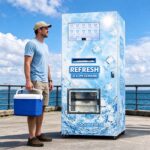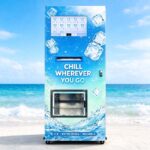


A WMT-I01 ice-making vending machine lists at US$4,600 for one unit, and the money that follows the invoice is what decides the payback. This page puts the machine price, freight and duty, installation, bags, filters, power and site rent into one ledger, shows what a bag of ice costs to make, and explains why the same machine pays back in five weeks at one site and five months at another. Send your country, unit count and payment setup through the form on this page for a landed price and the current build schedule.
Commercial ice vending machine cost splits into two numbers, and only one of them shows up on a quotation. The first is the machine: US$4,600 list price for a single WMT-I01 from Wider Matrix, an ice-making cabinet rated at 150 kg of cube ice every 24 hours with a 9 kg bin sitting in front of the ice maker. The second number is everything that happens after the invoice, and it is the one that decides whether the machine pays.
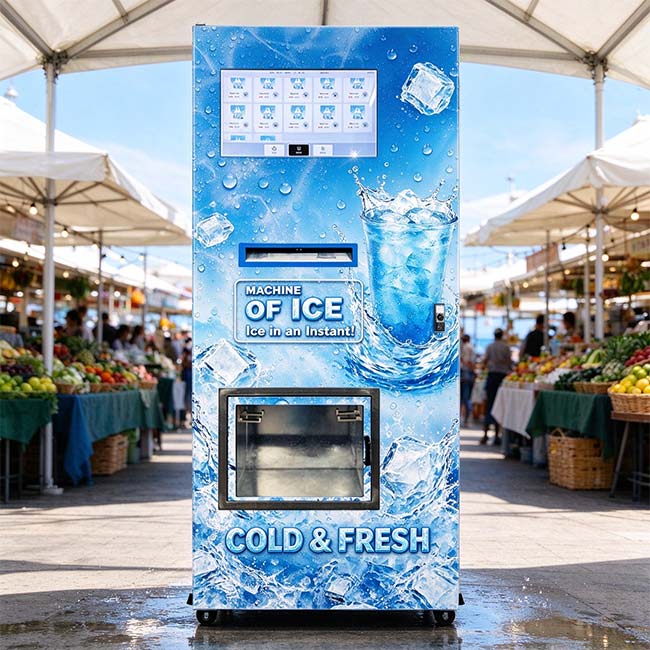
Freight, duty, a plumber for the water line or barrels if there is no line, bags, filter cartridges, and the electricity that runs a 1,000 W ice maker through the hottest month. None of it is exotic. It is just rarely written down in one place, which is why buyers set two machine prices side by side and end up confident about the wrong figure.
Ask a supplier for the commercial ice vending machine cost and you get the first number. Only your own market can produce the second. The ledger runs in the order the money actually leaves your account: the machine, then freight and duty, then site work, then running costs and site rent.
What the commercial ice vending machine cost includes
US$4,600 is the list price for one unit. Orders from two machines upward are quoted per order, so a distributor filling a container and a store owner testing one site get different numbers, and promotions move through the year. There is no minimum spend to clear: the minimum order is one machine.
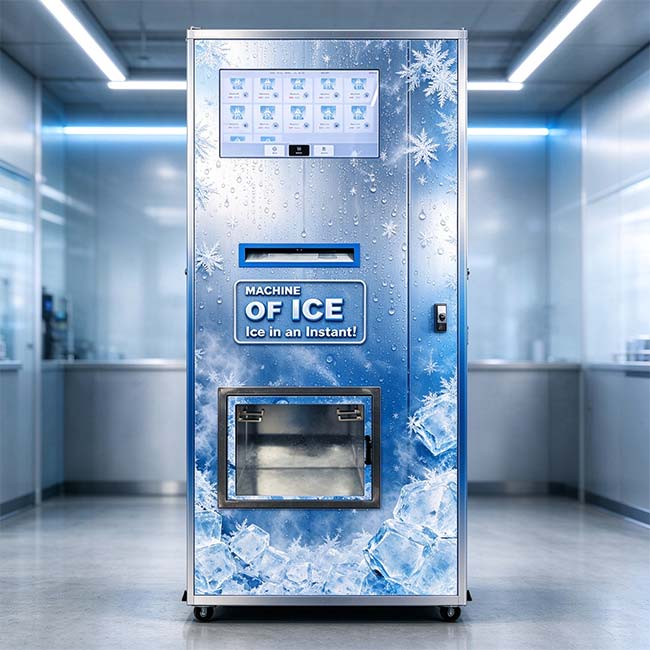
Anything beyond the standard build is what makes one commercial ice vending machine cost more than another, which is why two quotes in the same category rarely match. The crate holds the assembled unit, which is filled, run and ice-tested before it is packed, plus the 3-stage filtration set, the standard bagging module, a user manual, an installation video and a one-year warranty. Freight, duty, site work and bags are not in that crate.
| البند | How it moves the quoted price |
|---|---|
| Output build | 150 kg per 24 hours is standard; the 200 kg configuration uses a larger ice maker and costs more |
| أجهزة الدفع | Coin, note and change-giving modules are standard; card and contactless are configured per market, and a local card terminal can often be integrated through MDB instead of shipping one |
| التواصل | The 4G or WiFi module is optional, and it is what gives you sales reports, bin level and fault alerts |
| العلامة التجارية | OEM and ODM work covers body graphics, logo, screen interface language and printed bags |
| Voltage and plug | Built to 220 to 240V 50Hz or 110V 60Hz to match your market |
| شروط الشحن | Ex-works, FOB and CIF produce three different numbers for the same machine |
Two suppliers can quote the same model name and mean two different machines. Ask what ice maker is inside, whether the bagging module ships with it, and which payment modules are actually fitted. A quote that answers none of those three is not comparable to one that answers all of them. For a sense of where equipment pricing sits across the wider category, our guide to كم تبلغ تكلفة آلة البيع؟ covers snack units through robotic machines.
What arrives after the invoice
This is the part that turns a machine price into a project cost, and the total depends on your country and on how much work the site needs.
| التكلفة | Who quotes it | ما يجب التحقق منه |
|---|---|---|
| Ocean or air freight | Supplier or your own forwarder | Export packing is included; ask for FOB and CIF so you can compare |
| Duty, VAT and clearance | Your customs broker | Paid by the importer, and rates vary enough between countries that no supplier can quote them accurately |
| Water connection | Local plumber | A mains line uses a standard 1/2 inch fitting; bottled barrel water avoids plumbing but adds handling |
| Electrical work | Local electrician | 1,000 W maximum on single phase, dedicated circuit recommended |
| Bags | Supplier | Food grade, typically 2 kg or 4 kg, printed with your logo if you want; priced by size, printing and volume |
| Filters and wear parts | Supplier, at cost | Ask for the parts list and prices with the quotation, not after year one |
| الكهرباء | Your utility | At full draw the machine uses 1,000 W, so an hour of continuous freezing is one kilowatt hour |
| Site rent or revenue share | Landlord or site owner | Can be the largest recurring line on a busy site |
| معالجة المدفوعات | Your acquirer | Set by your market, not by the machine |
Duty is the line that shocks first-time importers, because it is the only one nobody quoted. Site rent is the line that quietly eats a marginal location, because a percentage of revenue looks harmless until the machine has a slow month. Both are worth pricing before you order rather than after the container ships.
What one bag of ice costs to make
Three inputs: water, power and the bag. That is the whole consumable list, and it is the economic case for making ice on site rather than buying it in.
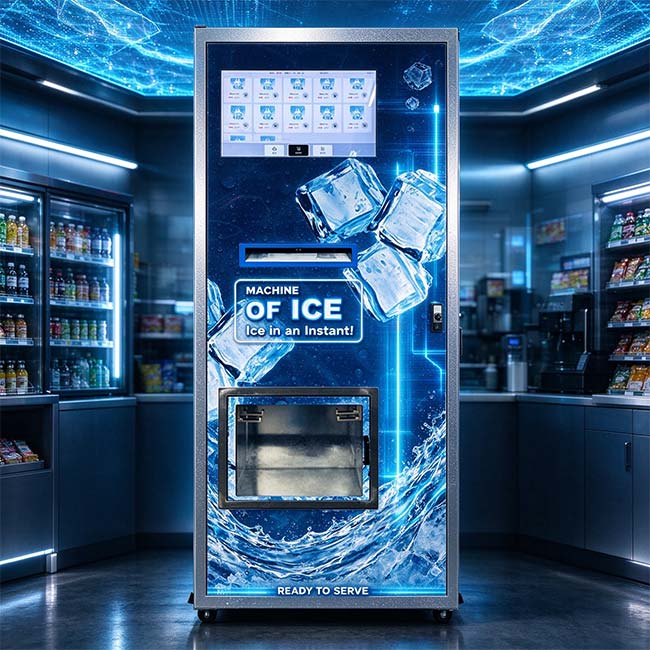
The factory example puts consumables at about $0.40 per bag on a 2.5 kg portion, covering water, electricity and packaging. Your own water tariff and power rate decide whether that lands higher or lower, so it is worth plugging in local figures rather than copying the number. Bags get cheaper in volume and more expensive with printing. Power is modest: 1,000 W at full draw, and the ice maker cycles rather than running flat out.
Then there is the machine itself, which is a fixed cost that has to be spread across every bag you sell. That is why the cost per bag is not really a cost question at all. It is a volume question.
How the payback works, and where it breaks
The commercial ice vending machine cost comes back out of bag margin, not out of revenue, so the only figure that matters is what you keep per bag after water, power and packaging. Using the factory example of 60 bags a day at $2.50 with about $0.40 of consumables, daily gross comes to roughly $126. Divide the US$4,600 machine into that and you get about 37 selling days. It is a seductive number, and it is missing freight, duty, site rent, payment fees and every week of the year when nobody wants ice.
Run the same arithmetic at a quieter site. Twenty bags a day at the same prices gives about $42 of daily gross, which puts payback near 110 days before the other costs. Same machine, same bag price, three times the wait. Anyone who quotes you a payback period without asking how many bags you expect to sell is doing arithmetic on your behalf with numbers you did not give them.
Do one afternoon of homework before trusting any of it. Find out what a 5 lb bag sells for within a few miles of your site, whether it is still in stock after 9pm in summer, and what the shop closes at. If delivered ice is cheap and always available, an ice vending machine is a harder business. If the local store sells out by noon or shuts at eight, the gap is where your margin lives. A wider look at running a vending route, including the costs people forget, is in how profitable a vending business really is.
Capacity, heat and the cost of an empty bin
Ice vending machine capacity is quoted in kilos per day, but what you actually sell is bags, and the two numbers behave differently under heat. The standard WMT-I01 is rated at 150 kg per 24 hours, with a 200 kg configuration for busier sites. Both ratings assume about 25 degrees ambient and inlet water around 20 degrees. Park the machine in full sun where afternoons pass 35 degrees and daily output falls, which pushes your cost per bag up because the fixed cost is now spread over fewer sales.
The 9 kg bin is the other half of this. It holds about four 2 kg bags or two 4 kg bags, and a fresh batch takes 6 to 8 minutes. During a genuine rush, a pier at dawn or a highway stop on a holiday weekend, customers can drain the bin faster than the ice maker refills it. Those are sales you never get back, and they are a real cost at a site with a hard 30-minute peak. Three ways to handle it: set smaller portions, order the 200 kg build, or place a second unit.
Shade is the cheapest of the three. Direct sun on a dark cabinet in a hot climate costs you capacity every afternoon of summer, and the fix costs nothing if you choose the spot carefully. Keep 30 cm clear at the rear and sides for heat exchange, and give the unit a floor drain for condensate and cleaning water.
Branding, payment and the options that add to the quote
Coin, note and change-giving modules come as standard, so a site where customers pay cash needs nothing extra. Card and contactless are configured per market, and because the controller speaks MDB, a locally sourced terminal can usually be integrated instead of shipping one from China, which is normally the cheaper route.
Where budgets grow is branding. Body graphics, a logo on the cabinet, a screen interface in your language, and printed bags all fall under OEM and ODM, and the cost depends on how far you go. Bag printing is quoted by size, artwork and volume rather than listed, the same as the bags themselves. If customization is part of your plan, ask for it as a separate line so you can see what it adds; our breakdown of what a custom vending machine costs to build goes through the same logic.
Owning, renting, or staying with delivered ice
Three ways to get ice in front of customers, with three different cost shapes.
| الطريق | Up front | Per bag | What you take on |
|---|---|---|---|
| Own a machine | US$4,600 plus freight, duty and site work | Water, power and a bag, about $0.40 in the factory example | Maintenance, filters, and your own site arrangement |
| Rent or lease locally | Low, set by rental companies in your market | Higher, since the rental sits on top of consumables | Less maintenance risk, more cost per bag, and you never own the asset |
| Keep buying delivered ice | Nothing, or a chest freezer | Purchase price plus delivery, handling and storage | Ordering, receiving, storage space, staff time, and stock-outs in hot weather |
Wider Matrix sells machines outright and the minimum order is one unit, so there is no fleet commitment before you test a site. If equipment finance or rental exists where you operate, take the monthly figure to a spreadsheet and set it against the margin on your expected bag count, because that comparison is the whole decision. The lease-versus-buy logic is the same one we walk through for other machines in is renting cheaper than buying.
Site costs that never appear on a quotation
An ice vending machine on someone else’s floor is a negotiation, not a delivery. Whether you pay a flat monthly rent or a share of revenue, that number belongs in your payback calculation before you sign anything, because it rises with sales instead of sitting still.
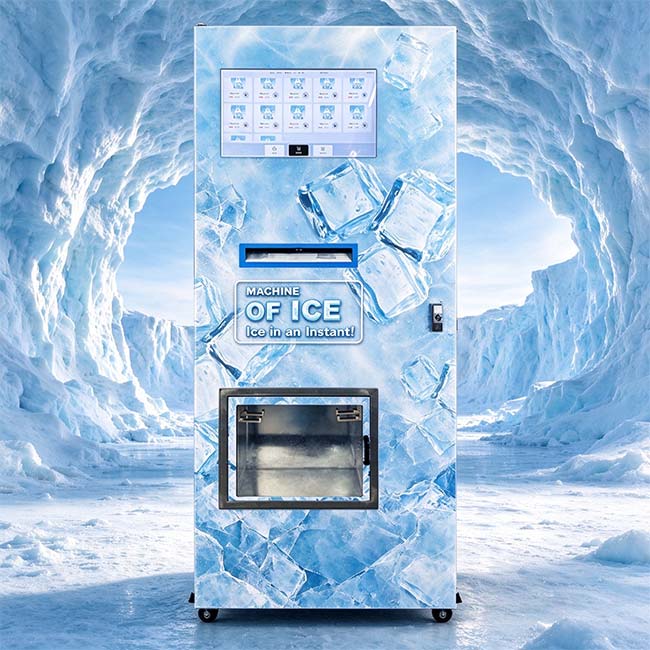
The physical requirements are easy to overlook too. You need a flat, load-bearing surface for an 800 x 1060 mm footprint, about 1.7 square meters once the space in front of the chute is counted, headroom for a 1920 mm cabinet, a floor drain, and enough light for people to use the machine at night. Ice is heavy, so the spot has to work for someone carrying a 4 kg bag to a car. Placement is discussed in more detail in هل مواقع آلات البيع متاحة مجانًا؟, which covers what sites charge and why.
Why a cheaper quote is usually a different machine
Two commercial ice vending machines can carry the same category name and be built to completely different standards. Before you compare prices, get these five things in writing from every supplier: daily output confirmed at your ambient temperature and water temperature, whether the bagging module is included, which payment modules are fitted, warranty terms that name the components covered, and a spare parts list with prices.
Certificates matter here as well. CE, FCC, RoHS and ISO 9001 documents should exist for the configuration you are buying, and copies should reach you before the container is booked rather than after customs asks for them. Wider Matrix builds the WMT-I01 in house rather than rebadging someone else’s unit, which is why voltage, language, payment setup and portion sizes can be changed for a market instead of offered as a fixed list. Every machine is water-tested and ice-tested before packing, the warranty runs a year with 24-hour online support, and consumable and wear parts are supplied at cost. If you are weighing factories rather than machines, الصين آلة البيع المصنعين والموردين covers what to check on a factory visit or a video audit.
If ice is only a summer business at your site
In markets with a short hot season, an ice vending machine earns hard for four months and stands still for eight, and the fixed cost has to be carried through all of it. One option is to put a second machine from the same Wider Matrix range into the same space, cotton candy, popcorn, ice cream, phone cases, puzzles, balloons, nail art, smoothies, protein shakes or fries, so the location keeps earning when the temperature drops. Freight is also cheaper per unit when two machines share a container.
If frozen desserts fit your site better than bagged ice, the pricing logic is laid out in our دليل أسعار آلات بيع الآيس كريم.
الأسئلة الشائعة
How much does a commercial ice vending machine cost?
US$4,600 is the list price for one WMT-I01, which includes the assembled machine, the 3-stage filtration set, the bagging module, a manual, an installation video and a one-year warranty. Orders of two or more are quoted per order. Freight, duty and site work are extra.
What other costs should I budget for besides the ice vending machine?
Freight, import duty and clearance, a plumber for the water line or barrels of water, an electrician to confirm the circuit, bags, replacement filter cartridges, electricity and whatever your site charges in rent or revenue share. Ask your supplier for FOB and CIF figures and your broker for the duty rate before you commit.
How much does it cost to make one bag of ice?
Water, power and the bag, which the factory example puts at about $0.40 for a 2.5 kg portion. The number moves with your local water tariff, power rate and bag order size, so calculate it with your own figures rather than copying ours.
How quickly does the machine pay for itself?
It depends entirely on how many bags you sell and what ice fetches locally. The factory example of 60 bags a day at $2.50 gives about $126 of daily gross, which would cover the US$4,600 machine in roughly 37 selling days before freight, duty, site rent and payment fees. At 20 bags a day the same calculation runs to around 110 days.
Does an ice vending machine need staff on site?
No. Customers choose a portion on the 21.5-inch screen, pay, and collect ice from a chute that opens by itself, so there is no cashier and no shift to cover. The optional 4G or WiFi module reports sales, bin level and faults to a phone, which is how one person looks after several machines.
Which payment methods can an ice vending machine take?
Coin, note and change-giving modules come as standard. Card and contactless are configured per market, and the controller supports MDB protocol, so a local terminal can usually be added rather than importing one. Processing fees are set by your acquirer.
Can I rent or lease instead of buying?
We sell machines outright with a minimum order of one unit. Whether rental or equipment finance exists in your market is a local question, so get the monthly figure from a local provider and compare it with the margin on the bags you expect to sell.
What does after-sales support cost?
The first year of warranty and 24-hour online support are included, along with installation and maintenance training and video guides. After that, consumable and wear parts are supplied at cost. Ask for the parts list and prices with your quotation so there is no surprise in year two.
Get a costed quote for your market
Send five things and the reply will be a number you can actually budget against: your country and nearest port, how many units you are considering, the voltage and payment setup used locally, whether you want bagged or bulk as the default, and roughly how many bags or kilos you expect on a good day. With those, Wider Matrix can confirm whether 150 kg is enough for your climate, quote the commercial ice vending machine cost for your order, and show what freight and the current build schedule look like.
If you want the machine to arrive ready for a specific site, mention that too. Portion sizes, language, voltage and bag printing are all set before the unit is built, and changing them later costs more than deciding now.