

A practical buyer’s guide to choosing a French fry vending machine for a small business, centered on the Wider Matrix WM888: what it cooks, its capacity and footprint, list price, running costs, a conservative ROI example, how it compares with popcorn, pizza, ice cream and cotton candy machines, and what to check before you order.
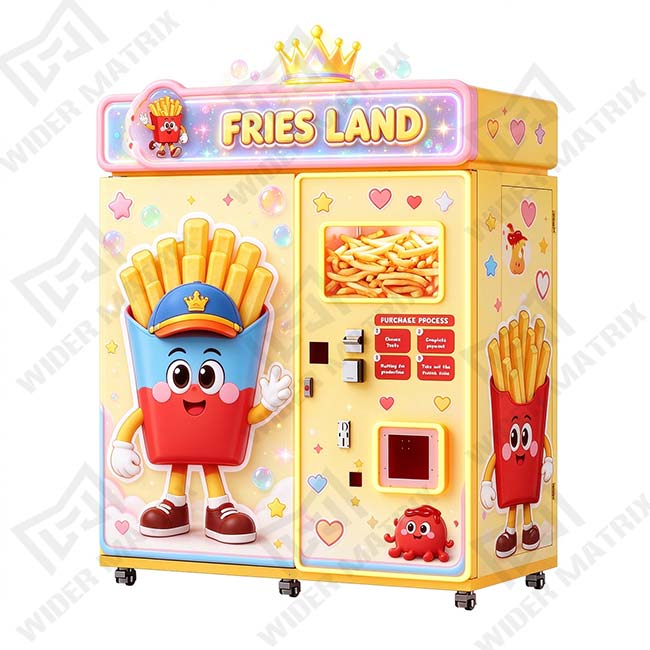
Hot fries without the fry cook
Most people who search for a French fry vending machine for a small business already have the location picked out. It could be the back wall of a convenience store, a lobby in an arcade, a gym corridor, a laundry, a car wash, or a university common room. What all these spots have in common is foot traffic that runs all day and into the evening, and none of them have room for a kitchen hood, a gas line, or a person paid to watch oil bubble for eight hours.
That gap is exactly what these machines are built to fill. A French fry vending machine takes a product people already buy for themselves without thinking and puts it where no food cart or fryer could realistically sit. The customer taps a screen, pays, watches the fries cook through a window, and picks up a hot cup in about 90 to 120 seconds. No cook, no register, no drive-through queue, and nothing for the owner to supervise from behind a counter.
If you are sizing up your first machine, the cost, the maintenance and the power questions matter more than any of the marketing copy. This guide walks through one specific model, the Wider Matrix WM888, because it is the kind of hot food machine that keeps coming up when owners compare options, and because its spec sheet answers most of the practical questions a small business actually asks. Price, capacity, power draw, oil changes, sauce channels, screen size and after-sales support are all laid out below in plain terms.
It is worth being precise about the word “best” here, because the best French fry vending machine for a small business is rarely the one with the longest feature list. It is the one that fits the floor you have, plugs into the power you can supply, holds enough stock for your busiest hour, and has a supplier who still answers the phone in month six. A cheaper machine that needs a technician every two weeks, or a bigger machine that does not fit the doorway, is no bargain. The WM888 earns its place in this guide on exactly those practical grounds, not because of any single headline number.
A quick word on expectations before the numbers. This is a commercial appliance that cooks and sells food, not a passive box of candy bars. It needs power, a floor that can hold 650 kg, oil that gets changed on a schedule, and a person who restocks it every day or two. Run that way, it lets a small location sell hot food around the clock without adding payroll. The rest of this guide explains how to decide whether that trade is right for your particular spot.
Why a fry machine makes sense in a small space
A traditional fry station eats space and money at the same time, and it keeps eating both in a slow hour just as fast as a busy one. You need a fryer, a hood with fire suppression, cold storage for frozen fries, a prep counter, and at least one employee through every open hour. The payroll, rent and utilities are fixed whether the store sells twenty cups or two hundred. That is the math that keeps so many independent convenience stores, movie lobbies, bowling alleys and car washes from selling fries at all, even though their customers look around for food every single shift.
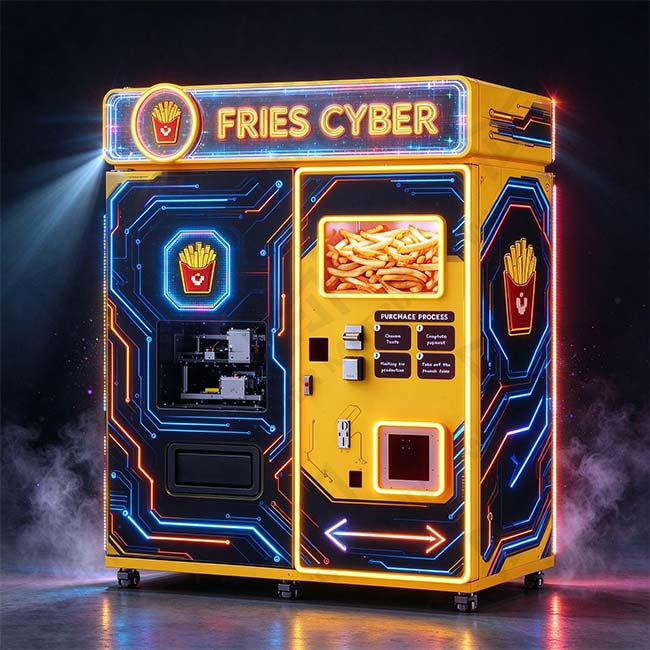
A self-contained machine flips that equation on its head. The freezer, the fryer, the oil tanks, the sauce packs, the cups and the payment terminal all live inside one cabinet that covers about two square meters of floor. It runs on 220V or 380V, so it slots into most commercial buildings without a rewire of the electrical system. It holds the fries frozen at down to -3 degrees C and only cooks what a customer actually orders, which means far less spoiled food and almost no idle labor sitting around between customers.
For an owner who already pays rent on a location, this is the important part. You are not opening a second store. You are adding a second till to a floor you already pay for, and that till keeps ringing through the hours when your own shop is shut. A fry machine next to the exit of a 24 hour gym sells to people who would otherwise drive to a fast food chain and spend nothing with you. That is revenue you currently give away to someone else every single night.
None of this means a machine prints money by itself. Foot traffic, placement, cleanliness and a dependable supplier decide most of the result, and any honest reading of the category should start before you fall in love with a particular model. If you are still deciding whether vending fits you at all, read a clear account of how much a vending machine makes each month first, and then a straight answer on whether vending machines are a good business for beginners. Both separate the marketing from the arithmetic better than any sales call will.
The labor point deserves one more line, because it is the single biggest reason a small business picks this category. A single-shift employee in many regions costs more per month than this machine costs to buy outright once taxes and benefits are added. A vending machine does not call in sick, does not need a schedule, and does not eat the till during a slow hour. For a location that cannot justify a full time kitchen worker but still has hungry customers, that is the whole argument in two sentences.
That overnight hour is worth thinking about on its own, because it is where a french fries vending machine quietly outperforms a staffed counter. A shop closes at ten, but a gym, bar district or late-night transit stop keeps moving until three. A machine that cooks and sells on its own turns those hours into sales instead of a locked door. At the same time, be honest about what it cannot do. A fry machine will not rescue a location with no foot traffic, and it still needs a person who shows up to restock and change oil. It removes the cook, not the owner. That split is the difference between a machine that earns its keep and one that gets blamed for a bad site.
The WM888 at a glance
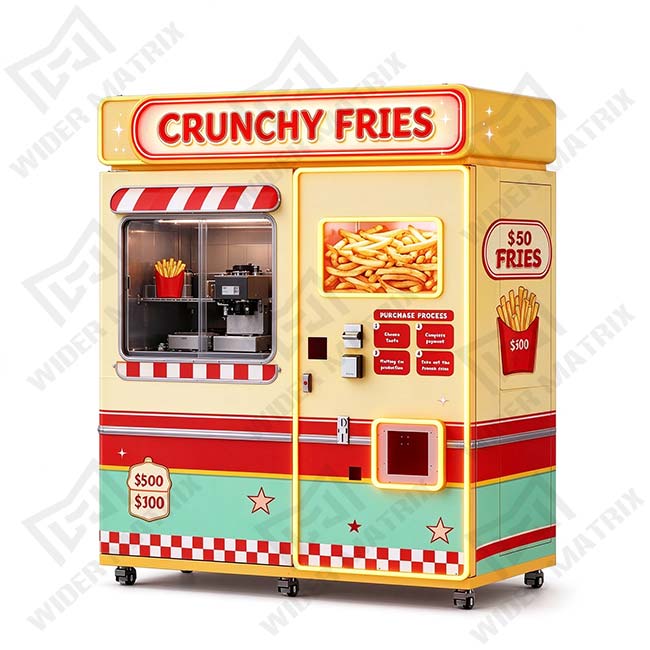
The WM888 is a multi-function hot food machine, not a single-item fry dispenser. That distinction shapes how you should read the spec sheet, because it changes what the machine can sell and how it should be positioned. The cabinet is built to cook fries of several cuts and a handful of other fried foods, which keeps the menu from going stale for repeat customers and lets one machine cover several cravings. The core numbers are in the table below.
| المعلمة | WM888 specification |
|---|---|
| نموذج | WM888 multi-function French fries machine |
| الأبعاد (الطول × العرض × الارتفاع) | 193 x 110 x 240 cm |
| البصمة | About 2 square meters |
| الوزن | 650 كجم |
| جهد الدخل | 220V or 380V, 50 to 60 Hz |
| القوة القصوى | 11,500 واط |
| الشاشة | 27-inch HD touch screen with ad playback |
| التدفئة | القلي العميق |
| خزانات القلي | 2 tanks x 10L, dual-tank simultaneous |
| سعة الصندوق الورقي | 160 boxes |
| Product capacity | 173 حصة |
| درجة حرارة التخزين | -3 degrees C, adjustable -3 to 20 degrees C |
| درجة حرارة القلي | 0 to 180 degrees C, triple-sensor control |
| Sauce capacity | 5 نكهات × 200 عبوة |
| دورة تغيير الزيت | About every 150 to 200 uses |
| المبرد | R290 |
| اللغات | أكثر من 85 لغة، تخصيص مجاني |
| الدفع | رمز الاستجابة السريعة، الدفع النقدي مع الفكة، بطاقة الائتمان، Apple Pay، Google Pay |
| الوقت الإنتاج | About 90 to 120 seconds per serving |
Some of these numbers deserve a slower read, because they are the ones that decide the shape of your day once the machine is on site. The 173-serving capacity works together with the 160 paper boxes and the five sauce channels. In practice a full load covers a busy evening rush without anyone opening the cabinet, and the box count is what sets the hard ceiling on how many orders the machine can hand out before a restock.
The dual 10 liter fry tanks are worth understanding on their own. Two tanks mean two orders cook at the same time, which is what keeps the line moving when three people order back to back at the start of a movie or the end of a gym class. A single-tank fryer behind the same foot traffic would buckle exactly when you are busiest, and a queue that stalls sells nothing except frustration.
The 650 kg weight tells you something less obvious but just as important. This is a freight-delivered commercial appliance that needs a reinforced or at least solid floor and a pallet jack or lift gate to position. You do not unload it from a pickup by hand, and you do not slide it into place on your own. Plan the delivery path in advance, because a machine this heavy moved into a basement or up a narrow stairwell becomes a real project, not an afterthought.
Finally, the 27-inch HD touch screen earns its place on the list twice. It is the ordering surface for the customer, and it doubles as an advertising display that plays images and video when the machine is idle. For a small business that pays for signs anyway, a screen already on the floor and facing your customers is free billboard space, and it can run your own promotions or a supplier’s content when nobody is buying.
Worth pinning down before going further is what kind of machine this is, because the term gets thrown around loosely. An automatic french fry machine in this class does the whole job itself, from the frozen tray to the sauced cup in the customer’s hand. It is not a countertop fryer that still needs a cook, and it is not a snack dispenser that drops a sealed bag. It sits between those two, a hot food vending machine that cooks to order and hands out food that is still hot. That distinction matters when you compare prices, because a machine that only warms a pre-cooked bag costs less, and it also sells less trust the moment a customer sees what they are holding.
What the machine cooks and how a customer uses it
Fries are the headline, but the machine is not limited to one shape. The supported product list spans thin cut, thick cut and crinkle-cut fries, then adds chicken wings, chicken nuggets and popcorn chicken for the meat side, and onion rings and hash browns for the vegetarian side. Squid rings are on the list as well. That range matters more than it first appears, because a customer who does not want fries on a Tuesday can still pick up nuggets on the way out, and that second option is often what turns a single visit into a habit.
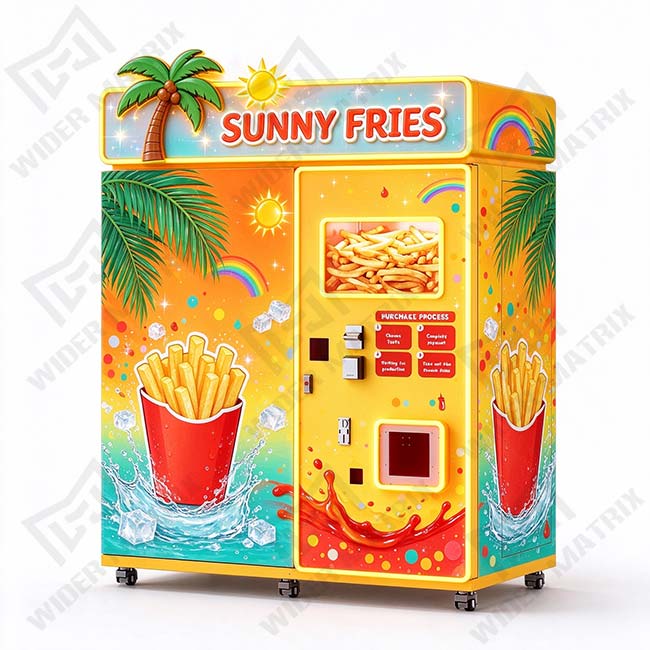
Sauces run on the same logic. The WM888 carries five flavors at up to 200 packs per channel, which covers ketchup, mayonnaise and barbecue sauce, with two more channels left to rotate as you learn your crowd. Five flavors turn one menu item into several combinations, and they give you a small lever to test what your particular customers reach for over the first month. The machine can fry in shortening, soybean oil, corn oil or peanut oil, so you match the oil to your local price and taste rather than being locked into one supplier’s chemistry.
The cooking itself is automated end to end. Food moves from frozen storage, into the fryer, through a fry and re-fry step for a crisp outside and soft center, then the oil drains and the food drops into packaging with sauce dispensed before it reaches the pickup window. The customer watches the whole process through the transparent window while it happens. That window is a selling point by itself, because people trust a fryer they can see working, and a real live cook always beats a reheated tray that might have sat for an hour.
For the shopkeeper, the flow is just as simple. The customer browses on the touch screen, picks a product and a flavor, pays by QR code, cash with coin change, or card including Apple Pay and Google Pay, then waits about 90 to 120 seconds for the food. There is no manual step in between. If you want a sense of what tends to move across vending formats generally, the breakdown in ما الذي يبيع أكثر في آلة البيع gives a useful cross-category reference point for building a menu.
Food safety, oil and how the food stays good
A vending machine that sells cooked food gets judged on cleanliness before anything else, because the customer stares straight at the cooking chamber through a window the whole time. The WM888 handles that pressure with a few concrete measures. Food sits in frozen storage that holds down to -3 degrees C, over a control range that runs from -3 to 20 degrees C, so stock stays properly cold until the moment it drops into the fryer. The system uses R290 refrigerant. Nothing thaws on a counter the way it would in a staffed kitchen.
Control on the fry side is just as deliberate. The unit runs a frying range of 0 to 180 degrees C with a triple-sensor setup and an intelligent constant temperature loop, which is the engineering answer to the two classic fryer failures: oil that overheats, and oil that swings so some orders come out pale while others come out dark. Each product can carry its own fry setting, and the machine drains the oil before serving, so the food arrives crisp rather than swimming in grease.
Oil is a food safety variable first and a cost second. The machine runs on shortening, soybean oil, corn oil or peanut oil, whichever your market prefers, and the change lands around every 150 to 200 uses. Skip that schedule and the flavor goes first, then the food. Treat the oil as an ingredient with a shelf life rather than a tank you ignore until it smokes, and the machine holds its quality for a long time. For an automatic fry machine like this, the oil schedule is the one habit that quietly decides whether customers come back.
Reading the spec sheet like a small business owner
A chain buyer reads a spec sheet one way, and a single-location owner reads it another. The chain cares about fleet reporting and volume contracts. An owner with one floor and one machine cares about two square meters of space, one power socket, a cabinet that does not demand a technician every week, and a supplier who answers the phone when something goes wrong. These are the checks that matter at that scale, taken one at a time.
Power first, because this is the one that causes surprises after the truck leaves. The WM888 draws up to 11,500W and runs on 220V or 380V at 50 to 60 Hz. Confirm that your meter, breaker and socket can carry that continuous load before the machine ships, not after. A commercial kitchen circuit is usually fine, but a wall outlet intended for a vending machine of candy bars is not, and an electrician’s visit costs far less before delivery than an emergency call on opening day.
Oil next. The machine deep fries in two 10 liter tanks, and the oil needs changing about every 150 to 200 uses. That is routine work, but it is real work, and it recurs for as long as the machine runs. Price the oil and a disposal or recycling arrangement into your monthly plan up front. A location that runs hot all day will cycle oil more often than one that serves a lunch rush, so your own number will land somewhere in that range and drift with your volume.
Then servicing reach. A 650 kg cabinet that fries food will need maintenance at some point no matter how well it is built. Check what the supplier covers, how long the warranty runs, and whether they send training and video guidance with the unit. The WM888 ships pre-assembled and tested, carries a one-year warranty, and is paired with 24-hour online support plus installation and maintenance videos. That support structure is the difference between a machine you keep running and a machine that sits dark for two weeks while you wait for a part and an answer.
The backend comes next. The cabinet has a cloud management system that shows real time sales, stock levels, best sellers and machine status, raises an alarm the moment something faults, and sends low-stock reminders before you run dry. Software updates arrive over the air rather than through a service visit. For an owner who holds a day job or lives off site, that phone dashboard is the closest thing to standing on the floor yourself, and it turns “is the machine out of fries” from a drive across town into a glance at a screen.
Payment is the last check in this list, and it is quietly one of the most consequential. The machine takes QR code, cash with coin change and credit cards, plus Apple Pay and Google Pay. In a small business you want every payment rail your customers already use, because a machine that only takes cards silently turns away the cash customer, and a machine with no cash at all underdelivers in laundromats, markets and transit stops where coins still circulate. The coin change function gets overlooked constantly, and it is the feature that keeps a machine usable in cash-heavy neighborhoods.
Price, running costs and a worked example
The WM888 carries a list price of US$9,800 for a single unit. That is a list figure, and the company is explicit that the number they quote today can land below it once you tell them your market, your order quantity and your destination. Bulk tiers for two to five units and six to ten units are quoted directly rather than published, so a single floating number on a website is never the final word. If you are surveying the whole market rather than one model, the figures sit in this vending machine cost guide, and the broader picture is in what vending machines actually cost.
The buying price is only the first number in the column. Frozen fries, cooking oil, paper boxes and sauce packs are recurring costs that move with your volume, and they never stop moving. Oil is the wildcard among them, because it ties to the 150 to 200 use change cycle and to whatever oil you stock in your region. A high-traffic machine that fries from opening to close will burn through oil on a shorter clock than one that only serves a lunch rush.
Wider Matrix publishes a conservative example to help buyers model the machine, with a clear note that it is an illustration rather than a promise. The scenario assumes 80 servings a day at 10 yuan a serving, which is 24,000 yuan in monthly revenue. Against that, ingredient costs of 7,200 yuan, rent or revenue share of 3,600 yuan, and roughly 1,500 yuan in energy leave about 11,700 yuan of gross profit each month, which points to a payback window of three to six months on the machine. Those are the company’s own assumed numbers, and they should be read as a starting model you rework with your local pricing, foot traffic and fixed costs rather than as a target anyone should guarantee. A broader, similarly careful look at the category is in هل آلات البيع مربحة؟.
To run the same arithmetic on your own location, start from the machine’s capacity instead of a dream. At 173 servings per full load and 90 to 120 seconds per order, the machine’s throughput will almost never be your bottleneck in a small venue; traffic is. Work backward from how many people actually pass your spot each day, pick a realistic fraction who buy, multiply by your planned price, and subtract oil, boxes, sauce, electricity and a maintenance reserve. If that bottom line does not pay the machine back inside the window that fits your own plans, the problem is the location or the price, not the appliance, and both are things you can change before you sign.
There is also a short list of costs that never appear in a spec sheet but show up on every invoice. Sea or air freight from the factory to your port, and then local delivery to the site. Import duties and taxes at your border, which vary widely by country. An electrician to confirm the 220V or 380V supply and the 11,500W draw. Card processing fees on every cashless sale, which eat a small percentage of each order. A spare-parts and maintenance reserve for the things that wear, from fry-basket seals to filters. None of these are reasons to avoid the machine; they are reasons to budget honestly so month one does not surprise you. A machine this heavy also arrives with one more up-front line: positioning and leveling, since a 650 kg cabinet should not sit tilted on a soft floor.
How the WM888 sits next to the rest of the range
The company behind the WM888 makes more than fryers, and if you are choosing one machine for one location you should see the alternatives side by side before you spend. Each model lands at a different price, power draw and footprint, and the honest answer to “which machine” is usually “whichever one matches what your customers already buy elsewhere.” The main options stack up like this.
| آلة | نوع | Footprint or weight | السعر المعلن | السرعة |
|---|---|---|---|---|
| WM888 | Hot food, deep fried | About 2 sq m, 650 kg | US$9,800 | 90 to 120 seconds |
| بوبكورن WM680 | Air-popped snack | 57 x 54 x 193 cm, 70 kg | US$1،800 | حوالي 120 ثانية |
| Pizza WM660 | Hot food, 12-inch pizza | 180 x 112 x 240 cm | US$8,250 | Fastest 120 seconds |
| آلة صنع الآيس كريم WM550 | Frozen dessert | 227 x 93 x 95 cm, 640 kg | US$5،799 | 15 second cup |
| حلوى القطن WM980 | Sugar spun dessert | 300 كيلوغرام | US$4,800 | آلي |
At the low end, the آلة بيع الفشار WM680 air-pops kernels in about 120 seconds, holds roughly 140 cups, runs on 220V at 3,000W, and weighs about 70 kg with a US$1,800 list price. It is a far lighter and cheaper way to enter vending, and it fits a lobby, cinema or arcade where the snack matches the mood. If popcorn is where you are leaning, there is a dedicated دليل آلات بيع الفشار الآلية and a frank look at ما إذا كانت آلات صنع الفشار مربحة أم لا.
On the hot food side, pizza is the closest cousin to fries. The WM660 bakes a 12-inch pizza in as fast as 120 seconds, holds 72 boxes, and lists at US$8,250, while the frozen WM660+ runs US$9,600 and stretches ingredient shelf life much longer. Pizza answers a fuller meal demand than a cup of fries, so it suits a site where people want lunch rather than a snack. The refrigerated versus frozen choice and the pricing are laid out in the pizza vending machine price guide. Ice cream occupies the middle ground with the آلة بيع الآيس كريم الأوتوماتيكية, and cotton candy spans from a US$4,800 WM980 up to a US$5,299 outdoor model for sites where the weather and the foot traffic both run hot.
The decision almost never comes down to the machine alone. A gym, bar district or late-night truck stop leans toward fries and hot food because the customer wants something hot and salty at hours when kitchens are closed. A family mall or a theme spot leans toward sweets because the customer is buying an experience, not a meal. If you already run one machine from this maker, the same cloud backend, app and support team cover the next unit, which makes a second and third machine cheaper to manage than mixing suppliers with different dashboards and different fault-call trees.
Setting the menu, the price and the screen
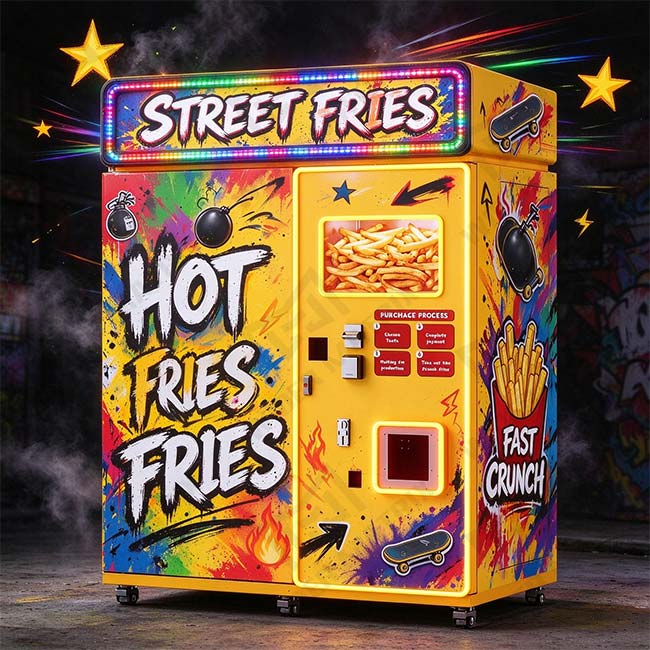
Once the machine is in, the work shifts from buying to merchandising, and the two levers you control are what you stock and what you charge. Start the menu narrow and let the sales data widen it. The WM888 can cook a long list of foods, but a new machine in a new spot sells better when the screen offers three clear choices than when it offers eight things a customer has to squint at. Lead with fries in two cuts, add the fried chicken items, and keep onion rings or hash browns for the non-meat option. Watch the best-seller ranking in the backend for a week, then drop the two items nobody buys and test the next two.
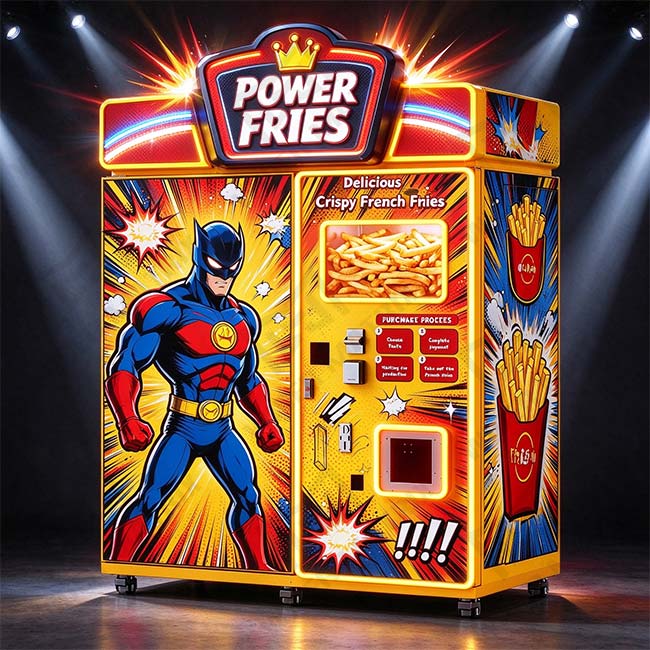
The five sauce channels turn into an upsell with no extra labor. A cup of plain fries at one price, then a small add-on for a sauce or a second flavor, raises the average order without complicating the machine. Most customers will not blink at the add-on, and the machine dispenses it automatically. Price the base cup to cover ingredient, oil, box and sauce costs with room left over, then let the add-ons carry the margin. There is no magic number that fits every town, so start where your nearest fast food chain sits and move a little once the data shows what the street will pay.
The 27-inch HD touch screen is the quietest revenue tool in the cabinet. When nobody is ordering, it plays images and video to whoever is standing nearby. That means your own daily special, the add-on combo you just created, or a local cross-promotion can run in front of customers who were not planning to buy anything until the screen put the idea there. It is also where you set the tone of the machine, from the language to the art, so it matches the room it lives in rather than looking like a loaner dropped in overnight.
The manufacturer, the certifications and the support
The machine comes from Wider Matrix (GZ) Technology Co., Ltd., a company based in Guangzhou in Guangdong Province, China. It has focused on vending machines and smart robots for about five years, lists more than 3,000 machines deployed worldwide, and runs a team of over 50 people. Its catalog stretches across phone case printers, screen protector machines, balloon machines, cotton candy machines, ice cream machines, pizza machines, popcorn machines, and the hot food fryer detailed in this guide.
For an overseas buyer, the credentials that matter are the certifications and the support rather than the slogan. The company holds CE, ISO 9001 and RoHS certifications, and its machines list CCC, RCM and CB as well, alongside its own patents. That paper trail is what lets a machine clear customs, meet local electrical codes and satisfy food equipment checks in different regions. It is also the first thing a serious buyer should ask any supplier to produce before wiring money rather than after. A working framework for that vetting process is in اختيار الشركة المصنعة المناسبة لآلات البيع.
The machine leaves the factory assembled and tested, which matters more than it sounds over a screen. A unit that arrives in pieces with a manual the installers have never seen will burn a week of a new owner’s time. This one is set up and run on the factory floor before it is crated, then followed by installation training, maintenance videos and a one-year warranty, with the cloud backend already activated. That hand-off from a tested machine on the truck to a live dashboard on your phone is the part of a purchase you cannot read off a price tag, and it is the part you will feel hardest during the first month on site.
Placement, permits and the first weeks
Where the machine goes decides more than any other single factor, because the same cabinet in two different corners of the same building can produce two completely different results. A few patterns hold across the whole category. A bottleneck where people already wait. A location where no nearby fryer exists. A spot with evening traffic that a day-only shop walks away from. College commons, transit hubs, arcades, car washes, laundry rooms and hospital lobbies all fit that shape, and each one has its own peak that you can see in the sales data within the first week.
Before you pour anything, sort the paper side. Hot food is different from crisps, so most regions treat a fry machine as food service rather than ordinary vending. Check with your local authority about food safety registration, any health inspection, and whether you need a permit for selling cooked food in that building. Electrical approval usually comes down to having a licensed electrician confirm the 220V or 380V supply and the 11,500W draw ahead of time. None of this is specific to one brand, and none of it should be skipped, because a machine that gets switched off by an inspector earns nothing at all.
Once it is live, lean on the backend rather than on guessing. The cloud dashboard shows sales by hour, best sellers and stock levels, which lets you move the machine to the side of the room that actually sells and tune the menu to what your customers reach for. The low-stock alerts tell you when to restock ahead of a Friday rush instead of discovering an empty cabinet on Saturday morning. For placement thinking that applies across every vending format, the patterns are gathered in where vending machines make the most money, and a step by step path from first machine to first sale runs through كيفية بدء مشروع تجاري لآلات البيع and the fuller guide to starting a vending business in 2025.
One operator habit is worth stating in plain terms because it is the cheapest lever you have: keep the machine clean and keep it stocked. A hot food machine with a smudged window and a sauce channel that reads empty turns customers away faster than a high price ever will. The cabinet handles cooking and payment on its own, but a human still changes the oil on schedule, wipes the front glass, and reloads boxes and fries. Ten minutes of care a day is usually enough to keep it looking like the day it arrived, and that daily care is most of what separates a machine that pays for itself from one that quietly earns a reputation as broken.
Seasonality is the last thing to budget around. Fries sell in every weather, but the shape of the demand shifts. Cold months push traffic to hot food, a heatwave pushes it toward ice cream, and if you run more than one machine across sites, that seasonal drift is exactly why a single backend covering several product types pays for itself. You do not need to predict it perfectly. You just need the dashboard to tell you when the mix has moved, so you can swap or relocate stock before the trend costs you a slow month.
Mistakes that cost new owners money
Most of the expensive errors in this category are knowable in advance, which makes them worth listing in one place. The most common is signing the location before checking the power. A fry machine needs a 220V or 380V supply that can carry 11,500W, and plenty of otherwise perfect sites only have an ordinary wall outlet. The electrician confirms this in an hour, and the machine does not belong at any site that cannot be wired to the spec.
The second mistake is treating oil as a fixed cost instead of a schedule. The change lands every 150 to 200 uses, and a busy week can chew through that quickly. Owners who wait until the fries taste off have already waited too long, and they are pushing the machine toward a repair call at the same time. Cost the oil by the serving and the surprise disappears.
The third is pricing by guess on day one and never revisiting it. A new owner sets a price from another town’s menu, watches it underperform for a month, and blames the machine when the real problem is the price. The backend tells you exactly what sells and when, so use it to test a small price change every few weeks until the numbers settle.
The last is skipping the paper side entirely. Hot food is a regulated category in most places, and a machine that cooks meat and fries brings its own health and electrical checks. A permit problem that shuts the machine for a week wipes out far more than the permit ever cost. Sort the local requirements before delivery, not after the first inspection.
الأسئلة الشائعة
How much does a French fry vending machine cost?
The Wider Matrix WM888 lists at US$9,800 for a single unit, with bulk pricing quoted directly for two to five units and six to ten units. The company notes that the price it quotes today can sit below the list figure once you share your market and order quantity.
Can a French fry vending machine run without staff?
Yes. The WM888 cooks, packages, sauces and serves the food automatically, and the whole process runs unattended around the clock. A person still needs to restock fries, boxes and sauces and change the oil, but no cook or cashier has to be present.
What can the machine cook besides French fries?
The WM888 handles thin, thick and crinkle-cut fries, chicken wings, chicken nuggets, popcorn chicken, onion rings, hash browns and squid rings. It can use shortening, soybean oil, corn oil or peanut oil, and it dispenses five sauce flavors.
كم من الوقت يستغرق تجهيز الطلب الواحد؟
A serving takes about 90 to 120 seconds from order to pickup. The dual 10 liter fry tanks cook two orders at once, which keeps peak-time queues from stalling.
How much power does the machine need?
The WM888 draws up to 11,500W and runs on 220V or 380V at 50 to 60 Hz. Check that your meter, breaker and socket can carry that load before the machine is delivered.
How often does the oil need to be changed?
Roughly every 150 to 200 uses. The exact number depends on what you cook and how often the machine runs, so oil cost and disposal should be part of the monthly budget.
Is there a warranty and after-sales support?
The machine ships assembled and tested, carries a one-year warranty, and comes with 24-hour online support plus installation and maintenance videos. It also receives software updates over the air rather than through service visits.
How does the WM888 compare to a popcorn or pizza machine?
The popcorn WM680 lists at US$1,800 and air-pops a serving in about 120 seconds, while the pizza WM660 lists at US$8,250 and bakes a 12-inch pizza. Fries suit a hot food and late-night crowd, while popcorn and sweets fit family and entertainment locations.
Getting a firm price instead of the list number
If the WM888 fits your location, the useful next step is a real quote rather than a plan built around the list price. Promotions update regularly, and the final number depends on your market, order quantity, destination, shipping terms and any customization you ask for, such as a machine skin in your own branding or a language set for your region. The list price is a reference point, not the invoice.
Before you reach out, have three things ready: your intended location and daily foot traffic, the number of units you are weighing, and your target country so the quote can account for shipping and certification. The machine supports 85 plus languages and takes QR, card and cash payments with coin change, so it ports across markets without much reconfiguration. Send those details to Wider Matrix with your quantity, and the number that comes back is the one that belongs in your budget.